
How to prevent qualification fraud in hiring?
Fake qualifications can cost companies trust and money. Learn how to detect, verify, and prevent qualification fraud in hiring.

Qualification fraud is a candidate claiming a degree, certificate, or licence they never earned. You stop it by checking the credential with whoever issued it, confirming the person in the interview is the person on the application, and testing the skill itself before an offer goes out.
That third step is the one most hiring teams skip, and it's the only one a forged document can't survive. A certificate can be bought for the price of a takeaway. A scored work sample cannot.
This guide covers what qualification fraud looks like in 2026, how common it has become now that AI writes the CV as well as the cover letter, and the verification sequence a small hiring team can actually run without a screening department behind it.
 ChatGPT
 Gemini
 Claude
 Grok
Grok Perplexity
TL;DR
- Qualification fraud means falsifying or misrepresenting a degree, certificate, licence, or grade to win a job. It is different from rounding up a job title.
- The volume has changed. Gartner expects one in four candidate profiles worldwide to be fake by 2028, and 67% of large UK employers say AI has pushed fraudulent applications up.
- Small employers are the soft target: 32% of SMEs check candidate qualifications against 52% of large organisations.
- Verify at the source, not from the PDF a candidate sends you. Issuing institutions confirm awards; a scanned certificate proves nothing.
- Document checks prove a record exists. They do not prove the person can do the work, or that the person sitting the interview is the applicant. Skills assessment and identity assurance cover that half.
- Make the checks identical for every hire, write them into your hiring policy, and get consent before you check anything.

What is qualification fraud in hiring?
Qualification fraud is the act of falsifying or misrepresenting academic or professional credentials to get a job. It covers a degree from a diploma mill, a forged certificate, a genuine document altered to show better grades or different dates, a professional licence that lapsed years ago, and a qualification claimed from a university the candidate never attended.
It is worth separating from CV exaggeration, because the two get treated as one problem and they are not. Inflating a job title or stretching a date range is dishonest. Claiming a nursing registration, a safety certification, or a chartered accountancy qualification you do not hold is a different category: it puts a person into a role where the qualification is the thing keeping other people safe.
The reason it slips through is dull rather than dramatic. Fake documents look convincing, they arrive with a plausible story, and the person reviewing them is filling three roles at once and looking at their fortieth application of the week. Nobody decides to skip verification. It just never gets built into the process.
How common is qualification fraud in 2026?
Common enough that the ranking assumption has flipped: the question is no longer whether a shortlist contains a fabricated claim, it's whether anyone checked. Gartner expects one in four candidate profiles worldwide to be fake by 2028, and 6% of the 3,000 candidates it surveyed admitted to interview fraud, either posing as someone else or having someone pose as them.
UK data from a YouGov survey of 526 HR decision makers, run for the degree-verification service Hedd in April 2025, puts numbers on the same shift. 67% of large employers said AI had contributed to fraudulent applications, against 64% of medium and 37% of small firms. 45% of large businesses had run into job application fraud. Among SMEs, 29% had.
Read those last two figures together with the verification numbers from the same survey and the story changes. Only 40% of HR decision makers check every candidate qualification. It's 52% at large employers and 32% at SMEs. So small firms report less fraud while checking roughly two thirds as often as big ones. One of those numbers is measuring fraud. The other is measuring how often anyone looks.
Pro tip: if your team has never caught a fake credential, that is not evidence you do not receive them. Run a spot audit: pick five hires from the last year in roles where a qualification was a requirement, and verify those credentials at the source now. The result tells you whether you have a detection problem or a volume problem.
Why does qualification fraud hurt employers?
The cost of a bad hire is well understood. The cost of a bad hire who was never qualified in the first place lands differently, because the damage is not confined to performance. It reaches insurance, licensing, contracts, and in regulated work, safety.
Risk | What goes wrong | Who feels it first |
|---|---|---|
Money | Salary, onboarding, and training spent on someone who cannot do the work, then spent again on the replacement | The budget holder, usually the founder or the hiring manager |
Legal and licensing | An unqualified person in a role that legally requires a credential: nursing, teaching, accounting, electrical work, heavy plant | Compliance, and whoever signed off the hire |
Safety and operations | Work that fails inspection, a site incident, or a system misconfigured by someone with no real training | The team on the ground, and the customer |
Client trust | Contracts that require named qualified staff, and clients who audit them | Account and delivery teams |
Internal trust | Colleagues who did earn the credential, working next to someone who did not | The rest of the team, quietly, for a long time |
Agencies, accountancy practices, construction firms, and property businesses feel this earlier than most, because a client or an insurer can ask to see the qualification behind a named person on an account. If the answer takes a week to find, that is already a problem.
How do you verify credentials before hiring?
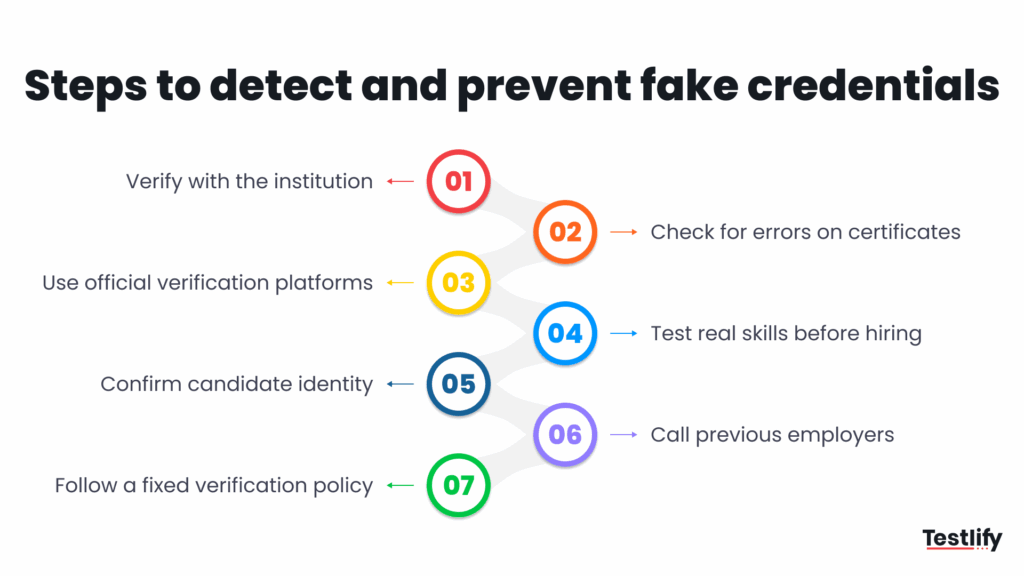
Verification is a sequence, not a single check, and each step catches something the others miss. Run it in this order.
- Verify with whoever issued the credential. Universities, awarding bodies, and professional registers confirm awards directly, and most have an online route for employers. A PDF the candidate emails you is not verification. It is a photograph of a claim.
- Read the document properly before you accept it. Mismatched fonts, a logo at the wrong aspect ratio, a missing registration number, a date that does not line up with the CV, or award wording a real institution would never use. There is more detail on spotting forged certificates elsewhere on this site.
- Confirm identity early, before the interview stage. A forged document and a borrowed identity travel together more often than teams expect. Photo ID checked against a live image, done at application rather than at offer, is the cheapest control here. The practical steps sit in our write-up on identity checks for remote hiring.
- Test the skill the qualification is supposed to prove. If someone claims advanced Excel, give them a modelling task. If they claim Python, give them code to fix. A scored work sample is the one check that returns an answer the candidate cannot borrow, buy, or forge.
- Check employment history through official channels. Call the company's published number, not the mobile on the CV. Ask for title, dates, and whether the person is eligible for rehire. Anything vague is worth a second call.
- Make it the same for every hire. Fraud enters through exceptions: the urgent role, the referral, the candidate the founder already likes. Write the checks into your hiring policy, apply them to every offer, and train the people who run the process so the standard survives a busy month.
Two honest limits are worth stating, because most guidance on this topic skips them. Source verification is slow and it is not free, so it works as a gate at offer stage rather than on every applicant. And a clean verification result tells you a record exists. It says nothing about whether the person is any good, and nothing about who actually sat your interview.
What does AI change about credential fraud?
Three things, and only one of them is the one people talk about.
The first is volume. Generating a plausible CV, a matching cover letter, and a reference letter on headed paper now takes a minute, so the number of applications that are partly fabricated has gone up rather than the sophistication of any single one. That is what the 67% figure above is really measuring.
The second is identity. Remote hiring made it normal never to meet a candidate in person, and voice and video synthesis made impersonation cheap. This is why interview-stage identity assurance has stopped being a large-enterprise concern.
The third runs the other way, and it gets less attention than it deserves. Credentials are becoming machine-verifiable. Universities increasingly issue certificates that resolve to a record held by the issuer, and tamper-evident credential records let an employer confirm an award in seconds instead of waiting two weeks for a registry to answer an email. Where a candidate can hand you a verifiable credential, take it. That path is faster and harder to fake than any document review.
One caveat on AI detection: a tool that flags an answer as AI-generated is evidence, not proof, and it should route the case to a human rather than trigger a rejection. Treat a flag the way you would treat an odd reference, as a reason to look closer.
Consent law applies to all of it. GDPR in Europe, FERPA for US education records, and POPIA in South Africa all require a lawful basis before you check or store someone's records. Ask for written consent as part of the application, tell candidates what you will check, and keep the results only as long as you need them.
How does Testlify help prevent qualification fraud?
Testlify covers the half of the problem document checks cannot reach: proving the skill is real and proving the right person demonstrated it. It does not contact universities or verify diplomas on your behalf, and any page that tells you otherwise is selling you something. Pair it with source verification for credential-dependent roles.
The approach has a name, the Testlify Assessment Integrity Framework: protect the trustworthiness of assessment results through identity checks, proctoring controls, AI-assistance detection, suspicious-behaviour signals, and reviewable evidence, while final judgment stays with a human. Results are only worth having if the team can trust how they were produced.
In practice, that means a few specific things.
Control | What it actually proves |
|---|---|
Skills assessments from a library of 3,500+ tests, plus custom ones | The candidate can do the work the credential claims. Coding tasks, spreadsheet and document work in the real apps, typing, and role-specific tests |
Photo ID verification with face match | The person starting the assessment matches the ID they submitted |
Dual-device proctoring | The candidate's phone acts as a second camera showing the room and the screen. The session will not start until it is active |
AI checker | Classifies an answer as human, AI-generated, or mixed, and separates fully generated work from AI-edited work |
Video and voice interviews with transcripts | One-way and two-way conversational AI interviews, with face and multiple-face detection flagging identity inconsistencies mid-session |
Trust score and proctoring flags | Green, yellow, or red with the evidence behind it. Yellow reads "a quick manual review is recommended", not "reject" |
The fairness detail matters as much as the detection. Testlify's own product copy tells reviewers that AI scores and insights are for guidance only and that human judgment makes the final call, auto-termination is opt-in with a threshold you set, and face verification data is deleted after 30 days with consent withdrawable at any time. A flag is a reason to look, not a verdict.
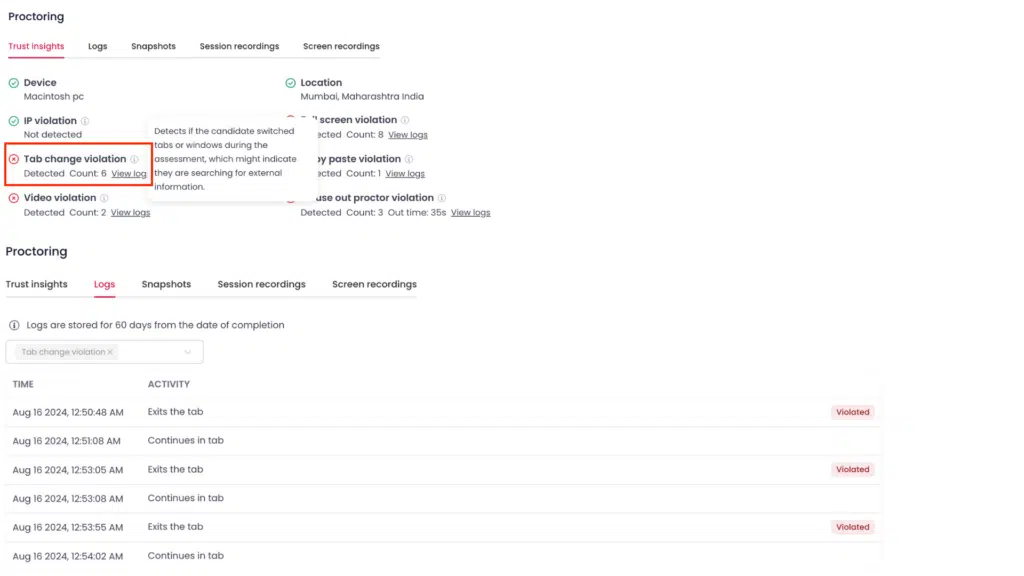
For a team running proctoring controls for the first time, start at the standard preset and reserve strict settings for roles where the qualification carries real risk. Over-proctoring a junior marketing hire costs you good candidates and proves nothing you needed to know. Testlify also connects to 100+ ATS platforms, so the evidence lands in the system your team already works in.
Verify skills before you make the offer
The fastest change most teams can make this quarter is to move one check earlier: put a short, scored assessment in front of every candidate for any role where a qualification is a requirement, before the interview rather than after it. See how it works on your own roles and book a demo, or browse the ready-made skills tests for the roles you hire most.
Key takeaways
- Qualification fraud is a verification failure, not a character mystery. Fake credentials get through because nobody checked, not because the forgery was clever. Build the check into the process and most of the problem disappears without anyone becoming suspicious of candidates.
- Small employers carry more of this risk than the numbers suggest. 32% of SMEs verify qualifications against 52% of large organisations, so a lower reported fraud rate partly reflects lower detection. If you hire under 200 people, assume you are undercounting and audit a handful of past hires.
- Source verification and skills assessment answer different questions. One confirms a record exists, the other confirms the person can do the work. Credential-dependent roles need both, because either one alone leaves an opening a determined candidate can walk through.
- Identity belongs early in the process. Checking who someone is at offer stage means you have already spent your interview hours on a person who may not be the applicant. Move it to application and the cost of fraud drops to near zero.
- Consistency beats intensity. A light check applied to every single hire catches more than a heavy check applied when someone feels uneasy. Exceptions are where fraud lives, and the urgent role is always the exception.
- Flags are evidence, not verdicts. Proctoring signals and AI-content detection should route a case to a human reviewer with the session evidence attached. Automatic rejection on a flag creates unfair outcomes and legal exposure, and it teaches your team to trust a score it should be questioning.
FAQs

B2B SaaS Content Writer
Rishav Kumar is a B2B SaaS content writer with 4 years of experience. He loves crafting engaging content. Always exploring fresh ideas, he's passionate about helping businesses grow through impactful writing.
LinkedInRelated resources
View all
Hiring Risks & Safeguards
Candidate ghosting in recruitment: Solutions
Hiring Risks & Safeguards
Candidate dishonesty: Key red flags

Hiring Risks & Safeguards
Which HR training strategies stop recruitment fraud?

Hiring Risks & Safeguards
How to detect cheating in exams using analytics

Hiring Risks & Safeguards
Which HR behaviors increase hiring fraud risk?

Hiring Risks & Safeguards
Recruitment fraud: Everything you need to know
Get started.
Hire on proof, not resumes.
Run your first skills-based assessment free — no credit card required.