
Are traditional background checks enough for HR compliance?
Traditional background checks are not enough for HR compliance. Learn the gaps, laws, and tools like Testlify that keep hiring fair and secure.
Traditional background checks have been a standard step in hiring for decades. It helps in verifying criminal history, education, and past employment, helping employers feel secure about a candidate.
But compliance demands in HR have grown far more complex. From laws like FCRA in the U.S. to GDPR in Europe, the question is no longer whether you should run checks, but whether your checks are conducted in a way that keeps you fully compliant.
 ChatGPT
 Gemini
 Claude
 Grok
Grok Perplexity
What do traditional background checks include?
For most HR teams, a background check is the first safeguard in the hiring process. It helps confirm that a candidate’s story matches official records. Here’s what usually gets checked:
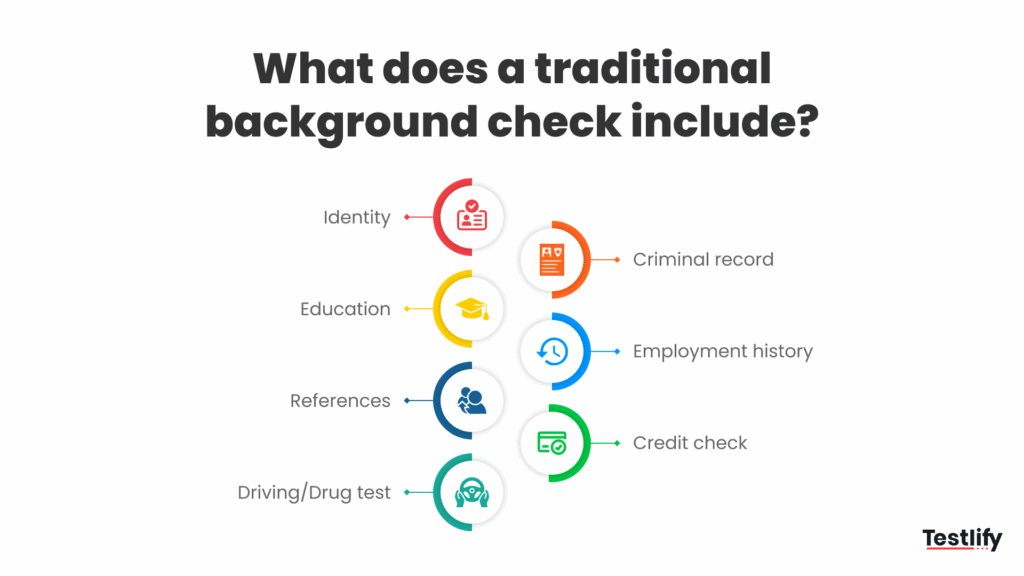
- Identity verification: Employers may ask for documents such as a passport, driver’s license, or Social Security card. This confirms that the person really is who they claim to be.
- Criminal record search: Databases are checked for convictions or pending cases. A finance firm may screen for fraud charges, while schools may look for any child-related offenses.
- Education and credential check: Degrees and certifications are verified with the issuing universities or licensing boards. A nursing role, for example, requires proof of a valid license.
- Employment history: Past jobs are verified by checking dates, titles, and duties. Some employers call references directly, while others use payroll records.
- Reference checks: Former managers or colleagues are asked about performance and conduct. Their feedback often highlights soft skills not visible on paper.
- Credit history (where legal): In roles that handle money or sensitive data, employers may use credit score monitoring to identify major debts or defaults.
- Driving and drug tests: For transport or safety-critical roles, motor vehicle records and drug screenings are common.
These steps can reveal clear risks, like a fake degree or a suspended license. They also give HR a basic level of assurance before moving forward.
But while useful, these checks are limited. A clean record today doesn’t guarantee compliance tomorrow, and that’s where more advanced processes come in.
Case in point: In 2012, Yahoo’s CEO resigned after it was revealed he had falsified his degree. A basic education verification would have caught it early.

Why do traditional checks often fall short for HR compliance?
A background check can flag a criminal record or verify a degree. But HR compliance demands more: consent, fairness, and respect for privacy. This is where traditional checks often fail.
1. Missing consent and legal steps
In the U.S., the Fair Credit Reporting Act (FCRA) requires employers to get written permission before running a background check. If a report is negative, the law says you must share it and give the candidate time to respond.
Many firms skip this “pre-adverse action” step. Courts have fined employers for rejecting people without following the law.
2. One-time snapshots miss later risks
A background check is usually run once, before hire. But a nurse could lose their license next year, or a driver could face a DUI. Without rescreening or continuous monitoring, employers may not know until damage is done.
3. Unfair blanket policies
Some employers reject anyone with a conviction. The EEOC (Equal Employment Opportunity Commission) says that the practice is discriminatory.
Employers must weigh the offense type, the years passed, and whether it relates to the job. Traditional checks don’t guide HR through this fairness test.
4. Patchy and outdated data
Databases sometimes fail to update in a timely manner, so old charges that should have been cleared still appear.
In Europe, the GDPR (General Data Protection Regulation) restricts the use of criminal data unless an official authority handles it. Using outdated or global databases without these limits can breach privacy laws.
5. Public failures
In 2012, Yahoo CEO Scott Thompson stepped down after it was revealed he claimed a degree he never earned.
A careful education verification would have caught the lie before his appointment. The case shows that relying on traditional checks without compliance safeguards puts both reputation and trust at risk.
Traditional background checks provide facts, but they don’t secure HR compliance. Compliance means lawful steps, fair assessments, and systems that stay current.
What should a compliance-ready screening process cover?
Running a background check is only the first step. To meet HR compliance standards, employers must follow a full process. Think of it as a checklist where each step reduces the risk of legal trouble or unfair hiring practices.
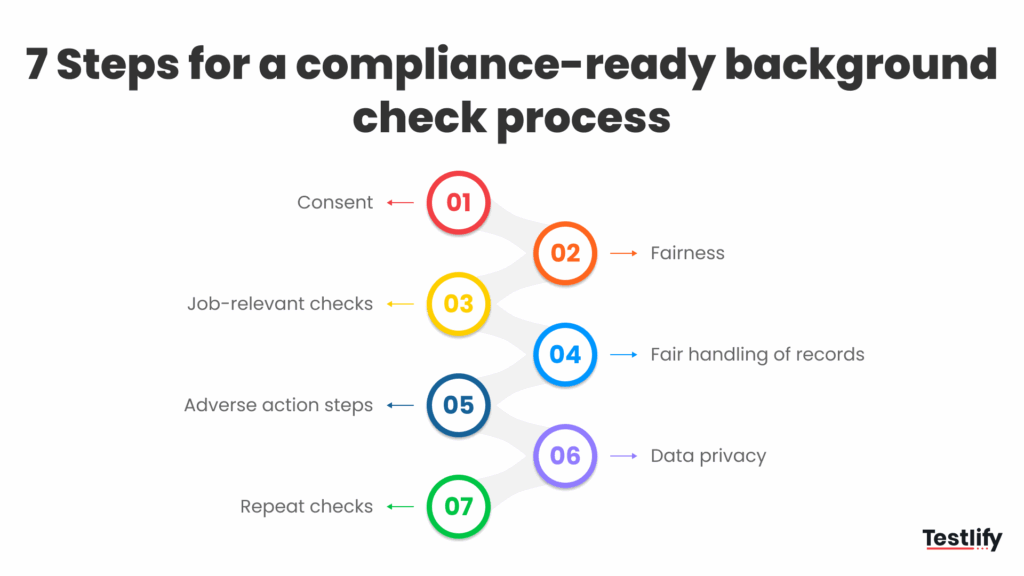
Get written consent
Before checking anything, employers must inform the candidate what will be reviewed and obtain their signed permission. In the U.S., this is required by the Fair Credit Reporting Act (FCRA).
In the EU, the GDPR requires consent or another lawful reason. Without it, the check itself may be unlawful.
Example: A company that runs a credit check without informing the candidate risks a lawsuit. Courts have fined employers for skipping this step.
Apply checks fairly and consistently
Every candidate for the same role should go through the same checks. Picking and choosing creates bias and violates EEOC (Equal Employment Opportunity Commission) rules.
Example: Screening one warehouse worker for drugs but not another could be seen as discrimination. A compliance-ready process avoids this by setting the same rule for all warehouse hires.
Focus on records relevant to the job
Compliance means checking what actually matters. A trucking company looks at driving records. A hospital checks medical licenses. Using unrelated records can be seen as unfair. U.S. law calls this “job-related and consistent with business necessity.” However, every candidate’s academic credentials has to be verified with their university transcript management software ( for eg : Parchment or EduTranscript) to confirm their qualifications and skills for the job.
Handle negative findings with fairness
If a record shows up, compliance means looking at three things: how serious the issue is, how long ago it happened, and whether it relates to the job. This is called an individualized assessment.
Rejecting someone just because “they have a record” can violate EEOC guidance.
Follow the adverse action steps
If a report could affect hiring, FCRA requires a two-step process. First, give the candidate a copy of the report and time to respond (pre-adverse action).
Second, if the decision stands, issue a final notice (adverse action). Many employers skip step one and end up in court.
Protect data privacy
Employers use sensitive data for background checks, but under GDPR Article 10, they can handle criminal data only under strict conditions.
Reports should be stored securely, shared only with decision-makers, and deleted when no longer needed. India’s new data law also stresses the same principle: consent, storage limits, and confidentiality.
Repeat checks when needed
A one-time check is not enough in high-risk industries. Banks, hospitals, and schools often run rescreening every year or two.
Some firms use continuous monitoring that alerts HR if a new record appears. This keeps workplaces safer and reduces liability.
What trends and laws are shaping screening policies today?
Background checks have always been about verifying whether a person is who they claim to be. What’s changing now is how governments expect employers to use that information.
Laws are being written to balance two things: giving people a fair chance to work and protecting their privacy.
Ban-the-Box and Fair Chance laws in the U.S.
In more than 35 states, employers can’t ask about criminal history on the first job application. This is called Ban-the-Box.
It doesn’t obliterate checks, but it moves them later in the hiring process. The idea is to let candidates be judged on their skills first, instead of being rejected before an interview.
Clean Slate laws
Several U.S. states now have Clean Slate laws. These laws automatically erase or seal certain older convictions after a set number of years. That means a background check may no longer show something that happened long ago.
For HR, the rule is simple: sealed records cannot be used in hiring decisions.
GDPR in Europe
The General Data Protection Regulation (GDPR) sets strict rules for the use of personal and criminal data.
Under Article 10, criminal data can usually only be handled by official authorities, not by private companies, without a legal basis.
Employers must explain to candidates what data they are collecting, keep it safe, and delete it when it’s no longer needed.
India’s data protection law
India passed the Digital Personal Data Protection Act in 2023. It requires explicit consent before collecting or sharing personal information. It also forces companies to store data securely and limit how long they keep it.
Global HR teams must update their background-check processes to comply with both Indian and European privacy laws when hiring across borders.
Continuous monitoring
More employers now use continuous monitoring. They set alerts so they know if authorities charge an employee after hire. This protects roles tied to safety or money, and they must still follow privacy laws.
Misused, it can feel intrusive. Used carefully, it closes a gap left open by one-time checks.
How does Testlify support compliant screening?
Running background checks the right way isn’t only about searching records. It also means handling personal data carefully, treating every candidate equally, and following the proper sequence of steps. That’s where mistakes often happen.
Testlify helps by making these rules part of the hiring process itself. It does not replace background checks, but it makes them easier to conduct in a way that aligns with HR compliance.
The first area is data privacy. When candidates take skills tests or share personal details, Testlify keeps that information encrypted and secure. It was built to meet strict rules like GDPR in Europe and FERPA in the U.S.
Recruiters can delete or anonymize data when it’s no longer needed, instead of keeping it on servers for years. This reduces the chance of a data breach or a fine.
For example, suppose a candidate requests that their test results be removed after a process ends. In that case, Testlify allows HR teams to do so quickly and lawfully.
The second is consistency. Compliance breaks down when one candidate is screened differently from another. Testlify provides recruiters with a step-by-step flow so everyone follows the same path.
The platform can also remind recruiters to send the legally required FCRA notices before rejecting a candidate based on a report. Instead of relying on memory or scattered notes, the system itself keeps hiring on track.
The third is fairness through skills-first hiring. A record alone should not decide someone’s future. Compliance bodies like the EEOC say employers must look at whether an issue is actually relevant to the job.
Testlify helps here by focusing on skills tests and structured interviews. If a candidate shows strong ability but has a minor record that does not affect the role, they still get fair consideration. This reduces bias and supports equal opportunity.
Record-keeping is another key part of compliance. Proving that you followed the rules matters as much as following them. Testlify logs every step — when candidates give consent, when employers conduct assessments, and when teams review reports.
If regulators or even candidates ask for proof, HR teams can provide exact timestamps rather than relying on memory. This kind of transparency makes audits less stressful and builds trust in the process.
Finally, Testlify helps teams stay up to date with changing laws. Hiring rules evolve constantly, from privacy updates like the CCPA in California to new fair-hiring acts in different states.
Testlify is updated with these changes, and its Trust Center shares guidance so recruiters know what has shifted. This reduces the risk of falling behind and of later compliance problems.
Conclusion: Closing the gaps for compliant hiring
Traditional background checks matter, but they’re not enough on their own. Laws like FCRA, GDPR, and Ban-the-Box demand more: fairness, privacy, and proof that you followed the rules.
With pre-employment assessment and AI video interviewing platforms like Testlify, you can combine skills testing, structured workflows, and secure records to keep your hiring both fair and compliant.
Don’t let compliance gaps put your next hire at risk. Book a demo with Testlify and see how easy compliant screening can be.
Key takeaways
- Traditional background checks cover ID, education, employment, and criminal records, but often miss modern risks.
- HR compliance requires consent, fairness, and job-relevant checks under laws like FCRA, GDPR, and Ban-the-Box.
- Trends such as Clean Slate laws and continuous monitoring are reshaping background verification practices.
- Testlify supports compliance with secure data handling, structured workflows, and audit trails.
- Closing compliance gaps builds trust, protects privacy, and ensures hiring decisions meet legal standards.
Frequently asked questions (FAQs)

B2B SaaS Content Writer
Rishav Kumar is a B2B SaaS content writer with 4 years of experience. He loves crafting engaging content. Always exploring fresh ideas, he's passionate about helping businesses grow through impactful writing.
LinkedInRelated resources
View all
Hiring Risks & Safeguards
Post-hire employee monitoring and behavioral analysis

Hiring Risks & Safeguards
How to prevent qualification fraud in hiring?

Hiring Risks & Safeguards
Candidate ghosting in recruitment: Solutions
Hiring Risks & Safeguards
Candidate dishonesty: Key red flags

Hiring Risks & Safeguards
Which HR training strategies stop recruitment fraud?

Hiring Risks & Safeguards
How to detect cheating in exams using analytics
Get started.
Hire on proof, not resumes.
Run your first skills-based assessment free — no credit card required.