
Reverse Recruiting: How It Works and When to Use It in 2026
Discover reverse recruiting: a game-changer for HR! Learn essential strategies to boost candidate engagement and attract top talent.
Reverse recruiting means different things depending on who you ask. For job seekers, it refers to hiring a career agent to manage their job search, applying to roles, optimizing resumes, and running outreach on their behalf.
For employers and HR teams, it means proactively sourcing passive candidates instead of waiting for applications. This guide covers the employer-side model: how to build a proactive talent pipeline, when it makes sense, and how to screen the people you bring in.
 ChatGPT
 Gemini
 Claude
 Grok
Grok Perplexity
TL;DR
- Reverse recruiting flips hiring: the employer reaches out to candidates first, instead of waiting for applications.
- It is built for passive talent. Roughly 60% of workers will consider a move but never apply on their own (LinkedIn).
- Use it for hard-to-fill, high-impact, or scarce-skill roles. Skip it for high-volume hiring on a tight budget.
- It costs more upfront than a job ad, but it pays back on roles where a wrong hire is expensive.
- Testlify fits at one step: score your pipeline on real skills before you spend hours on outreach or interviews.

What is reverse recruiting?
Reverse recruiting, also called reverse hiring or reverse headhunting, is a model in which the hiring team approaches candidates rather than waiting for them to apply. You build relationships with people who fit your roles, including those who are happy in their current jobs, and keep them warm until you have a seat for them.
Traditional hiring is reactive. You post an opening, then sort through the applicant pool that shows up. Reverse recruiting is proactive: you decide who you want first, then go get them. It is common in tech and other fields where the best people are rarely scrolling job sites or fighting through an applicant tracking system.
The whole point is to reach. By engaging passive candidates, you tap a talent pool that your competitors, who only run job ads, never see.
How does reverse recruiting work?
Reverse recruiting runs as a loop, not a one-off search. You define who you want, find them, reach out with something specific, and keep the relationship alive until timing lines up. Here is the sequence most teams follow:
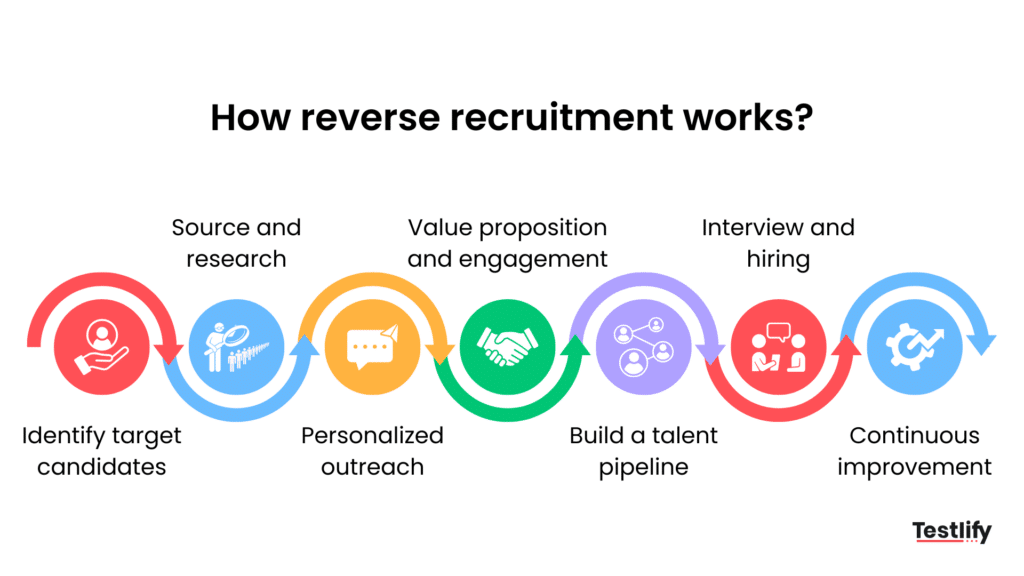
- Define the target: Write down the exact skills, experience, and traits the role needs. A sharp profile keeps outreach honest and stops you from chasing the wrong people.
- Source and research: Find people who match, using LinkedIn, industry events, and employee referrals. Read their work before you message them.
- Reach out personally: Send a message that names why this specific person fits. Generic copy-paste outreach gets ignored, and it should.
- Share the why: Tell them what is good here, the work, the team, the growth, and keep the conversation going even when there is no open role yet.
- Build the pipeline: People who are not ready now stay in your talent pipeline as warm, pre-screened contacts for later.
- Assess, then hire: When a seat opens, you interview people who already know you. Score them on the role’s real skills before the offer so fit is proven, not assumed.
What are the core principles of reverse recruiting?
A few ideas separate reverse recruiting from just spamming InMails. Get these right and the rest of the work gets easier.
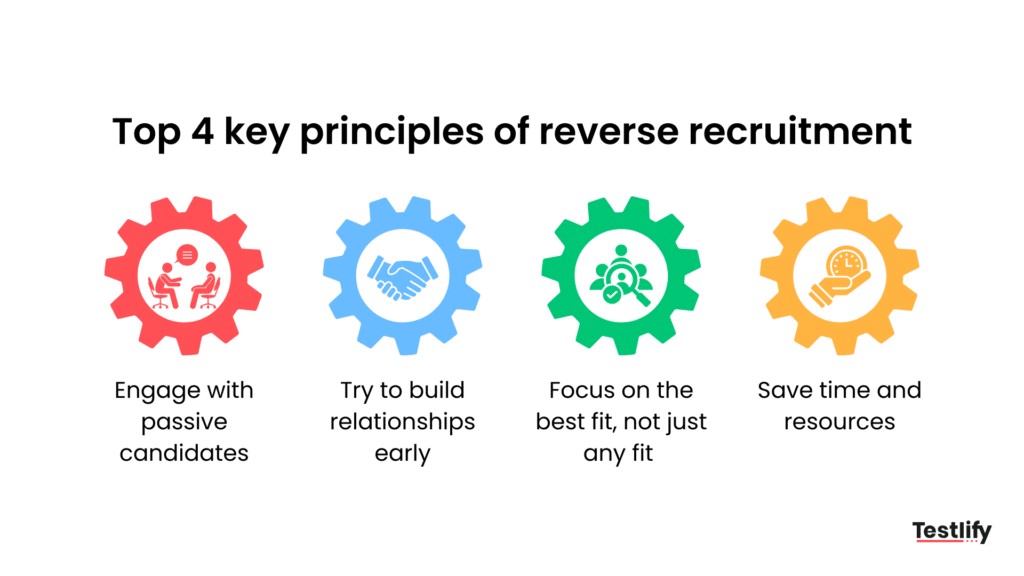
- Engage passive candidates: The people worth chasing are usually good at their current jobs. They are not applying anywhere, so you have to come to them.
- Build relationships early: Network before you need to. When you already know someone’s strengths and goals, you move fast the day a role opens.
- Aim for fit, not volume: This is not a wide net. It is targeting the handful of people who match the role and the culture, then doing right by them.
- Protect your team’s time: Reaching out to a short list of pre-screened people beats reading 300 resumes for one opening.
Reverse recruiting vs traditional recruiting
The simplest way to see the difference: traditional recruiting waits, reverse recruiting moves. One fills a specific open seat fast; the other plays a longer game to land people who would never have applied. Most teams need both. The table shows where each one wins.
Reverse recruiting | Traditional recruiting |
|---|---|
Proactive: you reach out to people | Reactive: you wait for applications |
Relationship-led, candidate-centric | Job-led, focused on the open role |
Targets passive, hard-to-reach talent | Attracts active job seekers |
Builds a long-term pipeline | Starts fresh for each role |
Slower to start, stronger long-term fit | Faster to start, less personal |
Higher cost per hire, lower miss rate | Lower cost per hire, more noise |
When should you use reverse recruiting?
Use reverse recruiting when the person you need is unlikely to apply. That usually means scarce skills, senior or high-impact roles, or a market where everyone is hunting the same short list. With ManpowerGroup’s 2024 Global Talent Shortage survey finding that 74% of employers struggle to fill roles, the people you want are getting harder to reach through ads alone.
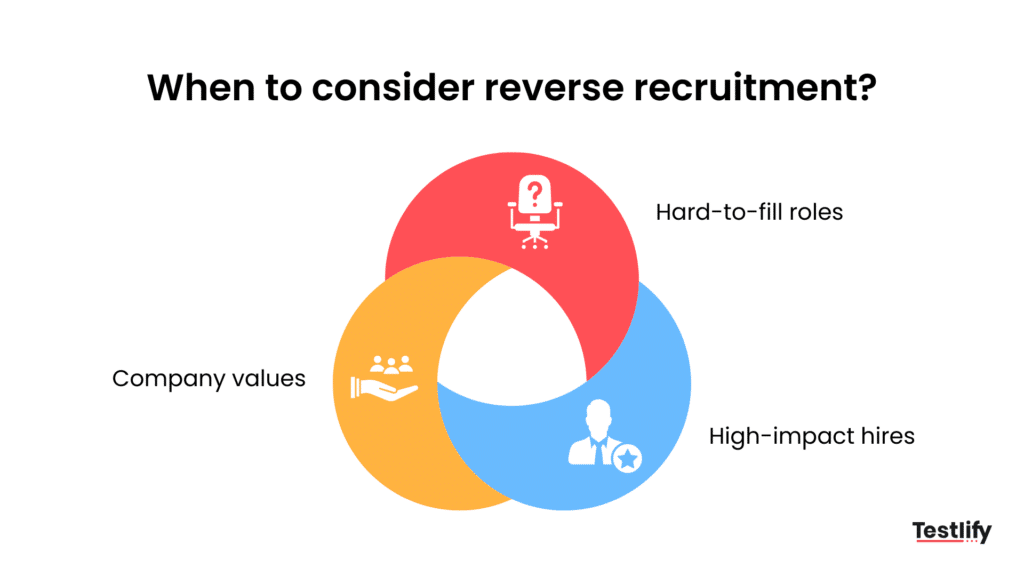
- Hard-to-fill roles: niche jobs where the right person is not browsing job boards.
- High-impact hires: leadership or specialist seats where one great hire moves the needle.
- Scarce-skill markets: fields like engineering or data where demand outruns supply.
Here is the honest caveat. Reverse recruiting is slow and hands-on, so it is the wrong tool for high-volume hiring or a tight budget. If you need 40 warehouse staff by next month, a good job ad and a fast screen will beat months of one-to-one outreach. Match the method to the role, not the hype.
How much does reverse recruiting cost?
Reverse recruiting costs more per hire than a job post, because someone is doing skilled, manual work: research, outreach, and relationship-building. If you bring in a firm, you will usually see one of three pricing models.
- Flat fee: a set price per search, often in the low thousands to around $10,000, covering sourcing and candidate support.
- Percentage of salary: commonly 15% to 30% of the hire’s first-year pay, which ties the fee to the role’s value.
- Custom quote: priced to the specific market and effort, used for unusual or senior searches.
- Add-ons: extras like background checks or skills assessments, typically a few hundred to about $1,000.
Put that next to the alternative. SHRM benchmarking pegs the average cost per hire at nearly $4,700 (2022), and a bad hire on a key role costs far more once you count lost time and a re-run search. On the roles that matter, paying more to get it right the first time is the cheaper option.
Pro tip: Before you pay for outreach, screen your existing pipeline on the actual skills the role needs. Spending a few thousand dollars to court a candidate who fails the first skills check is the most common way reverse recruiting budgets get wasted.
How do you implement reverse recruiting?
Reverse recruiting needs structure and a human touch in equal parts. These steps keep it from drifting into random messaging:
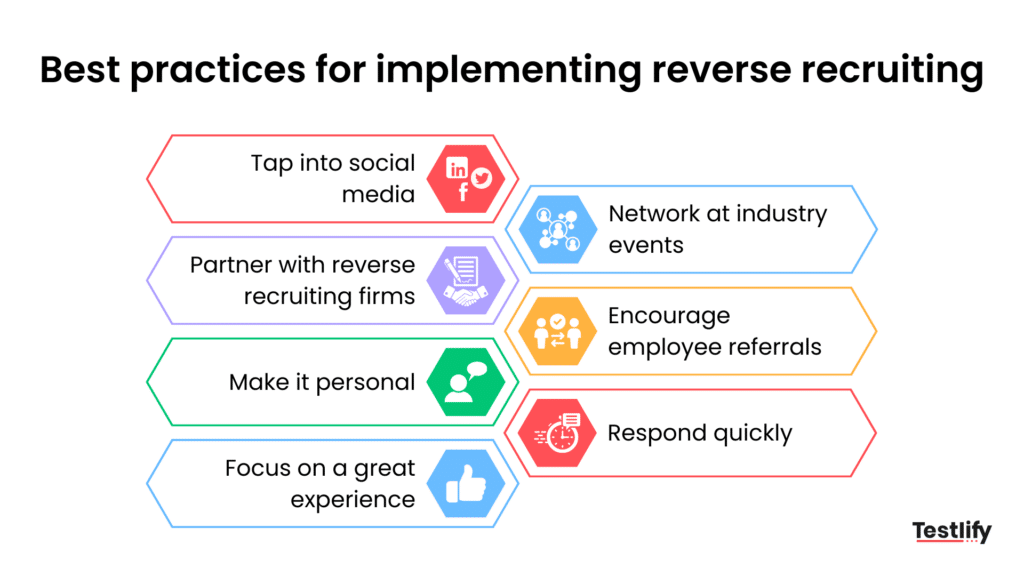
- Use social proof: Share real team stories on LinkedIn so passive talent sees what working with you is actually like.
- Show up at industry events: A face-to-face conversation builds trust faster than any cold message.
- Lean on referrals: Your current team knows good people. A simple referral program turns them into scouts.
- Personalize every message: Name the person’s work and why they fit. Templates read like templates.
- Reply fast: When someone shows interest, speed keeps the momentum and shows you value their time.
- Make the experience good: Be clear, answer questions, and protect your employer brand. People remember how you treated them, hired or not.
How do you measure reverse recruiting success?
Reverse recruiting takes real effort, so track whether it pays off. Four numbers tell you most of what you need to know:
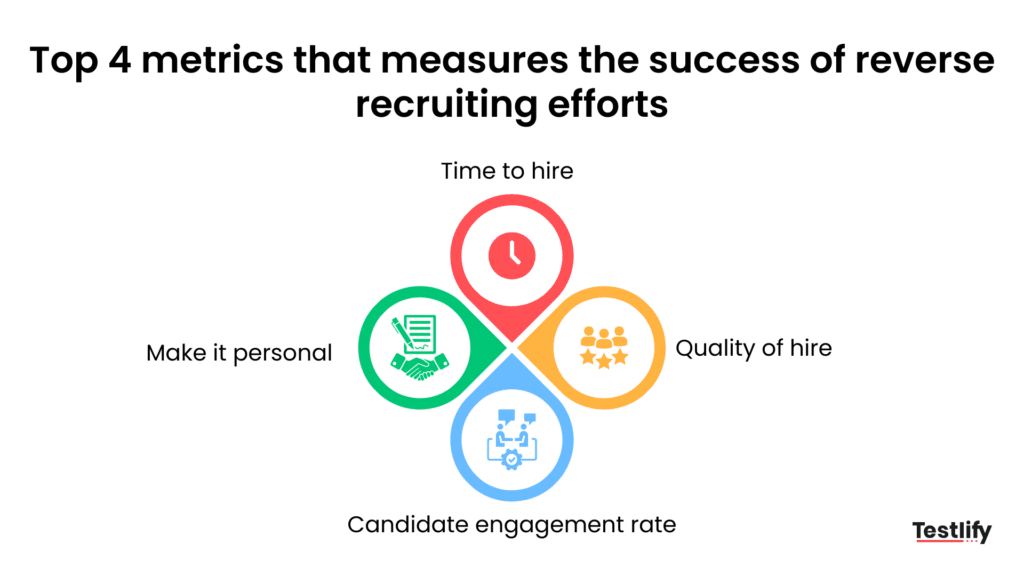
- Time-to-hire: How fast you go from first contact to signed offer. A warm pipeline should shorten it.
- Quality of hire: How new hires perform and whether they stay. This is the real test of who you sourced.
- Engagement rate: How many people reply and stay in the conversation. Low numbers mean your outreach is off.
- Offer acceptance rate: How many offers turn into yeses? A high rate means you courted the right people the right way.
Key takeaway: Reverse recruiting wins on quality, not speed-to-first-contact. Judge it on who you hired and whether they stuck, not on how many messages you sent.
Where Testlify fits in reverse recruiting
Let’s be straight about scope. Testlify does not source candidates or run your outreach; that is the human, relationship part of reverse recruiting, and it stays with your team. What Testlify does is the step that decides whether all that outreach was worth it: proving skills before you commit.
We use a simple approach we call the Testlify reverse-recruiting scorecard. Before you invest hours courting someone, you score your pipeline against the role’s real skills with a short assessment, then spend your outreach time on the people who actually clear the bar. It turns a gut-feeling shortlist into a ranked one.
Picture a 500-person software company hiring 20 engineers a year. Instead of deep-courting every promising name, the team sends a 30-minute coding assessment first, then focuses outreach on the top scorers. A screen that used to take six weeks of back-and-forth drops to about ten days because the short list is proven before the first real conversation.
That edge matters more every year. Korn Ferry projects that by 2030, more than 85 million roles could go unfilled globally, a talent shortage worth around $8.5 trillion in lost output (2030 forecast).
Screen your pipeline before you spend on outreach
Score passive candidates on the skills the role actually needs, then put your reverse-recruiting effort where it pays off. Start free with Testlify, or book a demo to see it in your roles.
Frequently asked questions (FAQs)

B2B SaaS Content Writer
Rishav Kumar is a B2B SaaS content writer with 4 years of experience. He loves crafting engaging content. Always exploring fresh ideas, he's passionate about helping businesses grow through impactful writing.
LinkedInRelated resources
View all
HR & recruitment
Technical Screening: Process, Types and Best Practices
HR & recruitment
Tech Recruitment Strategies: How to Win Tech Talent in 2026
HR & recruitment
Structured vs. Unstructured Interviews: Key Differences, Pros and Cons
HR & recruitment
Proactive Recruitment: Definition, Strategies & Examples

HR & recruitment
Blind hiring: What is it, process, and benefits

HR & recruitment
HR trends in higher education in 2026
Get started.
Hire on proof, not resumes.
Run your first skills-based assessment free — no credit card required.