Demo
Demo
 +1 (844) 755 8378
 Contact


Are you confident that your organization’s HR strategy is primed to meet the challenges of 2025?
Some organizations excel in areas like employee engagement, turnover management, employer branding, and employee satisfaction, while others struggle with HRM (Human Resource Management). Why is there such a stark contrast?
The answer lies in how they structure and manage their HR function. As a Human Resource professional, you should uncover these factors to build a great work culture. That’s where HR models help.
An HR model serves as a framework that outlines how the HR function is structured and delivers services within an organization. Human resource practitioners can provide maximum value to employees and the business through a proper HR model.
Ready to explore the 9 HR models that can position your organization among the top percentile? Let’s get started!
Summarise this post with:
 Chatgpt
 Perplexity
 Gemini
 Grok
Grok Claude
What is an HR Model?
An HR model is a framework that defines how HR is structured within an organization. It outlines HR’s role, responsibilities, and alignment with business goals. In simple terms, it acts as a blueprint for managing people effectively.
While HR strategy focuses on where HR strategy is headed, an HR model provides the structure and steps to get there. HR leaders use HR models to,
- Define key HR functions and workflows
- Clarify HR roles and responsibilities
- Set principles for HR objectives, accountability, and service delivery
In the past, HR was mainly about policy enforcement and administrative tasks. But today, it’s a strategic powerhouse that influences everything from employee experience to business growth.
This is why different HR models have emerged over the past years. Each HR model serves a different purpose, and the effectiveness of a model depends on company size, culture, industry, and strategic goals.
So, which HR model is right for your organization? Let’s find out!

The 9 HR models HR professionals must know
HR isn’t a one-size-fits-all function. What works for a large enterprise might not be effective for a fast-growing startup. That’s why different HR models exist.
From the globally recognized Ulrich Model to the transformative High-Impact HR Operating Model, we’ll break down 9 essential HR models to help you choose the best fit for your organization.
1. The Ulrich Model
The Ulrich Model is one of the world’s most widely adopted HR frameworks. David Ulrich introduced it in his 1996 book “Human Resource Champions.”
This model emphasizes that HR should handle operations and drive business success by aligning people strategies with company goals. Ulrich’s original framework outlined four key roles that HR must play to maximize the impact,

- Administrative expert: Focuses on internal operations and ensures that HR processes are efficient and structured for managing people.
- Employee champion: Works on employee well-being and employer-employee relationships to boost productivity and retention.
- Change agent: Works closely with managers and employees to bring meaningful changes and build a positive company culture.
- Strategic partner: Ensures HR isn’t just a support function but a key performer in shaping business success through smart workforce management.
The four roles in this model don’t mean that each represents a separate job title. Instead, HR professionals may take on one or more of these roles, depending on their responsibilities.
In 2005, Ulrich revised his model, extending it to five roles to reflect the growing complexity of HR.
- Employee advocate: Focuses on employee well-being and workplace satisfaction.
- Human capital developer: Ensures employees continuously develop skills to meet future business needs.
- Functional expert: Delivers HR expertise in areas like talent acquisition, performance management, compliance, etc.
- Strategic partner: Aligns HR with business needs and long-term workforce planning.
- HR leader: Works closely with the business leadership team. Aligns the HR team strategically and ensures delivering maximum value to the business.
Ulrich’s framework also led to the creation of the “Three-Legged Stool Model, ” specifically for large organizations. The three legs of the stool represent HR into three specialized areas,
- Shared services – A centralized team that handles routine HR operations and administrative services.
- Centers of Excellence (CoEs) – Specialized HR teams focused on complex areas like talent management and leadership development.
- HR Business Partners (HRBPs) – Senior HR professionals who work directly with business leaders, and their role is to align HR strategy with organizational goals.
The stool’s “seat” represents HR leadership, which designs and oversees the function as a whole.
Later, in 2008, David Ulrich, Jon Younger, and Wayne Brockbank expanded the model further. They added five HR service delivery roles to the model, namely. They identified five roles, i.e., service centers, corporate HR, centers of expertise, embedded HR, and operational HR.
Ulrich’s model is vital since the model makes HR a strategic function rather than an administrative one. It also improves efficiency by separating transactional and strategic HR work. Most importantly, it creates a direct link between HR and business success.
However, the model has challenges and criticism; companies may struggle to differentiate HR roles effectively, and HR teams may work in isolated structures if not appropriately implemented.
Many businesses still rely on this model, customizing it to fit their growth stage and unique HR needs.
2. The Harvard Model of HRM
The Harvard Model of HRM was introduced in 1984 by Michael Beer and his colleagues at Harvard University. The Harvard Model of HRM takes a strategic and holistic approach to human resource management.
This model focuses solely on HR policies and practices and highlights the broader impact of HR on stakeholders, business strategy, and society.

The Harvard Model stresses the importance of balancing stakeholder interests with business objectives while considering external factors influencing HR decisions. It consists of five key components:
1. Stakeholder interests: The foundation of HR decisions
HR operates within a broader ecosystem where multiple stakeholders have a say in managing people. According to the Harvard Model, HR policies should balance the interests of,
- employees who seek job security, fair compensation, and career growth.
- management, which requires a productive and skilled workforce
- shareholders who expect HR to optimize workforce efficiency for maximum profitability.
- government and unions impose labor laws and advocate for fair employment practices.
These diverse interests shape how HR policies are designed and implemented in an organization. HR initiatives may fail to achieve their intended impact if any stakeholder group is ignored.
2. Situational factors: The external influences on HR
HR decisions are shaped by internal and external factors that affect business operations. These situational factors include:
- Workforce characteristics – Employee demographics, skills, and expectations influence HR strategies.
- Economic climate – A recession or boom can change how companies hire, retain, and compensate employees.
- Labor laws & regulations – Legal requirements impact hiring, termination policies, workplace safety, and employee benefits.
- Unions & labor relations – In industries with strong unions, HR must negotiate policies that satisfy both the company and the workforce.
For example, a company may have to balance cost-cutting with employee well-being during an economic downturn. The Harvard Model ensures that HR remains flexible and responsive to these external influences.
3. HRM policies: Structuring HR to meet business needs
Once stakeholder interests and external factors are aligned, organizations must create HR policies to guide workforce management. These policies determine how employees are hired, managed, and rewarded to achieve both business and HR objectives.
The Harvard Model identifies four key HR policies that should be addressed. Stakeholder needs and situational factors play a major role in shaping these policies.
- Employee influences – Policies that define how employees participate in engagement strategies.
- Human resource flow – The movement of employees through recruitment, onboarding, training, promotions, and exits.
- Reward systems – Compensation, incentives, benefits, and recognition programs that motivate employees.
- Work systems – The design of work structures that determine how tasks are performed efficiently.
4 HRM outcomes: The direct impact of HR policies
When HR policies are effectively designed and implemented, they lead to four major HRM outcomes. These outcomes help organizations maintain a productive and engaged workforce. It ensures that HR strategies contribute to long-term business efficiency.
- Commitments – Employees develop a stronger sense of belonging and motivation that reduces turnover.
- Competence – HR policies support continuous training and development to ensure employees build skills that align with business needs.
- Congruence – Alignment between organizational goals and employee expectations leads to a collaborative workplace culture.
- Cost-effectiveness – Well-planned HR policies reduce unnecessary expenses and optimize recruitment and retention strategies. Establishing a clear expense policy further supports cost control by outlining reimbursement rules, travel budgets, and spending limits, ensuring financial transparency across the organization.
5. Long-term consequences: The broader impact of HRM
The Harvard Model plays a critical role in shaping an organization’s and its workforce’s long-term success. The Harvard Model ensures that HR benefits the company and its employees by focusing on these long-term effects. The three key long-term consequences are,
- Individual well-being – HR policies directly affect employee job satisfaction and work-life balance.
- Organizational effectiveness – A well-structured HR system enhances business performance and innovation.
- Societal well-being – Ethical HR practices contribute to diversity, inclusion, fair wages, and overall economic stability in society.
The Harvard Model is important since it encourages HR to think beyond internal policies and consider external influences. Additionally, it provides a long-term perspective, unlike traditional models that focus only on immediate workforce needs.
However, this model has certain drawbacks, like it’s complex to implement, and businesses in dynamic markets may find the model too broad and structured.
While it may not be the fastest model to implement, its long-term benefits make it a powerful tool for companies prioritizing sustainability and stakeholder balance.
3. The High-Impact HR Operating Model
The High-Impact HR Operating Model is a modern, agile HR framework designed to make HR a key driver of business success rather than just a support function.

Introduced by Deloitte, the High-Impact HR (HIHR) model shifts HR’s focus toward value creation.
This model transforms HR into a data-driven, technology-enabled function that helps companies navigate rapid workplace changes and digital transformation.
The High-Impact HR Model is built around four key pillars:
1. HR customers: The heart of the model
In this model, employees are treated as customers of HR services. Their needs and experiences directly influence HR strategies and policies.
HR focuses on employee needs to create better experiences that boost satisfaction and productivity. This shift from enforcing policies to shaping experiences helps build a motivated workforce.
2. The digital workplace: A connected HR ecosystem
With the modern workforce becoming increasingly digital, HR must embrace technology-driven solutions. The High-Impact HR Model integrates digital tools to ensure seamless workforce management.
Cloud-based HR platforms enable employees to access HR services anytime, anywhere, while AI-powered chatbots and self-service portals simplify HR inquiries and reduce administrative burdens.
Additionally, digital collaboration tools like virtual workspaces and communication platforms develop employee connectivity.
Related: Learn more about the best internal communication tools in this blog.
3. Workforce insights: Data-driven HR decision-making
The days have passed when HR decisions were based on intuition or past experiences. In this model, data and analytics drive every aspect of HR decision-making.
This model recommends utilizing HR analytics, AI-driven insights, and predictive modeling to identify workforce trends and predict turnover risks before they become major challenges.
4. Fluid interaction among HR components: Breaking down silos
The High-Impact HR Model encourages collaboration. The fluid approach ensures that HR teams can work together seamlessly. Rather than having rigid departments, HR operates in cross-functional teams that focus on key HR components.
HR becomes more efficient, responsive, and impactful by breaking down the silos, which helps them to contribute to business success and employee satisfaction.
4. The Storey Model
The Storey Model of HRM was developed by John Storey, a British HR professor and researcher.
The Storey Model of HRM highlights the shift from control-based HR (“hard” HRM) to commitment-driven HR (“soft” HRM). It explains how different HR approaches influence business performance.

According to Storey, hard HRM treats employees as resources, focusing on cost control. On the other hand, soft HRM views employees as valuable assets, emphasizing motivation and development.
The model identifies four key elements that define an organization’s HR approach,
- Beliefs & assumptions – How employees are perceived
- Strategic concepts – Whether HR is reactive or proactive
- Role of line management – The extent to which managers take responsibility for HR functions.
- Key levers – The focus on hiring, training, and company culture rather than just enforcing rules.
Storey’s model stresses that HR should be a strategic function, not just an administrative one. It also argues that HR’s effectiveness depends on its integration into the broader business strategy.
While both hard and soft HRM exist in businesses, Storey advocates for a commitment-based approach, believing that investing in employees leads to long-term growth.
The model is vital since it helps organizations assess their HR approach and shift towards a people-centric strategy. On the other hand, some also consider this model to be an oversimplified HR strategy.
5. The 8-Box Model by Paul Boselie
Paul Boselie developed the 8-Box Model of HRM. It provides a complete framework for understanding how internal and external factors impact HR policies and business outcomes.

Boselie’s model builds on previous HR frameworks like the Harvard Model but introduces a more structured approach to analyzing HRM. It begins with identifying four external factors that affect HR decisions or strategy.
- The external general market context – Refers to economic conditions, technological advancements, industry competition, and labor market trends.
- The external population market context – Focuses on cultural expectations that impact HR strategies.
- The external general institutional context – Includes government regulations, labor laws, compliance policies, and workplace safety standards.
- The external population institutional context – Covers trade unions and labor organizations that influence employee rights.
Then comes the internal HRM processes. HRM is structured into four inner elements that ensure HR aligns with business objectives and workforce needs.
- Configuration – The foundation of HR, shaped by company history, culture, technology, and workforce structure.
- HR strategies and practices – The core component of the model further breaks into four key stages,
- Intended HR practices – HR’s planned goals for hiring, training, performance management, and employee engagement.
- Actual HR practices – The implementation of these intended strategies in real-world operations.
- Perceived HR practices – How employees interpret and experience HR policies.
- HR outcomes – The results of HR policies.
- Critical HR goals – The above strategies lead to long-term outcomes, which include cost-effectiveness, flexibility, legitimacy, etc.
- Ultimate business goals – The broader impact of HR outcomes on organizational success that includes sustained competitive advantage, business viability, and strategic workforce planning.
8 Box Model is critical since it connects HR with external business conditions. Organizations can ensure that HR is responsive to market demands and workforce trends.
It also helps HR leaders assess whether their strategies are effectively implemented and perceived by employees.
As it requires detailed HR data analysis and external market evaluation, it is a bit complex for small businesses. Another vital challenge the 8 Box Model possesses is its reliance on external factors.
6. The HR Value Chain
The HR Value Chain Model was developed by Paauwe and Richardson in 1997. It is one of the most widely used HR frameworks. It explains how HR activities directly contribute to business success by distinguishing between HRM activities and HRM outcomes.

The HR Value Chain shows that everything HR does falls into two main categories,
- HRM activities: The day-to-day operational tasks HR performs, such as recruitment, compensation, training, and workforce planning. These activities focus on efficiency.
- HRM outcomes: The results HR aims to achieve through HR activities. The model emphasizes that HR should focus on efficiency and measure the impact of its activities.
For example, reducing the time to hire is a good strategy, but focusing on the quality of hire by hiring the right talent who stays longer and performs well is far more valuable in the long run.
The HR value chain model shifts HR’s focus from cost-cutting to value creation. Additionally, it helps HR leaders prove their strategic impact using measurable outcomes.
But the problem here is that the impacts aren’t always directly measurable, making it more problematic to quantify success.
7. The HR Value Chain Advanced
The HR Value Chain Advanced Model builds on the traditional HR Value Chain. While the standard model focuses on efficiency, effectiveness, and impact, this advanced version incorporates key performance indicators (KPIs) and HR enablers.
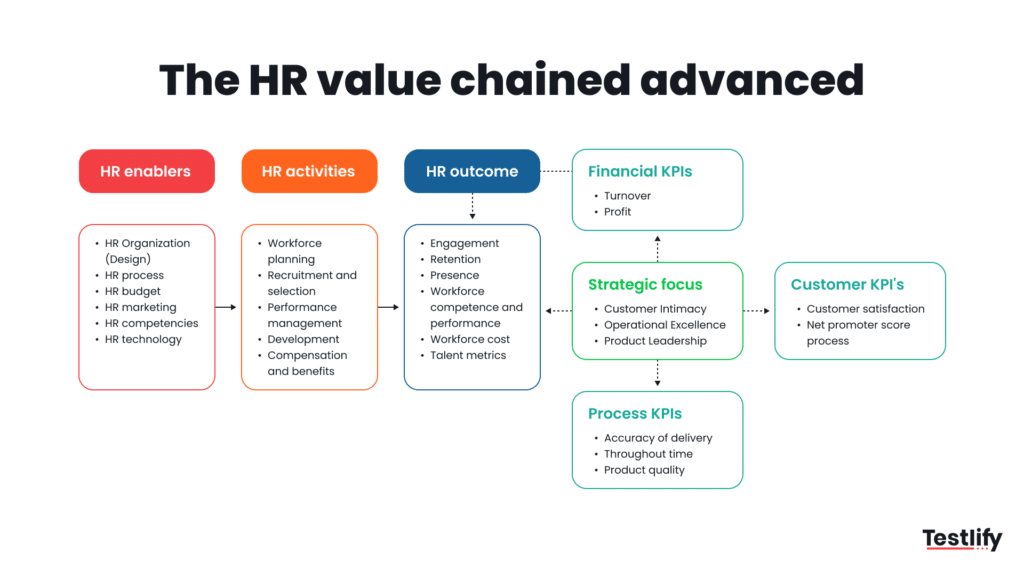
A significant addition to this model is the concept of HR enablers essential for HR to function effectively. These include HR technology, a structured HR organization, skilled professionals, and a sufficient budget. Without them, even the best HR strategies may fall short.
For example, it becomes difficult to improve engagement or retention without proper systems for tracking performance or managing recruitment.
Another key difference is the integration of business performance metrics through the balanced scorecard approach. This ensures that HR’s impact is measured through financial, process, and customer success metrics.
The HR Value Chain Advanced Model is beneficial for companies that want to move beyond basic HR metrics and prove HR’s direct contribution to business success.
Additionally, it helps organizations understand where HR investments are making the biggest impact and how they can optimize their strategies for long-term growth.
8. The Standard Causal Model of HRM
The Standard Causal Model of HRM explains how HR strategies and processes contribute to business success. It follows a step-by-step sequence, starting with the company’s overall strategy, which shapes HR strategy and practices.
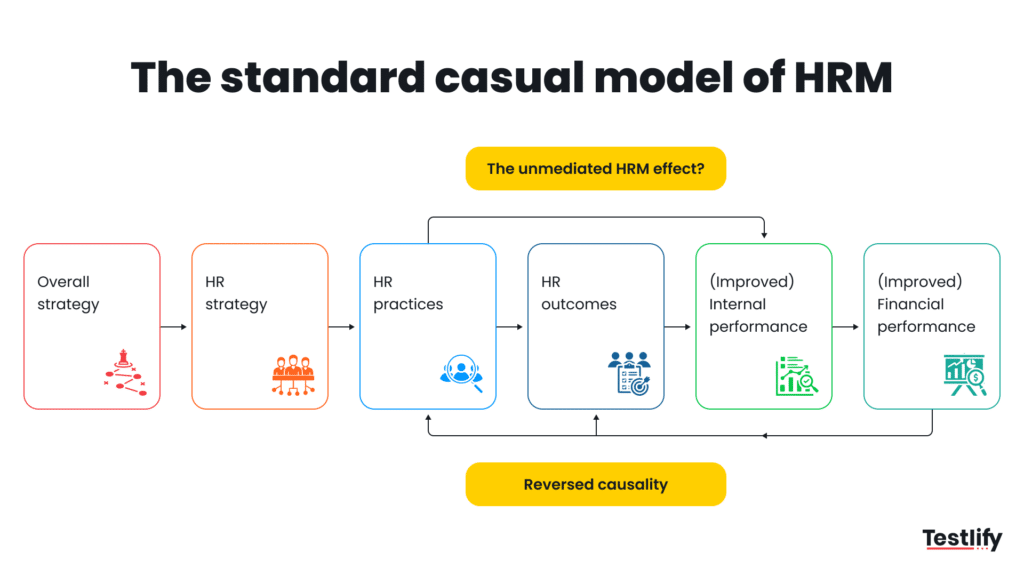
These HR activities influence employee performance, leading to better internal operations and, ultimately, improved financial results.
For example, employees become more engaged and productive when a company invests in hiring, training, and fair compensation.
The model also recognizes that this process is not always one-directional. Sometimes, strong business performance leads to higher investments in HR. Additionally, certain HR practices, like skill development programs, can directly enhance performance without passing through every stage of the model.
9. The Warwick Model
Developed by Hendry and Pettigrew at the University of Warwick, the Warwick Model focuses on how both external and internal factors shape HR strategies.

- The model consists of five key elements. The outer context includes external factors like political, economic, and technological factors influencing HR policies.
- The inner context refers to internal aspects such as company culture, leadership, and technology, which affect HR decisions.
- The business strategy context links external and internal influences to the company’s strategic goals.
- The HRM content covers core HR functions like workforce planning, reward systems, and employee relations.
- Finally, the HRM context focuses on how HR operates within the business, defining roles, structures, and outputs.
A major strength of the Warwick Model is its stress on adaptability. It highlights the need for HR to evolve in response to market changes and organizational shifts constantly.
How to select the best HR model for your business?
Every organization has unique HR needs, and selecting the right model depends on several key factors. Below are the main factors to consider,
- Business strategy: If your focus is performance-driven outcomes, choose a model that links HR practices to business success. Strategic HRM models may be more effective for companies prioritizing employee engagement and development.
- Organizational structure: Large organizations with complex HR functions may benefit from structured models like The Ulrich Model. Smaller or more flexible businesses may find holistic models like the Warwick or 8-Box Models more useful.
- Industry and competition: Some industries require HR to focus on workforce development and retention, while others prioritize compliance and risk management. Your HR model should reflect the industry’s unique challenges.
- HR team capabilities: If HR is expected to act as a strategic partner, models emphasizing leadership alignment and business impact are ideal. If the focus is on adapting HR to external influences, choose a model that supports this approach.
- Cost-effectiveness: The right HR model should provide measurable business impact. Models that connect HR initiatives to financial performance ensure a strong return on investment.
Wrapping up: Your HR strategy starts here
There is no perfect HR model that fits every business. What works for one company may not work for another. The real challenge is selecting a model and making it work in your unique environment.
The best HR strategies evolve, adapt, and align with business goals and workforce needs. Whether your focus is on efficiency, agility, employee experience, or strategic alignment, the right HR approach ensures that HR is not just a department but a key driver of business success.
At the end of the day, HR is about shaping the future of work. The real value lies not in the HR model but in how well it is implemented to support your people and business growth.