
AI upskilling guide for HR teams
Discover strategies for HR teams to upskill in AI and create a resilient, adaptable, and future-ready workforce.
AI upskilling represents one of the most important change management opportunities of our time. As businesses accelerate digital transformation, both executives and employees are asking a critical question: What new skills are needed to stay ahead of the competition?
The answer lies in building AI literacy and strengthening technical capabilities. As a result, organizations are embedding AI into everyday operations and long-term strategies. This rapid adoption creates unprecedented growth opportunities and a clear imperative for HR teams to lead AI upskilling initiatives.
In this article, we’ll explore how HR teams can approach AI upskilling to build a resilient, future-ready workforce.
 ChatGPT
 Gemini
 Claude
 Grok
Grok Perplexity
The growing AI skills gap in the U.S. job market
AI is transforming nearly every industry, yet a significant skills gap has emerged between employer needs and the current workforce capabilities.
In manufacturing, for example, 95% of organizations are already using AI in some capacity, yet 71% of manufacturing leaders say their workforce is not ready to leverage AI effectively.
Employers recognize that without skilled people to implement and manage AI, even the best tools won’t deliver value. In parallel, robust workforce management systems are critical to aligning employee roles and responsibilities with evolving AI capabilities in the workplace. Companies, as a result, are shifting focus from external hiring to developing internal talent to fill AI-related roles.
For HR teams, these trends signal that investing in AI skills development is now a strategic imperative. By supporting employees through targeted training and certifications, HR teams can help them close critical skill gaps and gain a competitive edge in the talent market.

How to approach AI upskilling
AI upskilling should start with a clear strategy and defined end goals, not just ad-hoc training sessions. Leading organizations first identify priority business outcomes and then map the AI skills needed to achieve them.
In fact, two-thirds of companies that were early adopters of generative AI already have a strategic plan to address future talent and skill requirements, underscoring the importance of a deliberate approach.
Equally important is taking a human-centric approach to AI upskilling initiatives. Many employees may fear that AI threatens their roles or find the technology intimidating. HR can turn initial fear into curiosity by framing upskilling as an opportunity for growth, not a compliance mandate.
This means communicating the “why” behind AI initiatives and reassuring staff that the goal is to augment human work, not replace it.
Practical steps for HR teams to drive AI upskilling
- Conduct a skills gap analysis: Begin with a skills gap analysis to understand your workforce’s current AI proficiency and identify roles that will be most impacted by AI.
- Prioritize high-impact areas: Rather than one-size-fits-all training, focus on critical roles and tasks where AI skills will drive business results. This “goals before roles” approach ensures AI upskilling initiatives are tied to tangible outcomes.
- Customize training to roles: Design AI learning programs that are role-specific by making use of leading skills assessment platforms like Testlify. The payoff can be huge, as research shows that role-based AI training can boost productivity impact by 56%.
- Foster an AI-first mindset: Training should cover not just what AI tools do, but how to think about integrating AI into problem-solving. Encourage teams to experiment with AI in their projects and share success stories. A culture of learning by doing helps solidify skills far better than any number of formal training sessions.
- Measure the impact: Track metrics such as AI tool adoption rates, time saved on AI-augmented tasks, and employee confidence levels pre- and post-training. This data will help refine your approach and also demonstrate ROI to the C-suite.
Top AI upskilling success factors
Implementing an AI upskilling program can be challenging, but certain factors consistently separate successful initiatives from those that fizzle out. Based on insights from HR research and companies that have led the way, here are the top five success factors for AI upskilling:
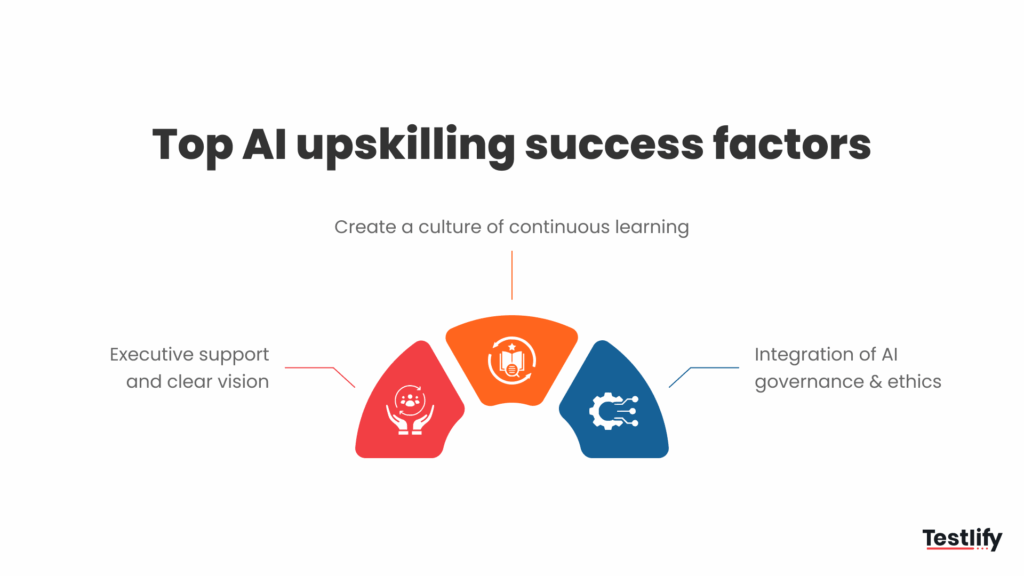
Executive support and clear vision
Successful upskilling starts at the top. When CEOs and CHROs visibly champion AI education, allocate budget, and articulate a clear vision, employees are more engaged.
Nearly 55% of business leaders agree that future C-suite executives will need a strong understanding of AI and that commitment must trickle down.
Leadership should communicate why AI skills matter for the company’s future and how employees’ careers will benefit. A concrete vision (e.g., “Within 2 years, all employees will be AI literate and able to automate at least 20% of their routine work”) gives purpose to the training.
Executive buy-in also means modeling the behavior: leaders should participate in AI training sessions or share their own learning experiences to underscore that everyone, from top-floor to shop-floor, is learning together.
Create a culture of continuous learning
Companies that succeed foster a culture where learning new skills is celebrated and experimenting with new tools is encouraged (and failures in the learning process are treated as learning opportunities).
One effective tactic is to gamify and socialize the learning. For instance, Microsoft found that AI training programs with peer collaboration elements saw 32% higher application of those AI skills in daily work.
You can nurture this by creating internal communities for AI learners, hosting friendly competitions, and showcasing team “bright spots” who achieved something notable with AI. When employees see colleagues embracing AI, it builds momentum.
In practice, that could mean offering digital badges, certifications, or even career incentives for those who advance their AI skills.
Integration of AI governance and ethics
HR teams should bake basic AI ethics, data privacy, and governance guidelines into upskilling programs. This dual focus ensures that, as more employees start wielding AI tools, they are aware of potential risks (like biases in AI decisions or data security issues)
According to HR Dive, 36% of CHROs are already advocating for AI governance policies to mitigate risks that come with AI adoption. Ultimately, an upskilled workforce that is also “AI aware” about ethics is a sustainable competitive advantage.
The role of AI skills tests in workforce development
While upskilling is fundamentally about learning, it’s closely intertwined with talent acquisition and management practices. HR leaders have a crucial role in identifying AI skill gaps and verifying that employees have the necessary competencies. This is where skill assessment tools become invaluable.
For example, Testlify is an AI-powered skills assessment and conversational interviewing platform that offers a comprehensive library of 3,500+ pre-built tests designed to evaluate your workforce’s AI proficiency.
The platform’s AI/Generative AI test helps evaluate an employee’s expertise in AI models and generative techniques, helping employers identify professionals capable of developing innovative AI-driven solutions for diverse applications.
Why recruiters should embrace AI skills tests?
From a recruiter’s perspective, integrating AI skills tests into your hiring pipeline offers several benefits:
- You can screen employees for AI proficiency early, focusing on identifying skill gaps and tailoring training to their specific roles.
- You gain objective data to compare employees and make fair internal hiring decisions based on merit.
- The tests can reveal specific strengths or weaknesses, which can lead to the creation of targeted training plans post-hire.
- It sends a message to new applicants that your organization values continuous learning and technical excellence, which can attract like-minded, ambitious talent.
Pairing upskilling programs with rigorous skill assessments creates a powerful feedback loop for talent development. You train employees in AI, evaluate their progress, fine-tune the training, and ensure the organization builds the capabilities it needs. This data-driven cycle eliminates guesswork and directly addresses the AI skills gap.
Also read: How generative AI enhances candidate skills assessments
Final thoughts
The advancement of AI is often compared to past industrial revolutions, being disruptive at first but ultimately productive in the long run. But what determines who wins or loses in this transition is preparedness.
For U.S. job seekers, proactively upskilling in AI is perhaps the single best way to prepare for the future of work. In turn, organizations that champion upskilling and invest in their people will cultivate a workforce that can innovate and adapt, keeping the company competitive.
In summary, AI upskilling is the smart move because it benefits everyone:
- Professionals gain career longevity, improve their productivity, and gain access to new opportunities by learning to work alongside AI.
- Employers gain agile, tech-savvy teams capable of unlocking AI’s value, rather than fearing it, leading to greater innovation and performance.
- Customers and society benefit from a workforce that can harness AI responsibly to solve problems, while human creativity and judgment remain in the loop.
If you’re a recruiter or an HR leader looking to empower your team and hire top talent for an AI-driven future, consider how Testlify can support your mission.
Book a demo with Testlify today to discover how our platform can elevate your AI upskilling strategies.
Frequently asked questions (FAQs)

Related resources
View all
HR & recruitment
Compensation Transparency: The hiring trend reshaping trust in Canadian and U.S. markets

HR & recruitment
Skills vs. Titles: Why HR Teams are Switching to Skills-based Hiring Worldwide

HR & recruitment
Blue-collar hiring: What recruiters need to know

HR & recruitment
Best assessments for hiring in media industry

HR & recruitment
Ways HR teams can simplify their work
HR & recruitment
How white label interview tools streamline enterprise talent pipelines
Get started.
Hire on proof, not resumes.
Run your first skills-based assessment free — no credit card required.