
Cross-cultural recruiting strategies for remote teams
Explore how recruiters can overcome cultural barriers to build inclusive, high-performing global remote teams.

Recruiting across cultures means hiring people whose ideas about work were shaped somewhere else, then judging them on what they can do instead of on how familiar they feel. The method does not change from country to country. Define the competency, decide what counts as proof, score every candidate the same way. What changes is which signals you can still trust.
Most advice on this topic stops at "be sensitive to differences". That is true and almost useless at 9am on a Tuesday with 40 applications from six countries in the queue. The harder question is mechanical: which parts of your hiring process quietly measure culture instead of capability, and what do you replace them with?
TL;DR
- Cross-cultural hiring fails at the evaluation step, not the sourcing step. The pipeline is easy to fill and hard to judge fairly.
- Resumes, small talk and interview confidence are the least portable signals you own. Work samples, structured questions and scored assessments travel much better.
- Language ability and job ability are two separate measurements. Blending them into one impression is the single most common mistake in global hiring.
- Write down the competencies and the scoring before the first call. A rubric agreed in advance is what stops "culture fit" from becoming "reminds me of me".
- Time zones are a design constraint, not an inconvenience. Async assessment and recorded interviews decide who can realistically apply.
- Structured interviews outpredict raw cognitive testing, so structure is the highest-return change most teams can make this quarter.
 ChatGPT
 Gemini
 Claude
 Grok
Grok Perplexity
How does recruiting across cultures work?
It works by separating the job from the customs around it. A role has competencies: things a person must be able to do. Those stay constant whether the hire sits in Manila, Munich or Manchester. Everything else, how a CV is written, how much credit someone claims for teamwork, how directly they disagree with an interviewer, is local convention wearing the costume of merit.
This is not a niche problem for companies with an office in three countries. Foreign-born workers made up 19.1% of the US labor force in 2025, according to the Bureau of Labor Statistics foreign-born workforce release. A team hiring only in one city is already hiring across cultures. Remote work simply removes the last excuse for pretending otherwise.
There is a skills argument too. In the World Economic Forum's Future of Jobs Report 2025, 63% of employers named skill gaps as the biggest barrier to transforming their business, and 70% expected to hire people with skills they do not have in-house today. You cannot close a gap that size from one postcode.

What breaks when you hire across five countries?
Five things break, and none of them is sourcing. Sourcing is the easy part. What breaks is the resume screen, the interview read, the language judgment, the calendar and the paperwork, roughly in that order, and each one quietly narrows the shortlist before anyone notices.
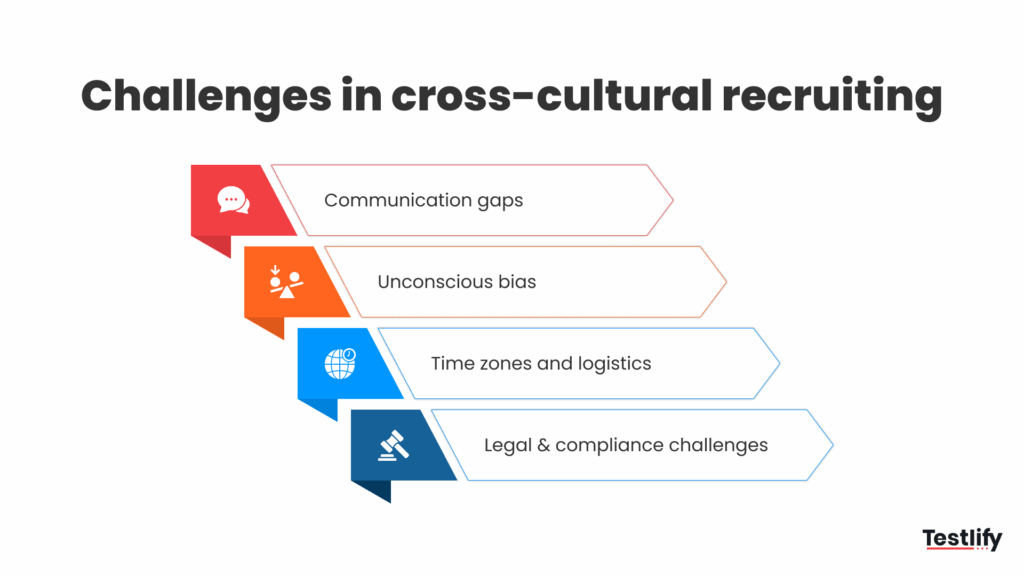
Resumes reward the local writing style
A US-trained candidate is taught to claim ownership: "led a team of 12, grew revenue 30%". A candidate from a culture that treats self-promotion as rude writes "supported the team". Same contribution, very different document. Screening on CV confidence sorts by writing convention, then calls the result merit.
Interview behavior is read wrong in both directions
Silence before answering reads as hesitation in one country and as respect for the question in another. Interrupting reads as engagement here and as rudeness there. Neither habit predicts whether someone can do the job. Interviewers rarely notice they are scoring it, which is exactly why it needs a rubric rather than more awareness training.
Language ability gets mistaken for job ability
An engineer who writes flawless code and hesitant English is not a weaker engineer. They may be a weaker communicator in English, which matters for some roles and barely at all for others. Decide which one the job needs, then measure it on purpose. Blending the two produces a shortlist of fluent speakers rather than strong performers.
Time zones quietly decide who can apply
Remote work is not equally normal everywhere, so a "global" process built around live calls is narrower than it looks. Eurostat's 2025 data puts the share of EU workers who usually work from home at 9%, ranging from 20.5% in Finland down to 1.3% in Romania (Eurostat working-from-home series). If every interview needs a 3pm Central European slot, several of those markets are effectively closed to you.
Pay, law and paperwork move slower than your pipeline
Employment law, notice periods, statutory benefits and contractor rules differ per country, and the answer changes the offer. Teams that leave this to the end lose candidates in week six of a five-week process. Find out what an offer in that country actually involves before you open the role, not after the final interview.
Which hiring signals distort across borders?
Here is the honest audit: a signal most teams already use, what happens to it when the candidate grew up somewhere else, and what measures the same thing without the cultural tax.
Signal you use today | What distorts it across cultures | Use instead |
|---|---|---|
Resume and cover letter | Self-promotion norms, CV formats, unfamiliar employer names, degree naming | A short work sample or role-specific skills assessment scored blind |
Interview confidence | Directness, eye contact, comfort with self-praise, tolerance for silence | The same structured questions for everyone, with a written scoring guide |
Spoken fluency | Accent, speed, idiom, nerves in a second language | A separate language test at the level the job needs, scored on its own |
Culture fit | Familiarity bias, shared references, school and employer prestige | Named behaviors mapped to the role, assessed as evidence, not vibes |
References | Reference customs vary; some markets give none, some give only dates | A structured reference request with the same questions for every finalist |
Availability | Notice periods run from two weeks to three months by country | Ask at the screening stage and plan the start date around it |
None of that requires you to become an anthropologist. It requires you to write down what you are measuring before you meet anyone.
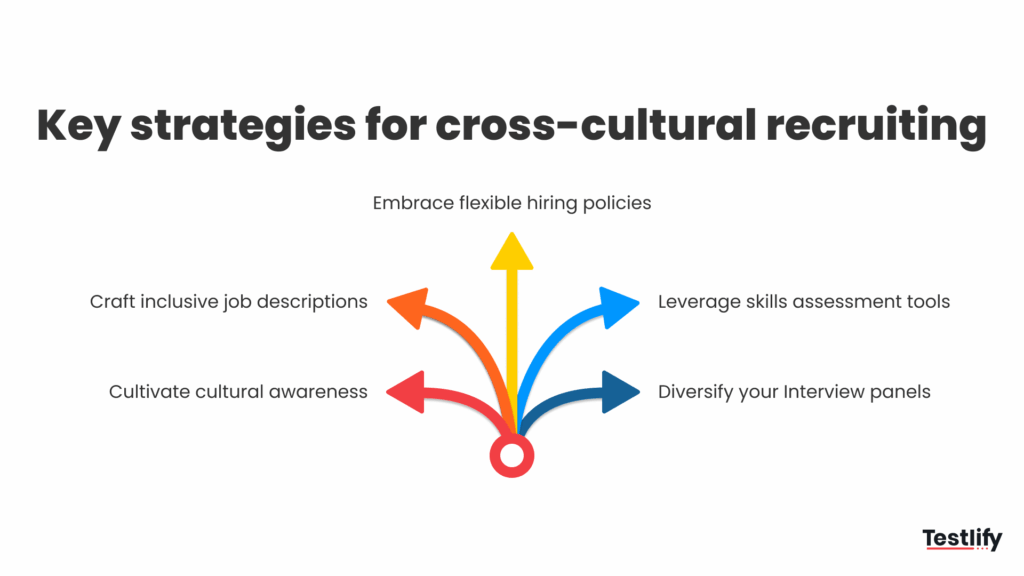
Five strategies for culture-fair hiring
These are ordered by return on effort. The first two cost an afternoon. The last one is a habit, and it is the one that sticks.
1. Define the competency before you pick the country
Start with the role, not the region. The Testlify Competency-to-Evidence Matrix maps every role to the competencies that matter, then connects each competency to measurable evidence through assessments, simulations, interviews, references and structured feedback. Written out, it is a short table: competency, why the role needs it, what counts as proof, who scores it. Do this once per role and the process stops depending on who happens to run the interview.
2. Write job ads that read the same in every market
Cut idioms, sports metaphors and unexplained internal words. "Rockstar", "hit the ground running" and "we work hard and play hard" translate badly and filter oddly. State the hours, the overlap you actually require, whether the role is employed or contract, and the salary range. Vague ads get vague applicants everywhere, and abroad they also get self-selection you never see. Testlify's job description templates are a reasonable starting skeleton if you are rewriting a stack of them.
3. Screen on evidence, not on polish
This is where the research is clearest. A 2022 meta-analysis in the Journal of Applied Psychology re-estimated the predictive validity of common selection methods and put structured interviews at 0.42 against 0.31 for general cognitive ability tests, making structure the strongest single predictor of job performance in the set (Sackett and colleagues, 2022). Structure means the same questions, in the same order, scored against the same written criteria. It is cheap, it is boring, and it beats the interviewer's gut across every border.
Pair it with a role-specific assessment so the first signal in the file is work, not writing style. Skills tests can be translated into the candidate's preferred language in real time, which removes one layer of noise, though translation quality varies by language pair and is worth spot-checking on your highest-volume markets before you rely on it.
4. Measure language deliberately, or not at all
Pick the level the job needs and test for it. A support role that handles written tickets in English needs written English. A backend engineer on an async team may need enough to follow a design doc and nothing more. Language proficiency tests give you a level instead of an impression, and pronunciation insights break a spoken response into accuracy, fluency and prosody rather than one gut rating of "good English". If the role does not need the language, do not score it. A lot of accent bias in remote hiring is just this: scoring something the job never asked for.
5. Calibrate the panel, then score independently
Diverse interview panels help, but only if the panel scores before it talks. Have every reviewer submit their rating first, then discuss the gaps. Where reviewers disagree hard on the same candidate, that is usually a definition problem in the rubric, not a candidate problem. Weighted scoring helps here: a test can carry a weight from x0 to x5, so the competency that actually predicts performance in the role counts for more than the one that is easiest to observe. Testlify's AI scoring ships with the disclaimer that says the quiet part out loud, "AI scores and insights are for guidance only. Use human judgment for final decisions", and reviewers can keep the AI score out of the final average entirely.
What does a global talent pool actually get you?
Three things, in descending order of how confident anyone should be about them.
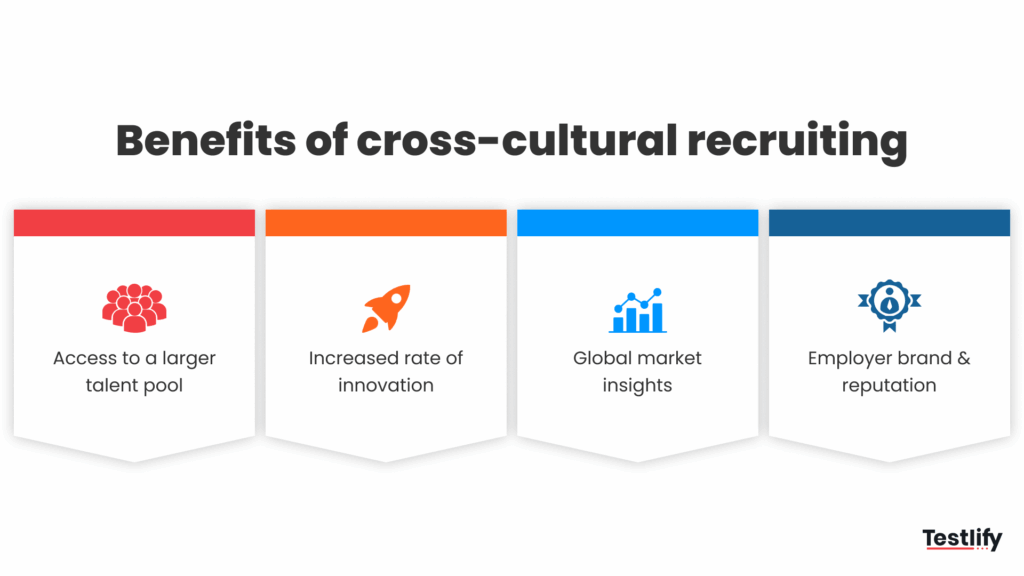
The obvious one is supply. Widening from one city to one continent can turn a shortlist of four into a shortlist of forty, and it changes who you can afford. For a 60-person company that cannot outbid the local giants for senior people, this is often the whole strategy.
The second is coverage. A support or operations team spread across three time zones answers customers at 2am without anyone working at 2am, which is a real structural advantage over a competitor hiring in one place.
The third is the performance argument, and it deserves a careful reading. McKinsey's 2023 study of 1,265 companies across 23 countries found that firms in the top quartile for ethnic representation on executive teams had a 39% greater likelihood of financial outperformance than those in the bottom quartile (Diversity Matters Even More). Note what that says: a greater likelihood of outperforming, at executive level, correlational. It is not a promise that a diverse team earns 39% more, and anyone who tells you otherwise has not read it. Treat it as a reason to take the work seriously, not as a business case you can put in a board deck unchallenged.
Pro tip: Run one round of your existing process as a blind pass. Strip names, photos, schools and employers from the first screen and see how much your shortlist changes. It is a far more convincing argument for structure than any article, because it runs on your own pipeline and your own candidates.
How do you onboard across time zones?
Hiring well and then onboarding badly wastes the whole exercise. Three habits do most of the work.
First, write things down. A distributed hire cannot absorb context by sitting near people, so the handbook, the decision log and the "who owns what" page carry weight they never had in an office. Second, give the first two weeks a fixed schedule with named owners rather than an open invitation to ask questions, which is culturally much harder for some new hires than others. Third, set the overlap expectation in writing on day one, in both directions: what hours the team expects, and what hours the team promises not to expect.
There is a device caveat worth knowing before you promise candidates anything. Assessments and proctoring run on Chromium desktop browsers, Chrome or Edge, and the mobile app is a fallback for recording audio and video rather than a way to sit a full test on a phone. In markets where candidates are mobile-first, say so in the invitation and give people time to find a laptop. Nothing sours a first impression faster than a candidate failing a system check at 11pm.
The same principle applies to accommodations. Testlify's request flow asks candidates directly whether they are fluent in English and whether they have a condition affecting memory or concentration, then routes the request to an administrator who adjusts the session. It is a human-reviewed request, not automatic extra time, and the distinction is worth stating to candidates so nobody assumes an answer they will not get. For more on the management side once people are hired, see managing a distributed team.
Hire across cultures with evidence
Testlify is where the evaluation half of this lives: role-based skills assessments, structured and AI interviews with automatic multilingual transcripts, weighted scoring and reviewer calibration, all in one place. It integrates with the ATS most teams already run and ships a simple built-in hiring pipeline for teams that have none. If the cultural signal you keep tripping over is communication, the cross-cultural communication test, the global mindset assessment and the cultural adaptability test measure it directly instead of leaving it to an interviewer's impression. Book a walkthrough and bring a role you are struggling to fill.
FAQs

Related resources
View all
HR & recruitment
How recruiters can find top talent with skills-based hiring tools

HR & recruitment
Quiet firing: Signs it’s happening and how to prevent it

HR & recruitment
AI upskilling guide for HR teams

HR & recruitment
Compensation Transparency: The hiring trend reshaping trust in Canadian and U.S. markets

HR & recruitment
Skills vs. Titles: Why HR Teams are Switching to Skills-based Hiring Worldwide

HR & recruitment
Blue-collar hiring: What recruiters need to know
Get started.
Hire on proof, not resumes.
Run your first skills-based assessment free — no credit card required.