
How recruiters can find top talent with skills-based hiring tools
Want the best job seekers? See how skills-based hiring tools help recruiters uncover hidden talent others overlook.

Recruiters today are realizing that traditional hiring practices are failing to keep pace with the demands of the workforce. Degree requirements, rigid job descriptions, and years of experience filters are leaving many critical roles unfilled.
At the same time, the widening skills gap means companies struggle to find candidates with the right abilities, even when talent exists outside conventional credential filters.
The reality is clear: the old playbook doesn’t work anymore. Hiring solely based on credentials means overlooking capable job seekers who can deliver the best results.
To stay competitive, recruiters need new strategies to identify high-potential job seekers in a market where skills, not credentials, determine success. This is where skills-based hiring tools make a difference.
In this article, we’ll explore skills-based hiring in detail and share how recruiters can identify the best job seekers using the right skills-based hiring tools.
 ChatGPT
 Gemini
 Claude
 Grok
Grok Perplexity
The rise of skills-based hiring
In recent years, skills-first hiring has moved from buzzword to mainstream. Surveys show a dramatic uptick in adoption. In 2024, 81% of U.S. employers are adopting skills-based hiring, up from 73% in 2023 and 57% in 2022.
The rationale for adopting skills-based hiring tools is compelling. Research by McKinsey indicates that hiring for skills is five times more predictive of job performance than hiring for education.
At the same time, a skills-centric approach aligns with broader organizational goals. Companies that embrace skills-first hiring also see it as a way to close opportunity gaps.
In short, hiring by skills is a strategic response to talent shortages, a driver of better performance, and a catalyst for workforce diversity.

Challenges in a skills-first hiring landscape
In a skills-first hiring landscape, organizations face significant challenges in fully embracing the shift, with slow progress despite widespread commitment to change. The major challenges include:
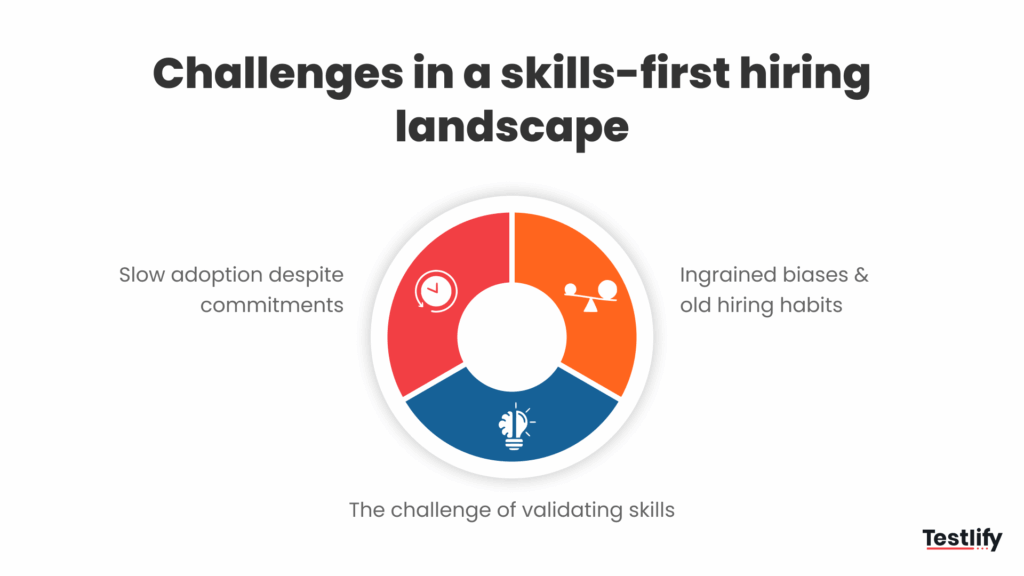
1. Slow adoption despite commitments
While the rise of skills-based hiring is undeniable, it doesn’t mean the transition has been easy. Many organizations are still straddling the old and new paradigms.
A joint study by Harvard Business School and the Burning Glass Institute found that despite publicized commitments to drop degree requirements, actual hiring practices have been slow to catch up.
In many cases, companies removed the degree ask from job postings but saw little change in who they ultimately hired. About 45% of companies that pledged to hire for skills made no meaningful changes in practice, and another 18% backtracked after initial efforts.
This shows that simply eliminating credential requirements isn’t enough, as organizations must also change how they source, assess, and select job seekers.
2. Ingrained biases and old hiring habits
One major challenge for recruiters is overcoming ingrained biases and habits. Data revealed that despite the broader adoption of skills-based hiring, over 60% of employers still admit to rejecting qualified candidates for lacking a college degree.
Old heuristic bias dies hard. Hiring managers may feel uncertain about evaluating candidates without the familiar benchmarks of specific education or X years of experience.
Internal resistance can crop up as HR teams might embrace the concept, but front-line hiring managers may question whether skills can substitute for years on the job. Building consensus for a skills-first mindset requires education and evidence.
3. The challenge of validating skills
Traditionally, recruiting has relied heavily on resumes and unstructured interviews, which don’t always reveal true candidate ability. Moving to a skills focus means implementing assessments, structured interviews, or job simulations, which are new elements that require investment and know-how.
In a McKinsey employer survey, companies cited sourcing nontraditional candidates and validating skills as their top challenges when implementing skills-based practices. It’s one thing to say you value skills, and another to build a hiring process that reliably measures those skills.
Is the market rewarding adaptability?
The talent market is rewarding those who adapt. For CHROs, the task at hand is to equip their recruiting teams with the tools and strategies to truly operationalize skills-based hiring so they can find the best people out there, not just the people with the most polished resumes.
Strategies to identify top talent using skills-based hiring tools
Identifying top talent in a skills-based hiring market requires a shift in recruiter tactics. Here are several strategies and best practices that recruitment teams can use to identify high performers in a skills-first way:
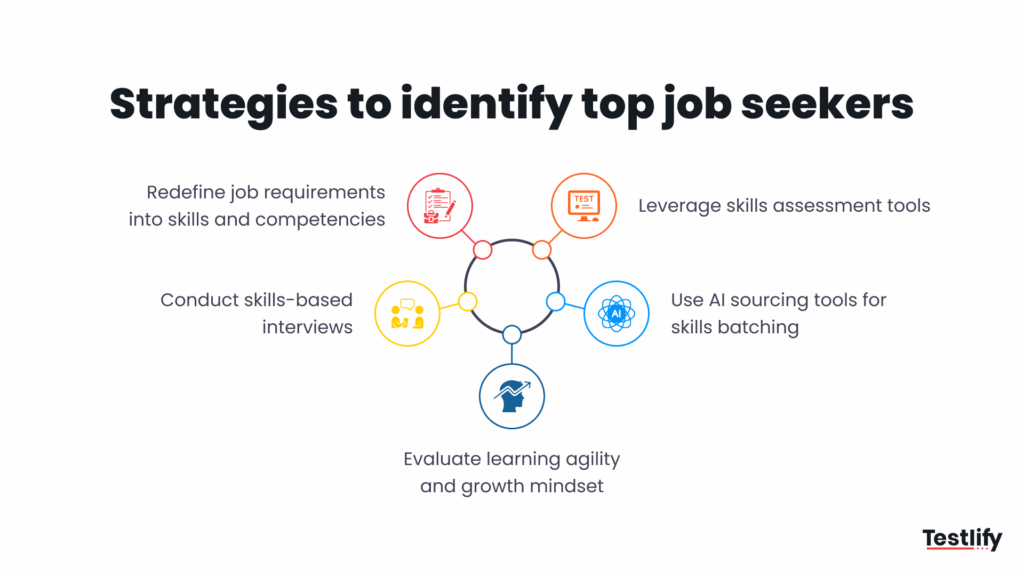
Redefine job requirements into skills and competencies
Start by translating traditional job descriptions into specific skills, competencies, and outcomes. Instead of filtering for degrees and experience, it is more prudent to define the core skills that a job seeker needs to succeed in your company.
This creates a clear target for what to look for in candidates. Recruiters can then search talent pools for those skills directly. By knowing the exact competencies required, you’ll catch top candidates who might be overlooked by a traditional keyword scan.
To make this process easier, you can create unbiased, inclusive job descriptions with our free AI Job Description Generator or browse from 500+ ready-to-use job description templates.
Leverage skills assessment tools
Integrate skills assessments early in your hiring funnel to objectively evaluate job seekers’ capabilities. This can include creating coding tests for developers, typing tests for transcriptionists, and situational judgment tests tests salespeople.
Modern platforms like Testlify make hiring seamless by enabling recruiters to benchmark candidates globally and handle high-volume hiring with ease. It also offers multilingual capabilities, allowing recruiters to screen & evaluate candidates globally within a unified system.
Conduct skills-based interviews
Traditional unstructured interviews often stray into hypothetical or subjective areas. Instead, structured interviews that focus on skills and past accomplishments can better reveal a candidate’s potential.
Develop a set of standardized questions or practical problems related to key job tasks. For example, ask an analyst candidate how they would approach a real business case, or have a marketing candidate critique a sample campaign.
Scoring rubrics should be based on demonstrated skill proficiency. Research shows that structured interviews, especially combined with work samples, are far more predictive of success than “gut feel” conversations.
For enterprise roles, a single job posting can attract 1,000+ applications, making it nearly impossible for recruiters to call or interview everyone. In these cases, conversational AI interviews help screen candidates simultaneously at scale.
To keep the human touch, platforms like Testlify allow recruiters to record and review responses anytime. This approach works across industries and roles, including blue-collar hiring. Furthermore, the platform is mobile-friendly and features advanced proctoring capabilities to ensure a fair, reliable process.
Use AI sourcing tools for skills batching
New tools driven by AI can parse resumes and online profiles to infer candidates’ skills (including those gained through non-traditional paths). AI-based sourcing platforms can match candidates to roles based on skill similarity, even if titles or industries differ.
Additionally, some companies are building skills databases or talent marketplaces internally, tagging employees and applicants with granular skill profiles. Such data-driven approaches help identify top talent by focusing on capability rather than pedigree.
Evaluate learning agility and growth mindset
A growth mindset is a strong predictor that an employee will acquire whatever new skills are needed down the line. Hiring for potential as much as current skill sets can ensure you snag high-ceiling talent.
Recruiters should look for evidence of upskilling, such as certifications, online courses, hackathon participation, or progression into new skills over time. Interview questions can probe how candidates have learned new technologies or skills in the past.
Many forward-thinking companies even give assessment opportunities to candidates to demonstrate skills they might not have formal experience in, tapping into that pool of high-potential learners.
By implementing these strategies, recruiters can more effectively identify which candidates truly have the right stuff for the job.
Which is the best assessment tool for skills-based hiring?
When it comes to implementing skills-based hiring effectively, the right assessment platform makes all the difference. Among the many options available, Testlify stands out as the best tool for recruiters who want to identify top job seekers with accuracy, speed, and confidence.
Here’s why Testlify leads the way:
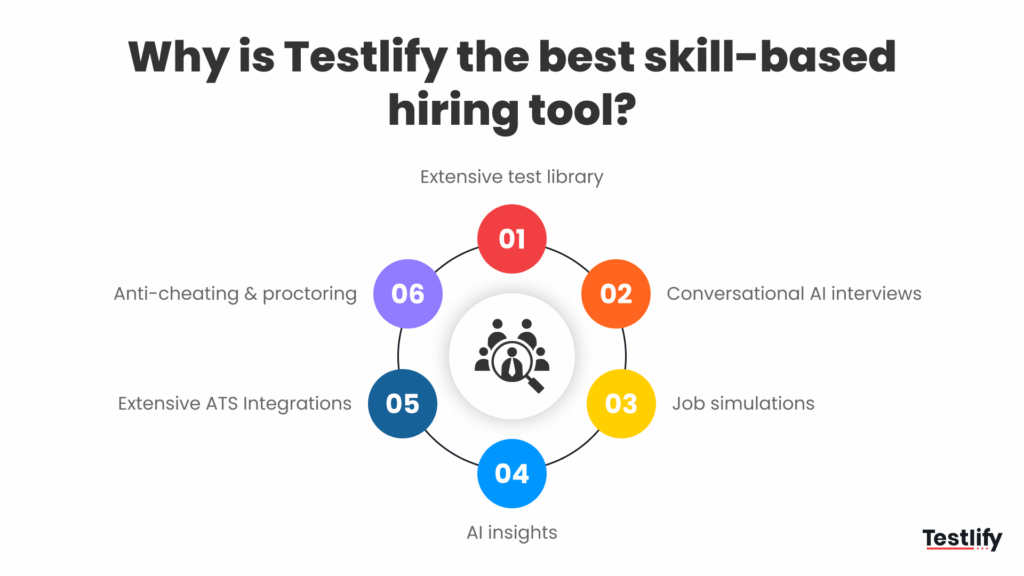
- Extensive test library: Features over 3,000 role-specific tests and also comes with the flexibility to create custom tests tailored to specific roles.
- Conversational AI interviews: Leverage conversational AI interviews across chat, voice, and video formats to accurately evaluate the skills of job seekers.
- Job simulations: Accurately assess how candidates perform in situations that mirror workplace challenges, giving recruiters deeper insight into job-readiness.
- AI insights: Provides concise summaries of each job performance, clearly highlighting strengths, areas for improvement, and fit for the role.
- Extensive ATS Integrations: Seamlessly integrates with 100+ applicant tracking systems, making skills assessments a natural extension of your existing hiring processes.
- Anti-cheating & proctoring: Dual webcam monitoring, randomized questions, AI assistance detection, and browser lockdown features ensure test integrity and reliable results.
Final thoughts
The evidence is overwhelming that leveraging skills-based hiring tools often leads to better hiring outcomes. For HR leaders ready to embrace this paradigm, the advice is clear: make skills the currency of your talent decisions.
Revisit your job criteria, invest in skill assessment tools, train hiring managers on competency-based evaluation, and continuously refine your methods with data. As you modernize your hiring process, consider leveraging platforms built for skills-based hiring.
Testlify offers a comprehensive skills assessment solution to help you identify the best candidates quickly, accurately, and without bias.
Book a demo with Testlify today and experience the future of skills-based hiring.
Frequently asked questions (FAQs)

Related resources
View all
HR & recruitment
Quiet firing: Signs it’s happening and how to prevent it

HR & recruitment
AI upskilling guide for HR teams

HR & recruitment
Compensation Transparency: The hiring trend reshaping trust in Canadian and U.S. markets

HR & recruitment
Skills vs. Titles: Why HR Teams are Switching to Skills-based Hiring Worldwide

HR & recruitment
Blue-collar hiring: What recruiters need to know

HR & recruitment
Best assessments for hiring in media industry
Get started.
Hire on proof, not resumes.
Run your first skills-based assessment free — no credit card required.