
Top 13 types of hiring bias and how to avoid them
Learn about 13 types of hiring bias and how to avoid them to build a more equitable, data-driven hiring process.

Every recruiter aims to evaluate candidates fairly, yet hiring bias often finds subtle ways to influence decisions. In fact, an estimated 48% of hiring professionals admit that bias influences their hiring decisions.
In this guide, we’ll explain what hiring bias is, explore the most common types, and provide actionable tips for HR teams to proactively avoid them.
 ChatGPT
 Gemini
 Claude
 Grok
Grok Perplexity
What is hiring bias?
Hiring bias occurs when personal preferences or prejudices unfairly influence hiring decisions. This often leads to HR teams overlooking highly qualified candidates in favor of those who align with their own subjective preferences.

How hiring bias hurts business performance
Besides the obvious ethical and DEI (Diversity, Equity, Inclusion) concerns, hiring bias hurts business outcomes. It can cause recruiters to overlook high-potential talent, leading to bad hires or homogenous teams.
Such missteps can result in tens of thousands of dollars in lost turnover and cause organizations to miss out on the performance boost that inclusive teams deliver.
In short, hiring bias can be termed as a “leaky bucket” in the hiring process, as it lets great candidates slip away and dilutes the quality of the talent pipeline.
Common types of hiring bias
Unfortunately, bias remains deeply ingrained in both society and hiring practices. Preconceived judgments often creep into interviewers’ minds, subtly influencing how they assess candidates.
For HR leaders aiming to build more equitable hiring systems, awareness starts with identifying the most common types of biases that influence the interview process.
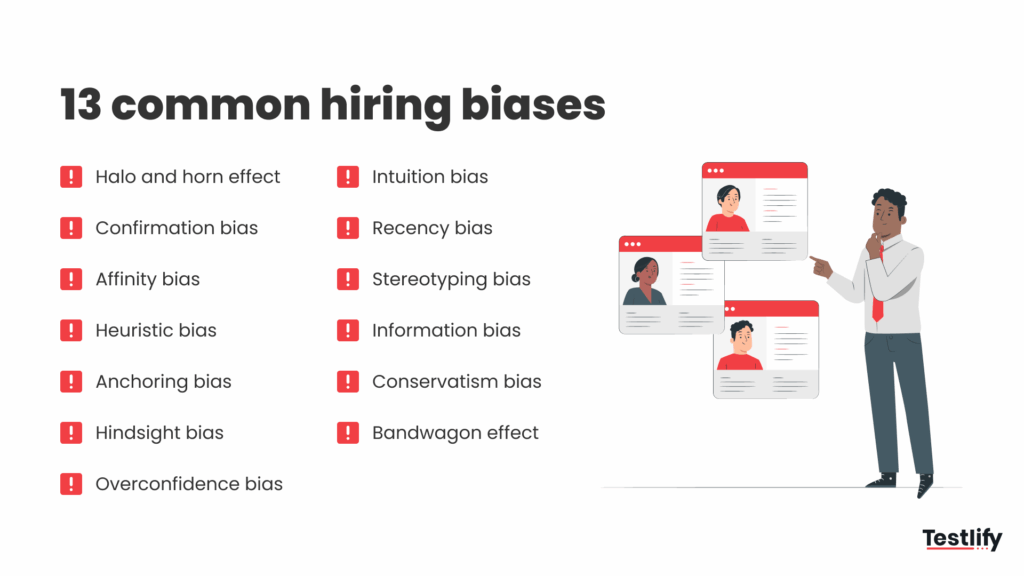
1. Halo and horn effect
A strong first answer can cast a “halo,” making all subsequent answers seem better than they are. Conversely, one awkward or weak response can create a “horn” effect, leading interviewers to undervalue later, stronger responses.
Tips to avoid the halo and horn effect
- Use structured interview formats to evaluate each candidate consistently across multiple dimensions. Take breaks between interviews to reset your perception and avoid carrying impressions from one candidate to the next.
- Encourage multiple interviewers with varied perspectives to mitigate bias.
Also read: What is halo and horn effect? Impact on hiring explained
2. Confirmation bias
Interviewers sometimes may consciously or unconsciously seek information that confirms their initial impression of a candidate.
Tips to avoid confirmation bias
- Establish objective criteria for evaluating all candidates.
- Encourage interviewers to actively seek information that might disprove their initial impressions.
- Use standardized assessments or tests to ensure evaluations are based on consistent data rather than subjective first impressions.
Also read: Addressing unconscious bias in hiring
3. Affinity bias
Humans naturally gravitate toward people who are similar to themselves. In an interview, this can translate into better ratings for candidates who share the interviewer’s background, mannerisms, or interests.
Tips to avoid affinity bias
- Implement blind hiring practices, where demographic information is anonymized during the initial stages.
- Train interviewers to recognize and challenge their own biases.
- Encourage diversity in hiring panels to ensure a wider range of perspectives.
Also read: What is affinity bias and how to avoid it
4. Heuristic bias
This occurs when interviewers rely on immediate examples or recent experiences instead of objective data. For example, after interviewing a particularly impressive candidate, a recruiter might unfairly compare all subsequent applicants against that single individual.
Tips to avoid heuristic bias
- Document candidate evaluations in a structured way to minimize reliance on memory or personal impression.
- Ensure that interviewers review each candidate in isolation before comparing them to others.
- Provide interviewers with training on the impact of heuristics and encourage them to reflect on their decision-making processes.
Also read: What is heuristic bias? An in-depth guide for recruiters in 2025
5. Anchoring bias
Anchoring bias happens when the first piece of information overly influences later judgments. If the candidate stumbles through his introduction, the interviewer might unconsciously carry that impression throughout the evaluation.
Tips to avoid anchoring bias
- Ensure interviewers focus on the entire evaluation criteria, rather than focusing too heavily on the initial impression.
- Use structured interviews where questions and evaluation criteria are standardized to prevent early impressions from dominating.
- Encourage multiple evaluators to provide feedback before making final judgments.
6. Hindsight bias
After a candidate performs poorly, interviewers might say, “I knew they weren’t the right fit.” In reality, this reflects hindsight bias, the belief that an outcome was predictable after it happened. This illusion of foresight reinforces overconfidence and blinds interviewers to the limits of their intuition.
Tips to avoid hindsight bias
- Document interview feedback immediately after each interview to capture genuine impressions, reducing the likelihood of hindsight bias.
- Focus on the decision-making process rather than the outcome.
- Conduct regular post-hire evaluations to review past decisions and identify any biases in hiring practices.
7. Overconfidence bias
This bias stems from overestimating one’s ability to judge people accurately. For example, a hiring manager might believe they can “just get a feel” for candidates in casual conversation, ignoring structured evaluation metrics or skill assessments.
Tips to avoid overconfidence bias
- Combine interviews with objective assessments (e.g., skill tests, job simulations) to validate judgments.
- Ensure interviewers understand the limitations of their intuition and encourage data-driven decision-making.
- Provide training on how to assess candidates against predefined competencies and performance metrics.
8. Intuition bias
Closely linked to overconfidence, this bias involves trusting your gut. Even when a candidate objectively performs well, an interviewer might reject them based on a vague feeling that something “felt off.” In hiring, intuition should supplement data, not replace it.
Tips to avoid intuition bias
- Rely on structured interviews and objective assessments rather than subjective impressions.
- Implement a scoring system for interviews to reduce the influence of unquantifiable feelings.
- Encourage a reflective approach, where interviewers question their instinctive reactions and base decisions on facts rather than feelings.
9. Recency bias
This is the tendency to weigh recent information more heavily than earlier data. In multi-round interviews, a poor final round may overshadow a stellar earlier performance. Likewise, after a full day of interviews, the most recent candidate may be remembered most vividly, whether they were the best fit for the role or not.
Tips to avoid recency bias
- Take notes throughout the interview process to ensure a more balanced recall of all candidates.
- Use a consistent rating system to evaluate each candidate immediately after the interview, reducing the influence of the final interview.
- Ensure interviewers provide feedback on each candidate separately before moving on to the next.
10. Stereotyping bias
Stereotyping bias involves making assumptions based on group identity rather than individual merit. For example, assuming someone from a prestigious company must be intelligent, or making cultural assumptions that influence evaluation. This bias directly undermines diversity and inclusion efforts.
Tips to avoid stereotyping bias
- Promote awareness and training on the dangers of stereotyping and its impact on diversity and inclusion.
- Adopt structured interview frameworks that focus on job-relevant criteria and reduce opportunities for biased judgments.
- Implement blind hiring processes where personal identifiers (e.g., names, photos, or educational institutions) are excluded from resumes.
11. Information bias
Interviewers sometimes seek excessive, irrelevant information in the belief that more data equals better decisions. For instance, placing weight on hobbies or reference checks that have no real bearing on job performance.
Tips to avoid information bias
- Define the information that is relevant to the hiring decision and train interviewers to stick to it.
- Establish clear guidelines for what constitutes valid information for evaluating a candidate’s qualifications.
- Use objective assessments that focus directly on job performance rather than subjective or extraneous details.
12. Conservatism bias
This is the tendency to favor traditional methods or established beliefs over new evidence. Despite decades of research showing structured interviews outperform unstructured ones, many organizations still cling to outdated, bias-prone processes.
Tips to avoid conservatism bias
- Regularly review and update hiring practices to ensure they align with current best practices and research.
- Encourage openness to new tools, technologies, and techniques that can improve the hiring process.
- Provide training on the importance of structured interviews and data-driven decision-making to improve fairness and effectiveness.
13. Bandwagon effect
Also known as groupthink, this bias happens when interviewers conform to the opinions of others, especially during debriefs. If a senior leader expresses enthusiasm (or skepticism), others may unconsciously align their views rather than share independent perspectives.
Tips to avoid the bandwagon effect
- Ensure all interviewers are encouraged to provide independent feedback before a group discussion.
- Separate the evaluation process from the final decision-making process by having a diverse group of decision-makers.
- Regularly rotate interviewers and have them share their perspectives individually to avoid groupthink.
Dangers of hiring bias
Hiring managers and recruiters often rely on intuition for hiring and promotion decisions, which can lead to biased judgments. If left unchecked, these biases can limit diversity, shape a toxic company culture, and ultimately cost your organization both its revenue and reputation.
- Legal risks: Discriminatory hiring practices can result in costly lawsuits and damage your company’s reputation and finances.
- Negative brand image: Biased hiring practices can discourage top talent from considering your organization and lead to higher offer rejection rates.
- Increases turnover: Biased hiring can result in poor-fit employees who negatively affect team morale, contributing to higher turnover rates.
How skills assessment tools can help eliminate hiring bias
When it comes to hiring, even the most experienced recruiters can fall prey to unconscious bias. Personal impressions, educational backgrounds, or cultural similarities can all subtly influence decisions, often at the expense of fairness and objectivity.
Skills assessment tools help fix that by focusing on what really matters: a candidate’s ability to do the job. They bring structure, fairness, and data into the hiring process so every candidate gets a fair shot.
Here’s how skills assessment tools can help recruiters reduce hiring bias:
- Better recruitment equity: Promotesskill-based hiring, which values talent and effort over background, creating fair opportunities for candidates who’ve faced barriers in traditional hiring.
- Objective candidate evaluation: Assessments highlight what candidates can do and not where they’ve worked or studied. This helps uncover talented people who might have been overlooked because of an unimpressive resume.
- Promotes diversity and inclusion: By focusing on skills alone, assessments open doors for candidates from all backgrounds. This leads to stronger, more creative, and inclusive teams.
Best skills assessment tests to reduce hiring bias
Depending on the role, here are the best types of skill assessment tests that can give you a clearer understanding of a candidate’s capabilities:
- Cognitive ability tests (e.g., problem-solving, logical reasoning, attention to detail)
- Role-specific tests (e.g., tailored assessments for various job roles)
- Programming tests (e.g., coding, algorithm design, technical proficiency)
- Software skills tests (e.g., Microsoft Office, CRM systems, other software tools)
- Psychometric tests (e.g., personality traits, emotional intelligence, behavioral tendencies)
- Situational judgment tests (e.g., decision-making, conflict resolution, judgment in real-life situations)
- Live coding tests (e.g., real-time coding challenges and assessments)
- Language tests (e.g., proficiency in speaking & writing a specific language)
While these skill assessment tests are highly effective in minimizing hiring bias, it’s important to remember that candidates are more than just their scores. Take the time to learn about their experiences, values, and aspirations. Combining objective evaluation with genuine human understanding creates a hiring process that’s both fair and empathetic.
Final thoughts
When organizations recognize and address hiring bias, they open the door to a wider pool of talent that can drive innovation and growth.
Are you ready to make bias-free hiring a reality? With Testlify, you can build a more equitable, data-backed hiring process that truly focuses on skills over titles.
Book a demo today and transform the way you hire.
Frequently asked questions (FAQs)

Related resources
View all
HR & recruitment
Cross-cultural recruiting strategies for remote teams
HR & recruitment
How recruiters can find top talent with skills-based hiring tools

HR & recruitment
Quiet firing: Signs it’s happening and how to prevent it
HR & recruitment
AI upskilling guide for HR teams
HR & recruitment
Compensation Transparency: The hiring trend reshaping trust in Canadian and U.S. markets

HR & recruitment
Skills vs. Titles: Why HR Teams are Switching to Skills-based Hiring Worldwide
Get started.
Hire on proof, not resumes.
Run your first skills-based assessment free — no credit card required.