
Quiet firing: Signs it’s happening and how to prevent it
Learn what quiet firing is, how it harms workplace culture, and proven steps HR can take to prevent disengagement and turnover

Quiet firing is when an employer or manager indirectly encourages an employee to leave by withholding feedback, promotions, development opportunities, or meaningful work. Unlike layoffs or formal performance management, quiet firing happens gradually. This guide covers the signs of quiet firing, real workplace examples, its impact on employees and organizations, and best practices for preventing it.
 ChatGPT
 Gemini
 Claude
 Grok
Grok Perplexity
TL;DR
- Quiet firing is deliberate neglect: sidelining an employee until they quit, so the company avoids a direct conversation or a severance cost.
- The signs are a pattern, not a single event: no feedback, fewer responsibilities, exclusion from meetings, stalled growth, and a manager who has gone distant.
- It is the mirror image of quiet quitting. Quiet firing is driven by the manager; quiet quitting is the employee’s response.
- Managers drive 70 percent of the variance in team engagement, so preventing quiet firing is mostly a management problem, not a perks problem.
- The fix is structure: clear role expectations set at hiring, honest feedback, fair use of performance plans, and managers held accountable with data.

What is quiet firing?
Quiet firing is a pattern of management neglect designed to make an employee leave on their own. Instead of addressing a performance concern or a role mismatch openly, the manager withholds the things people need to stay: feedback, recognition, growth, and meaningful work. Over weeks or months, the employee gets the hint and resigns. The meaning is right there in the name. The firing is real, but it is never said out loud.
The core of quiet firing is avoidance. A hard conversation about performance, fit, or a role that has outgrown a person is uncomfortable, so some managers dodge it. That dodge has a price. Gallup’s 2023 State of the Global Workplace report put the cost of low engagement at 8.8 trillion dollars in lost productivity worldwide, about 9 percent of global GDP, with only 23 percent of employees engaged at work. Quiet firing pours fuel on that fire, one sidelined person at a time.
What are the signs of quiet firing?
The signs of quiet firing show up as a steady withdrawal of support, not one dramatic moment. Watch for these, especially when several appear together and get worse over time.
- Feedback and communication dry up. One-on-ones get cancelled or go silent, and honest feedback stops arriving. No news is not good news here.
- Exclusion from meetings and projects. The employee is left out of decisions and work they used to own. The circle quietly gets smaller.
- Shrinking responsibilities. Good work moves to other people, and what is left is busywork well below the person’s skill.
- Stalled growth. Raises, promotions, training, and stretch assignments stop, often with no explanation and no timeline.
- A colder working relationship. A once-supportive manager turns short, vague, or hard to reach, and small slights start to add up.
One sign on its own can be a bad week or a busy quarter. The tell is the pattern: several of these, pointing the same direction, month after month. That is when HR should step in and ask questions.
Silent firing signs: is it the same thing?
Silent firing is another name for quiet firing, so the silent firing signs are the same ones above: withdrawn feedback, lost responsibilities, exclusion, and stalled growth. Some HR teams and articles use “silent firing” or “silent layoff” to describe the same slow push toward the door. The label does not change the behavior or the fix. If a manager is managing someone out through neglect rather than an open process, treat it as quiet firing no matter which word people use for it.
Quiet firing examples in the workplace
Real quiet firing examples tend to look reasonable one at a time, which is what makes them hard to catch. A few common ones:
- A senior analyst is passed over for a promotion two cycles running, with no feedback on what to improve, while a peer is fast-tracked.
- A remote employee is quietly dropped from the recurring planning meeting, then told later that “decisions were already made.”
- A high performer’s projects are reassigned “to balance the load,” leaving them with low-stakes admin work for months.
- A manager sets a target that is not realistic, offers no support, then uses the missed number as a reason to withhold a raise.
What if an employee quits after an HR ultimatum?
Sometimes quiet firing turns loud at the end: a manager or HR issues an ultimatum, such as “accept this role change or move on,” or “be back in the office five days a week by Monday, or resign.” When an employee quits after an HR ultimatum that a court would see as a serious, unilateral downgrade of their job, it can count as constructive dismissal in many jurisdictions, and the resignation may be treated as a firing in disguise. That is a legal and reputational risk, not a clean exit. The safer path is an open, documented performance process, not a cornering tactic dressed up as a choice.
Quiet firing vs quiet quitting
Quiet firing and quiet quitting get mentioned in the same breath, but they run in opposite directions. Quiet firing is something a manager does to an employee. Quiet quitting is how an employee responds to a job that no longer feels worth the extra effort. One is a cause, the other is often the effect, and they can feed each other in a loop.
Aspect | Quiet firing | Quiet quitting |
|---|---|---|
Who drives it | The manager or employer intentionally or unintentionally creates conditions that push an employee toward leaving. | The employee chooses to limit their effort to the responsibilities outlined in their role. |
What it looks like | Withholding feedback, promotions, meaningful work, training, recognition, or career development opportunities. Employees may also be excluded from key meetings or projects. | Completing assigned tasks but avoiding overtime, extra responsibilities, or work beyond agreed expectations. Maintaining healthy work boundaries becomes the priority. |
Primary intent | Encourage the employee to resign voluntarily, avoid difficult performance conversations, or gradually phase them out without a formal termination. | Protect personal time, reduce burnout, and establish work-life boundaries after feeling disengaged, undervalued, or exhausted. |
Common causes | Poor leadership, avoidance of difficult conversations, cost-cutting, organizational restructuring, bias, or ineffective performance management. | Burnout, lack of recognition, stagnant career growth, poor management, unclear expectations, or declining job satisfaction. |
Typical warning signs | Sudden exclusion from important projects, minimal communication, cancelled one-on-ones, no performance feedback, denied learning opportunities, or unrealistic expectations. | Reduced participation in optional meetings, reluctance to volunteer, decreased enthusiasm, avoiding after-hours work, and focusing only on required deliverables. |
Who is affected first | The employee’s morale, confidence, and career progression, eventually damaging team trust and organizational culture. | Team productivity, innovation, and collaboration may decline over time, while the employee’s long-term career growth can also stagnate. |
Business impact | Higher turnover, legal and reputational risks, lower employee engagement, and loss of experienced talent. | Lower discretionary effort, reduced innovation, slower execution, and weaker team collaboration if widespread. |
Best response | Address issues through transparent communication, regular feedback, fair performance management, career development, and respectful offboarding when necessary. | Re-engage employees by improving leadership, recognizing contributions, offering meaningful work, creating growth opportunities, and addressing workload or burnout. |
Long-term outcome if ignored | Increased attrition, declining employer brand, lower trust in leadership, and difficulty attracting talent. | A disengaged workforce, reduced productivity, higher turnover risk, and weaker organizational performance over time. |
Why does quiet firing happen?
Quiet firing usually comes from weak management, not cartoon villainy. A few root causes show up again and again:
- Conflict avoidance. Direct performance conversations are hard, so the manager avoids them and lets neglect do the talking.
- Untrained managers. People promoted for output, not people skills, often have no playbook for a struggling or misaligned report.
- Cost dodging. A quiet resignation avoids severance, paperwork, and the optics of a layoff, so some employers let it happen.
- A bad role fit that was never fixed. When someone was hired into the wrong role, the mismatch curdles into disengagement instead of a reset.
That last cause is worth sitting with. A lot of quiet firing starts as a hiring problem: unclear expectations and a fuzzy sense of what the role actually needs. Fix that at the source and you remove much of the fuel.
How can HR leaders prevent quiet firing?
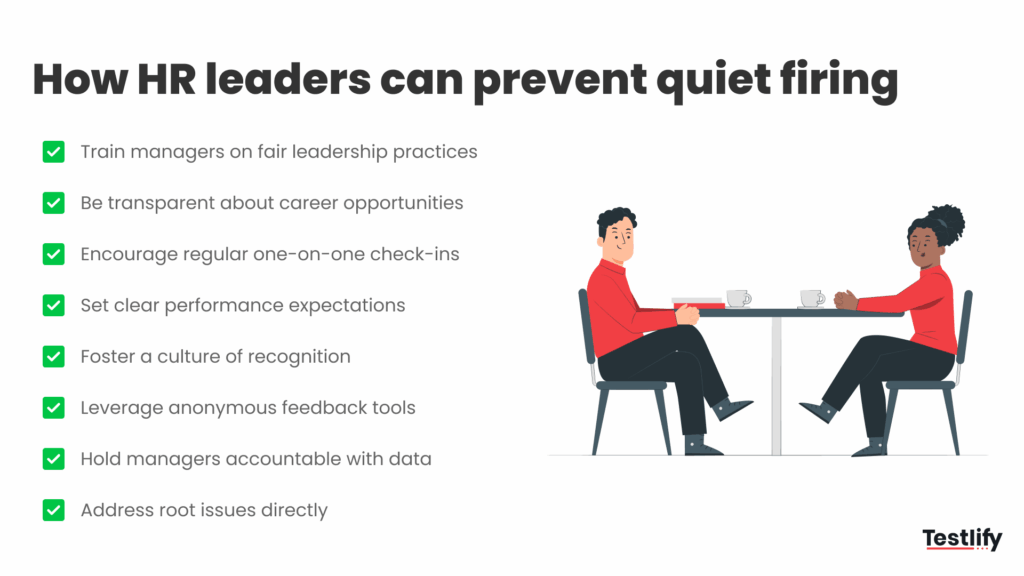
HR leaders prevent quiet firing by replacing vague, gut-feel management with structure: clear expectations, honest feedback, fair process, and manager accountability. Because managers drive 70 percent of the variance in team engagement, per Gallup’s analysis of 2.7 million employees across roughly 100,000 teams, the manager layer is where the biggest gains sit. The other 30 percent is pay, policy, and everything else combined. Here is what works.
Set clear performance expectations early
Ambiguity is where quiet firing hides. When “good” is undefined, a manager can move the goalposts and call a strong performer a weak one. Give every role written expectations tied to the skills and outcomes that matter, share them openly, and revisit them in each review. Clear performance metrics make it much harder to sideline someone quietly, because the record speaks for itself.
Use performance improvement plans the right way
A performance improvement plan should be a genuine path back, not a paper trail for a decision already made. Used honestly, a performance improvement plan names the specific gaps, sets realistic milestones, and gives the support and time to close them. Used as quiet firing, it sets someone up to fail so the exit looks earned. The difference is intent and support. If your managers cannot point to the help they offered during a plan, it was not a real plan.
Pro tip: Before any performance improvement plan starts, have the manager write one sentence answering “what does success look like in 90 days, and how will we help this person get there?” If they cannot answer the help half, the plan is not ready, and HR should push back.
Handle flexible working requests fairly
A flexible working request is a common flashpoint for quiet firing. Denying every flexible working request without a real business reason, or piling on rigid rules to make someone’s life harder, is a classic way to push a person out without a word. Set a consistent, written policy for how requests are judged, apply it evenly, and record the reason for each decision. Fair and predictable beats arbitrary every time, and it keeps you out of legal trouble.
Run honest one-on-one check-ins
Regular one-on-ones are the earliest warning system you have. A short weekly or biweekly check-in, where the manager actually listens, surfaces disengagement long before someone starts job hunting. Train managers to ask real questions (“what is getting in your way?”) and to give the direct feedback quiet firing withholds. A person who hears the truth can act on it. A person met with silence just leaves.
Hold managers accountable with data
Recognition and one-on-ones matter, but accountability makes them stick. Track engagement, promotion rates, and voluntary exits by team, and treat a single manager’s cluster of quiet resignations as a signal worth investigating. Voluntary quits are a normal part of the market (3.3 million US workers quit in a single month, October 2024, a rate of 2.1 percent, per BLS JOLTS data), so what you are hunting for is a cluster on one team, not the odd departure. When a team keeps losing good people who leave without complaint, that is often quiet firing showing up in the numbers. Managers who know the pattern is visible are far less likely to fall into it.
How can skills assessments reduce quiet firing?
Skills assessments cannot manage a person for you, but they attack quiet firing at its most common root: the wrong person in the wrong role, with no shared definition of what the job needs. Get the match and the expectations right at hiring, and far fewer relationships drift into the neglect that quiet firing runs on.
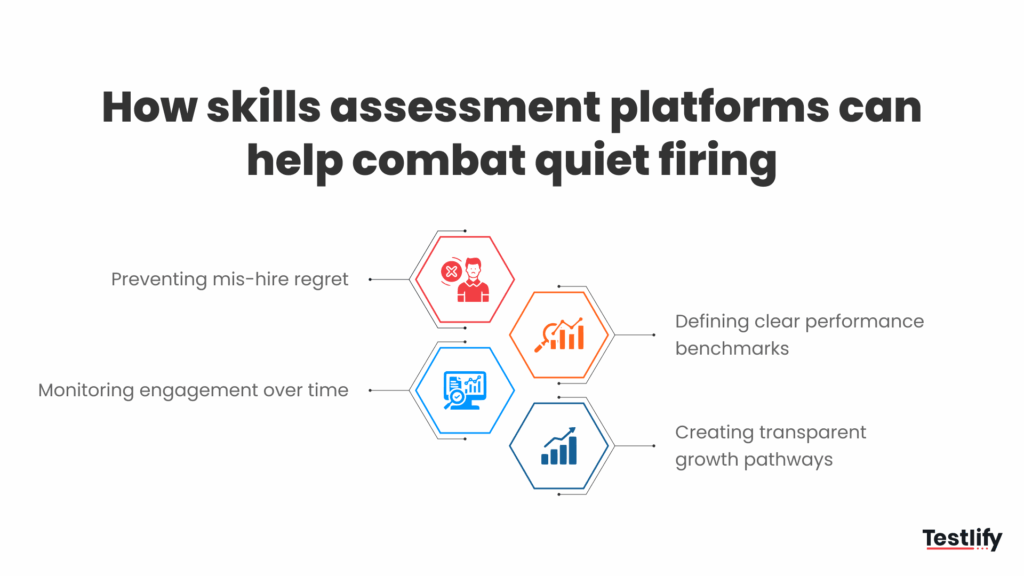
This is where Testlify fits. The idea is simple: start with the role, map each competency that matters to measurable evidence, and evaluate people against that evidence instead of gut feel. When both the manager and the employee agree up front on what the role needs and how it will be measured, there is no fog for quiet firing to grow in. Objective evidence, gathered with tools like a situational judgment test or a role-specific coding assessment, gives a fair baseline that a manager cannot quietly move.
Picture a 500-person company hiring 20 support reps a quarter. If each hire is scored on the same role-relevant skills before the first interview, expectations are clear on day one, and a struggling rep gets a real, evidence-based development conversation instead of a slow freeze-out. Testlify is a pre-hire assessment platform, so it owns the front of that story, getting the right person in with the right expectations, while fair management owns the rest.
Key takeaways
- Quiet firing is deliberate neglect. It pushes people out through withdrawal instead of an honest exit, which means it is preventable by management, not fate. Name it early and you can stop it.
- Read the pattern, not the incident. One cancelled meeting is nothing, but feedback, growth, and inclusion all fading together is the signal. Train HR and managers to spot the trend so they intervene before a resignation letter, not after.
- The manager is the lever. With 70 percent of engagement variance sitting with managers, fixing quiet firing means training and measuring managers, not adding another perk. Invest there and the rest follows.
- Structure beats good intentions. Clear expectations, honest performance plans, fair rules for flexible working, and real one-on-ones remove the ambiguity quiet firing needs. Write the process down so it cannot bend to one manager’s mood.
- Fix the hiring root. A lot of quiet firing starts as a role mismatch, so getting the right person into the right role on clear, measured expectations prevents the drift before it begins. That is where assessment pays off.
- Watch the legal edge. An ultimatum that corners someone into quitting can read as constructive dismissal, so an open, documented process protects both the person and the company. When in doubt, put it in writing and offer real support.
Frequently asked questions (FAQs)

Related resources
View all
HR & recruitment
AI upskilling guide for HR teams

HR & recruitment
Compensation Transparency: The hiring trend reshaping trust in Canadian and U.S. markets

HR & recruitment
Skills vs. Titles: Why HR Teams are Switching to Skills-based Hiring Worldwide

HR & recruitment
Blue-collar hiring: What recruiters need to know

HR & recruitment
Best assessments for hiring in media industry

HR & recruitment
Ways HR teams can simplify their work
Get started.
Hire on proof, not resumes.
Run your first skills-based assessment free — no credit card required.