
5 Essential HR goals and objectives for a thriving 2026
Discover 5 essential HR goals and strategies for 2025 to boost employee engagement, address skills gaps, and align with organizational success.
HR teams stand at the center of transformation as workplaces undergo profound changes. In the years ahead, this evolution will only accelerate. From adopting flexible work models to addressing skills gaps and promoting diversity and inclusion, HR plays a critical role in shaping the future of work.
The modern workforce also demands mental health support, engaging training programs, and innovative strategies to attract and retain top talent.
As we look toward 2025, setting clear and impactful HR goals and objectives is no longer optional—it’s essential. Notably, 92% of executives prioritize HR transformation. This highlights the importance of aligning HR with business objectives to drive long-term success.
This guide aims to help you meet the evolving demands of today’s workforce. Let’s explore the five essential HR goals and objectives every organization must prioritize to build a thriving workplace.
 ChatGPT
 Gemini
 Claude
 Grok
Grok Perplexity
Why HR goals and objectives matter for a thriving 2026?
The success of any organization depends on its ability to adapt. This adaptability is driven by an HR team with a clear vision and the foresight to make critical decisions at the right time. To remain agile, competitive, and future-ready, setting well-defined HR goals and objectives is crucial.
Aligning HR goals and objectives with business objectives serves as a roadmap for long-term success. Key challenges such as bridging the skills gap, improving the employee experience, and promoting diversity and inclusion are addressed through these strategic goals.
Research shows that organizations with clear HR objectives see a 20% rise in employee engagement. As 2025 approaches, the growing emphasis on flexible work models and mental health requires HR teams to proactively meet workforce needs.
This not only ensures operational efficiency but also drives your graph of employer branding towards greater heights. So, why do HR goals and objectives matter? Because they lay the foundation for a thriving workplace where employees excel, business objectives are achieved, and the organization remains ahead of the curve.

5 Essential HR goals and objectives for 2025
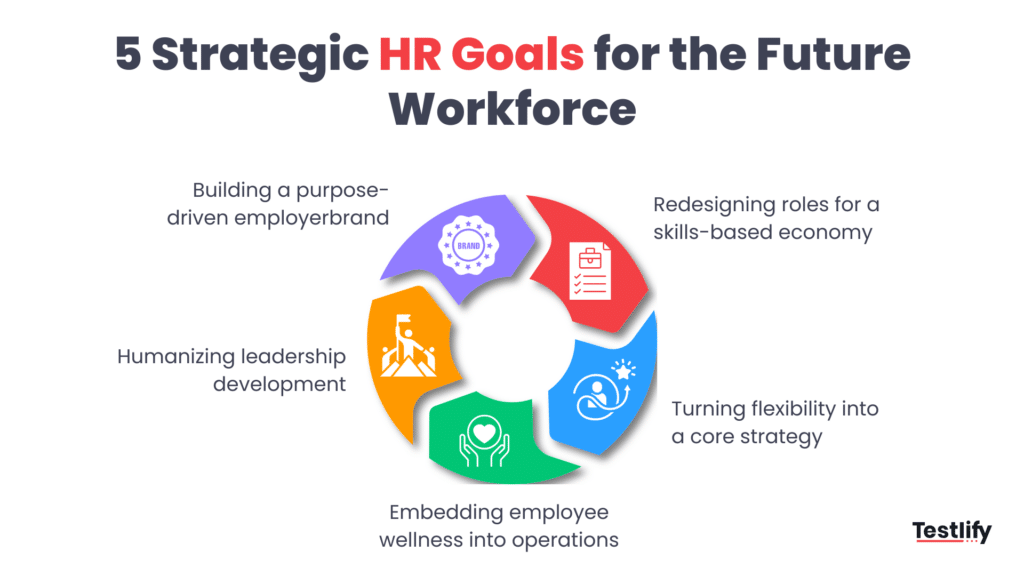
1. Redesigning roles for a skills-based economy
The traditional approach of hiring based on degrees and titles no longer guarantees success. In 2025, the focus will shift to skills-first hiring and dynamic role design. HR teams must identify critical gaps in skills and restructure roles to reflect the demands of a rapidly evolving economy.
This includes developing action plans to enhance the skills of current employees, utilizing AI tools to assess skill sets, and crafting engaging job postings that draw in candidates with flexible abilities.
2. Turning flexibility into a core strategy
Flexible work isn’t a benefit but a way of survival. It includes more than work from home or a hybrid work model. Flexibility for 2025 encompasses customized schedules, project-based assignments, and fluid career paths.
Invest in tools for asynchronous work. Define new metrics for productivity as well. Such a workforce ensures employees deliver their results without compromising personal goals.
3. Embedding employee wellness into business operations
Mental health and wellness are no longer add-ons. It’s now the very fabric of business success. In 2025, it’s time for HR teams to move beyond those generic wellness programs and integrate well-being into every aspect of the employee lifecycle.
Some ideas include providing mental health days, predictive burnout analytics, and team-wide resilience training. This approach must be able to equip teams to handle challenges proactively.
4. Humanizing leadership development
In 2025, HR has the opportunity to engender empathetic leadership that supports the employee experience. This can be done through programs that train active listening in managers and conflict resolution, as well as programs that promote diversity and inclusion at all levels.
Additionally, mentorship ecosystems should connect seasoned leaders with emerging talent, ensuring a steady pipeline of high-potential leaders who can navigate the complexities of modern workplaces.
5. Building a purpose-driven employer brand
Employer branding in 2025 is no longer just about reputation but about purpose. Employees today seek workplaces that are in line with their values. HR must collaborate with marketing and leadership to define and promote a purpose-driven company culture that resonates with both current and future employees.
This can be done by amplifying employee stories, showcasing sustainability initiatives, and ensuring that the organization’s actions reflect its stated values.
How to align HR goals and objectives with organizational objectives?
Aligning HR goals and objectives with organizational objectives is essential for driving business success. To achieve this, HR leaders must first understand the company’s mission and strategic priorities. Setting SMART objectives—specific, measurable, achievable, relevant, and time-bound—ensures clarity and focus.
For example, rather than vaguely aiming to improve employee engagement, HR can set a clear goal to achieve a 15% increase through structured development programs.
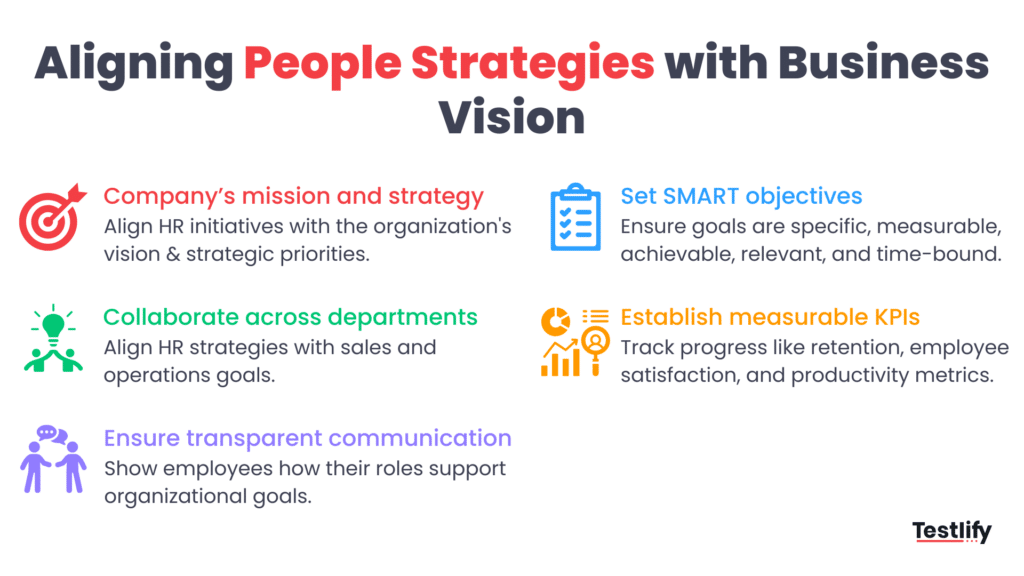
Collaboration with other departments is equally important. For instance, HR can align efforts by supporting the sales team’s expansion goals with relevant talent strategies. Additionally, establishing measurable KPIs like retention rates or employee satisfaction scores helps track progress and refine strategies over time.
Finally, communication is effective. When employees know how their role contributes to a larger organizational goal, it keeps them engaged, motivated and connected to the organization’s vision.
Challenges in achieving HR goals and objectives and how to overcome them
Achieving HR goals and objectives is no easy task, with challenges such as the skills gap, employee disengagement, and budget constraints often hindering progress. As industries evolve, existing skill sets can become outdated, but HR can address this through upskilling and AI-driven tools for skills mapping.
Disengaged employees resist change, slowing initiatives. Integrating inclusivity, transparent communication, and involving employees in decision-making can mitigate this. Budget constraints can be tackled by demonstrating ROI and aligning programs with business objectives to gain stakeholder support.
Finally, resistance to change can be overcome through empathy, open communication, and change management training.
Key takeaways:
- Upskill employees to bridge the skills gap.
- Promote inclusivity and involve employees to boost engagement.
- Demonstrate ROI to secure funding for HR initiatives.
- Use empathy and open communication to manage resistance to change.
Final thoughts
As we look toward 2025, the role of HR is evolving rapidly. It’s essential to set clear HR goals and objectives to build a workplace that balances business success with employee satisfaction.
The future of work requires innovation, agility, and a purpose-driven approach. When HR leads with vision and strategy, organizations are not only prepared for change but thrive in it.
Now is the time to take action. How will your HR team shape the future of your organization?
Frequently asked questions (FAQs)

B2B SaaS Content Writer
Rishav Kumar is a B2B SaaS content writer with 4 years of experience. He loves crafting engaging content. Always exploring fresh ideas, he's passionate about helping businesses grow through impactful writing.
LinkedInRelated resources
View all
HR & recruitment
101 guide to using the 9-box matrix

HR & recruitment
Modern recruitment hacks and pitfalls to avoid in 2026

HR & recruitment
7 innovative HR initiatives you must know in 2026

HR & recruitment
Quiet hiring: A bold solution or a hidden workplace problem?

HR & recruitment
Different recruitment types: Pros, cons, & what works best

HR & recruitment
HR workplace failures: What’s breaking your culture?
Get started.
Hire on proof, not resumes.
Run your first skills-based assessment free — no credit card required.