
Skills vs. Titles: Why HR Teams are Switching to Skills-based Hiring Worldwide
Skills vs. Titles: Discover which of the two is truly driving the future of hiring and shaping the workforce worldwide

Hiring is undergoing a fundamental shift. Traditionally, employers relied on formal credentials and job titles like college degrees or past job positions as proxies for a candidate’s ability.
Today, however, a growing number of organizations are recognizing that skills and engagement are far more indicative of the future success of candidates. In fact, skills-based hiring is rapidly becoming mainstream: 81% of employers practiced skills-based hiring in 2024, up from just 56% in 2022.
This trend is not limited to the United States; across Europe (EU), as well, businesses facing talent shortages are rethinking old hiring habits.
Surveys show that 80% of EU employers report difficulty finding workers with the right skills, underscoring a continent-wide push toward skills-first recruitment.
In this article, we explore why leading companies are moving beyond credentials and embracing a skills-first hiring approach. We will also discuss what HR leaders can do to implement skills-based hiring in their organizations.
 ChatGPT
 Gemini
 Claude
 Grok
Grok Perplexity
The rise of skills-based hiring
Skills-based hiring prioritizes candidates’ abilities over their educational pedigree or previous job titles. A few years ago, it was considered an emerging idea; now it’s becoming a standard best practice. Recent surveys confirm this dramatic shift.
A 2025 HR Dive report that surveyed over 1,000 hiring decision-makers in the U.S. and UK revealed 85% now use skills-based hiring methods, and more than half of U.S. employers have removed college degree requirements from some roles.
These numbers illustrate a fast-growing consensus: focusing on skills opens up new talent pools and leads to better hires.
Why the sudden shift?
A major driver is the tight labor market and widening skills gap. Employers can no longer afford to insist on narrow credentials when critical skills are in short supply.
“The ongoing labor shortage provides a strong incentive for firms to expand their ability to recruit and retain workers,” explains Justin Ladner, Senior Labor Economist at SHRM.
By emphasizing what candidates can do rather than where they learned to do it, companies can cast a much wider net. Indeed’s hiring lab found concrete evidence of this change: the share of U.S. job postings requiring at least a 4-year degree fell to 17.8% in early 2024, down from 20.4% in 2019.
Many high-profile employers, from tech giants like IBM, Apple, and Google to major banks, have publicly eliminated degree requirements for numerous positions, focusing instead on certifications, portfolios, and real-world skills. The result is a broader talent pipeline that includes capable candidates who might have been overlooked in a credentials-first model.
Europe is experiencing a similar evolution. Faced with acute skill shortages in fields like technology and green energy, European businesses and even government agencies are embracing skills-first strategies. Eurostat reports that 72% of EU businesses struggled to find workers with the right digital skills in 2022.
In response, organizations across Europe are shifting hiring criteria to focus on transferable skills and potential, rather than insisting on specific degrees or title experience for every role.
This approach is seen as crucial to remain competitive: according to Deloitte, 90% of CEOs believe their companies need to prioritize employee skills over roles and titles to stay competitive. In other words, even top leadership recognizes that having the right skills in-house is more important than traditional job descriptors.

Why traditional credentials are losing the skills vs. titles debate
Credential-based hiring, where a candidate’s degree, certifications, or previous job titles serve as a primary filter, is increasingly viewed as an outdated proxy for actual ability. There are a few key reasons for this re-evaluation:
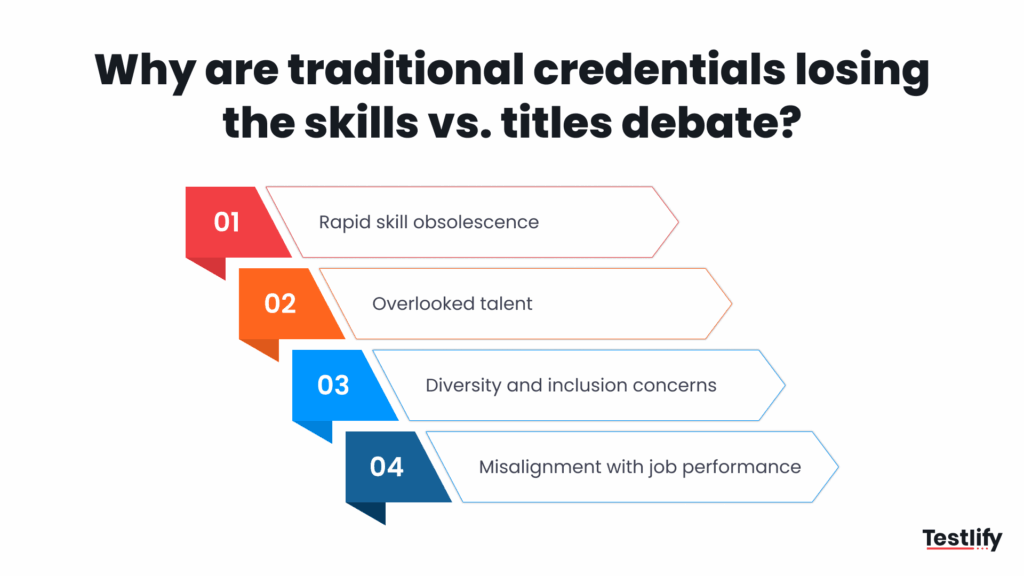
Rapid skill obsolescence
In the modern economy, skills evolve quickly with technology and market changes. A college degree earned 10 or even 5 years ago may not reflect the cutting-edge skills needed today.
A Harvard Business Review study found that adopting skills-based hiring practices significantly reduced reliance on traditional qualifications (like university degrees) by 31% in certain fast-changing industries.
Employers have learned that a prestigious title on a resume doesn’t guarantee a candidate can thrive in a role if the required skills have since advanced.
Overlooked talent
A heavy emphasis on credentials can cause employers to overlook high-potential candidates from non-traditional backgrounds. Many capable individuals have developed their skills through boot camps, online courses, or on-the-job experience rather than formal degrees.
These self-taught or cross-functional candidates might be screened out by an old-school hiring approach. In a recent survey, 3 in 4 job seekers believe employers should be willing to forgo some job requirements, like specific years of experience or credentials, to find the right person.
The message is clear: capable talent exists, and they are seeking employers with the foresight to value potential over pedigree.
Diversity and inclusion concerns
Traditional credential requirements can unintentionally reinforce biases. Requiring a degree from a certain school or a long tenure at brand-name companies often favors candidates from privileged backgrounds.
By contrast, skills-based criteria level the playing field and encourage diversity. LinkedIn’s Global Talent Trends report highlighted that companies using skills assessments in hiring were 50% more likely to achieve their diversity goals.
By dropping rigid credential filters, organizations can consider a wider range of candidates, including those who may have the right skills but a less typical résumé, fostering a more inclusive workforce.
Misalignment with job performance
Perhaps most importantly, there is mounting evidence that credentials simply aren’t the best predictors of success on the job. Employers have long observed that some hires who “looked good on paper” underperform, while others who were given a chance excel beyond expectations.
One reason is the “title bias,” assuming someone is qualified because of a fancy title or degree, rather than verifying their actual competencies. Research now backs up the intuition that focusing on skills leads to better outcomes. In fact, one study found that a skills-based approach was 5× more predictive of job performance than education or experience criteria.
Forward-thinking organizations are now actively closing this gap by redesigning job descriptions, training hiring managers to spot skills, and investing in tools to assess candidates’ abilities directly.
The benefits of a skills-first hiring approach
Shifting the hiring mindset from “credentials and titles” to “skills and engagement” isn’t just a feel-good, progressive idea. It delivers tangible improvements across key hiring and talent metrics. Below, we outline some of the major benefits that an engagement-driven, skills-focused hiring strategy can bring, backed by recent statistics:
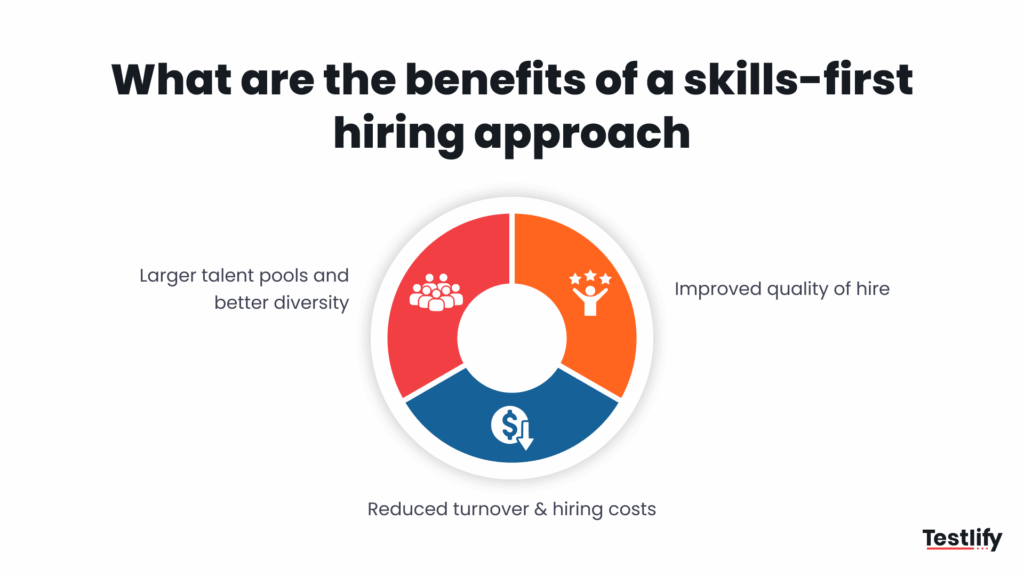
1. Larger talent pools and better diversity
When you remove unnecessary degree requirements or strict experience thresholds, the pool of qualified candidates grows dramatically. LinkedIn’s analysis found that by focusing on skills over rigid criteria, companies can increase their talent pool by up to 19X for certain roles.
This is a staggering figure as it means positions that once had a very limited candidate supply (due to overly restrictive job specs) can suddenly be filled much faster because more people are deemed eligible to apply.
Not only is the talent pool larger, but it’s also more diverse in background. As noted, skills-based hiring opens the door to non-traditional candidates who may bring unique perspectives. Companies report direct improvements in diversity outcomes after adopting this approach. For example, LinkedIn data shows 25% increases in gender diversity at companies that embraced skills-first hiring practices.
There’s also a bias reduction component that drives these results. Removing elitist filters (like “must have Ivy League education” or “must have Big-5 experience”) helps level the playing field.
Over time, this creates a richer, more inclusive team. McKinsey famously found that companies in the top quartile for diversity are 27% more likely to financially outperform their peers.
2. Improved quality of hire
When you hire for proven skills (and potential to learn), you’re matching people to roles more accurately than when hiring based on vague prestige factors. The data support this unequivocally.
According to an ADP research report, 90% of companies that prioritize skills over degrees report fewer hiring mistakes, and 94% say that skills-based hires outperform hires made based on credentials like degrees or tenure.
Skills-based hiring also tends to surface candidates who excel in the role, even if their background is unconventional. Fewer mis-hires mean less disruption and cost, and improved retention suggests those employees are thriving in their roles.
Crucially, a skills-first approach helps avoid the classic pitfall of hiring someone who looks ideal on paper but underperforms. Many HR leaders have experienced hiring a candidate with stellar credentials only to discover they lack practical skills or fail to adapt.
In fact, 78% of employers admit they have hired a candidate with strong technical skills who ultimately did not perform well due to poor soft skills or cultural fit.
This highlights a major blind spot of credentials-focused hiring: it often overlooks “soft” skills like communication, problem-solving, adaptability, and teamwork, which are critical for job success.
By contrast, a skills-based, engagement-driven process evaluates the whole candidate, including these soft skills and their alignment with company values. Over 70% of employers say that evaluating candidates’ complete skill set, personality, and culture fit leads to better hiring outcomes.
3. Reduced turnover and hiring costs
Mis-hires and quick quits are expensive, as the cost of a bad hire can be several times the person’s salary when you factor in recruitment, training, lost productivity, and the cost to replace them.
By one estimate, 75% of employers have made a bad hire that costs their company an average of $17,000.Skills-based hiring helps avoid these costly mistakes. We already cited data that companies report fewer hiring mistakes and higher retention with this approach.
Higher retention means lower recruiting costs over time and a more stable, experienced workforce. Deloitte found that organizations practicing skills-first hiring are 98% more likely to retain their high performers, essentially doubling their odds of keeping their best people.
This translates into a tremendous competitive advantage, as those high performers continue to grow within the company instead of taking their talents elsewhere.
How to implement skills-first hiring
Transitioning to a skills-over-titles hiring model requires rethinking your recruitment processes and leveraging the right tools. Here are the best practices for HR leaders to implement skills-based hiring in a practical, scalable way:
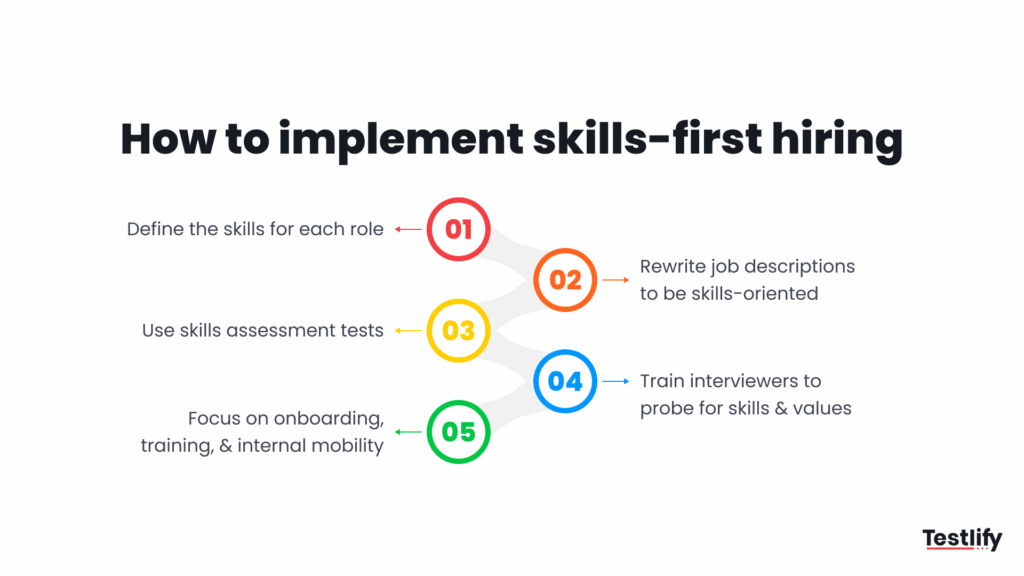
Define the skills for each role
Start by breaking down jobs into the specific skills and outcomes required, rather than relying on proxies like “5+ years experience” or a generic degree. Identify both the hard skills (technical abilities, software proficiency, language skills, etc.) and soft skills (communication, teamwork, problem-solving, adaptability) that predict success in the role.
This might involve a skills-mapping exercise or consulting with team leaders about what capabilities the best performers in that role possess.
By clearly defining the target skill set, you create a roadmap for what to assess in candidates. (Also read: Hard skills vs Soft skills: Which one should you prioritize?)
Rewrite job descriptions to be skills-oriented
Remove unnecessary credential requirements unless they are truly essential. Instead, focus the description on what the candidate will actually do, emphasizing the skills, achievements, and impact they’re expected to deliver rather than simply the time they’ve spent in previous roles.
Tools like Testlify’s Free Job Description Generator make this process easier by helping HR leaders craft skills-focused, engaging, and inclusive job postings that align with a skills vs. titles approach.
Use skills assessment tests
These can take many forms, such as coding tests, language proficiency tests, role-specific tests, cognitive ability tests, situational judgment tests, and many more. The goal is to see candidates in action and ensure that they are the right fit for the role.
Modern skills assessment platforms like Testlify make it easy to implement this at scale.
Testlify offers3,500+ ready-to-use tests across various skills and industries, from coding challenges to conversational AI interviews to language tests.
You can customize assessments by combining multiple tests (including your own questions) to target the exact skill profile you need.
The platform’s coding and programming testsallow evaluation of real-world programming skills for technical roles, and its conversational AI-powered interview feature gives great insight into the communication and presentation skills of candidates.
How Residential Proxies Support the Shift Toward Skills-Based Hiring
As HR teams across the globe transition from traditional title-based recruitment to a skills-first approach, the need for reliable data gathering and competitive intelligence has become more critical than ever. Tools like residential proxies are playing a surprising but important role in this shift. By allowing recruiters and HR platforms to collect real-time data from job boards, freelance marketplaces, and competitor listings without being blocked or flagged, residential proxies help identify trending skill sets and market demands. This information enables organizations to better align job descriptions, training programs, and hiring strategies with actual skills rather than outdated job titles. As companies continue to prioritize capability over credentials, having access to accurate, location-specific hiring data through residential proxies offers a valuable edge in the global talent race.
Train interviewers to probe for skills and values
Engagement-driven hiring doesn’t end with automated tests. The interview stage should also be aligned with skills and cultural add. Train your hiring managers and interview panels to conduct structured job interviews that focus on relevant competencies.
For example, incorporate behavioral questions that elicit how candidates have applied their skills in real situations.
This can be complemented with values-based questions to assess cultural alignment and intrinsic motivation. By standardizing these questions and scoring rubrics, you further reduce bias as everyone is measured against the same criteria.
Hiring teams should also be educated on the pitfalls of halo effects tied to credentials so they remain focused on evidence of skill and engagement.
Focus on onboarding, training, and internal mobility
Ensure new hires have personalized onboarding that addresses any skill gaps and integrates them into the team culture. Provide mentorship or buddy programs to boost engagement from day one.
Additionally, adopt a skills-based mindset internally: identify your employees’ skills and interests, and create pathways for internal mobility and upskilling.
Many organizations are now mapping skill inventories of their workforce and using internal “gigs” or stretch assignments to keep employees growing. This not only increases retention (employees see a future with you) but also maximizes the return on your skills-based hiring by continually aligning people’s capabilities with company needs.
As a bonus, when promotion and project opportunities are advertised in terms of skills needed rather than tenure or department, it further reinforces an inclusive, engagement-focused culture.
Throughout these steps, technology is your ally. Tools like Testlify are purpose-built to enable skills-based hiring in a seamless, scalable way. Testlify’s platform integrates with popular Applicant Tracking Systems (SAP SuccessFactors, Greenhouse, Workday, and more).
It also automates candidate screening using assessment results to instantly shortlist top talent, which can improve recruiter productivity by 6× and cut down time-to-hire by 55%, as reported by companies using Testlify.
By deploying such tools, even large organizations in Europe with high-volume hiring can reliably move to a skills-first model without overburdening their HR team.
Final thoughts
The past methods of hiring, rooted in degree requirements and familiar pedigrees, are ill-suited for today’s needs. A skills-based, engagement-driven approach widens the talent funnel, surfaces hidden gems of candidates, and results in employees who perform better and stay longer.
For HR leaders, the task now is to operationalize this approach. That means updating policies, retraining hiring teams, and equipping your organization with the right tools to assess skills objectively.
The good news is that the payoff in diversity, performance, and retention is proven and substantial. Organizations that have embraced this shift are already realizing measurable rewards.
Ready to transform your hiring process and see promising results firsthand?
Book a demo with Testlify and take the first step toward building a future-ready, skill-driven workforce!
Frequently asked questions (FAQs)

Related resources
View all
HR & recruitment
Blue-collar hiring: What recruiters need to know

HR & recruitment
Best assessments for hiring in media industry

HR & recruitment
Ways HR teams can simplify their work
HR & recruitment
How white label interview tools streamline enterprise talent pipelines

HR & recruitment
How AI interviewers are reducing time-to-hire across industries

HR & recruitment
Best Alternatives to Traditional Interviews for Modern Hiring
Get started.
Hire on proof, not resumes.
Run your first skills-based assessment free — no credit card required.