
How to simplify candidate screening with sales test in 2027
Use a short, role-based sales test right after applying to rank sales candidates on real skill, then interview only the strongest people.

Candidate screening with a sales test means every applicant for a sales role takes the same short, role-based assessment before anyone reads a resume in depth or books a call. This is how to simplify candidate screening with sales test results: the test ranks people on selling skill, communication and judgment, so recruiters spend their time on a short list of proven candidates instead of a long pile of resumes.
TL;DR:
- Put one role-based sales test right after the application, before phone screens, and interview only the candidates who clear your cut-off.
- Combine three or four short parts: a sales skills test, situational judgment, a personality profile and, for senior roles, cognitive ability. Keep the total under about 45 minutes.
- Match the mix to the role. SDRs need prospecting and resilience, account executives need discovery and negotiation, account managers need relationship skills.
- Set score weights and the cut-off before results come in, and check them against your current top reps.
- LinkedIn's 2025 research found 93% of TA pros say accurate skills assessment is crucial to quality of hire.
- Keep it fair: same test and scoring for everyone, job-related questions, and accommodations on request, as the EEOC expects.
- Use the test as evidence, not the decision. A structured interview and a role-play still decide the final shortlist.
 ChatGPT
 Gemini
 Claude
 Grok
 Perplexity
What is candidate screening with a sales test?
Candidate screening with a sales test is the step where sales applicants complete a standard assessment of selling skills, behavior and judgment before interviews. Everyone answers the same questions and tasks, the results are scored the same way, and the hiring team moves forward only the candidates whose scores match what the role needs.
A sales test can include multiple-choice questions on sales process knowledge, realistic customer scenarios, a personality profile, a short written email task or a recorded pitch. The point is to see how a candidate sells, talks to people and solves problems, which a resume and a 20-minute phone call rarely show.
Sales hiring is constant work. The US Bureau of Labor Statistics projects about 1.7 million openings each year in sales occupations, and the median annual wage for the group was $38,530 in May 2025. High volume and frequent turnover mean recruiters screen the same roles again and again, so a faster first filter pays off quickly.

Why use a sales test to screen candidates?
A sales test screens candidates faster and more fairly than resumes alone because it measures the skills a seller uses every day instead of the claims on a resume. It gives recruiters a ranked list on day one, judges every candidate on the same criteria and gives hiring managers evidence for the interview.
- Finds top talent early: The test shows who can communicate, persuade and solve customer problems before anyone spends time on a call.
- Saves recruiter time: Candidates take the test online, scoring is automatic and the team reviews a ranked list instead of every resume.
- Fairer comparisons: Every candidate gets the same questions and the same scoring, so a polished resume or a confident manner counts less than skill.
- Objective evidence: Scores replace gut feel and first impressions with a clear measure of how suited a candidate is to the role.
- Lower turnover: Hiring people who already show the skills and traits the role needs makes a poor fit less likely, and psychometric tests can help reduce turnover when they measure the right traits.
- Better hiring decisions: Interviewers walk in knowing each candidate's strengths and gaps, so they can probe the right areas.
Hiring teams already see skills as the core of quality of hire. LinkedIn's Future of Recruiting 2025 found that 93% of talent acquisition pros say accurately assessing a candidate's skills is crucial for improving quality of hire, and companies with the most skills-based searches are 12% more likely to make a quality hire.
Which types of sales tests should you use?
Sales tests come in five main types: sales skills tests, situational judgment tests, personality assessments, cognitive ability tests and work samples such as a role-play or mock pitch. Most teams combine two to four of them, because each type shows a different part of what makes a seller succeed.
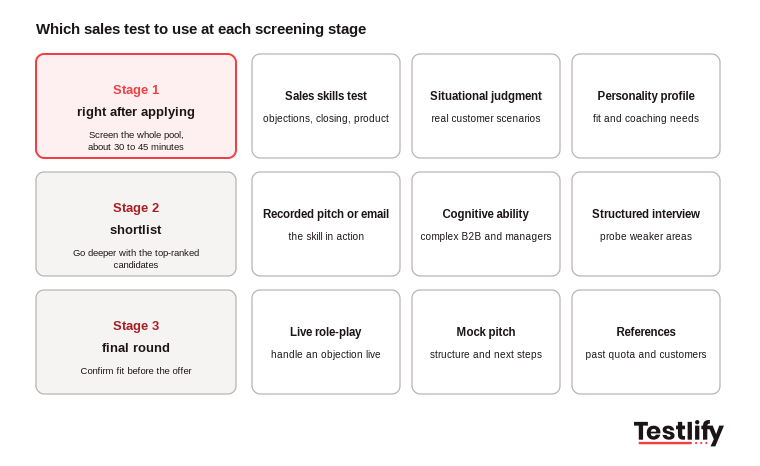
- Sales skills tests: These check product knowledge, prospecting, objection handling, negotiation and closing. Testlify's sales aptitude test covers communication, persuasion, product knowledge, customer service, time management and problem-solving in 30 questions and 20 minutes, and a negotiation test adds depth for deal-heavy roles.
- Situational judgment tests (SJTs): Candidates read real sales scenarios, such as an angry customer, a stalled deal or two urgent tasks, and choose what to do. Situational judgment tests show how someone makes decisions when things change quickly.
- Personality assessments: The Big Five personality test looks at traits such as extraversion, conscientiousness and emotional stability, and a DISC personality assessment shows communication style. Use them to understand fit and coaching needs, not as a pass or fail gate.
- Cognitive ability tests: Numerical, verbal and logical reasoning questions show how quickly a candidate learns and thinks through complex deals. Cognitive ability tests matter most for complex B2B and sales manager roles.
- Work samples and role-play: A written prospecting email, a recorded pitch or a live objection role-play shows the skill in action. Communication tasks like these work well as a short video or audio answer in the first round, then as a live role-play with the shortlist.
Pro tip: Ask candidates to pitch a well-known product or a made-up one, never your own. Everyone starts from the same knowledge, so you score the selling, not how much homework they did on your company.
What should a sales test measure for each sales role?
A sales test should measure the few skills that decide success in the specific role, not every sales skill at once. Hunters who open new business need different strengths than farmers who grow existing accounts, so the test mix changes with the job.
Role | Skills to test first | Test mix | Example Testlify test |
|---|---|---|---|
Sales development rep (SDR) | Prospecting, written outreach, resilience, coachability | Sales skills + SJT + personality + short email task | |
Account executive | Discovery, objection handling, negotiation, closing | Sales skills + negotiation + SJT + recorded pitch | |
Account manager | Relationship building, upselling, problem solving | Sales skills + SJT + personality | Sales aptitude test |
Sales manager | Coaching, forecasting, pipeline review, numerical reasoning | Role test + cognitive ability + SJT | |
Inside or retail sales | Communication, product knowledge, customer service | Sales skills + communication + typing or chat task | Sales aptitude test |
For entry-level roles, weight coachability and learning ability more than experience. Sales experience is useful, but attitude and adaptability often predict how fast a new rep ramps up, and a shorter ramp time starts with hiring people who learn quickly.
How to simplify candidate screening with sales test: 7 steps
Simplifying candidate screening with a sales test takes seven steps: define the role profile, pick a short test mix, place the test right after the application, explain it to candidates, run it online with proctoring, score it against preset weights, and interview the shortlist using the results. Then review the test after every hiring round.
- Define the role profile: List the four to six skills and traits the role needs, such as communication, persuasion, problem solving and resilience. Decide whether you are hiring a hunter or a farmer, and agree on the must-haves with the hiring manager.
- Pick a short test mix: Choose two to four tests that cover the profile. Use a role-specific sales test rather than a generic one, and keep the total time under about 45 minutes so strong candidates do not drop out.
- Place the test early: Send the test right after the application, or after a quick knockout check on must-haves such as location or work rights. Testing before phone screens is what saves the most recruiter time.
- Explain the test to candidates: Tell candidates why you use the test, how long it takes, what kinds of questions to expect and how the results are used. Clear instructions protect both the candidate experience and the accuracy of the scores.
- Run it online with proctoring: Send the test through your assessment platform so candidates can take it from anywhere, and switch on proctoring so the score reflects the candidate's own work.
- Score against preset weights: Apply the weights and cut-off you agreed before results came in. Review the ranked list, not each answer, and look at the detail only for borderline candidates.
- Interview the shortlist using the results: Use each candidate's weaker areas to choose questions for a structured interview and a live role-play. Then decide with test scores, interviews, references and experience together.
After each hiring round, compare test scores with how the new hires perform. Drop questions that do not separate strong and weak reps, update scenarios for your current product, and adjust the cut-off. A sales test gets more useful every time you hire.
Speed matters because good candidates are scarce. SHRM's 2025 Talent Trends found that nearly 70% of organizations still struggle to recruit for full-time roles, so a screening process that reaches the best sellers in days, not weeks, is a real edge.
How do you score sales test results and set a cut-off?
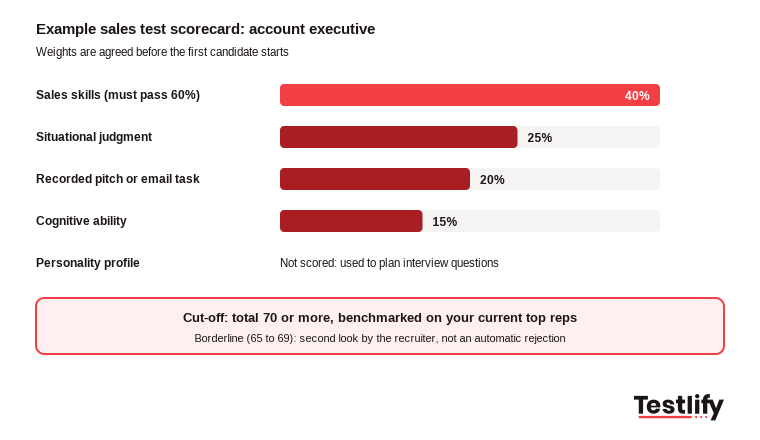
Sales test results are scored with weights set before anyone sees a score: each part of the test gets a share of the total based on how much it matters for the role, and the team agrees on a minimum total and any must-pass sections. Setting this up first keeps the shortlist consistent and stops people from moving the bar for a favorite candidate.
- Benchmark on your own team: Ask a few current top reps to take the same test. Their scores show what "good" looks like for your sales motion, which beats a guess.
- Use a range, not a single line: In the example above, everyone with a total of 70 or more moves to interview, and candidates between 65 and 69 get a second look from the recruiter rather than an automatic rejection.
- Score written and spoken tasks with a rubric: Rate each task on the same three or four criteria, such as structure, listening, handling the objection and asking for next steps. An interview scorecard works well for this.
- Analyze the results properly: Look for patterns across candidates, such as a scenario nobody gets right, which usually means a confusing question rather than a weak pool.
Key takeaway: The cut-off and weights are the real screening decision. Agree on them with the hiring manager before the first candidate starts, and the test will shortlist the same way every time.
How do you keep a sales test fair?
A sales test stays fair when every question is tied to the job, every candidate gets the same test and scoring, candidates who need adjustments get them, and the team checks results for groups that are screened out more than others. Fair tests also hold up better if a hiring decision is ever challenged.
- Keep it job-related: Test only skills the role really uses. The EEOC's guidance on employment tests says a test must be job-related, and that an employer whose test screens out a protected group should look for an equally effective option with less impact.
- Same test, same scoring: Every candidate for the role takes the same version, under the same time limit, scored the same way, without favoritism.
- Offer accommodations: Under the ADA, candidates with a disability can ask for reasonable changes, such as extra time or an audio version of written questions. Tell candidates how to ask.
- Watch for bias: Review questions for language or scenarios that favor one background, and check pass rates by group after each hiring round.
- Protect candidate data: Store results securely, limit who can see them and tell candidates how long you keep them.
- Check AI tools: If an AI tool scores or ranks candidates in New York City, Local Law 144 requires a yearly bias audit and notice to candidates.
How should you explain the sales test to candidates?
Candidates should know before they start why the sales test is part of the process, how long it takes, what kinds of tasks it includes and how the results will be used. A clear explanation lowers drop-off, reduces anxiety and gives you scores that reflect skill rather than confusion.
- Explain the test: State the format, the number of sections and the total time in the invite.
- Share the goal: Tell candidates which skills you are looking for and that the results guide the interview.
- Offer practice: Give one or two sample questions so candidates know what to expect.
- Answer questions: Name a contact for technical or accessibility questions.
- Give feedback: Share a short summary of strengths and gaps after the decision. It costs little and improves how candidates see your brand.
What mistakes make sales test screening harder?
The most common mistakes are using a generic test, ignoring communication and problem solving, overvaluing experience, giving unclear instructions and treating the score as the whole decision. Each one either lets weak candidates through or screens out strong ones.
- Using generic tests: A general aptitude quiz misses the skills that matter for your sales role. Pick a role-specific test.
- Ignoring communication skills: Some teams focus on product or technical knowledge and never hear the candidate sell. Add a written or spoken task.
- Neglecting problem solving: Sellers face objections and changing deals every day. Include scenarios that test quick thinking.
- Overvaluing sales experience: Years in sales do not guarantee results. Weigh attitude, adaptability and coachability too.
- Unclear instructions: Confused candidates score lower for the wrong reason. Test the invite on a colleague first.
- Relying only on test results: Use interviews, references and culture fit alongside the score.
- Not analyzing results: Skipping the review of patterns means missing weak questions and the strengths of good candidates.
- Testing too late: A test after three interview rounds adds work instead of removing it. Put it first.
How does Testlify help you screen sales candidates?
Testlify helps hiring teams screen sales candidates with ready-made sales tests, role-play style tasks and automatic scoring in one platform. Recruiters send one assessment link, candidates take it online, and the team gets a ranked shortlist with a per-skill breakdown for every candidate.
- Sales tests for every role: Choose from 3,500+ validated tests, including sales aptitude, SDR, account executive, sales manager and negotiation tests, or generate a custom assessment from your job description with the AI test builder.
- Real selling tasks: 25+ question types include audio, video and chat answers, and Voice AI and Video AI interviews let candidates pitch or handle an objection on their own time. See how Testlify video interviews work.
- Weighted scoring and insights: Set weights per test, auto-shortlist by score threshold and read AI-written strengths, gaps and suggested follow-up questions for the interview.
- Trustworthy results: 20+ proctoring checks, including webcam snapshots, tab monitoring and AI assistance detection, keep remote scores honest. Learn more about anti-cheating and proctoring.
- Fits your stack: Results sync to 100+ ATS and HRIS tools through Testlify integrations, and tests run in 15+ languages for global sales teams.
See the full workflow on the sales hiring software page.
Ready to screen your next sales hire on skill?
Build a sales test for your open role in minutes, send it to every applicant, and interview only the candidates who prove they can sell. Start a 7-day free trial of Testlify, no credit card required.
Frequently asked questions (FAQs)

Head of Sales
Pradeep is the sales and business growth engine behind Testlify’s enterprise expansion, bringing over 20 years of experience scaling revenues in complex, high-growth environments. He played a pivotal role in taking Testlify to $1M ARR, building a high-performing sales organization from the ground up and forging the strategic partnerships that accelerated market penetration.
LinkedInRelated resources
View all
HR & recruitment
How to screen electrical engineer candidates: a 6-step process

HR & recruitment
How to simplify candidate screening with SQL tests

HR & recruitment
How to simplify candidate screening with resilience test

HR & recruitment
Resilience testing in hiring: what it measures and how to use it

HR & recruitment
How project manager test helps you screen candidates

HR & recruitment
How Management test helps you screen candidates
Get started.
Hire on proof, not resumes.
Run your first skills-based assessment free — no credit card required.