
How to hire top talent using project manager test results
A practical guide to picking, running and scoring a project manager test so you shortlist proven planners and leaders, not polished resumes.
A project manager test is a timed, skills-based assessment that shows how a candidate plans work, manages risk, controls budgets and leads people through real project scenarios. To hire top talent using project manager test results, you pick a test that matches the role and level, run it before interviews, score it against weights you set in advance, and use the gaps it shows to shape the interview.
Resumes tell you which projects someone was near. A good test shows what they would actually do when a vendor slips, a sponsor adds scope or the budget runs short.
TL;DR / Key Takeaways
- To hire top talent using a project manager test, define the 5 or 6 skills the role needs, test them before the first interview, and interview only the top scorers.
- Test planning, scope, risk, budget, stakeholder communication and team leadership. Add agile or a tool such as Jira or MS Project only when the job uses it.
- Match the test to the level: a 10-minute, 12-question screen suits coordinators and mid-level PMs, while senior and technical PM roles need a 50-minute test.
- Weight the skills before anyone takes the test, set a cutoff band instead of a single hard number, and have a person review borderline scores.
- The US has about 1.09 million project management specialists and about 76,500 openings a year, so a fast, fair screen gives you an edge.
- A hiring test is not the PMP exam. It checks job decisions, not memorized certification content.
 ChatGPT
 Gemini
 Claude
 Grok
 Perplexity
What is a project manager test?
A project manager test is a pre-employment assessment that measures the skills a project manager uses every day: planning, scheduling, scope and change control, risk, budget, stakeholder communication and team leadership. Candidates answer scenario questions, knowledge questions and short work tasks, and the hiring team gets a score per skill.
Most tests mix three formats:
- Scenario questions: A realistic project situation, such as a key supplier missing a deadline, with options for what to do next.
- Knowledge questions: Core concepts such as critical path, earned value, work breakdown structures and agile ceremonies.
- Work samples: A short written task, such as drafting a project charter or a status update for a sponsor.
A hiring test is different from a certification exam. The PMP and CAPM exams check whether someone knows a body of knowledge. A project manager test checks how a candidate applies that knowledge to the work your team actually does, in minutes rather than hours.

Why hire top talent using project manager test results instead of resumes?
Hiring teams that hire top talent using project manager test results compare every candidate on the same skills, not on job titles or brand-name employers. Project management titles mean very different things across companies, so a test is the fastest way to see who can plan, prioritize and lead.
The pool is large and noisy. The US Bureau of Labor Statistics counts about 1,094,300 project management specialist jobs in 2025, a median pay of $102,320, and about 76,500 openings a year, with 7% growth expected from 2025 to 2035.
Applications are not getting easier to sort either. According to a LinkedIn survey published in January 2025, 73% of HR professionals say fewer than half of the applications they receive meet all the listed criteria, and 64% say qualified talent got harder to find in the past year.
Project manager hiring is hard for a second reason. Unlike a developer, a project manager has no single output you can review. The skill mix is broad: planning, budget control, risk calls, stakeholder management and the people skills to keep a team moving. Interviews reward confident storytellers, and resumes list projects without showing the decisions behind them.
A test fixes that in four ways:
- Objective comparison: Every candidate answers the same questions and is scored on the same criteria, which cuts first-impression bias.
- Faster shortlists: You interview the top 5 to 10 scorers instead of 30 resumes that looked similar.
- Better interviews: Weak areas in the score report become targeted interview questions.
- Fairer candidate experience: Candidates know what they will be judged on and get to show real skills, which matters for career changers who lack a PM title.
What skills should a project manager test measure?
A project manager test should measure the skills that decide whether projects land on time and on budget: planning and scheduling, scope and change control, risk management, budget and cost control, stakeholder communication, and team leadership. Add methodology and tool skills only when the role depends on them.
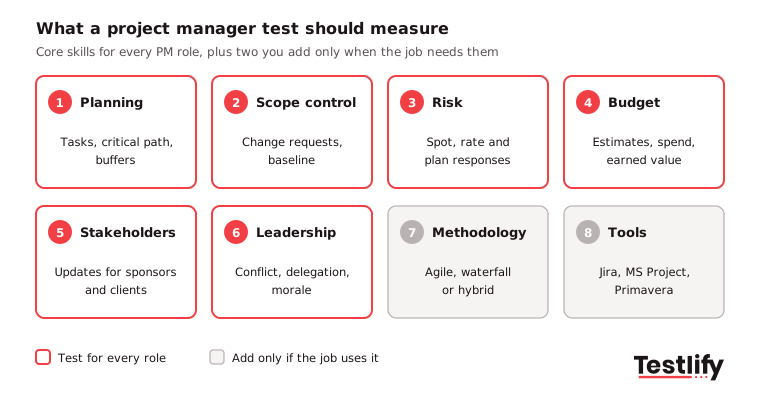
Keep the list short. Five or six skills tested well tell you more than twelve skills tested with two questions each. For the full skills breakdown, see how to assess project management skills.
What types of project manager tests are there?
Project manager tests come in five main types: role-specific skills tests, situational judgment tests, methodology and tool tests, work samples, and personality or behavior assessments. Most hiring teams combine two or three of them in one assessment so they see both knowledge and judgment.
- Role-specific skills tests: Scenario and multiple-choice questions on the project lifecycle, scope, risk and budget. They are the core of most PM assessments.
- Situational judgment tests: Short people problems, such as two senior engineers in conflict, where the candidate picks the best and worst responses. They show leadership style.
- Methodology and tool tests: Agile and Scrum knowledge, or skills in Jira, MS Project, SAP PS or Primavera. They suit roles where the tool is part of daily work.
- Work samples: Written or uploaded tasks such as a project charter, a risk register or a one-page sponsor update. They show how the candidate writes and thinks.
- Personality and behavior assessments: Work style and communication preferences. Use them to guide interview questions and team fit discussions, never as a pass or fail gate.
Some teams add a short cognitive ability test for junior roles, where there is little track record to go on.
Which project manager test fits each role and level?
The right project manager test depends on the seniority of the role and whether it is technical or agile. A short role-specific test suits coordinators and mid-level project managers, while senior, program and technical project manager roles need a longer test that covers governance, integration and stakeholder strategy.
Role | Testlify test | Length | What it covers |
|---|---|---|---|
Project coordinator, junior PM | 10 min, 12 questions | Planning, communication, budgeting, team leadership | |
Project manager (mid-level) | Project manager test | 10 min, 12 questions, scenario-based | Project lifecycle, situation handling, earned value, tools and methods |
Senior PM, program manager | 50 min, 30 questions | Strategic leadership, governance, program and benefits management, change leadership | |
Technical project manager | 50 min, 80 questions | Technical expertise, integration, scope, schedule, cost, agile, compliance | |
Agile or Scrum project manager | 10 min, 12 questions | Sprint planning, daily Scrum, reviews and retros, agile estimation |
A common setup for a mid-level role: the project manager test, one tool test if the team lives in Jira or MS Project, and one written work sample. That keeps the candidate's time under 30 minutes.
How do you hire top talent using project manager test results?
You hire top talent using project manager test results by following eight steps: define the role, choose the tests, add a work sample, set integrity controls, invite candidates early, score against set weights, interview the top performers on their gaps, then decide and track the hire. The test narrows the field; people make the final call.
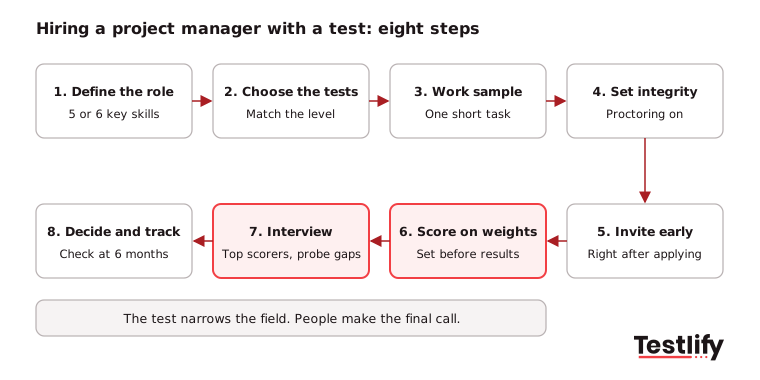
- Define the role: List the 5 or 6 skills that matter most, the methodology, the tools and the level. Start from a clear project manager job description and ask the hiring manager what a great first 90 days looks like.
- Choose the tests: Pick the role test that matches the level from the table above. Add a tool or agile test only if the job needs it.
- Add a work sample: One short task, such as a sponsor update on a delayed project, shows writing and judgment that multiple choice cannot.
- Set integrity controls: Turn on proctoring such as full-screen mode, copy and paste blocking and webcam snapshots, and tell candidates up front.
- Invite candidates early: Send the assessment right after application or a short resume screen, ideally straight from your ATS, and mention it in the job post so nobody is surprised.
- Score against set weights: Agree the weight of each skill and the cutoff band before results come in, then rank candidates on the weighted score.
- Interview the top performers: Invite the top scorers and use their weakest skill areas to plan follow-up questions. Our list of project manager interview questions helps here.
- Decide and track: Combine test scores, interviews and references, make the offer, then compare test scores with performance ratings after six months to refine your weights.
Pro tip: Tell candidates the test length and the skills it covers in the job post. Clear expectations raise completion rates, and strong candidates see the process as fair rather than as a hurdle.
What do sample project manager test questions look like?
Sample project manager test questions put the candidate in a real project situation and ask for the best next step. Strong answers follow a sound process, protect the baseline, involve the right people and explain the trade-off. Weak answers jump to blame, skip the change process or promise everything.
- Scope change: "A sponsor asks for a new reporting feature two weeks before launch. What do you do first?" A strong answer logs the request, assesses impact on schedule, cost and risk, and takes options to the sponsor or change board before agreeing.
- Schedule slip: "A critical-path task is five days late. What are your options?" A strong answer names fast tracking, crashing, re-sequencing or cutting scope, with the cost of each.
- Earned value: "Planned value is $50,000, earned value is $40,000 and actual cost is $45,000. Is the project ahead or behind, and over or under budget?" The candidate should say behind schedule (SPI 0.8) and over budget (CPI about 0.89).
- Team conflict: "Two senior engineers disagree on the architecture and the sprint is stalling. How do you handle it?" A strong answer hears both sides, sets a decision deadline and escalates to the technical lead if needed, without picking a winner by seniority.
- Stakeholder update: "Write a three-sentence update for a sponsor on a project that will miss its date." A strong answer states the new date, the reason and the recovery plan, with no jargon.
How do you score results and set a cutoff?
Score project manager test results with a weighted scorecard: give each skill a weight based on the role, multiply by the candidate's score, and rank on the total. Set the cutoff as a band, not a single number, and have a person review candidates near the line before anyone is rejected.
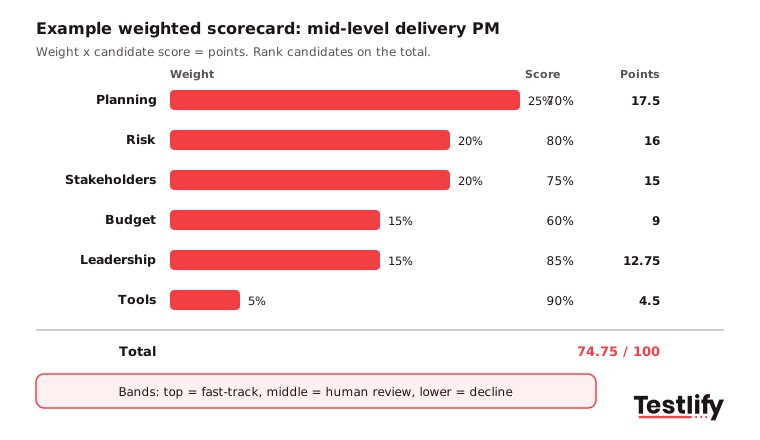
A simple scorecard for a mid-level delivery role might weight planning 25%, risk 20%, stakeholder communication 20%, budget 15%, leadership 15% and tools 5%. A candidate who scores 70% on planning adds 17.5 points to the total, and so on across the skills.
Use the results in three bands:
- Top band: Fast-track to interview.
- Middle band: Interview if the weak skill is one you can coach, or if the work sample was strong.
- Lower band: Decline with a courteous note, after a quick human check of anyone close to the line.
Measuring the outcome matters as much as the cutoff. LinkedIn's Future of Recruiting 2025 found that 93% of talent acquisition pros say accurately assessing skills is crucial to quality of hire, yet only 25% are highly confident they can measure quality of hire. Comparing test scores with six-month performance ratings closes that gap.
Key takeaway: The cutoff is a starting point, not a verdict. Adjust the weights after each hiring round based on how your hires actually perform.
What mistakes should you avoid with project manager tests?
The most common mistakes with project manager tests are testing certification trivia instead of job decisions, making the test too long, using the score as the only signal, skipping proctoring, and ignoring accessibility. Each one either hides strong candidates or lets weak ones through.
- Trivia over judgment: Questions that ask for PMBOK definitions reward memorization. Use scenarios from your own projects.
- Tests that run too long: Keep screening under 30 minutes for most roles. Save longer tasks for the final stage.
- A score as the only signal: Tests complement interviews, reference checks and portfolio reviews. They do not replace them.
- No integrity checks: Unproctored tests make it hard to trust results, especially with AI tools one tab away.
- Ignoring fairness and access: Under EEOC guidance on employment tests, a test that screens out a protected group must be job-related and consistent with business necessity, and employers must offer reasonable accommodations, such as extra time, to candidates with disabilities. Review pass rates across groups after each round.
How does Testlify help you hire project managers?
Testlify helps hiring teams hire project managers by combining ready-made project management tests, custom questions, AI interviews, proctoring and ATS sync in one platform. Teams build a role-specific assessment in minutes, send it from their ATS, and get a ranked shortlist with a score for every skill.
- Test library: 3,500+ tests, including the project manager, advanced L6, technical PM, agile and tool tests above. Browse the Testlify test library.
- AI test builder: Paste a project manager job description and get a custom assessment in under a minute, with suggested skills and scoring criteria.
- 25+ question types: Add a written work sample, a file upload of a project plan, an Excel or Google Sheets task, or a video answer.
- AI interviews: Run structured video, audio or chat interviews that score every answer against the same criteria.
- Integrity: 20+ proctoring checks, including full-screen enforcement, copy and paste blocking, webcam snapshots and AI assistance detection. See anti-cheating and proctoring.
- Reporting: Per-skill breakdowns, weighted scoring, benchmarks and AI-written pros and cons for each candidate.
- ATS sync: 100+ ATS and HRIS integrations, including Workday, Greenhouse, Lever and SmartRecruiters, with two-way sync. See Testlify integrations.
- Global reach: Assessments in 15+ languages for multi-country hiring.
More than 1,500 talent teams use Testlify, and it holds a 4.7 rating on G2.
Ready to hire your next project manager?
Pick the test that matches your role, add one work sample, and send it to your next batch of applicants. You will know who can plan, prioritize and lead before the first interview. Start a 7-day free trial with no credit card, or book a demo to see a project manager assessment built for your team.
Frequently asked questions

Content Writer
Yashika Khandelwal is a Content Writer with 3+ years of experience creating research-backed content on hiring, talent assessment, and HR technology. She is a registered Organizational Psychologist and subject matter expert who combines behavioral science with practical recruitment insights to produce accurate, evidence-based content.
LinkedInRelated resources
View all
HR & recruitment
How to hire top talent using deductive reasoning test: a 2026 guide

HR & recruitment
How to assess HTML5 developer skills for hiring

HR & recruitment
How to hire top talent using sales tests: a step-by-step guide

HR & recruitment
How to hire top talent using analytical ability test

HR & recruitment
Candidate screening tools: 7 types and how to choose them
HR & recruitment
How to improve employer brand: 10 steps that hold up in 2026
Get started.
Hire on proof, not resumes.
Run your first skills-based assessment free — no credit card required.