
How technical assessments fuel the Amazon hiring process
Explore how technical assessments strengthen Amazon hiring process and enable the company to assess skills and hire top talent at scale

Amazon’s growth from an online bookstore to a global tech powerhouse has been fueled by the core philosophy of hiring and developing the best talent. To power its million-strong workforce, the company relies heavily on technical assessments to identify candidates who can excel in their respective roles.
These assessments aren’t standalone filters but integral checkpoints in the company’s multi-stage recruitment process. They allow recruiters to measure the coding proficiency, problem-solving, and decision-making skills of candidates at scale.
In this article, we will explore how Amazon’s hiring process works, how the company leverages technical assessments to find top talent, and what HR leaders can learn from its approach.
 ChatGPT
 Gemini
 Claude
 Grok
Grok Perplexity
Amazon hiring process explained
Candidates typically progress through several stages designed to gradually filter for technical skills, problem-solving ability, and cultural alignment. The typical stages include:
Online coding assessment (OA)
An initial online coding test (often on a platform like HackerRank) that automatically evaluates a candidate’s coding skills. This stage efficiently filters a large candidate pool based on problem-solving and coding proficiency.
For many roles, the OA also includes additional components such as “Work Style” simulations, aligning with Amazon’s leadership principles
Phone screening
A live 45–60 minute interview conducted via phone or video (now using Zoom), where an Amazon engineer poses coding problems in a collaborative coding environment.
These conversations will cover the candidate’s experience, including the past challenges faced and how they handled them.
Throughout our interviews, we avoid brain teaser questions because we’ve found them unreliable for predicting a candidate’s success at AWS. Instead, we focus on behavior-based questions that ask about your experience and work style.
Interview loop
A series of virtual interviews (commonly 4–6 rounds) takes place with multiple Amazon team members. These rounds cover in-depth technical and behavioral evaluation:
- Coding Interviews: 2–3 interviews focused on data structures and algorithms, where candidates solve coding challenges on a whiteboard or shared editor.
- System Design Interview: Candidates might be asked to design a scalable system. They are then evaluated on their design thought process, scalability considerations, and ability to handle trade-offs
- Behavioral Interview: One or more rounds dedicated to Amazon’s Leadership Principles, exploring the candidate’s past behavior and decision-making through situational questions.
- Bar Raiser Interview: One interviewer in the loop is a Bar Raiser, where an Amazon employee from outside the hiring team, trained to be an objective evaluator. The Bar Raiser’s role is to ensure the candidate meets Amazon’s high hiring standards and cultural criteria.
Hiring decision and debrief
After the loop, all interviewers convene in a debrief meeting led by the Bar Raiser. Each interviewer submits their feedback and ratings independently before the meeting. In the debrief, the group discusses the candidate’s performance across all dimensions using evidence from the interviews.
The Bar Raiser facilitates a discussion to reach a consensus on hire or no-hire, ensuring that any decision is backed by concrete data that the candidate would “raise the bar” relative to current team members.
Only if the panel (with Bar Raiser agreement) is convinced the candidate is above the bar will an offer be extended. This end-to-end process can span a few weeks.
Amazon even abides by a “2&5 Promise,” pledging to update candidates within two business days after a phone screen and five business days after an interview loop.
This structured yet brisk timeline reflects Amazon’s intent to provide a good candidate experience while rigorously vetting for top talent.

How Amazon uses technical assessments to evaluate candidate skills
Amazon’s technical assessment tests are crafted to evaluate three broad areas in candidates: problem-solving ability, system design skills, and cultural fit. Here’s how each is specifically tested and measured throughout the hiring process:
Problem-solving and coding ability
The online coding tests gauge a candidate’s algorithmic thinking and coding fluency under time pressure. Amazon’s interview questions often require creative problem-solving, not just rote memorization of formulas, and interviewers listen for the candidate’s logical reasoning.
A strong candidate will methodically break down a problem, perhaps starting with a brute-force solution and then optimizing it, while articulating their thought process clearly.
Amazon also values attention to detail in coding: handling edge cases, writing clean and correct syntax (since candidates must write actual runnable code, not pseudocode, during interviews.
HR leaders can see in Amazon’s approach the benefit of role-specific tests over brainteasers or trick questions.
System design and architectural thinking
Especially for senior engineer roles, Amazon heavily emphasizes system design skills. The company evaluates whether a candidate can think at a higher level of abstraction and deal with architectural trade-offs.
They evaluate an ability to articulate a design’s components (e.g., web services, databases, caches), justify choices (monolith vs microservices), and discuss how the system would scale, handle failures, and meet performance needs.
Cultural fit and leadership principles
Amazon’s focus on cultural fit is one of its defining features. Rather than a vague notion of “fitting in,” Amazon codifies culture in its Leadership Principles, and they evaluate candidates against these relentlessly.
Every behavioral question in the interviews is mapped to one or more principles, and interviewers document how a candidate’s answers demonstrated (or failed to demonstrate) those principles
The Work Style Assessment in the online stage also asks candidates situational questions like how they’d prioritize tasks or react to a team conflict, with answers mapped to preferred Amazon behaviors. By the end of the process, Amazon has a detailed read on whether the candidate’s working style and values align with the company’s culture.
Key learnings for HR teams
Amazon’s technical assessment process offers several best practices that HR and talent acquisition leaders can adapt to strengthen their own hiring of technical talent. Here are key takeaways:
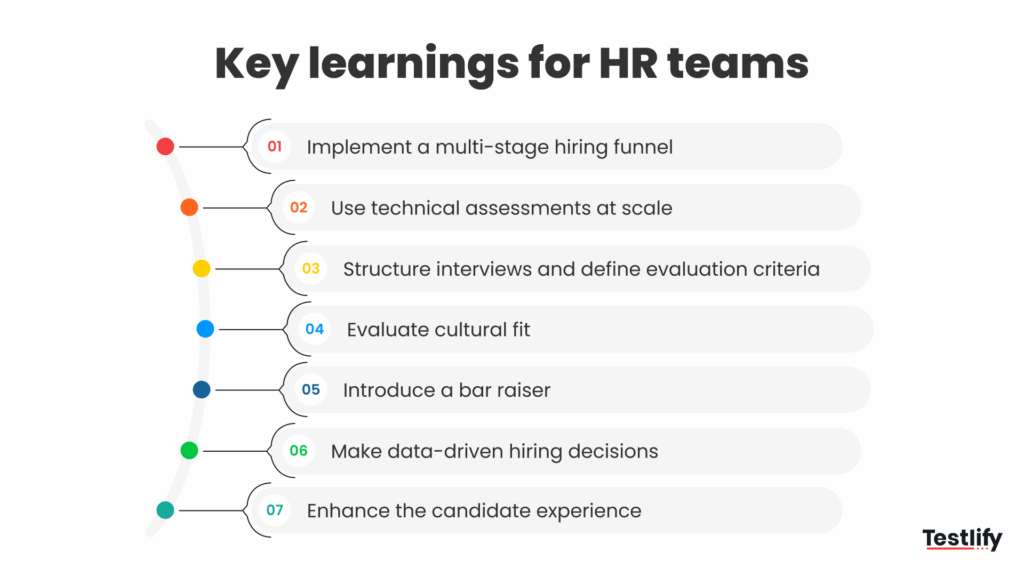
Implement a multi-stage hiring funnel
By using a staged process that moves from online assessments to phone screens and finally to interview loops, Amazon showcases the value of sequential filtering. Early technical assessments help save valuable interviewer time by objectively filtering out unqualified candidates.
Design your process so that each stage evaluates specific attributes (for example, basic coding first, advanced skills next, and finally team fit) before allocating more resources.
Use technical assessments at scale
Leverage coding tests that are scored automatically to handle large applicant volumes without bias. Amazon’s experience demonstrates that well-designed coding challenges provide a strong initial signal of technical competency.
Ensure the tests are relevant to the daily work of the role and include evaluation of problem-solving approach, not just final answers.
Structure interviews and define evaluation criteria
Unstructured interviews can lead to inconsistent and biased decisions. Amazon combats this by training interviewers to ask planned questions tied to competencies and leadership principles, and by using standardized methods like STAR for behavioral answers.
HR leaders should develop interview kits for their teams: clearly outline what skills/traits each interview round assesses and provide sample questions. This leads to more consistent evaluations and easier comparison across candidates.
Evaluate cultural fit
A strong company culture should manifest in hiring. Amazon operationalizes this via its Leadership Principles, as every candidate is explicitly measured on cultural fit as part of the assessment.
The lesson for others is to identify your organization’s core values or principles and integrate them into interview questions and scoring rubrics. Define what good answers look like that exemplify those values.
Introduce a “Bar Raiser”
One of Amazon’s most distinctive practices is having a Bar Raiser to serve as an objective advisor during the interview process. Because Bar Raisers sit outside the hiring team, they bring a fresh perspective to identify strengths and gaps that may go unnoticed.
Companies can emulate this by appointing experienced interviewers (from different teams or a central hiring committee) who can serve as neutral gatekeepers.
These individuals should be well-trained, respected, and authorized to veto hires that don’t meet the agreed bar. This mechanism is especially useful as a company grows and needs to keep hiring standards from slipping under pressure.
Make data-driven hiring decisions
Encourage interviewers to gather evidence and document their feedback thoroughly. All hiring discussions should revolve around specific examples and data points from interviews, as done at Amazon’s debriefs.
Define quantitative or categorical ratings for key competencies to facilitate comparison. Over time, collect data on which hires become top performers and which interview responses predicted that. Use these insights to refine your hiring criteria.
Enhance the candidate experience
Despite its rigor, Amazon tries to respect candidates’ time and effort, as seen in practices like the “2&5 Promise” for timely updates and providing preparation guidance (they publicly share interview tips and emphasize what to expect).
A takeaway here is that a tough assessment process can still be transparent and candidate-friendly. Clearly communicate your hiring steps to candidates, give them resources to prepare, and close the loop with feedback or prompt decisions.
Over to you
Amazon’s methodical use of technical assessments has become a benchmark in identifying and hiring exceptional technical talent. Through its data-driven and culturally aligned process, the company ensures that every hire raises the bar for the organization.
For HR leaders, the lesson is not to replicate Amazon’s process exactly but to embrace its philosophy: structured evaluation, objective data, and alignment with company values.With modern tools like Testlify, even fast-growing companies can implement Amazon-style assessments to find top technical talent efficiently, fairly, and at scale.
Book a demo today and transform your hiring process with ease.
Frequently asked questions (FAQs)

Related resources
View all
HR & recruitment
Case studies of companies that have successfully used coding assessments to hire top talent

HR & recruitment
How LMS can help you create a collaborative learning environment

HR & recruitment
Top 7 recruitment trends in customer service manager hiring

HR & recruitment
Top 7 recruitment trends in data engineer hiring

HR & recruitment
Top 7 recruitment trends in marketing coordinator hiring

HR & recruitment
How to implement a learning management system successfully
Get started.
Hire on proof, not resumes.
Run your first skills-based assessment free — no credit card required.