
Key hiring metrics every large organization should monitor
Discover enterprise hiring metrics for enterprises to boost recruitment efficiency, improve quality of hire, and make data-driven hiring decisions.

Hiring isn’t just about filling positions, it’s about making smart, data-informed decisions that drive business success.
Hiring metrics clearly show how well your recruitment strategies are working. They help pinpoint inefficiencies, improve candidate experience, and ensure you’re hiring the right people, faster.
In fact, companies that use data-driven recruiting are two times more likely to improve their recruiting efforts, according to LinkedIn.
This blog breaks down the enterprise hiring metrics that truly matter so you can build a high-performing team with confidence and clarity.
 ChatGPT
 Gemini
 Claude
 Grok
Grok Perplexity
What are hiring metrics?
Hiring metrics are measurable data points that help HR teams track the effectiveness and efficiency of their recruitment processes. They show how well your hiring strategy is working, from how fast you fill roles to how well new hires perform.
By using these metrics, you can identify what’s working, fix what’s not, and make smarter decisions to attract and retain top talent.
Why do enterprise hiring metrics matter in large organizations?
In large enterprises, the hiring process is multifaceted, involving multiple departments, numerous candidates, and various stages.
Without a clear understanding of how each component performs, it’s challenging to identify bottlenecks, inefficiencies, or areas for improvement. Enterprise hiring metrics provide:
- Visibility into the efficiency and effectiveness of your recruitment process.
- Data-driven insights to make informed decisions.
- Benchmarking capabilities to compare performance over time or against industry standards.
- Strategic guidance for resource allocation and process optimization.

Core enterprise hiring metrics every HR team should track
Let’s delve into the essential enterprise hiring metrics that can help streamline your recruitment process.
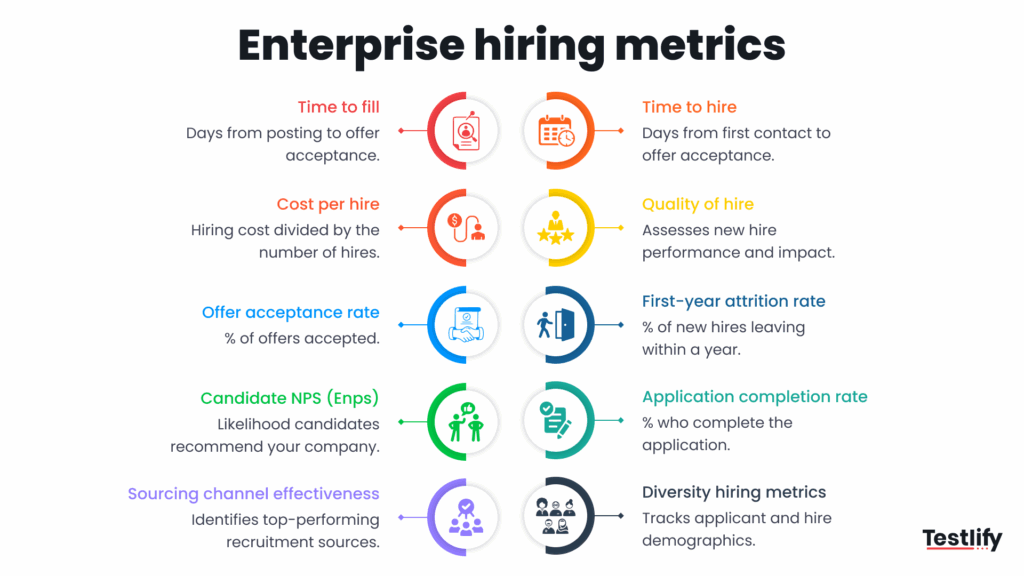
1. Time to fill
Time to fill tracks the number of days between opening a job requisition and having an accepted offer. It reveals how quickly your organization can respond to talent needs. A high time to fill may point to inefficiencies such as slow approvals or lengthy interviews.
Measuring this helps identify where delays occur. Calculate it by subtracting the job opening date from the offer acceptance date to find opportunities to streamline your recruitment cycle.
2. Time to hire
Time to hire measures how many days it takes from a candidate’s application (or sourcing) to when they accept an offer. It reflects how efficient and responsive your hiring process is.
Long timelines can lead to losing top candidates. Track application and offer acceptance dates, and average the results. This metric helps pinpoint friction in the candidate journey and guides improvements for faster, more competitive recruitment processes.
3. Cost per hire
Cost per hire reveals the total investment made to bring in a new employee. It includes everything from job ads and recruiter fees to interview expenses and onboarding costs. This metric is vital for budgeting and assessing hiring ROI. A high cost might suggest inefficiencies or expensive channels.
To measure, total your recruitment expenses and divide by the number of hires. It helps HR allocate resources more effectively and justify recruitment budgets to leadership.
4. Quality of hire
Quality of hire evaluates the value a new employee brings based on performance, engagement, and retention. It’s one of the most strategic metrics, helping HR understand if hiring decisions are truly successful.
Measured using performance reviews, manager feedback, productivity data, and retention rates, this metric provides a holistic view of talent effectiveness. Monitoring it helps ensure you’re not just hiring fast but hiring well and building a high-performing workforce over the long term.
5. Offer acceptance rate
Offer Acceptance Rate (OAR) measures the percentage of candidates who accept your job offers. It reflects how attractive your roles, compensation, and employer brand are. A low rate might point to issues like uncompetitive offers, poor candidate experience, or misalignment with expectations.
Calculate it by dividing the number of accepted offers by the total offers extended. Monitoring this helps ensure you’re closing the right candidates and signals where you may need to strengthen your value proposition.
6. First-year attrition rate
This metric tracks how many new hires leave your organization within their first year. High first-year attrition is costly and often signals poor onboarding, mismatched expectations, or cultural misfit. It’s a red flag that the hiring process may need improvement.
Measure it by dividing the number of first-year leavers by total new hires, multiplied by 100. Monitoring this helps reduce early turnover and refine hiring, training, and onboarding strategies to improve retention.
7. Candidate Net Promoter Score (eNPS)
Candidate NPS gauges how likely candidates are to recommend your company to others based on their hiring experience. It’s a strong indicator of employer brand and recruitment process quality.
After interviews or hiring decisions, survey candidates on a 0–10 scale. The higher your eNPS, the better your candidate experience. Use it to identify areas for improvement, even from candidates you don’t hire, and boost your brand’s appeal.
8. Application completion rate
Application completion rate shows how many applicants finish the job application after starting it. If this number is low, it could mean your application process is too long, confusing, or not mobile-friendly.
That results in candidate drop-off before you even evaluate them. Measure by dividing completed applications by started ones, multiplied by 100. Improving this metric ensures your process is accessible and encourages more qualified candidates to apply and engage fully.
9. Sourcing channel effectiveness
This metric helps identify which recruitment sources (job boards, referrals, social media, etc.) bring in the best candidates. It evaluates both volume and quality of hires by source. Use it to assess ROI and shift efforts toward high-performing channels.
Track each hire’s source, then correlate with performance and retention. This insight helps optimize spending, refine sourcing strategies, and focus on the platforms that consistently deliver strong, long-term talent for your organization.
10. Diversity enterprise hiring metrics
Diversity enterprise hiring metrics track demographic representation across candidates and hires, such as gender, ethnicity, age, or disability status. These insights help ensure your hiring process is inclusive and aligned with DEI goals.
Analyze demographic data at each recruitment stage to spot drop-offs or biases. Improving this metric supports innovation and better decision-making by building diverse teams. It also reinforces your organization’s values, enhances employer branding, and fosters a more equitable workplace culture.
Tools and technologies to enhance enterprise hiring metrics
Implementing the right technologies can significantly improve how you collect, track, and act on hiring data. Here are the key tools every HR team in a large organization should consider:
AI-powered talent assessment platforms
Platforms like Testlify help evaluate candidates’ skills objectively through tests, simulations, and behavioral assessments. The tool offers data-driven insights into candidate capabilities beyond resumes, improving the quality of hire.
Results are quantifiable, helping you compare applicants fairly and consistently. They also reduce time spent on unqualified candidates and align hiring decisions with the real requirements of the role.
AI recruiting platforms like Testlify use artificial intelligence to automate candidate screening, enhance matching, and reduce unconscious bias. These tools analyze thousands of data points to surface the best-fit candidates faster.
They also help personalize outreach and improve candidate experience. By integrating AI, your team gains speed, consistency, and a smarter way to make decisions based on predictive hiring insights.
Applicant Tracking Systems (ATS)
ATS platforms such as Greenhouse, Lever, and iCIMS automate job postings, application tracking, and reporting. They help manage the entire recruitment lifecycle efficiently and ensure all hiring data is centralized.
ATS tools make it easier to measure metrics like time to fill, source effectiveness, and pipeline health offering clarity and consistency throughout the hiring process and enhancing collaboration among HR and hiring managers.
HR analytics software
HR analytics tools transform raw data into meaningful insights through visual dashboards and detailed reports. They allow you to explore hiring trends, performance metrics, and workforce demographics at a glance.
These platforms are key to identifying gaps, forecasting hiring needs, and supporting strategic decisions with credible, evidence-based information that’s easy to share with leadership teams.
Leveraging metrics for continuous improvement
Collecting data is only the first step. To truly benefit from enterprise hiring metrics:
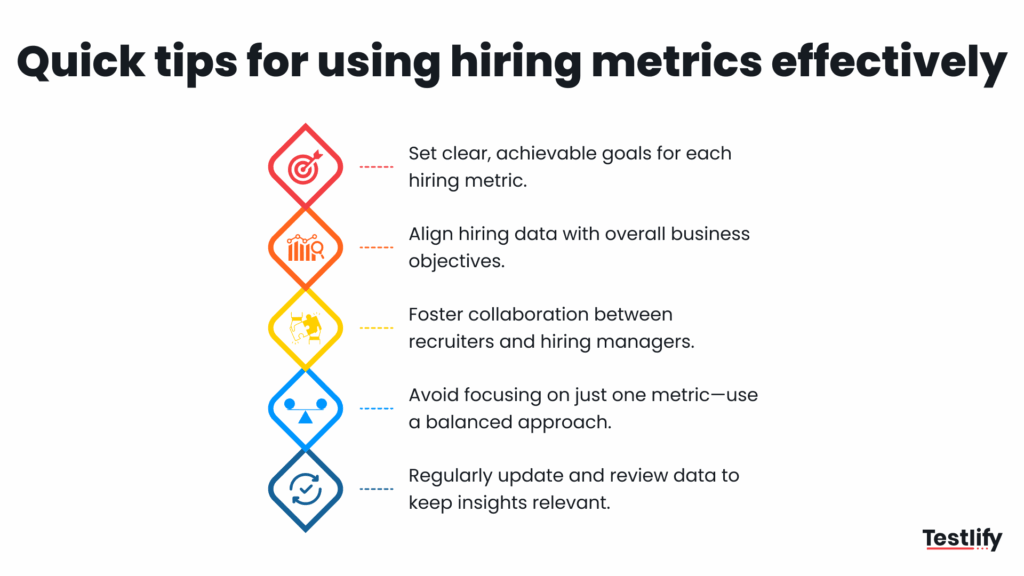
Regularly review metrics
Monitoring enterprise hiring metrics regularly ensures your team stays informed and responsive. Use real-time dashboards to track performance and identify any sudden changes or red flags. By reviewing data frequently, you can quickly spot inefficiencies, assess recruitment team effectiveness, and make informed decisions. Consistent reviews help keep your hiring strategy aligned with organizational goals and continuously improve the recruitment process.
Identify trends
Looking at enterprise hiring metrics over time helps you uncover valuable patterns and trends. Whether it’s an increase in time to hire or a drop in offer acceptance rate, these insights highlight areas needing attention.
Analyzing trends allows you to forecast future needs, adjust your strategies proactively, and make data-backed decisions that improve recruitment efficiency and candidate quality across departments or roles.
Benchmark against industry standards
Comparing your metrics to industry benchmarks helps you understand how your recruitment performance stacks up. It provides context like: Are your time-to-fill rates competitive? Is your offer acceptance rate lagging?
Use benchmark data to set realistic goals, justify improvements, and demonstrate value to leadership. Staying aware of how peers perform helps guide strategic improvements and ensures your hiring practices remain competitive.
Implement changes
Data is only powerful when it drives action. Use your hiring insights to make meaningful changes, whether that’s rewriting job descriptions, streamlining interview stages, or investing in more effective sourcing channels.
Metrics highlight what’s working and what’s not. Acting on this data leads to smarter, faster, and more inclusive hiring processes. It also signals a culture of continuous improvement within your HR function.
Conclusion
Enterprise hiring metrics are more than just numbers; they are insights that drive strategic hiring decisions. By consistently tracking and analyzing these metrics, you can optimize your recruitment processes, enhance candidate experience, and ultimately build a stronger, more effective workforce.
Remember, the key is not just to collect data but to use it proactively to inform decisions and foster continuous improvement in your hiring practices.
For further reading, explore Enterprise Architect.
Frequently asked questions (FAQs)

Content Writer
Yashika Khandelwal is a Content Writer with 3+ years of experience creating research-backed content on hiring, talent assessment, and HR technology. She is a registered Organizational Psychologist and subject matter expert who combines behavioral science with practical recruitment insights to produce accurate, evidence-based content.
LinkedInRelated resources
View all
HR & recruitment
Global hiring insights: Key strategies for success

HR & recruitment
How to operationalize DEI in the enterprise recruitment funnel

HR & recruitment
Building a global interview infrastructure

HR & recruitment
Breaking hiring silos: Aligning TA with L&D and DEI

HR & recruitment
How to build a recruitment center of excellence (CoE)?

HR & recruitment
Seasonal and project-based hiring: Playbook for volume flexibility
Get started.
Hire on proof, not resumes.
Run your first skills-based assessment free — no credit card required.