
Recruitment sources: Types, advantages and disadvantages
Explore the best internal and external recruitment sources to find top talent. Learn how to choose the right channels for effective hiring!

Recruitment sources are the channels a company uses to find candidates, and they split into two families: internal sources (people who already work for you) and external sources (everyone else). Most hiring teams use both. The real question is not which family wins, but which channel fits the role you are filling right now.
That question has teeth. There were 7.4 million job openings in the United States in June 2026 and 5.3 million hires that month, according to the Bureau of Labor Statistics JOLTS release. Openings outnumbered hires that month, as they do most months. That gap is where source strategy either pays for itself or quietly burns budget.
TL;DR
- Internal sources are faster and cheaper, and they are badly underused: one in four US employees says there is no path to advancement where they work.
- External sources buy you skills you cannot build in time, which matters when 63% of employers name skill gaps as their single biggest barrier to change.
- Referral programs cut attrition by about 15%, but raising the referral bonus buys quantity at the cost of quality.
- Match the channel to the role, not to a company-wide policy. Volume roles, specialist roles, and leadership roles reward different sources.
- Whichever mix you pick, candidates from different channels arrive with wildly different evidence attached, so evaluate them on one consistent standard.
 ChatGPT
 Gemini
 Claude
 Grok
Grok Perplexity
What are recruitment sources?
A recruitment source is any channel that puts a candidate in front of your hiring team. Internal sources draw from people already on the payroll through promotions, transfers, and internal job postings. External sources reach the open market through job boards, referrals, agencies, campus programs, social platforms, and direct outreach. Every hire arrives through one of them.
Tracking which one is worth the effort. Source data tells you where your good hires actually came from, as opposed to where you assumed they came from. Those two answers differ more often than most teams expect, and the gap usually shows up in the channels nobody owns.

What are the main types of recruitment?
There are three. Internal recruitment fills a role from inside the organisation. External recruitment goes to the open market. Hybrid recruitment runs both at once, posting internally and externally on the same timeline so the strongest candidate wins on evidence rather than on who applied first.
Plenty of teams call themselves hybrid when they are not. Posting a job internally for five days before it goes public is not a parallel process, it is a formality with a waiting period attached. A genuine hybrid process compares internal and external candidates against the same scorecard, at the same stage.
Types of recruiting: agency, in-house, and hybrid
Separate from where candidates come from is who does the recruiting. In-house teams own the process end to end and know the business. Agencies and search firms bring market reach and speed for roles you cannot fill alone, at a fee normally charged as a percentage of the hire's first-year salary. Embedded or hybrid recruiting rents agency capacity that works inside your process and your systems. The trade is control against reach, and it changes by role, not by principle.
Internal and external sources of recruitment
The two families answer different problems. Internal sources solve for speed, retention, and cultural continuity. External sources solve for capability you do not have and perspective you cannot generate from within. Here is how they compare on the dimensions that drive the decision.

Dimension | Internal sources | External sources |
|---|---|---|
Speed to hire | Faster. The candidate is known, references are internal, and onboarding is shorter. | Slower on average, though referrals and direct sourcing beat generic job ads. |
Cost | Lower direct cost, but backfilling the vacated role is a real second cost. | Ranges widely. A careers page hire and a retained search hire are not in the same bracket. |
Risk | Lower. You have observed the person do actual work. | Higher variance, so screening quality carries more weight. |
Skills reach | Limited to what already exists in the building. | Access to skills the organisation has never had. |
Diversity effect | Tends to reproduce the current mix. | Can widen the mix, if the sourcing channels are widened too. |
Morale effect | Positive when promotion feels earned, corrosive when it looks like favouritism. | Can demotivate internal candidates who were passed over without explanation. |
What are the internal sources of recruitment?
Internal sources fill a vacancy with someone already employed by the organisation. The main ones are promotions, lateral transfers, internal job postings, and rehiring former employees. Some teams add project-based moves and secondments, which let someone try a role before either side commits.
Most organisations underuse this channel, and there is hard evidence for that. Gallup's October 2025 polling found that one in four American employees say they lack opportunities for career advancement. Big employers do better, with 74% of workers at organisations of 1,000 or more saying those opportunities exist, against about one in three at the smallest firms. Better is not the same as solved. A quarter of your workforce believing there is no way up is a retention problem and a sourcing problem wearing the same coat.
The skills picture makes the case sharper. The World Economic Forum's Future of Jobs analysis puts it as a headcount of 100: 59 of every 100 workers will need training by 2030, and of those, 19 could be upskilled and then redeployed somewhere else inside their own organisation. That is 19% of the global workforce representing internal supply that most companies currently treat as unavailable.
Advantages of internal sources of recruitment
- Speed. No sourcing cycle, no cold outreach, and a shorter ramp because the person already knows how the company works.
- Lower cost. No advertising spend, no agency fee, and far less recruiter time per hire.
- Lower risk. You have watched this person work for months or years. No interview simulates that.
- Retention. Visible internal movement answers the advancement question before it turns into a resignation.
- Institutional knowledge stays put. The context that takes a new hire two quarters to absorb walks into the role on day one.
Disadvantages of internal sources of recruitment
- It moves the vacancy, it does not remove it. Every internal promotion opens the role underneath it. Plan the backfill at the same time.
- A narrow pool. If the capability is not in the building, no internal process will conjure it.
- Sameness compounds. Promote only from within for long enough and the organisation stops encountering ideas it did not already hold.
- Politics. A promotion that looks arbitrary damages more morale than an external hire ever would.
- Peter-principle risk. Strong performance in one role is weak evidence of fit for a different one, especially the jump into management.
What are the external sources of recruitment?
External sources reach candidates who do not work for you. The list is long: job boards and aggregators, your own careers site, employee referrals, recruitment agencies and headhunters, campus and graduate programs, professional networks and communities, social platforms, job fairs and events, returning alumni, and direct sourcing from a talent database.
They matter because capability is moving faster than any internal pipeline can. The World Economic Forum's Future of Jobs Report 2025 found 63% of employers name skill gaps as the key barrier to transforming their business, with close to 40% of the skills a job requires expected to change by 2030. When the skill did not exist in your organisation three years ago, external hiring is not a preference. It is the only route.
Advantages of external sources of recruitment
- Reach. The open market is orders of magnitude larger than your employee directory.
- New capability. You can buy a skill set the organisation has never held, at the moment it becomes necessary.
- Fresh perspective. People who learned the job somewhere else question assumptions that insiders stopped noticing years ago.
- Competitive intelligence. Experienced external hires arrive knowing how other organisations solved the problem in front of you.
- Diversity headroom. External channels can widen the candidate mix in ways internal promotion structurally cannot.
Disadvantages of external sources of recruitment
- Cost. Advertising, agency fees, recruiter hours, and assessment tooling all land on the external side of the ledger.
- Time. Sourcing, screening, interviewing, notice periods, and onboarding add up to months for senior roles.
- Uncertainty. You are predicting performance from a few hours of contact, which is why screening rigour matters more here.
- Ramp time. Even a strong hire spends a quarter or more learning systems, people, and context.
- Internal morale. Hiring externally into a role people wanted has a cost, and it is paid in engagement.
Recruiting sources: which channels deliver hires?
Channels are not interchangeable. Each one trades cost against speed against quality in its own way, and the honest version of this table has no single winner.
Channel | Strongest for | Watch out for |
|---|---|---|
Employee referrals | Retention and cultural fit at moderate cost | Reproduces the existing network, so diversity needs deliberate attention |
Careers site | Motivated candidates who already chose you | Only works if traffic gets there in the first place |
Job boards | Volume and speed for well-understood roles | High applicant counts, low signal per application |
Agencies and search | Scarce senior and specialist roles | Fees, and a shortlist shaped by someone else's judgement |
Campus programs | Building a pipeline two or three years out | Little work history to assess, so structured evaluation is essential |
Direct sourcing | Passive candidates who are not applying anywhere | Recruiter-hour intensive and slow to convert |
Communities and events | Niche technical and creative talent | Hard to forecast, easy to over-invest in |
Referrals deserve a closer look, because the research contradicts the usual advice. A National Bureau of Economic Research study of randomly introduced referral programs found that having a program reduced attrition by roughly 15% and cut labour costs. But it also found that larger referral bonuses increase the number of referrals while decreasing their quality, and that the lift in referral volume was modest either way. So the standard move, raising the bonus when the pipeline looks thin, is the one thing the evidence argues against. Run the program for the retention effect. Do not try to buy your way to more referrals.
Sources of hiring: how to match channel to role
Source strategy fails when it is set once at the company level and applied to every requisition. Match it to the role shape instead.
- High-volume roles (support, retail, operations, frontline). Job boards and your careers site for reach, plus structured screening early, because the constraint is sorting hundreds of applicants rather than finding them.
- Specialist and technical roles. Direct sourcing, communities, and referrals. The people you want are employed and not reading job ads, so the channel has to reach them.
- Leadership roles. Internal succession first, search firms second. Both need structured evaluation, because the cost of a wrong senior hire compounds across a whole team.
- Early-career roles. Campus programs, internships, and alumni networks, paired with skills-based assessment. There is little work history to read, so evidence has to come from what candidates can demonstrate now.
- Urgent backfills. Internal transfers and referrals, which are the two fastest channels you have. Then fix the pipeline that let the backfill become urgent.
How do you choose the right mix of sources?
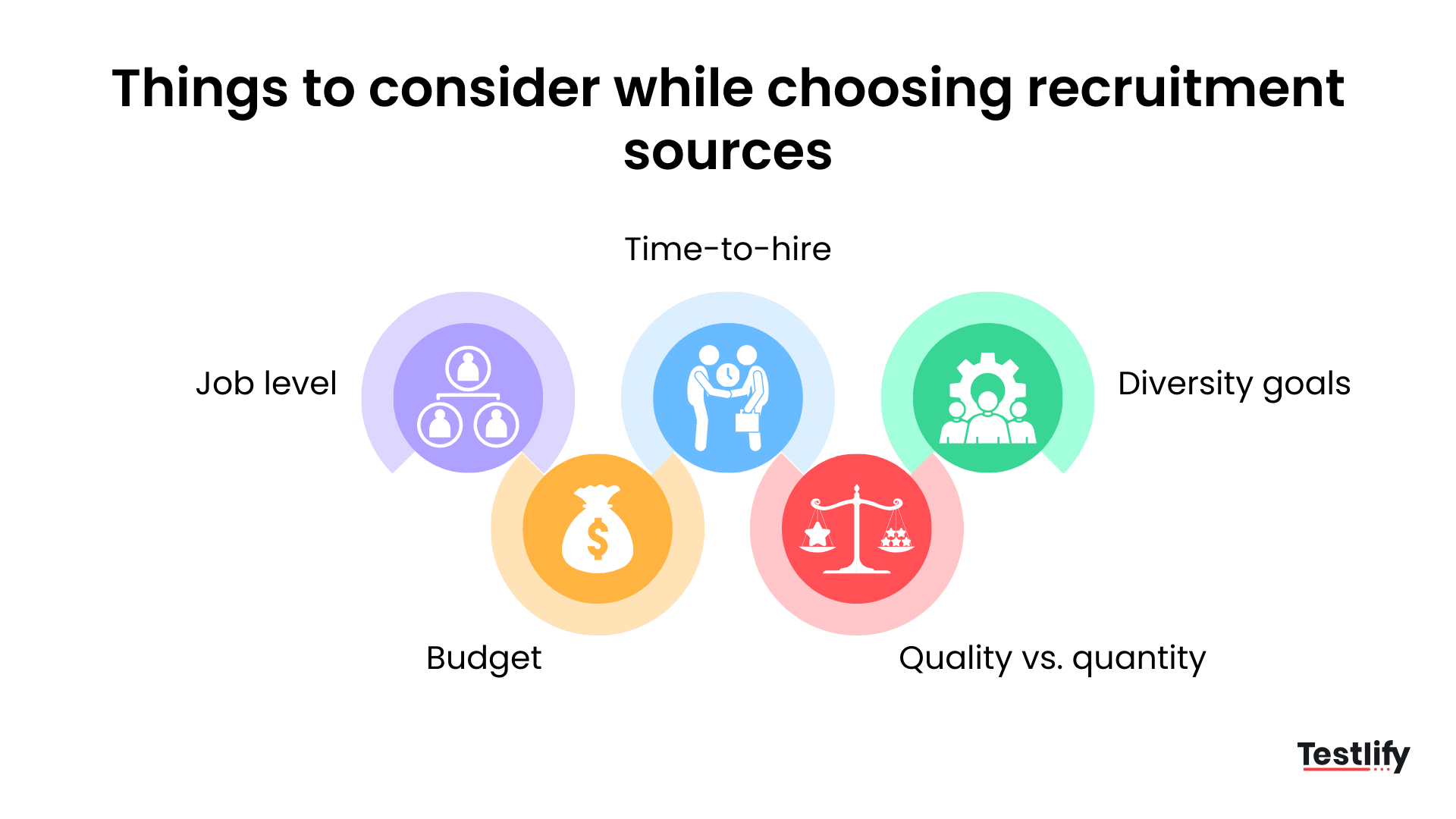
Start from the constraint. If the binding constraint is time, weight internal moves and referrals. If it is capability, weight external channels and accept the longer cycle. If it is cost, your careers site and internal mobility are the cheapest routes you own. Trying to optimise all three at once is how teams end up posting every role to every channel and drowning in unqualified applications.
Then measure. Track quality of hire, retention at 12 months, time to fill, and cost per hire by source, and review it quarterly. Most teams find two or three channels produce the majority of their good hires while budget stays spread evenly across eight. A worked example: a 1,200-person software company hiring 40 people a year might find referrals and direct sourcing produce most of its strong engineering hires, while a third of its recruitment-advertising spend generates volume that never converts. Reallocating that spend costs nothing and changes the pipeline within a quarter. The numbers here are illustrative, but the pattern is common, and you can only see it if source data is tracked properly. Testlify's guide on tracking recruitment sources covers the tooling side.
Fuentes de reclutamiento: internas y externas
Las fuentes de reclutamiento son los canales que una empresa usa para encontrar candidatos, y se dividen en dos grupos. Las fuentes internas cubren una vacante con personas que ya trabajan en la organización, mediante promociones, transferencias y convocatorias internas. Son más rápidas y económicas, y el riesgo es menor porque ya conoces el desempeño de la persona.
Las fuentes externas buscan candidatos en el mercado abierto: portales de empleo, la página de empleo de la empresa, referencias de empleados, agencias de reclutamiento, ferias universitarias, redes profesionales y búsqueda directa. Dan acceso a habilidades que la organización no tiene, aunque cuestan más y toman más tiempo. Cada fuente de reclutamiento tiene ventajas y desventajas, y ninguna funciona bien para todos los puestos. La mejor estrategia casi nunca depende de un solo canal: conviene combinar ambos grupos según el puesto, el presupuesto y la urgencia. El resto de esta guía desarrolla cada punto en inglés.
How do assessments improve every source?
Here is the part most source guides skip. Candidates from different channels arrive carrying completely different evidence. A referral comes with a colleague's judgement attached. A job-board applicant comes with a resume and nothing else. An internal candidate comes with performance history that no external candidate can match. Compare them on impressions and the channel decides the hire, not the person.
The Testlify Multi-Signal Talent Evaluation Model exists for exactly this problem. It combines multiple role-relevant signals, including skills assessments, interviews, work simulations, references, and structured reviewer feedback, so that a candidate advances when several independent signals agree rather than when one strong impression carries them. Applied to source strategy, it does something useful: it makes candidates from different channels comparable on the same evidence, which is the only way to find out which of your sources genuinely produces better hires.
Pro Tip: Run the same assessment on internal and external candidates for the same role, in the same week. Teams that do this are often surprised, and the surprise is the point. An internal candidate everyone assumed was not ready sometimes outperforms the external shortlist, and you learn it before paying an agency fee.
Want to see how structured assessment changes what your sourcing data tells you? Book a demo and walk through it with your own roles. For the wider process context, Testlify also covers building a recruitment team and the internal versus external decision in more depth.
Key takeaways
- Internal sources are the cheapest capacity you already own, and most companies leave it idle. With one in four employees saying advancement is not available to them, and 19 of every 100 workers globally positioned to be upskilled and redeployed internally, the internal pipeline is usually larger than the org chart suggests. Audit it before opening an external requisition, because the fastest hire in the building may already be in it.
- External sources are how you buy capability you cannot grow in time. When 63% of employers call skill gaps their biggest barrier and roughly 40% of job skills are set to change by 2030, some skills simply have to be hired in. Budget for the longer cycle rather than pretending an internal move can substitute.
- Raising your referral bonus is the wrong lever. The research shows bigger bonuses bring more referrals of lower quality, while the program's real value is a roughly 15% reduction in attrition. Keep the program, hold the bonus steady, and measure it on retention rather than on volume.
- Channel strategy belongs to the role, not to the company. A frontline requisition and a principal-engineer search need different channels, different timelines, and different screening. One company-wide sourcing policy guarantees you are wrong on most requisitions.
- Track quality of hire by source or the whole exercise is guesswork. Cost per hire alone will push you toward cheap channels that produce weak hires. Retention at 12 months and hiring-manager satisfaction, split by source, are what tell you where to move the budget next quarter.
- Consistent evaluation is what makes source comparison honest. Candidates arrive from different channels with unequal evidence attached. Putting every candidate through the same structured assessment is the only way to see the channel's contribution rather than the resume's polish.
Frequently asked questions (FAQs)

Content Writer
Yashika Khandelwal is a Content Writer with 3+ years of experience creating research-backed content on hiring, talent assessment, and HR technology. She is a registered Organizational Psychologist and subject matter expert who combines behavioral science with practical recruitment insights to produce accurate, evidence-based content.
LinkedInRelated resources
View all
HR & recruitment
How to improve recruitment diversity: enterprise HR guide

HR & recruitment
The cost of a bad hire in the age of AI: What every company should know

HR & recruitment
How AI is changing the game for job applicants: Navigating the risks in hiring

HR & recruitment
Top 7 recruitment KPIs and how to effectively track them in 2026

HR & recruitment
9/80 work schedule: A definitive guide for 2026

HR & recruitment
What is job enlargement and how to implement it? Pros & Cons
Get started.
Hire on proof, not resumes.
Run your first skills-based assessment free — no credit card required.