
How can companies assess soft skills using AI in skills assessments?
Discover how companies can assess soft skills using AI in skills assessments to improve hiring accuracy, candidate quality, and decision-making.

If you’ve ever hired someone who aced the technical interview but couldn’t survive their first stakeholder meeting, you already know the painful truth: skills tests don’t catch everything. The “everything” they miss is usually soft skills, communication, empathy, adaptability, collaboration, and judgment under pressure. And those are the very skills Harvard Business Review research has long pointed to as the real reason most new hires fail, not technical gaps.
The good news? In 2026, you no longer have to rely on gut feel, vague interview impressions, or a 20-minute behavioral chat to figure out whether someone can actually work well with humans. AI can now measure soft skills with surprising accuracy, and at scale.
This guide walks HR leaders through exactly how it works, which tools matter, what to watch out for, and how to roll it out without creating legal or candidate-experience headaches.
 ChatGPT
 Gemini
 Claude
 Grok
Grok Perplexity
Why are soft skills suddenly the hiring priority?
Soft skills used to be the “nice-to-have” everyone talked about but few measured. That window has closed.
According to LinkedIn’s Workplace Learning Report, 91% of L&D professionals say soft skills, what SHRM now calls “power skills“, are becoming more critical than ever. SHRM’s 2025 Talent Trends report goes a step further: it found that 43% of organizations are now using AI to support HR work, with the majority directing that AI at recruiting. Translation: your competitors are already automating parts of the hiring funnel you’re still doing manually.
There’s a structural reason this shift is happening now. As AI automates more technical tasks, the human skills AI can’t replicate, judgment, persuasion, emotional intelligence, creative problem-solving, become the actual differentiator on a team. A Harvard Business Review Analytic Services report found that 91% of business leaders believe having the right talent is critical for AI success, and increasingly, that “right talent” is being defined by power skills, not just technical depth.
So the question isn’t whether to measure soft skills more rigorously. It’s how.
As recruitment processes become increasingly automated, teams are also adopting tools that simplify candidate sourcing and outreach. Exploring the best LinkedIn automation tools can help recruiters reduce repetitive tasks and spend more time on the human side of hiring, including communication and candidate evaluation.

What are soft skills?
Soft skills are interpersonal and cognitive traits that affect how someone works, not what they technically know. The ones most companies care about:
- Communication: written and verbal clarity, active listening, tone
- Emotional intelligence: self-awareness, empathy, regulating reactions
- Collaboration and teamwork: sharing credit, handling conflict, building trust
- Adaptability and resilience: staying effective when things change
- Critical thinking and problem-solving: breaking down ambiguity, reasoning through trade-offs
- Leadership and influence: getting alignment without authority
- Customer orientation: handling complaints, building rapport, de-escalating
- Coachability: taking feedback and applying it
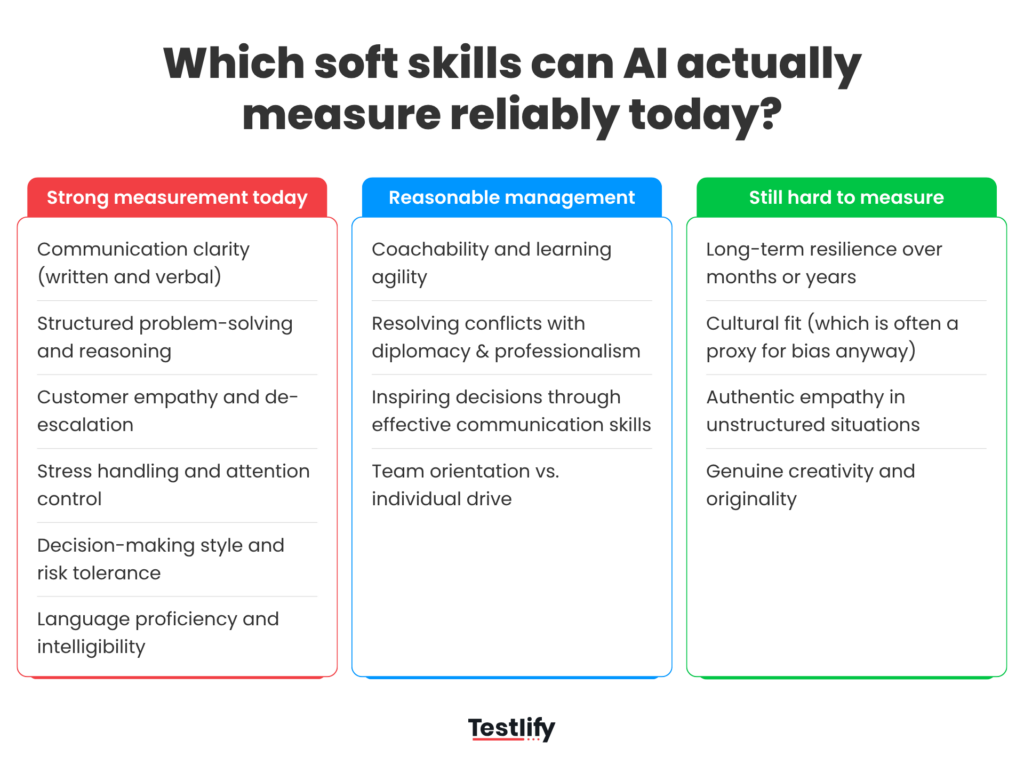
The reason these have always been hard to measure is simple: they show up in behavior, not on a résumé. A degree doesn’t prove empathy. A certification doesn’t prove resilience. And a 45-minute interview only shows you what someone is like during a 45-minute interview.
This is exactly where AI changes the math.
Why is AI better at this than traditional methods?
Traditional soft skills assessment, behavioral interviews, personality questionnaires, and reference checks, has three core problems:
- It’s subjective: Two interviewers can rate the same candidate completely differently.
- It’s gameable: Candidates have practiced “Tell me about a time when…” answers since college.
- It doesn’t scale: You can’t deeply interview 5,000 applicants.
AI helps on all three fronts. It applies the same evaluation criteria to every candidate. It can analyze signals humans miss, micro-patterns in word choice, response structure, and decision-making under time pressure. And it can do this for thousands of candidates in parallel, in minutes.
The result is a more objective baseline that human recruiters can then build on, instead of replace. Think of AI as a high-signal first filter, not the final judge.
6 main ways AI assesses soft skills through
AI doesn’t have one method for measuring soft skills, it has several, and the best assessment stacks combine them. Here are the six you’ll see in the market.
1. AI-powered video interview analysis
This is the most well-known method. Candidates record answers to structured questions, and AI analyzes the response on multiple dimensions: word choice, tone, pacing, structure of the answer (did they actually answer the question?), and increasingly, semantic content, whether their reasoning makes sense.
Modern platforms have moved away from facial-expression scoring (which raised serious bias and validity concerns) and now focus on what candidates say, how they structure their thinking, and which competencies their answers actually demonstrate. Tools like HireVue and Willo are leaders here. HireVue reports that some customers have cut time-to-hire by up to 70% using AI-driven video interviews.
2. Natural language processing on written responses
NLP models can read open-ended written answers and score them against rubrics for things like clarity, empathy, structured reasoning, and customer-centric language. This is particularly powerful for customer support, sales, and management roles where written communication is half the job.
Instead of a recruiter reading 800 short essays, the AI surfaces the top 50 with the strongest signals, and flags any that look AI-generated by the candidate, which is increasingly important.
3. Gamified behavioral assessments
Platforms like Pymetrics pioneered this approach: candidates play short neuroscience-based games that measure attention, risk tolerance, learning from feedback, fairness, and decision-making. The games collect over a thousand behavioral data points per candidate and match them against a profile of high performers already in the role.
The advantage is that games are far harder to game than a personality questionnaire. You can’t strategically click your way to a different cognitive style, your behavior over hundreds of micro-decisions reveals who you are.
4. Conversational AI simulations and role-plays
This is where things get really interesting. AI chatbots and voice agents can now run realistic role-plays, an angry customer, a tough negotiation, a difficult team conversation, and evaluate how the candidate handles them in real time.
For customer-facing roles, this is a near-perfect signal: you’re literally watching the candidate do the job. Platforms like HiringBranch report that their soft-skills AI assessments led to dramatically better retention, they cite that for every top-skilled candidate hired, 27 bottom-skilled candidates quit or were fired within four months, based on a study of 5,000 hires.
5. Voice and speech analysis
Beyond what someone says, AI can analyze how they say it: pacing, filler words, energy, articulation, conversational rhythm. For roles like sales, customer service, and leadership, vocal delivery is part of the actual skill.
This is usually layered onto video interviews and conversational simulations rather than used alone.
6. Continuous performance signals from internal data
For existing employees, AI can pull signals from systems you already have, Slack, email metadata, project management tools, peer review platforms, even calendar patterns, to surface signals about collaboration, responsiveness, knowledge-sharing, and influence.
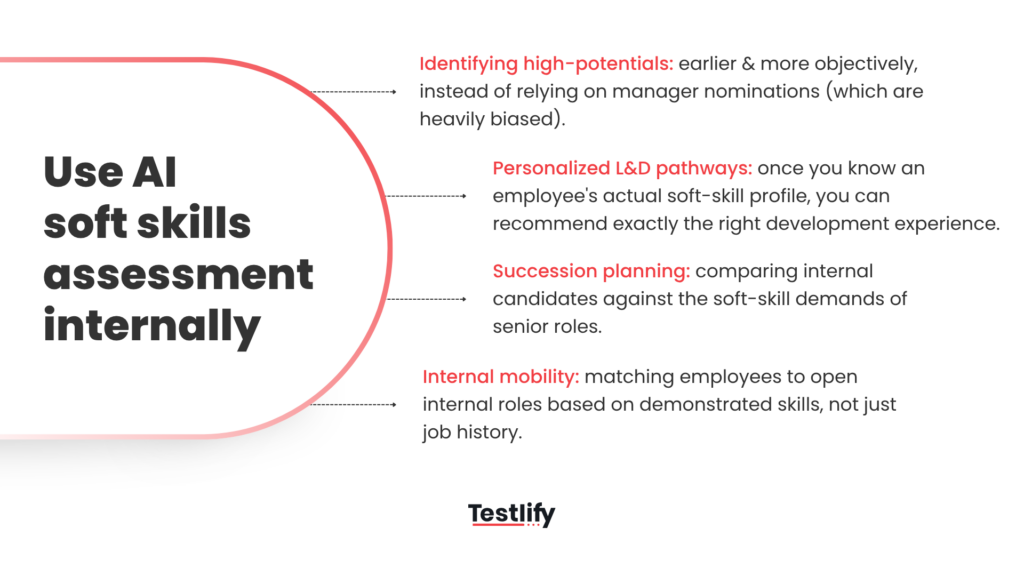
A word of caution: this is where the legal and ethical risks are highest. Most companies use it carefully for development purposes (identifying high-potentials, flagging burnout risk) rather than for performance ratings, and with clear employee consent.
A step-by-step playbook: How HR can roll out an AI soft skills assessment?
Here’s a practical sequence that works for most mid-sized to enterprise teams.
Step 1: Define the soft skills that actually matter for each role
Don’t try to measure everything. Pick the 3–5 soft skills that genuinely predict success in the role. A call-center agent needs empathy, patience, and de-escalation. A senior PM needs influence, structured thinking, and stakeholder communication. These are different.
Build a simple competency model tied to actual on-the-job performance, not a generic “leadership / communication / teamwork” checklist.
Step 2: Choose the right tool for your volume and maturity
Match the tool to your hiring volume and complexity. High-volume frontline roles (support, sales, retail) benefit most from conversational AI simulations and gamified assessments. Mid-funnel professional roles benefit from AI video interview analysis layered on structured questions. Leadership hires still need heavy human involvement, use AI for pattern recognition, not decision-making.
Evaluate vendors on: scientific validation (ask for the validity studies), bias auditing, ATS integration, candidate experience, and explainability of the scores.
Step 3: Validate the tool against your own performance data
This step is the one most HR teams skip, and it’s the one that separates a real assessment program from buying expensive software. Run the tool on a sample of your existing employees whose performance you already know. Does the AI’s soft-skills score correlate with their actual performance ratings, retention, and promotions? If yes, you have a tool that works for your context. If not, you have a black box.
Step 4: Build in human oversight
California’s Civil Rights Council regulations, which took effect October 1, 2025, explicitly require meaningful human oversight of any automated decision system used in hiring, with someone trained and empowered to override the AI. Even where the law doesn’t mandate it, you should. AI should narrow your funnel and provide signals; humans should make final decisions, especially negative ones.
Step 5: Integrate with your ATS and HRIS
A standalone assessment tool that doesn’t talk to your ATS is friction your team won’t tolerate. Native integration with platforms like Workday, Greenhouse, SAP SuccessFactors, or Lever is now table stakes, make sure scores flow automatically into the candidate record.
Step 6: Communicate transparently with candidates
Candidates increasingly want to know when AI is being used and how. A Harvard Business Review study of over 13,000 participants found that when candidates knew they were being assessed by AI, they tended to emphasize analytical traits and downplay empathy, creativity, and intuition, which can distort your results. So you need clear disclosures, but also assessment design that signals “we want the real you, not robot-you.”
Tell candidates what’s being measured, give them an alternative assessment route if they have a disability that affects the digital format (this is a legal requirement under ADA in the US), and offer feedback where possible.
Step 7: Measure outcomes, not just adoption
After 6–12 months, ask the only questions that matter: Did quality of hire improve? Did first-year attrition drop? Did time-to-hire decrease? Did manager satisfaction with new hires increase? Did adverse impact ratios stay within acceptable thresholds across protected groups?
If you can’t answer those, you’re using AI for the appearance of rigor, not the substance of it.
The risks you have to manage
AI in hiring is now under serious legal scrutiny. The optimistic narrative has met reality. Here’s what to actually worry about.
Bias and disparate impact
AI models learn from historical data, and historical hiring data is full of bias. A model trained to find “successful” candidates from a dataset where most past successful candidates were one demographic will reproduce that pattern. The Workday class action, which was certified in 2025, is the clearest warning shot yet: vendors and the employers using them can both be on the hook for algorithmic discrimination claims.
Run regular bias audits. New York City’s Local Law 144 requires annual independent bias audits for any automated employment decision tools used on NYC candidates. Best practice now is continuous monitoring, not annual snapshots.
Compliance across jurisdictions
The legal landscape is fragmented and moving fast. The EU AI Act treats hiring AI as high-risk and imposes strict requirements. California’s October 2025 regulations require human oversight, bias testing, four-year record retention, and reasonable accommodations. Colorado’s AI Act and a growing list of state-level laws are following. If you hire across jurisdictions, your tool stack needs to be compliant with the strictest one.
Candidates gaming the AI
When candidates know AI is reading their responses, they adapt. They use the keywords they think the model wants, they answer the way they think a “good candidate” sounds. Mix assessment types, gamified, conversational, written, video, so candidates can’t optimize for a single channel.
Over-reliance and loss of human judgment
The biggest organizational risk is cultural: hiring teams stop trusting their own judgment and outsource the decision to a confidence score on a dashboard. AI should expand the funnel and surface signals you’d otherwise miss, not narrow your thinking to whatever the algorithm rewards.
The bottom line
Soft skills are no longer the squishy part of hiring. They’re the part AI is actually really good at measuring at scale, if you use the right tools, validate them on your own data, keep humans in the loop, and stay ahead of the compliance curve.
The HR teams that will win the next decade aren’t the ones using AI to automate hiring. They’re the ones using AI to see people more clearly than they ever could before, across thousands of applicants and across their entire workforce, and then making smarter, faster, fairer decisions about how to deploy talent.
That’s the real opportunity here. The technology is ready. The question is whether your hiring process is.
Frequently asked questions (FAQs)
Related resources
View all
Skill assessment
Why skill assessments is essential for recruiters in 2026

Skill assessment
Technical assessments: what they are and why they matter
Skill assessment
The future of coding assessments in the hiring process

Skill assessment
Common mistakes to avoid while creating coding assessment
Skill assessment
How to use coding assessments to hire the right talent
Skill assessment
Bridging the skills gap for sports teams
Get started.
Hire on proof, not resumes.
Run your first skills-based assessment free — no credit card required.