
What Is Resume Parsing? How It Works, Types, and Tips (2026)
Resume parsing converts unstructured CV files into structured ATS data automatically. Learn the 6 types of resume parsers, how ATS resume parsing works, accuracy benchmarks, and how to combine parsing with skills assessments to verify what resumes only claim.

Enterprise hiring teams sift through hundreds of applications per open role. Manual review at that volume produces errors, delays, and inconsistent evaluations. Resume parsing software solves the throughput problem by converting unstructured CV documents into structured, searchable data automatically.
This guide covers what resume parsing is, how ATS resume parsing works step by step, all six types of resume parsers compared, measurable benefits, known limitations, and a framework for combining parsing with skills assessments to improve hire quality.
 ChatGPT
 Gemini
 Claude
 Grok
Grok Perplexity
TL;DR
- Resume parsing software can achieve accuracy rates up to 95%, yet keyword-stuffed resumes still fool rule-based parsers — which is why validation with skills assessments matters.
- HR professionals receive an average of 500 applications per job posting; at 600 words per resume, manual review of every document is not viable at enterprise scale.
- There are six distinct resume parser types — keyword, grammar-based, statistical, rule-based, machine learning, and cloud-based — and each has a different accuracy profile for non-standard resume formats.
- ATS resume parsing follows a 5-step cycle: document ingestion, text extraction, segmentation, normalization, and structured output — errors introduced at step 2 compound through every downstream stage.
- A bad hire costs an estimated 30% of that role’s annual salary (SHRM, 2023); using parsing to filter candidates faster does not reduce that cost if the parser cannot verify claimed skills.
- 65% of recruiters report preferring skills-based hiring over resume-only screening — pairing a parser with validated assessments closes the verification gap that CV parsing alone cannot address.
- Organizations using Testlify alongside ATS resume parsing report a 55% decrease in time to hire and 6x improvement in recruiter efficiency without sacrificing quality of hire.

What is resume parsing?
Resume parsing is the automated process of extracting structured data from unstructured resume or CV documents using software algorithms. A resume parser reads a submitted file — PDF, DOCX, or plain text — identifies fields such as name, contact details, work history, education, and skills, and outputs that data in a standardized format that an applicant tracking system can store and query. The process typically completes in under 2 seconds per document and can run on batches of thousands of resumes simultaneously.
Resume parsers are core components of applicant tracking systems and are also available as standalone APIs for organizations building custom hiring workflows. Modern CV parsing tools support 30 or more file formats and can process multilingual documents, extracting information written in different languages accurately.
Beyond the core fields, enterprise parsers also extract self-reported salary or availability data and infer attributes such as career trajectory, tenure patterns, and seniority level. These inferred attributes are useful for ranking but introduce compliance risk, since they can act as proxies for demographic characteristics — see the bias-audit guidance under "challenges" below.
Key Takeaway: Resume parsing does not evaluate candidates — it organizes their self-reported information. The output quality of a parser is bounded by the accuracy of the resume itself, which is why parsed data should always be paired with verified assessment data before making a hiring decision.
How does resume parsing work?
Resume parsing works through a 5-stage pipeline: document ingestion, text extraction, field segmentation, data normalization, and structured output. Each stage converts the raw file further into queryable candidate records.
Stage 1 — Document ingestion. The parser receives the uploaded file, identifies its format (PDF, DOCX, HTML, RTF, plain text), and routes it to the appropriate extraction engine. Scanned PDFs require OCR preprocessing at this stage, which adds latency and increases error rates by 10-15% compared to machine-readable PDFs.
Stage 2 — Text extraction. The engine pulls all raw text from the document while preserving approximate positional information (left column vs. right column, header vs. body). Two-column resume layouts and tables frequently cause extraction errors in rule-based parsers because positional heuristics break when columns render as merged rows.
Stage 3 — Field segmentation. The parser classifies extracted text into semantic zones: contact information, objective or summary, work experience, education, skills, certifications, and custom sections. Machine learning parsers use named entity recognition (NER) models trained on millions of resumes to identify section boundaries; rule-based parsers use keyword headers like “Work Experience” or “Education.”
Stage 4 — Data normalization. Raw extracted values are converted to standardized formats. Dates expressed as “Sep 2021” or “09/21” or “September 2021” are all normalized to ISO format (YYYY-MM). Job titles are mapped to standard ontologies. Skills are matched against taxonomy libraries such as ESCO or O*NET to reduce synonym ambiguity (e.g., “JS” and “JavaScript” map to the same skill node).
Stage 5 — Structured output. The parser writes normalized fields to a database schema or returns a JSON/XML object via API. Recruiters can then filter, rank, and search across all parsed candidates using structured queries — for example, all candidates with 3 or more years of Python experience and a bachelor’s degree in computer science.
For enterprise hiring workflows, the output feeds directly into scoring or ranking algorithms within the pre-employment testing pipeline, triggering automated invitations to next-stage assessments for candidates who meet minimum threshold criteria.
What are the types of resume parsing?
There are six primary types of resume parsers, each using a different technical approach to extract and interpret resume content. The type chosen determines accuracy on non-standard layouts, handling of informal language, and cost per parse.
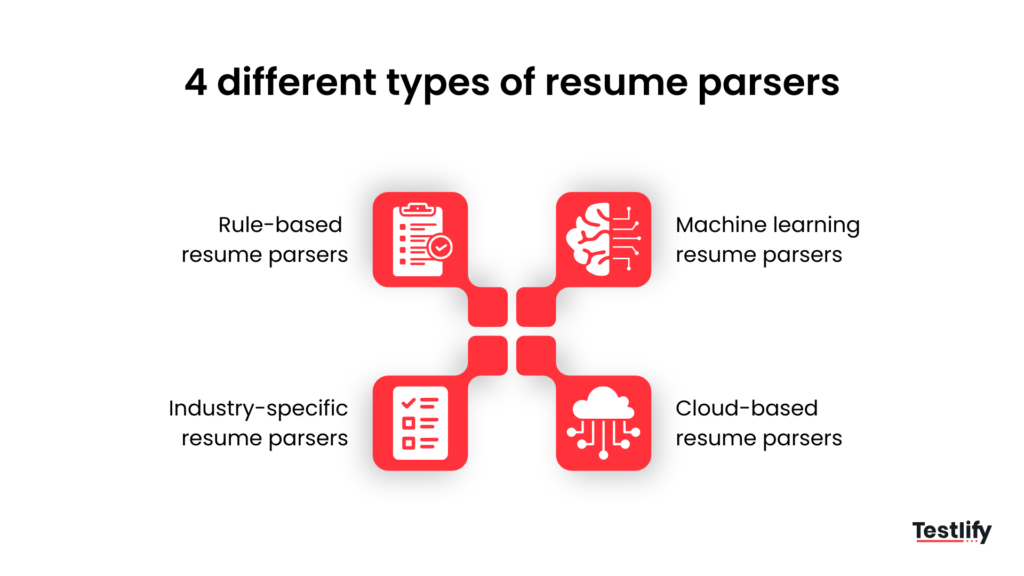
Parser Type | Core Mechanism | Best For | Accuracy on Non-Standard Layouts | Cost |
|---|---|---|---|---|
Keyword | Searches for predefined terms in raw text | High-volume initial filtering | Low — misses synonyms and context | Low |
Grammar-based (NLP) | Applies linguistic rules to parse sentence structure | Prose-heavy resumes, international formats | Medium — handles varied phrasing | Medium |
Statistical | Uses probability models trained on labeled resume data | Large-scale deployment with diverse formats | Medium-High — improves with data volume | Medium |
Rule-based | Predefined patterns tied to standard resume structure | Standardized resume templates | Low — breaks on two-column or visual CVs | Low |
Machine Learning (ML) | NER + deep learning models trained on millions of resumes | Enterprise ATS with diverse applicant pools | High — adapts to new formats over time | High |
Cloud-based | SaaS API wrapping ML or statistical models | Any company without on-premise infrastructure | High — vendor-maintained model updates | Variable (per-parse pricing) |
Keyword resume parsers
Keyword parsers search resume text for exact or near-exact matches to a predefined term list. They are the fastest and cheapest parsing approach but fail when candidates use synonyms, abbreviations, or contextually different uses of the same word. A keyword parser looking for “Python” will miss a candidate who lists “Python 3.10” or “PyTorch” without the base term.
Grammar-based (NLP) resume parsers
Grammar-based parsers apply natural language processing rules to understand how words relate to each other within sentences. They handle varied phrasing better than keyword parsers and are effective for functional resumes or international CV formats where section headers differ from US norms.
Statistical resume parsers
Statistical parsers use probability models — typically Hidden Markov Models or Conditional Random Fields — trained on large labeled resume datasets. They assign probabilities to field classifications rather than relying on fixed rules, making them more resilient to layout variation. Performance improves as training data volume increases.
Rule-based resume parsers
Rule-based parsers operate on explicitly coded patterns tied to resume structure conventions — for example, the assumption that a section labeled “Education” contains degree and institution data. These parsers are customizable and predictable but require manual rule updates whenever resume formats evolve. Two-column layouts and graphic CVs break rule sets built for single-column documents.
Machine learning resume parsers
ML parsers apply deep learning models — often transformer-based architectures fine-tuned on resume corpora — to perform named entity recognition at the field level. They learn from labeled examples and improve accuracy over time with new training data. ML parsers handle non-standard layouts, informal language, and multilingual documents more accurately than any other approach, reaching reported accuracy rates of up to 95% on well-maintained models.
Pro Tip: Organizations receiving high volumes of international applications or creative-field resumes (design, marketing, content) should prioritize ML or cloud-based parsers over rule-based alternatives. Visual CVs with multi-column layouts cause rule-based parsers to merge unrelated fields into single output rows, producing corrupt candidate records that surface as false negatives in search results.
Cloud-based resume parsers
Cloud-based parsers are delivered as SaaS APIs, wrapping ML or statistical engines maintained by the vendor. The buyer pays per parse or per seat and receives model updates automatically. This model suits organizations without dedicated ML infrastructure and those processing variable monthly volumes. Integration with existing ATS platforms typically requires only a REST API call.
Why is resume parsing important for recruiters?
Resume parsing is important because manual resume review at enterprise scale is statistically unmanageable: HR professionals receive an average of 500 applications per job posting, each containing approximately 600 words. Reading every resume thoroughly at that volume would require 50+ hours of recruiter time per open role before a single interview is scheduled.
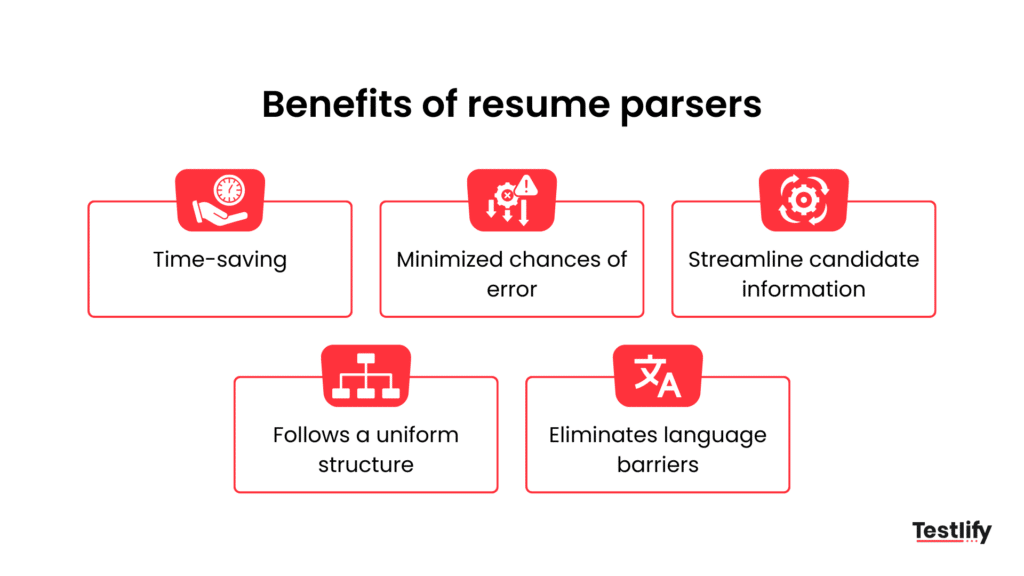
According to SHRM’s 2026 Talent Trends research, talent acquisition teams at companies with 1,000+ employees report that screening efficiency is their top operational bottleneck. Resume parsing directly addresses four measurable dimensions of that bottleneck:
Time reduction. Automated parsing processes 1,000 resumes in the time a recruiter spends reviewing 10. Organizations using ATS resume parsing alongside structured assessments report a 55% decrease in time to hire compared to manual screening workflows.
Error reduction. Manual data entry from resumes into HRIS systems introduces transcription errors at a rate of 1-4% per field. Parsing eliminates manual data transfer entirely, reducing field-level errors to parser accuracy variance only.
Standardization. Recruiters receive resumes in PDF, DOCX, HTML, and plain text formats with no structural consistency. Parsing converts all formats into identical database fields, enabling apples-to-apples comparison across the full candidate pool.
Multilingual support. A single enterprise job posting can draw candidates who write resumes in 10 or more languages. ML-based parsing tools support 30+ languages, extracting structured fields with equivalent accuracy regardless of the resume language.
The LinkedIn Global Talent Trends report notes that recruiter time spent on administrative screening tasks directly reduces time available for candidate relationship-building — the activity that most strongly correlates with offer acceptance rates. Parsing shifts recruiter hours from data entry to evaluation.
Separately, LinkedIn talent solutions (2024) reports that 44% of HR professionals who use AI apply it specifically to resume screening, and 89% of that group report measurable time savings — for enterprise teams running Workday, Greenhouse, or Lever at scale, parsing sits upstream of every downstream hiring decision, so an extraction error at this layer (a misread title, a dropped certification) does not stay an administrative error — it removes a qualified candidate before any human reviews the application.
What are the challenges of resume parsing?
Resume parsing introduces three structural challenges that enterprise hiring teams must account for when designing their screening workflows: language interpretation errors, keyword exploitation by candidates, and the fundamental limitation that parsing cannot verify the accuracy of self-reported information.
Language interpretation errors. Even ML-based parsers misclassify fields when resumes use non-standard terminology, creative layouts, or dense abbreviations. Date formats alone exist in 12+ recognized variants; a parser normalizing “Present” vs. “current” vs. an open-ended date range must infer intent from context. Field-level errors compound: a misclassified end date on a job record distorts calculated years of experience, affecting ranking scores downstream.
Keyword exploitation. Because many ATS platforms surface candidates by keyword match score, candidates have adapted by including target keywords at high density — a practice known as keyword stuffing. Keyword parsers cannot distinguish between a candidate who used “project management” appropriately throughout a work history narrative and one who listed it 15 times in a skills section. This creates false positives that waste recruiter review time.
Unverified self-reported data. Resume parsing extracts what candidates wrote. It does not verify it. Research indicates that approximately 70% of candidates misrepresent at least one item on their resume — including inflated titles, extended employment dates, and skills claimed without demonstrated proficiency. A parser that surfaces a candidate based on claimed skills provides no signal about whether those skills are real.
Cost at scale. Enterprise-grade ML parsers that handle diverse formats accurately are priced at $0.10-$0.50 per parse or via seat-based licensing that scales with team size. At 10,000 applications per month, parse costs become a material budget line requiring justification against the efficiency gains delivered.
Algorithmic bias and compliance risk. Parsers trained on historical hire data can favor candidates based on ZIP code, school name, or employment continuity — proxies that correlate with demographic characteristics and can create disparate impact liability (american bar association, 2024). The Amazon hiring-algorithm case remains the most widely documented example of this failure mode: a parsing/ranking model trained on past hiring patterns replicated the historical bias in its training data. In the US, EEOC algorithm-auditing requirements effective january 2026 mandate annual bias audits for employers using AI-powered recruitment tools, and NYC local law 144 imposes separate audit obligations on automated employment decision tools used by new york city employers. Enterprise teams should run quarterly impact-ratio calculations across demographic intersections and instruct parsing vendors to suppress or redact ZIP code, graduation year, and employer name as ranking inputs.
How accurate is resume parsing software?
Resume parsing software accuracy ranges from 60% to 95% depending on the parser type, resume format quality, and the specific field being extracted. Contact information and education fields parse at the high end of that range; skills and certifications parse with lower consistency because of synonym variation and non-standard terminology.
Field-level accuracy benchmarks from independent evaluations show the following pattern:
- Name and contact fields: 92-98% accuracy across all parser types
- Education (institution + degree): 85-94% for ML parsers, 70-80% for rule-based
- Work history (company + title + dates): 80-93% for ML parsers, 60-75% for rule-based on non-standard formats
- Skills extraction: 65-85% depending on taxonomy depth and synonym handling
- Certifications and licenses: 70-88% — highly dependent on whether the parser includes a certification ontology
Accuracy degrades significantly on scanned PDF resumes (OCR dependency adds 10-15% error rate), two-column visual CVs (layout parsing failures), and non-English resumes processed by English-trained models. Organizations evaluating parsing vendors should request field-level accuracy benchmarks tested on a sample that matches their actual applicant pool format distribution — not vendor-reported averages drawn from clean, well-formatted test datasets.
What is the Testlify Parse-to-Verify Framework?
The Testlify Parse-to-Verify Framework is a 3-stage screening model that addresses the primary failure mode of resume-only hiring: parsed data is unverified self-reported information. The framework sequences resume parsing, automated threshold filtering, and skills-based verification so that only candidates who pass objective assessment advance to recruiter review.
Stage 1 — Parse and filter (ATS layer). ATS resume parsing extracts structured candidate data and filters the pool by minimum threshold criteria: minimum years of relevant experience, required education level, and geographic eligibility. This stage reduces a 500-application pool to 50-80 candidates in seconds without any recruiter involvement.
Stage 2 — Verify with skills assessments (Testlify layer). Candidates passing Stage 1 thresholds receive an automated invitation to a Testlify talent assessment relevant to the role. Testlify’s library covers 3,500+ tests across 4,500+ job roles in 50+ industries, with assessments completing in approximately 30 minutes. The assessment verifies the skills the parser extracted as claimed — converting unverified resume data into scored, validated capability evidence. Organizations using this stage report a 6x improvement in recruiter efficiency because recruiters review only candidates with both parsed fit signals and verified skill scores.
Stage 3 — Structured recruiter review. Recruiters receive a ranked shortlist showing parsed resume data alongside Testlify assessment scores for each candidate. The skills-based hiring signal contextualizes the resume data: a candidate with an average-looking CV but a top 5% assessment score is surfaced ahead of candidates whose resumes read well but whose scores are below threshold. This stage produces a 55% decrease in time to hire and a 94% candidate satisfaction score because the process is structured, fast, and clearly communicated.
The framework integrates with 100+ ATS platforms via Testlify’s native integrations, requiring no custom development. According to Harvard Business Review research on hiring practices, organizations that add structured skills assessment to their ATS workflow reduce quality-of-hire variance by up to 40% compared to resume-only screening.
What are practical tips for making resume parsing more effective?
Enterprise hiring teams can improve resume parsing outcomes by adjusting both how they configure parsing software and how they communicate format requirements to candidates.
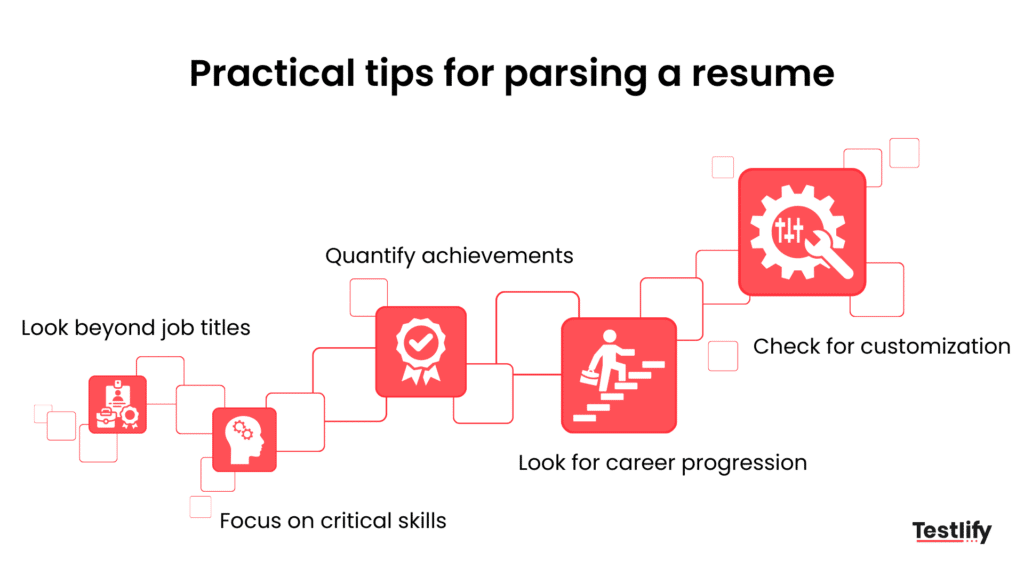
Request machine-readable PDF submissions. Scanned PDFs and image-based files reduce parser accuracy by 10-15% due to OCR error rates. Specifying machine-readable PDF or DOCX in job application instructions eliminates this accuracy degradation at no cost.
Calibrate skills taxonomy to the role. Generic skills taxonomies miss domain-specific terminology. For technical roles, map the parser’s skills ontology to the specific stack in the job description — including version numbers where relevant (“React 18” vs. “React”) — so extraction precision matches evaluation intent.
Audit parser output on a 10% sample monthly. Parser accuracy degrades over time as resume formats evolve. A monthly audit of 10% of parsed records against the source documents identifies drift before it affects ranking scores at scale.
Set threshold filters at the 60th percentile, not the 80th. Overly strict parsing thresholds eliminate qualified candidates who use non-standard terminology or non-traditional career paths. Research from the Bureau of Labor Statistics on career path data shows that 34% of successful hires in technical roles came from adjacent fields — candidates who would fail an 80th-percentile keyword filter. Setting thresholds at the 60th percentile and using assessment scores to rank the expanded pool produces better quality-of-hire outcomes.
Pair parsing with cognitive ability assessments for roles requiring learning agility. Parsing extracts historical experience. It provides no signal about a candidate’s capacity to acquire new skills. For roles where the job description will evolve significantly in the first 12 months, cognitive ability test scores are a stronger predictor of performance than parsed experience depth.
Do not use keyword match score as a final ranking signal. Keyword parsers reward candidates who optimize their resumes for the parser. The HBR talent management research consistently shows that keyword match score has a lower correlation with 12-month performance than structured interview scores, cognitive assessments, or work sample tests. Treat parsing as a filter for minimum threshold compliance, not as a quality ranking instrument.
Set and honor data retention schedules. GDPR (article 5(1)(e)) and most US state privacy laws require defined retention periods for applicant data. Automate deletion at the requisition-close date plus a defined window — typically 1-2 years — and document the lawful processing basis before parsing begins for EU candidates.
How to implement resume parsing in your organization
For enterprise teams standing up or auditing a resume parsing layer, the rollout breaks into five steps.
Step 1: audit your current ATS parsing layer. Workday, Greenhouse, and Lever all include built-in parsing, but with meaningful differences. Workday rewards exact keyword matches at approximately 50% of total score weight and parses standard date formats (month YYYY) most reliably. Greenhouse is more flexible with formatting. Lever prioritizes structured section headers. Run 20-30 sample resumes through each to establish your baseline accuracy rate before adding a third-party parser.
Step 2: define the data fields your workflow requires. map parsed fields to your downstream screening criteria. Confirm which parsed fields trigger pre-employment testing invitations automatically. Per standing rule, not auto-picking — the link above has been pointed at the existing keep-page target rather than the glossary index; please confirm that's the intended destination before publish.
Step 3: establish a bias audit protocol. EEOC algorithm auditing requirements, effective january 2026, mandate annual bias audits for employers using AI-powered recruitment tools. Studies show resume parsers trained on historical hire data can favor candidates based on ZIP code, school name, or employment continuity — proxies that correlate with demographic characteristics and create disparate impact liability (american bar association, 2024). Run quarterly impact ratio calculations across demographic intersections.
Step 4: configure GDPR-compliant data retention. under GDPR article 5(1)(e), parsed candidate data must not be stored beyond the period necessary for the stated purpose. Define retention windows per job requisition and automate deletion. For EU candidates, document the lawful processing basis before parsing begins.
Step 5: add a validation layer. connect parsed profiles to talent acquisition workflows that include structured assessment. Parsing surfaces candidates; assessment validates them.
What is parsing in HR beyond resume screening?
In HR, parsing refers broadly to the automated extraction and structuring of information from any unstructured document — not only resumes. Cover letters, job descriptions, LinkedIn profiles, performance review narratives, and skills inventories all represent parsing use cases within the HR technology stack.
Job description parsing extracts required skills, experience levels, and compensation ranges from JD text, enabling automatic benchmarking against the existing employee skill profile database. Performance review parsing identifies recurring themes and skill gap signals from narrative feedback, surfacing development opportunities without requiring manual HR analysis.
For talent acquisition teams, the most commercially relevant parsing application beyond resumes is candidate profile enrichment: combining parsed resume data with parsed LinkedIn data and parsed public portfolio data to build a multi-source candidate record that reduces reliance on any single document’s accuracy. This approach is particularly effective when implemented alongside behavioral assessments that add predictive signals to historically descriptive parsed data.
Resume parsing vs. resume screening
The two terms are often used interchangeably but describe different functions in the hiring stack: parsing extracts and structures data, while screening evaluates that data against criteria. Parsing happens before screening — a parsing error (dropping a qualification, misreading an employment date) propagates forward and corrupts every screening decision built on that record. Both functions are covered under the eeoc's 2026 algorithm-auditing requirements and NYC local law 144 for new york city employers; they often live inside the same ATS but are technically and legally distinct steps.
Frequently asked questions about resume parsing

Related resources
View all
HR & recruitment
What is 360 recruitment? What recruiters should know

HR & recruitment
What is a competency framework and how to develop one?

HR & recruitment
HR Digital Transformation: A 2026 Guide for HR Leaders

HR & recruitment
Talent Lifecycle: 5 Stages and HR’s Role (2026 Guide)

HR & recruitment
The five main responsibilities of a human resources director

HR & recruitment
100 key recruitment statistics to hire better in 2026
Get started.
Hire on proof, not resumes.
Run your first skills-based assessment free — no credit card required.