
How to build an inclusive workplace: 12 steps for 2026
Twelve steps to an inclusive workplace, from leadership commitment and fair hiring to daily habits, legal guardrails and inclusion metrics.

Knowing how to build an inclusive workplace comes down to one test: can every employee contribute fully, be heard and progress on merit, whatever their background? An inclusive workplace is one where people of every background, identity and working style are respected, get a fair shot at hiring, pay and promotion, and can speak up without fear. Diversity is who you hire. Inclusion is how those people are treated once they arrive.
TL;DR / Key Takeaways
- To build an inclusive workplace, start with leadership commitment, measure where you stand, then fix hiring, pay, promotion and everyday habits, and track progress every quarter.
- Belonging pays off in retention: SHRM found 61% of workers unhappy with their sense of belonging had seriously considered quitting in the past year, against 18% of those who were satisfied.
- Respect is the weak spot: Gallup reports only 37% of US employees strongly agree they are treated with respect at work.
- Inclusion starts at hiring. Structured, skills-based selection gives every candidate the same questions and scoring, which cuts room for bias.
- Keep programs open to everyone. Under 2025 EEOC guidance, limiting employee resource groups or training to one protected group can be unlawful.
- Measure inclusion with survey scores, promotion and pay gaps, exit reasons and who gets recognized, not with headcount alone.
 ChatGPT
 Gemini
 Claude
 Grok
 Perplexity
What is an inclusive workplace?
An inclusive workplace is an organization where every employee is valued, treated fairly and able to contribute fully, regardless of sex, race, age, religion, disability, sexual orientation, background or working style. Differences are treated as part of how the team gets better results, not as something to manage around. Testlify's HR glossary entry on inclusion covers the term in more depth.
Diversity, inclusion and belonging are related but not the same. A company can hire a diverse team and still lose people if they feel ignored, talked over or passed over for promotion.
Diversity | Inclusion | Belonging | |
|---|---|---|---|
What it means | The mix of people on the team | How those people are treated and heard | How people feel about being there |
Question it answers | Who is in the room? | Does everyone get a fair say and a fair shot? | Do people want to stay? |
How you see it | Hiring and headcount data | Pay, promotion and participation data | Engagement and exit surveys |
What it needs | Fair, wide-reaching hiring | Fair systems and inclusive managers | Both of the above, over time |
In an inclusive workplace, differences in backgrounds, personalities, opinions and work styles are respected. How a team handles those differences decides whether they create conflict or better ideas.

Why does building an inclusive workplace matter?
Building an inclusive workplace matters because it keeps good people, improves decisions and lowers legal risk. Employees who feel respected and included are more engaged, stay longer and speak up with ideas and problems early, when they are cheaper to fix.
- Higher engagement and retention: The SHRM Global Employee Monitor (October 2026, 5,107 workers in 26 countries) found 74% of workers feel a sense of belonging. Among workers dissatisfied with their belonging, 61% had seriously considered quitting in the past year, against 18% of satisfied workers. Lower turnover cuts recruiting and training costs.
- More creativity and better decisions: Teams that hear different viewpoints spot more risks and generate more options. Diverse perspectives only help when people feel safe enough to share them.
- Better customer understanding: A workforce that reflects its customers understands their needs better, which builds trust and loyalty.
- Fewer legal risks and costs: Fair, consistent processes reduce the chance of discrimination complaints, fines and damage to your reputation.
- A stronger employer brand: Candidates notice how a company treats people. Inclusive practices make it easier to attract talent for hard-to-fill roles.
Key takeaway: Inclusion is a retention and decision-quality lever, not only a values statement. Treat it like any other business program, with an owner, a budget and metrics.
How to build an inclusive workplace: 12 steps
The 12 steps below fall into four stages: commit, hire and promote fairly, build daily habits, and measure. Work through them in order, but expect to run several at once.
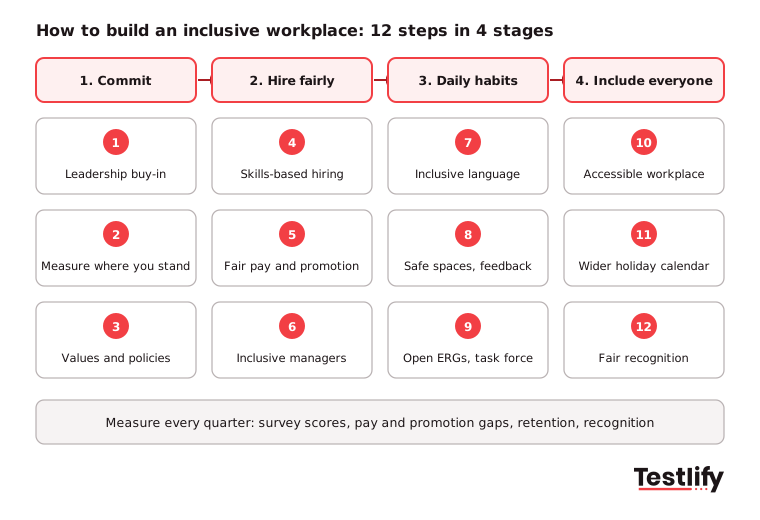
1. Get leadership buy-in and hold leaders accountable
An inclusive workplace starts at the top. Leaders set the tone, release the budget and show through their own behavior that inclusion is a priority. Without that commitment, efforts stall after the first workshop.
Ask leaders to take part in training, address their own unconscious bias and visibly support fair policies. Then hold them to it: set clear goals, review progress in leadership meetings and tie part of each leader's review to their team's inclusion results. Deloitte describes six traits of inclusive leaders: commitment, courage, awareness of bias, curiosity, cultural intelligence and collaboration.
2. Measure where you stand first
Run an anonymous inclusion survey and review your people data before launching anything. Look at pay, promotion rates, project assignments and exit reasons by team and level. The gaps tell you where to start, and the baseline lets you prove progress later.
3. Write inclusion into your core values and policies
Revisit your core values and state a clear commitment to fair treatment and inclusion. Ask employees, including those from underrepresented groups, for input on the wording. Then check that hiring, promotion, project allocation and resource decisions actually follow the values. A value that is never used in a decision is only a slogan.
4. Hire on skills with a fair, structured process
Hiring is where most exclusion begins. Recruit from wide talent pools, write job descriptions that list the skills a role needs instead of proxies like specific degrees, and score every candidate on the same criteria. Structured interviews and skills assessments give every candidate the same questions and scoring guide, so decisions rest on evidence rather than gut feel or "culture fit". For a step-by-step view, see how to design a fair and inclusive hiring process.
Pro tip: Agree on the scoring rubric before you see any candidates. Criteria written after the first interview tend to describe the candidate the panel already liked.
5. Make pay, projects and promotions fair
Fair project placement and promotion use clear, consistent criteria for evaluating skills and interests, which removes favoritism. Review compensation each year for unexplained gaps (see Testlify's guide to pay equity) and publish how promotion decisions are made. A sponsorship program, where senior leaders advocate for high-potential employees, widens access to stretch roles. Keep it open to every employee and select sponsees on clear criteria.
6. Train managers to lead inclusively
Managers shape most of an employee's daily experience. Train them to run inclusive meetings: share agendas in advance, use accessible formats, set ground rules, invite quieter people to speak and follow up in writing. Encourage frequent one-on-one sync-ups, where employees can raise concerns, ideas or a microaggression they experienced. Teach managers to listen without judgment and to follow up on what they hear. Ongoing diversity training works better than one session a year.
7. Model inclusive language
Language signals who belongs. Use gender-neutral terms, address people by their names and pronouns, and avoid assumptions about anyone's background, family or abilities. Leaders should set the example, correct their own mistakes briefly and share simple written guidelines so everyone knows what good looks like. Apply the same standard to job ads, internal emails and client communication.
8. Create safe spaces and real feedback loops
Psychological safety means people can speak up, disagree or admit a mistake without fear of judgment or reprisal. Create channels for it: listening sessions, anonymous surveys, town halls, private rooms and moderated online forums. Leaders should visibly back these spaces, respond to what they hear and report back on changes made. When a misstep happens, apologize, listen, act and check in later.
9. Build employee resource groups and an inclusion task force
Employee resource groups (ERGs) bring together people with shared identities, interests or experiences. Give them a clear purpose, an executive sponsor and a small budget, and keep membership open to anyone who wants to join. An inclusion task force with members from different levels, departments and locations can review policies, suggest training and track commitments. Give it a clear mandate, share its progress across the company and avoid asking the same few people to carry the load.
10. Make the workplace accessible to everyone
Accessibility covers buildings, tools and schedules. The CDC reports that more than 1 in 4 US adults have some type of disability. Audit offices for step-free access, check that internal software works with screen readers, caption videos, offer quiet spaces for focused work and support remote employees' home setups. Multilingual signage and documents help people who work in a second language, and written agendas help introverts contribute.
11. Expand the holiday calendar and offer flexible time off
Research which religious and cultural holidays your employees observe, add major ones to the company calendar or at least acknowledge them, and offer floating holidays people can use for their own celebrations. Avoid scheduling key meetings and deadlines on major observances. Explain the change to everyone so it reads as respect, not special treatment.
12. Recognize everyone's contributions and celebrate differences
Set transparent recognition criteria that apply to every role, and add peer recognition so less visible work gets noticed. Let people choose public or private recognition. Check every quarter who receives recognition: if some groups are consistently missed, that points to bias worth fixing. Employee recognition tools make this data easy to pull. Round it out with events that celebrate differences: workshops, panel discussions, heritage months and volunteering, scheduled so remote, shift and part-time staff can join.
What does an inclusive workplace look like day to day?
An inclusive workplace looks like small, consistent habits more than big programs. The table compares common situations.
Situation | Non-inclusive workplace | Inclusive workplace |
|---|---|---|
Hiring | Unstructured chats, "culture fit" decisions | Same questions, skills tests and scoring rubric for every candidate |
Meetings | The loudest voices dominate | Agenda shared early, quieter people invited to speak |
Stretch projects | Go to the manager's favorites | Assigned on stated criteria and rotated |
Promotions | Criteria unclear, decided informally | Published criteria, calibrated across teams |
Recognition | Same visible people every time | Peer nominations, recognition data reviewed by group |
Holidays and schedules | One culture's calendar only | Floating holidays, no key deadlines on major observances |
Feedback | Annual survey, no follow-up | Regular one-on-ones and surveys, actions reported back |
Remote and frontline staff | Left out of events and information | Events and updates designed for every location and shift |
How do you keep inclusion efforts legally sound?
Inclusion efforts stay legally sound when every program is open to all employees and no employment decision is based on a protected characteristic. In the US, Title VII protects every worker, and the EEOC's 2025 technical assistance on DEI-related discrimination spells out where programs can cross the line.
- Open groups and training: Limiting ERG membership to one protected group, or separating employees by protected group for training, can be unlawful even when the content is identical.
- No protected traits in decisions: Hiring, promotion, pay, mentoring and project selection cannot be motivated even in part by race, sex or another protected characteristic. The EEOC says there is no "diversity interest" exception.
- Careful with slates: Diverse-slate rules for interview pools can create risk. Widen sourcing instead of setting quotas.
- Vendors count too: Employers can be liable for recruiters and staffing agencies acting on their behalf.
- AI hiring tools: In New York City, Local Law 144 requires a bias audit before an automated employment decision tool is used, plus notice to candidates. Ask any vendor for its audit.
The safest inclusion strategy is also the most effective one: fair, consistent processes that apply to everyone. Laws differ by country and state, so check your plans with employment counsel.
How do you measure an inclusive workplace?
You measure an inclusive workplace by tracking how fairly people are treated and how included they feel, not only who you hire. Combine survey data with people data, review it every quarter and break it down by team, level and location so gaps are visible.
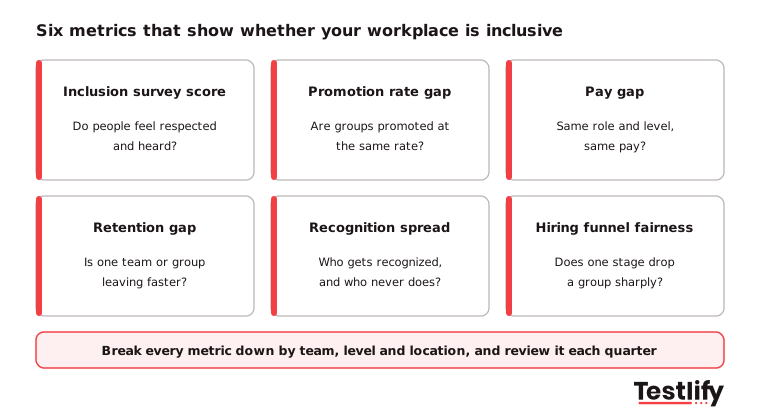
Metric | How to measure it | What a warning sign looks like |
|---|---|---|
Inclusion survey score | Anonymous questions on respect, voice and fairness | Scores 10+ points lower for one group or team |
Promotion rate gap | Promotions divided by eligible employees, by group | One group promoted much less often at the same performance |
Pay gap | Pay for the same role and level, by group | Unexplained gaps after adjusting for role and tenure |
Retention gap | First-year and overall attrition, by group and manager | One team or group leaving faster |
Recognition spread | Who receives awards and peer recognition | The same small group every quarter |
Hiring funnel fairness | Pass rates at each hiring stage | One stage drops a group sharply |
Respect is worth tracking on its own. A Gallup study from January 2025 found only 37% of US employees strongly agree they are treated with respect at work, matching the 2022 record low. Gallup also found engaged employees are five times more likely to feel respected, and employees whose manager holds weekly coaching conversations are four times as likely to be engaged.
What are the common challenges in building an inclusive workplace?
The common challenges in building an inclusive workplace are weak leadership commitment, employee skepticism, thin resources and poor communication. Each has a practical fix.
- Weak leadership commitment: Leaders approve a program, then stop showing up. Fix it with goals in leaders' reviews and quarterly progress updates.
- Skepticism and backlash: Opinions on DEI are divided. Pew Research Center found in late 2024 that 52% of US workers say focusing on DEI at work is mainly a good thing, down from 56% in early 2023, while 21% say it is a bad thing. Frame inclusion as fair treatment for everyone and show the data behind each change.
- Insufficient resources: Programs run on volunteers' spare time burn out. Give ERGs and the task force a budget and protected hours.
- Poor communication: Changes nobody hears about change nothing. Explain the why, share results and report back on feedback.
- Tokenism: Asking the same few employees to represent their group in every panel wears them out. Spread the work and pay attention to who carries it.
- Leaving out frontline and remote staff: Hourly, shift and remote employees often report lower inclusion. Design surveys, events and recognition for every location.
How does Testlify support fair, inclusive hiring?
Testlify supports fair, inclusive hiring by giving every candidate the same role-based assessment and scoring them on skills, with explainable results and human oversight. Hiring is the first inclusive step most companies can control, and it is where Testlify fits.
- Skills-based screening: Build an assessment from a job description, or choose from 3,500+ tests covering technical, cognitive, situational judgment, language and role-specific skills in the Testlify test library. Using skills assessments to reduce bias in hiring keeps the focus on what candidates can do.
- Consistent structured interviews: AI interviews ask every candidate the same role-based questions and score answers against the same criteria, with a person reviewing decisions.
- Candidates in their own language: Assessments run in 15+ languages, so language skill is only tested when the job needs it.
- Audited for bias: Testlify's matching model completed a third-party NYC Local Law 144 bias audit on June 16, 2023.
For more ideas beyond hiring, see these workplace inclusion strategies.
Ready to make hiring the first inclusive step?
An inclusive workplace begins with who gets hired and how. Browse the Testlify test library to build a skills-based assessment for your next role, or book a demo to see structured, explainable scoring in action. Start a 7-day free trial, no credit card needed.
FAQs on how to build an inclusive workplace

Wordpress Developer
Yash Patel is a Wordpress and SEO Specialist at Testlify with 3+ years of experience in technical SEO, on-page optimization, and content strategy. He works on improving Testlify's organic presence and produces content focused on hiring, talent assessment, and HR technology.
LinkedInRelated resources
View all
HR & recruitment
How to create and maintain a supportive work environment for employee well-being

HR & recruitment
How to build a diverse and inclusive workplace for improved employee engagement

HR & recruitment
How to handle workplace conflicts with professionalism

HR & recruitment
How to manage workplace conflicts with professionalism

HR & recruitment
How to implement effective flexible work arrangements

HR & recruitment
How to create an effective workplace communication plan
Get started.
Hire on proof, not resumes.
Run your first skills-based assessment free — no credit card required.