
Skills Profile: What It Is and How to Build One (2026)
Learn what a skills profile is, its benefits, and how to create one to align workforce capabilities, close skill gaps, and drive career growth effectively.
TL;DR
- A skills profile turns “this person seems capable” into a number a hiring manager can defend in a promotion meeting.
- A resume documents where someone worked. A skills profile documents what they can do right now, which is what actually predicts performance.
- Self-rated skills inflate on their own. Stacking assessment scores, work samples, and manager input before rating a skill fixes that.
- Six components belong in every profile: technical skill, behavioral skill, proficiency level, certification, assessment result, and a skills gap score.
- The same profile that sharpens hiring also shortens internal moves, since a manager can see who already holds a skill before opening an external search.
- A profile nobody updates becomes more dangerous than no profile, because people keep acting on numbers that stopped being true months ago.
- Most build efforts fail for the same four reasons: stale data, self-report bias, no shared rating scale, and skill lists too long for anyone to read.
 ChatGPT
 Gemini
 Claude
 Grok
Grok Perplexity
What is a skills profile?
A skills profile is a structured record of one person’s skills, each rated against a proficiency scale and backed by evidence instead of a self-description. It answers a question a resume cannot: how good is this person at each skill the role actually needs.
Definition and what it captures
A resume lists job titles and years of tenure. A skills profile lists the technical skills, hard and soft skills, and role-specific knowledge a person can demonstrate today, each tied to a proficiency level and a piece of evidence.
- The skill itself: named at a level specific enough to act on, such as “conflict resolution across cross-functional teams” rather than “leadership.”
- A proficiency rating: a level on a fixed scale, since “knows SQL” carries no information until a level is attached to it.
- Evidence for that rating: an assessment score, a work sample, a certification, or documented manager feedback.
- AI-era additions: judgment, communication under ambiguity, and responsible AI use, which recent labor market data now treats as core rather than optional.
Skills profile vs resume vs competency framework
People conflate these three, and the mix-up leads to bad hiring calls. A resume tells a story about the past, a competency framework describes what a role needs in the abstract, and a skills profile measures a real person against that need right now.
Dimension | Resume | Competency framework | Skills profile |
|---|---|---|---|
What it captures | Past jobs and titles | Skills a role should need | What one person can do now |
Basis | Self-reported claims | Role design | Verified evidence and scores |
Granularity | Job level | Skill list, no ratings | Skill level, with proficiency |
Kept current? | Rarely | Reviewed yearly | Updated as skills change |
Best used for | A first screen | Defining the target | Matching, gaps, development |
A competency framework sets the target, and a profile shows how close a real person sits to it. Both matter, and the resume is only the doorbell, a point covered in more depth in our article: CVs vs online assessments.
Key takeaway: A resume tells you where someone has been. Only a skills profile tells you what they can actually do, and that distinction is what separates an evidence-based hire from a guess.

Why do skills profiles matter?
Skills profiles matter because 63% of employers name skill gaps their single biggest operational blocker, according to the World Economic Forum’s Future of Jobs Report. Most of those same leaders still cannot say what skills their own workforce already holds.
The cost of guessing on hiring and promotion decisions
Without a profile, hiring, promotion, and training calls get made on job titles and resumes that hide what a person can really do. Enterprise teams either pass over someone who could grow into a role or hire externally for a gap they already had covered internally.
The U.S. Department of Labor estimates a bad hire can cost up to 30% of that employee’s first-year salary. A skills profile catches the mismatch before the offer goes out, not six months into onboarding.
What the data shows
McKinsey’s 2022 analysis found that hiring for skills predicts job performance five times more accurately than hiring for education. That is not a marginal edge over resume-based hiring.
Separately, 91% of talent acquisition professionals say accurate skills assessment is crucial to quality of hire, per LinkedIn’s Future of Recruiting 2025 research. A profile is what makes that kind of skills-based decision possible at scale, instead of one-off for a single role.
Key takeaway: Skill gaps are not a knowledge problem inside the workforce. They are a visibility problem for the people managing it, and a skills profile fixes the visibility, not the workforce.
Key competencies of skills profile
A skills profile is only as useful as the components inside it. Six elements separate a profile that drives real decisions from a list of buzzwords nobody trusts.
Technical skills
Technical skills are the role-specific abilities someone needs to do the job itself, independent of how they behave around a team. A developer’s grasp of Python or an analyst’s command of financial modeling both belong here, and both should be rated, not just listed.
Behavioral and soft skills
Behavioral and soft skills cover the interpersonal and cognitive traits that determine how well someone performs alongside others, including communication, interpersonal skills, and adaptability. These matter as much for a technical role as for a management one, and their absence is part of why so many personality hires underdeliver against their technical scores.
Proficiency levels
Proficiency levels rate how far someone has progressed on a given skill, typically scored on a fixed scale such as beginner, intermediate, and expert. An employee can sit at intermediate in data analysis while rating as expert in coding, a difference a single “skilled” label on a resume would have hidden entirely.
Certifications and credentials
Certifications and credentials are third-party verified achievements, such as diplomas, licenses, or vendor certificates, that back a specific skill claim with someone else’s signature. An AWS certification for a cloud engineer or a PMP credential for a project manager both carry weight precisely because the employer did not issue them.
Assessment results
Assessment results give objective, third-party evidence of ability through structured or practical testing rather than a manager’s impression. Scores from a coding assessment or a language proficiency test on a validated skills assessment platform turn a proficiency claim into a number two different managers would agree on.
Skills gap analysis score
A skills gap analysis score measures the distance between what an employee can do today and what their current or target role actually requires, turning vague skill gaps into a specific number.
An individual contributor might need three points of growth in negotiation and none in forecasting before qualifying for a management track, and the score is what makes that gap specific instead of a vague “needs more experience.”
Key takeaway: A profile with only a skill list and no proficiency, evidence, or gap score is not a skills profile. It is a keyword list, and keyword lists do not survive contact with a real hiring decision.
6 benefits of skills profile
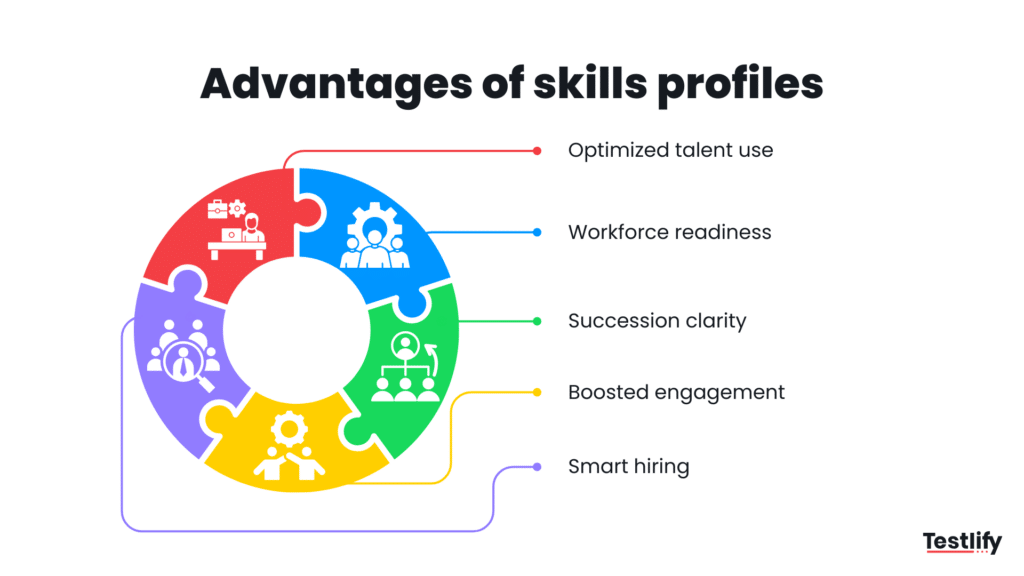
Once a profile exists for a role or a team, the payoff shows up in six places across the employee lifecycle. Each one compounds on the others, since better hiring data also means better internal mobility and succession data later.
Sharper hiring decisions
Matching a candidate’s rated skills to the role cuts mismatched hires that a polished resume, or a keyword-based screening-out approach, would have let through. Organizations using skills-based hiring are 12% more likely to make a quality hire than those relying on resumes alone, per LinkedIn’s 2025 research.
Faster internal mobility
Seeing who already holds a skill lets a team fill a role from inside before opening a costly external search. Organizations with pre-built visibility into existing skills fill roles up to two times faster than those that default straight to external recruiting, per LinkedIn’s Global Talent Trends 2025 data.
Targeted L&D spend
A profile points L&D budget at the skills inventory gaps that block real work instead of generic courses nobody asked for. Ninety-four percent of employees say they would stay at a company longer if it invested in their development, per LinkedIn’s 2025 Workplace Learning Report, and a profile is what tells L&D exactly where to point that investment.
Stronger succession planning
A profile shows who sits two skills away from a leadership role, so that gap can start closing years before the seat opens up. Organizations with a leadership development plan tied to real skills data are twice as likely to report improved quality of hire into those roles, according to Deloitte’s Human Capital Trends research.
Lower mis-hire and mis-promotion costs
Replacing a mismatched mid-level hire or promotion costs 50% to 200% of that employee’s annual salary, according to SHRM. A profile catches the proficiency gap before either decision gets made, not after the exit interview.
Clearer skills-gap forecasting
A profile aggregated across a team turns individual gaps into a forecast of where the whole function will fall short as talent management priorities shift. Fifty-eight percent of the skills required for a given role will change by 2028, per Gartner, and a team without aggregated profile data will not see that shift coming until it already hurts output.
Key takeaway: These six benefits are not separate wins. They compound, because the same evidence that sharpens one hire also feeds the succession plan and the training budget for the next five.
How to create an effective skills profile
Building an effective skills profile takes six steps, moving from purpose to a living document that gets updated as skills change. Start with the role a profile needs to serve, not with a test catalog or a list of nice-to-have skills.
Step 1: Define the purpose and scope
Decide why the profile exists before collecting a single data point. Hiring for one open role needs a tight profile of eight to twelve skills, while planning workforce development across a team needs a broader map tied to a specific business goal.
Step 2: Map role competencies to the skills profile
List the competencies the role truly needs, then split each into specific, measurable skills, separating non-negotiables from nice-to-haves. A skills mapping framework keeps this honest, so a team measures what predicts performance rather than a wish list drawn up in a meeting.
Step 3: Collect evidence for each skill
Gather signals from more than one source so no single opinion decides the rating.
- Skills assessments: objective scores from a validated skills assessment platform for technical and cognitive skills.
- Work samples: real output, such as a code review or a written brief, for skills a test cannot fully capture.
- Manager and peer input: structured ratings on interpersonal skills seen day to day.
Step 4: Rate proficiency on a fixed scale
Convert the evidence into one clear rating per skill using a scale simple enough for two different managers to apply the same way. A four-level scale works for most teams and is easy to defend in a hiring review.
Level | Label | What it means |
|---|---|---|
1 | Aware | Knows the basics, needs supervision |
2 | Working | Handles routine tasks alone |
3 | Proficient | Handles complex work, coaches others |
4 | Expert | Sets the standard, solves novel problems |
Pro tip: Anchor every level to observable behavior, not a feeling. “Level 3 in SQL” should mean a specific assessment score plus one reviewed project, so two managers rating the same person land on the same number.
Step 5: Organize and share the profile
Group the rated skills into categories a reader can scan fast: core skills, transferable skills, and skills in development. Keep it on one screen, since a profile that takes ten minutes to read will not get used in a hiring meeting that lasts thirty.
Step 6: Keep the skills profile current
Skills move, so the profile has to move with them. Refresh ratings after a major project, a certification, or a performance review, and at least every 90 days for fast-changing technical roles, since a stale profile earns more trust than it deserves.
Key takeaway: A profile is only as fair as its weakest evidence source. Lead with assessment data, not self-report, or the whole profile inherits the bias of whoever filled it out.
Where skills profiles fail
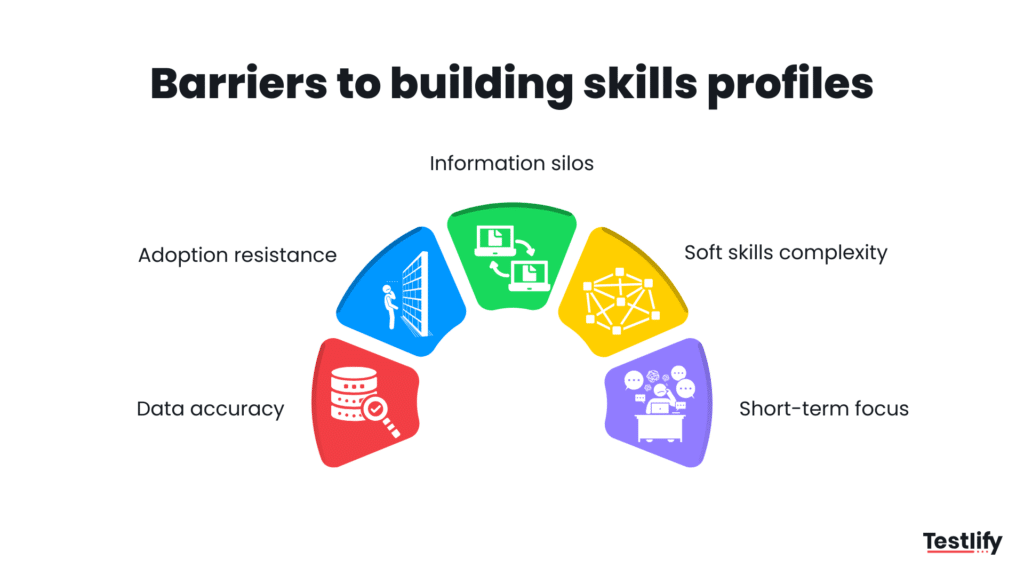
Most profiles fail for the same handful of reasons, and knowing them upfront saves months of rework later. Five barriers show up more than any other.
Information silos
Skills data trapped across an ATS, an LMS, and a performance tool never resolves into one view of what a person can do. A manager checking three systems for one rating gives up and reverts to a resume instead.
Adoption resistance
Employees and managers who see a profile as HR busywork, or as a surveillance tool, fill it out carelessly or skip it entirely. Framing the profile around career growth and internal mobility, not compliance, is what gets honest data in the first place.
Soft skills complexity
Technical skills score cleanly against a test or a certification, but behavioral skills resist a single objective number. Structured manager observation over multiple projects, not a one-time survey, keeps a soft skill rating defensible.
Data accuracy
Self-rated scores inflate on their own, since the least skilled people often rate themselves highest. Leading every rating with assessment evidence or a work sample, not a self-report field, keeps the data accurate enough to act on.
Short-term focus
A profile built for one hiring cycle and never touched again stops reflecting reality within months. Treating the profile as a living document, refreshed on real events like a certification or a performance review, keeps it useful past the first use case.
Key takeaway: Every one of these barriers is an organizational discipline problem, not a tooling gap. Fixing the data pipeline, the incentive to participate, and the refresh cadence matters more than picking a rating scale.
Use cases: Where skills profiles make a difference
A skills profile creates value well beyond recruitment. The same verified skills data can support hiring decisions, uncover internal talent for future roles, and guide learning investments across the organization. These are the three areas where skills profiles consistently deliver the greatest impact.
Hiring and shortlisting
Skills profiles give hiring teams objective data to compare candidates against role requirements, rather than relying on resumes alone. By combining assessment results, work samples, and proficiency ratings, recruiters can identify strengths, spot critical gaps, and make more confident hiring decisions.
For example, a demand planning candidate may score highly in forecasting and SQL but show weaker negotiation skills in a work sample. Rather than rejecting an otherwise strong hire or overlooking the gap entirely, the hiring manager can make an informed decision and create a targeted development plan from day one.
Internal mobility and succession
Skills profiles make internal talent visible by showing what employees can do today, not just the roles they currently hold. Managers can quickly identify employees who already possess most of the skills needed for open positions, reducing the need for external hiring.
The same data strengthens succession planning by highlighting employees who are close to being ready for leadership or specialist roles. Instead of scrambling to replace key talent after a resignation, organizations can proactively develop high-potential employees based on measurable skill gaps.
Learning and development
Skills profiles help organizations invest in training where it delivers the greatest impact. By comparing current capabilities with role requirements, HR and L&D teams can identify shared skill gaps and prioritize development programs that address real business needs.
Rather than offering generic learning programs, organizations can create targeted upskilling and reskilling initiatives backed by objective skills data. This improves employee growth while ensuring learning budgets are aligned with future workforce requirements.
Key takeaway: The same profile data serves three different rooms: the hiring panel, the succession review, and the L&D budget meeting. Building it once and reusing it across all three is what makes the initial data-collection effort worth the time.
Final thoughts
Skills-first organizations have one advantage over everyone else: they know what talent they already have before they start looking for more. That visibility turns workforce planning from a reactive exercise into a strategic one, helping leaders redeploy existing talent, close emerging skill gaps earlier, and make better investment decisions.
The organizations that benefit most are not the ones with the most sophisticated framework, but the ones that keep their skills data current and use it consistently across hiring, mobility, performance, and learning. When skills become the common language across those decisions, talent management becomes faster, fairer, and far more effective.
Testlify’s features 3,500+ validated, role-specific assessments plus conversational AI interviews to help recruiters identify top talent with the right skills at scale. Book a demo and build a skills-first hiring process.
Key takeaways
- A skills profile measures the present, not the past. It rates what a person can do now, which is why it drives better decisions than a resume that only lists former titles.
- Evidence beats self-report. Lead every proficiency rating with an assessment score or work sample, because self-ratings inflate and will skew the whole profile if left unchecked.
- Map the role first. Define the competencies that predict performance, then measure people against them, since a profile without a clear target is just a list of skills.
- A shared scale keeps ratings honest. A written four-level scale with behavior anchors means two managers rate the same person the same way, which makes the data trustworthy.
- Keep it current or lose the trust. Refresh ratings on real events like a project close or certification, since 39% of skills in use today will change by 2030.
- The point is decisions, not documents. A profile pays off only when it changes who gets hired, moved, or developed, so build it to be read in a meeting, not filed away.
Frequently asked questions (FAQs)

B2B SaaS Content Writer
Rishav Kumar is a B2B SaaS content writer with 4 years of experience. He loves crafting engaging content. Always exploring fresh ideas, he's passionate about helping businesses grow through impactful writing.
LinkedInRelated resources
View all
HR & recruitment
Talent mobility: Benefits, strategies, and best practices

HR & recruitment
Deductive vs inductive reasoning: What are they and when to use?

HR & recruitment
Building a Winning Team in the Financial Sector — Essential Recruiting Tips

HR & recruitment
What Is a Percentile Score? Meaning, Calculation, and Use in Hiring

HR & recruitment
What is predictive validity and why do recruiters need it?

HR & recruitment
Employee autonomy: what it is and how to build it
Get started.
Hire on proof, not resumes.
Run your first skills-based assessment free — no credit card required.