
Hard skills vs Soft skills: Which one should you prioritize while hiring?
Hard skills vs soft skills: Learn which skills HR should prioritize, backed by data, expert insights, and practical frameworks for smarter hiring decisions.
Most hiring teams treat this as a ranking problem. It isn't. The honest answer is that hard skills decide whether someone can do the work at all, and soft skills decide whether the work survives contact with other people, and the only question worth your time is how much weight each one gets for the specific role you are filling right now.
TL;DR
- Hard skills are teachable, testable abilities (SQL, payroll reconciliation, Figma). Soft skills are behaviors (listening, judgment, follow-through) that show up in how the work gets done.
- The split is a job-ad habit, not a fact about the job. For software developers, the US Bureau of Labor Statistics names six important qualities and four of them are behavioral.
- Hard skills can carry a score. Personality and culture tests cannot, and any vendor telling you otherwise is selling you a number that does not mean what you think.
- Pick a weight per role before you see a single candidate. Writing it down after the fact is how gut feel gets laundered into a scorecard.
- Both kinds of testing carry legal exposure, and the exposure sits with you, not with the vendor whose test you bought.
 ChatGPT
 Gemini
 Claude
 Grok
Grok Perplexity
Soft vs hard skills: what actually differs
Hard skills are specific, teachable abilities you can demonstrate on demand: writing a SQL query, closing a month-end book, running a CAD model. Soft skills are patterns of behavior: how someone listens, decides under pressure, and handles a colleague who disagrees. One answers "can you", the other answers "what happens when you do".
The difference that matters for hiring is not definitional. It is about evidence. Hard skills produce evidence that holds still: a candidate either wrote working code or didn't. Soft skills produce evidence that depends on the situation, the day, and who else was in the room. That is why the two belong in different columns of your process, scored differently, and never averaged into one number as though they were the same kind of thing.
Dimension | Hard skills | Soft skills |
|---|---|---|
What it answers | Can this person do the task | What happens around the task |
How it is acquired | Training, coursework, repetition | Experience, feedback, coaching over years |
Best evidence | Work sample, coding test, job-knowledge test | Situational judgment, structured interview, references |
Scoring | Numeric, with a defensible cutoff | Qualitative, compared against a rubric |
Time to fix after hire | Weeks to months | Months to years, sometimes never |
Transfers between roles | Rarely, often role-specific | Almost always |
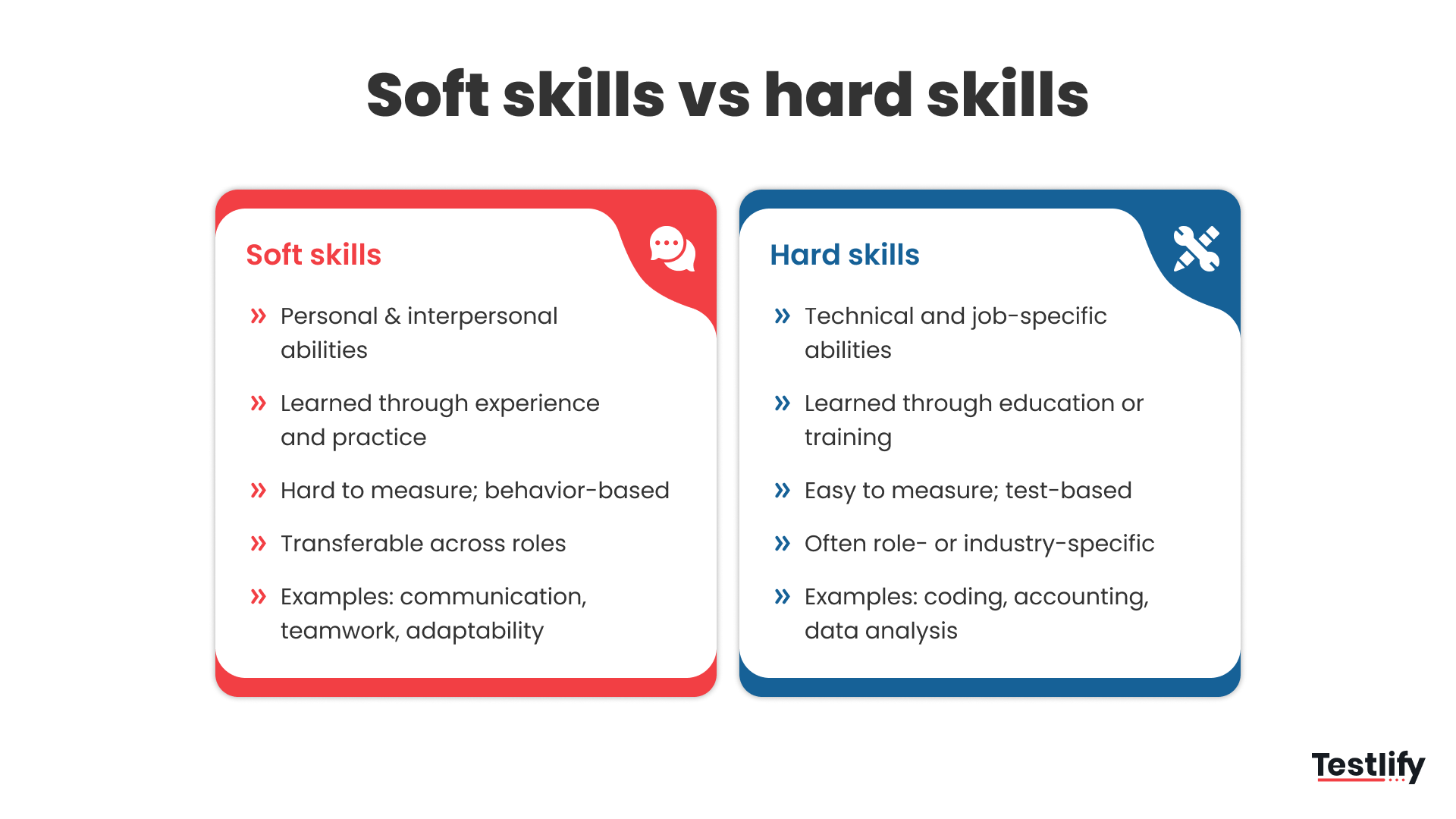
Read the last two rows together and the usual advice inverts. What takes years to build is what most processes assess least, because a short online course and a quarterly review will not fix it after the offer goes out.

What are 3 examples of hard skills?
Three that recur across most hiring: a technical skill (writing SQL, or Python), a domain skill (payroll reconciliation, clinical coding, contract review), and a tool skill (Figma, Salesforce administration, Excel modeling). All three share the trait that makes a hard skill useful in hiring: you can set a task and watch someone either complete it or not.
That test is the real definition. If you cannot imagine a 30-minute exercise that would settle the question, you are probably looking at a behavior wearing a technical label. "Attention to detail" is not a hard skill. "Proofreads a 2,000-word contract and catches the three altered clauses" is.
- Technical: SQL, Python, R, Java, front-end frameworks, infrastructure scripting.
- Domain: payroll reconciliation, GAAP close, medical coding, QA test-case design, logistics routing.
- Tool: Excel and Google Sheets modeling, Figma, HubSpot or Salesforce administration, Word and PowerPoint production.

What are the 5 soft skills employers test for?
Five come up again and again in role profiles across industries: communication, problem solving, collaboration, adaptability, and dependability. They are not personality traits in the horoscope sense. Each one has observable behaviors attached, which is exactly what makes them testable instead of merely discussable.
- Communication. Can they explain a technical decision to someone who will never read the code, in writing, without burying the point.
- Problem solving. Given an ambiguous brief, do they ask the clarifying question or do they build the wrong thing confidently.
- Collaboration. What do they do when a peer's work blocks theirs. Escalate, work around it, or quietly absorb the delay.
- Adaptability. How they behave when the plan changes mid-sprint, measured by what they did last time rather than what they say they'd do.
- Dependability. The unglamorous one, and the strongest predictor your reference calls will ever surface. Did the work land when they said it would.

Notice that every one of those is phrased as a behavior in a situation. That phrasing is the whole trick. "Good communicator" cannot be assessed. "Explains a technical decision in writing to a non-technical reader" can be, with a 20-minute exercise and a rubric.
Soft skills and technical skills in federal job data
Here is the part the hard-versus-soft framing gets wrong, and the evidence is public. Take software development, the most stereotypically technical job in the economy. The Bureau of Labor Statistics occupational profile lists six important qualities for the role: analytical skills, communication skills, creativity, detail orientation, interpersonal skills, and problem solving. Four of those six are behaviors. Only analytical skill and, arguably, detail orientation read as technical at all. Programming is not on the list.
The O*NET occupational record for software developers goes further. It files Active Listening and Speaking as essential skills for the occupation, sitting beside Critical Thinking and Active Learning, and puts Programming in a separate transferable-skills group. Behaviours like Dependability, Attention to Detail and Adaptability are filed under a distinct heading called Work Styles, as a different kind of thing entirely rather than a softer version of the same thing.
So the federal occupational taxonomy, built from surveys of people doing the work, does not sort abilities into hard and soft. It sorts them by what they are evidence of. The hard-soft binary is an artifact of how job ads are written and how resumes are skimmed. It does not describe the job, which is why arguing about which half matters more produces a worse hiring process than simply asking what evidence each requirement needs.
The numbers around that role make the stakes concrete. BLS projects 10% employment growth from 2025 to 2035 for software developers, QA analysts and testers, about 185,400 new jobs and roughly 106,100 openings a year, at a 2025 median wage of $135,980 for developers and $104,300 for QA analysts and testers. Hiring at that volume and that salary on a resume skim is an expensive habit.
What does a hard skills assessment measure?
A hard skills assessment measures whether someone can produce a specific output under defined conditions. Done properly it gives you a score, a comparison against other candidates, and a defensible cutoff. Done badly it measures how well someone handles being timed, or how recently they revised for an exam that looks nothing like the job.
The distinction is whether the task resembles the work. A multiple-choice quiz on Python syntax measures recall. A short project where the candidate fixes a failing test in a real repository measures the thing you are hiring for. The second is harder to build and much harder to argue with.
Methods that actually produce a score
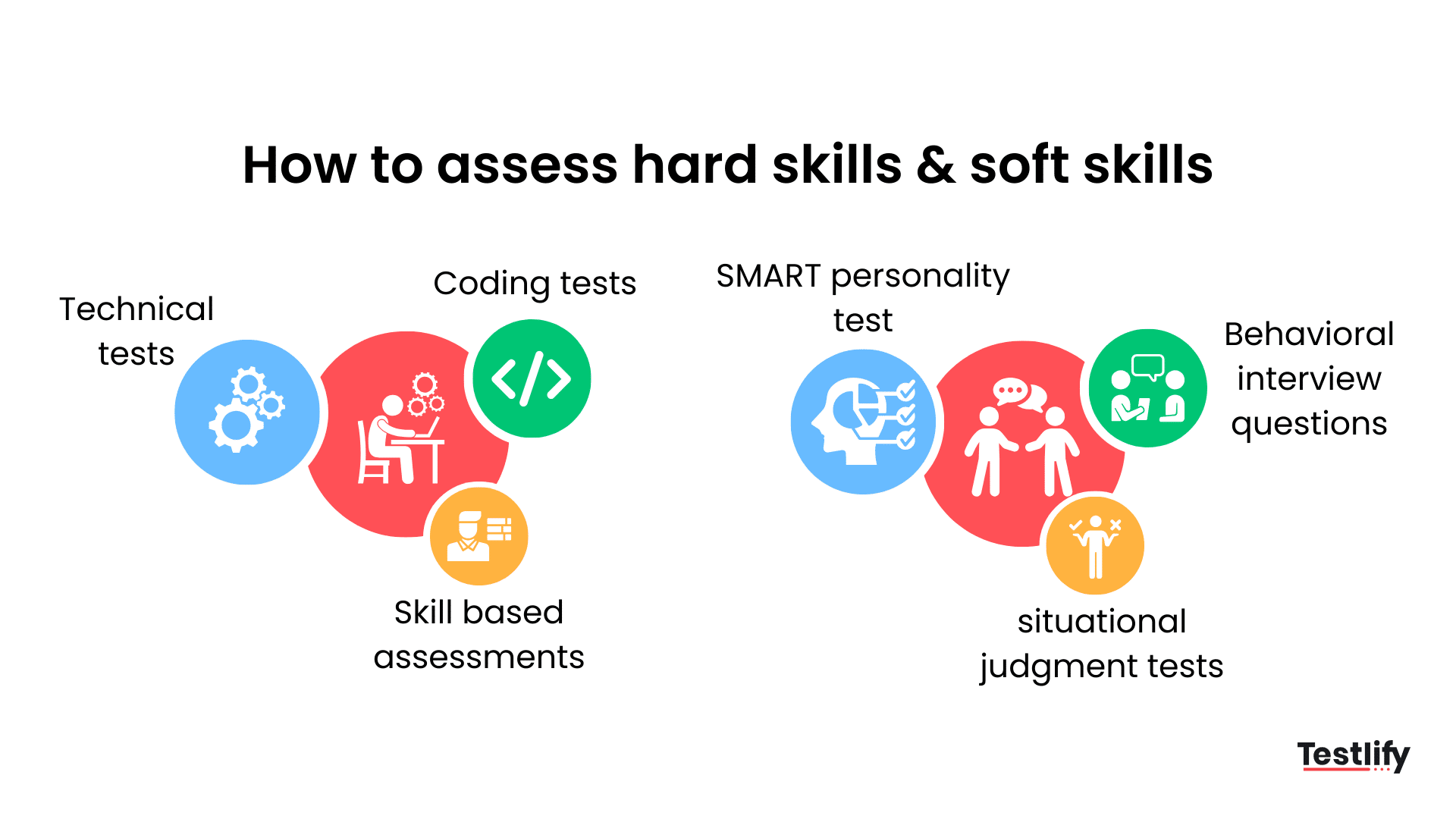
The US Office of Personnel Management keeps a working catalogue of 13 selection methods for federal hiring, from job-knowledge tests and work samples to situational judgment tests, biodata, and structured interviews. It is a useful list precisely because it does not separate technical from behavioral assessment. Situational judgment tests and emotional intelligence tests sit in the same catalogue as job-knowledge tests, as tools of equal standing.
OPM also attaches a warning worth repeating before anyone builds their own: most of those methods "require considerable test development and measurement expertise to develop in-house". Writing twenty questions in a spreadsheet over a Friday afternoon does not produce an assessment. It produces an opinion with a percentage attached.
Where soft skills break the scoring model
There's a hard limit here that most vendors skate past, and Testlify states it in the product itself: personality and cultural tests are qualitative and do not carry a total score. That is not a gap. It is the honest position. A score implies a single ordered scale with a defensible cutoff, and behavior under pressure does not have one. What you can do is compare a candidate's responses against a rubric written before you met them, and record which specific behaviors showed up.
Which means a balanced process is not one number. It is a numeric score on the technical side, a rubric-scored judgment on the behavioral side, and an explicit weight telling you what to do when the two disagree.
Does ChatGPT change soft skills vs hard skills?
It changes what a hard skills test proves, not which skills matter. If a candidate can complete your take-home with a chat assistant in four minutes, that take-home was measuring recall, and recall is now cheap. The skill that survives is judgment: knowing which output is wrong, which requirement was missed, and when the confident answer is confidently incorrect.
Two practical consequences. First, work samples need to be built on the assumption that AI assistance is available, because it is, so test the review and the reasoning rather than the keystrokes. Second, the behaviors that used to be treated as nice-to-have are now load-bearing. Someone who ships plausible AI output they cannot explain is a liability in a way that was not possible three years ago.
And the honest caveat, because the internet has mostly skipped it: nobody has good longitudinal data on this yet. The reasoning above is a position, not a finding. Treat anyone quoting a precise percentage on how AI reweights skills demand with suspicion, including the vendors.
How should you weight each skill type per role?
Weight by what you cannot fix after the hire. Set the split in writing, as part of the role definition, before the first candidate applies. That single discipline does more for hiring quality than any individual test you could buy, because the weight is the actual decision. Everything after it is just evidence collection.
The Testlify Competency-to-Evidence Matrix is the version of this worth copying: start with the role, not the test. List the competencies the role genuinely requires, map each one to the evidence that would settle it, then attach a weight and a cutoff. The output is a table, and it should fit on one page.
Three questions that set the weight
- How fast does this skill decay or train? A tool skill someone picks up in three weeks should not outrank a behavior that takes three years. Weight the thing you cannot fix.
- What does failure cost? A misconfigured payroll run and a tense client call fail at different magnitudes. Weight toward whichever failure you cannot absorb.
- Is there a hard floor? Some roles have a genuine technical gate (a clinician, a structural engineer). Below the floor nothing else counts, so set it as a qualifier rather than a weight.
Turning the weights into a real scorecard
Weights only work if the tooling applies them consistently. Testlify exposes this directly: each test in an assessment carries a weight from x0 to x5, so a test weighted x5 moves the final score five times as much as one weighted x1, and any question can be marked non-scored when it is there for signal rather than arithmetic. Scores resolve at three levels (question, test, and overall assessment), and candidates can be benchmarked by percentile rank against other candidates and other reviewers.
For a mid-level operations hire at a 60-person company, a defensible starting split looks like this: a job-knowledge test at x3, a practical exercise at x5, a situational judgment test at x3, and a personality and culture section at x0, read as evidence rather than scored. The x0 is not a demotion. It is an admission that the section informs a judgment instead of computing one.
Pro tip: write the weights into the job requisition before the role opens, and have the hiring manager sign off on them there. The moment weights get set after the first few candidates, they stop being criteria and start being a justification for whoever interviewed well.
Where skills testing creates legal risk
This is the part most hard-versus-soft comparisons skip, and it is the one that costs real money. Under US law, any test or selection procedure that screens people out has to be job-related and consistent with business necessity. If a procedure disproportionately excludes people by race, sex, religion, color or national origin, the employer has to show that job-relatedness, and then show there was no less discriminatory alternative that would predict performance equally well.
The sentence in that guidance that should change how you buy assessments: "the employer is still responsible for ensuring that its tests are valid". Vendor documentation does not transfer the liability. A validity study in a sales deck is not a defence if the test does not fit the job you ran it for.
Personality testing carries a second, narrower risk. EEOC guidance on disability-related inquiries draws the line at design and purpose: tests measuring personality traits such as honesty, preferences and habits are not medical examinations, but tests "designed to identify a mental disorder or impairment" are, and those are restricted. If a soft skills assessment starts reading like a clinical screen, that is the boundary it is crossing.
Structured formats help on both fronts. OPM's guidance on structured interviews makes the case plainly: the point of structure is that candidates "have equal opportunities to provide information and are assessed accurately and consistently". Consistency is both the fairness argument and the evidence you would need if the process is ever questioned.
What do hiring teams get wrong about this?
Four mistakes do most of the damage: averaging the two scores into one number, screening hardest for the skills that are easiest to train, trusting a single soft-skills score, and running the assessment after the interviews instead of before them. The first is the most common and the most expensive.
Averaging everything into one number. A candidate who scores 90 on the technical test and 40 on judgment is not a 65. They are a specific risk you either accept or don't, and the average hides exactly the information you need.
Screening hardest for the trainable half. Job ads list tools with version numbers and behaviors with adjectives. Only one of those gets a filter, and it is the one a two-week course would fix.
Buying a soft skills score and believing it. If a vendor hands you a single number for collaboration, ask what scale it sits on and what the cutoff is defensible against. The useful version of that product gives you behavioral evidence against a rubric, not a verdict.
Testing late. Running assessments after the interview loop means the interviews set the expectation and the test gets read as confirmation. Put the evidence first and the interview becomes a chance to probe what the evidence showed, which is a better use of an hour of everyone's time.
The counterargument deserves airtime: front-loading assessment adds friction, and in a tight market for senior candidates that friction costs you people. That's real. The answer is usually length rather than sequence, so a 25-minute work sample before the first call, not a 90-minute battery.
If you want the mechanics of running both halves in one process, evaluating hard and soft skills in one workflow covers the sequencing in more depth, and the behaviors that count as soft skills breaks down the definitions this page treats as settled. For a view of what your team already has, building a skills inventory is the usual starting point, and the research on soft skills in hiring collects the published data.
Testlify's test library covers role-specific skills, coding, cognitive ability, psychometrics, situational judgment and personality and culture, with 25+ question types including work samples bound to the real Google and Microsoft office apps, so the technical and behavioral halves of a scorecard can be built in one assessment rather than two disconnected ones. Book a demo to see how the weighting works on a role you are hiring for now.
FAQs

B2B SaaS Content Writer
Rishav Kumar is a B2B SaaS content writer with 4 years of experience. He loves crafting engaging content. Always exploring fresh ideas, he's passionate about helping businesses grow through impactful writing.
LinkedInRelated resources
View all
HR & recruitment
Job Description vs Job Specification: Key Differences (2026)
HR & recruitment
How to create a game-changing talent strategy?
HR & recruitment
Integrating AI into leadership development for a stronger talent pipeline
HR & recruitment
10 Proven strategies to attract top talent in 2026
HR & recruitment
What are pink collar jobs? A definitive guide
HR & recruitment
Inbound Recruiting: How to Attract Top Talent in 2026
Get started.
Hire on proof, not resumes.
Run your first skills-based assessment free — no credit card required.