
How do assessment libraries cover niche skills?
Learn how to use skill assessments to evaluate niche skills of candidates and uncover top talent.

Assessment libraries cover niche skills through curated catalogs of pre-built tests across hundreds of specialized domains.
Platforms like Testlify maintain 3,500+ ready-to-deploy assessments spanning rare programming languages, emerging AI frameworks, and industry-specific engineering disciplines.
HR leaders deploy these tests to verify capabilities that resumes obscure and interviews miss. Subject-matter experts validate every assessment to ensure it accurately measures the skills required for the defined job.
 ChatGPT
 Gemini
 Claude
 Grok
Grok Perplexity
Why niche hiring breaks every standard recruiting playbook
Traditional recruiting systems were built for high-volume hiring, not niche talent. They depend on keyword matching and standardized screening workflows that fail when the role demands rare or highly technical expertise.
For example, your best Rust engineer may never appear in a recruiter search because her resume describes “memory-safe systems programming” instead of the exact keywords in your job description.
A conventional applicant tracking system filters her out before a recruiter ever sees her profile. She then joins a competitor that handed her a 90-minute concurrency challenge instead of reading her CV. That competitor now ships features 40% faster than you.
The lesson is that companies that hire effectively for niche roles evaluate candidates through role-specific assessments and job simulations that reveal hidden candidate skills.
The reality is simple: standard recruiting playbooks were designed for generalist hiring. Niche hiring demands a skills-first approach and a hiring mindset focused on validated expertise.

What are niche skills?
Niche skills are specialized knowledge and expertise that individuals possess pertaining to a specific industry, role, or technical domain.
Unlike general skills like communication or teamwork, niche skills are narrow in scope but deep in impact, often requiring advanced training, certifications, or focused experience to master.
This makes them highly valuable but harder to find in the talent pool.
A skill is considered niche when
- Qualified talent is scarce
- Expertise can only be developed through years of hands-on experience
- Market demand consistently exceeds the available talent supply
Common traits of niche skills include:
- Steep learning curves that span years, not weeks
- Limited public training resources or certifications
- Strong dependence on domain context and tooling
- Premium compensation outside standard salary bands
- Rapid technology cycles that obsolete textbook knowledge
Smart HR teams build skills-based hiring programs to surface these capabilities early in the funnel. Resume-based hiring misses them by design.
Best examples of niche skills in 2026
Niche skills cluster in five high-demand categories right now. Each category combines technical depth with business impact that justifies premium compensation.
The most valuable niche technical skills today include LLM fine-tuning, Rust systems programming, post-quantum cryptography, MLOps infrastructure, and SAP S/4HANA migration.
These roles command 30 to 50% salary premiums over generalist software engineering positions.
AI and machine learning specializations
AI hiring continues to accelerate, but companies are no longer looking for broad AI knowledge alone. They need specialists who can build, optimize, and scale production-grade systems.
Some of the most sought-after niche AI skills include:
- LLM fine-tuning and RLHF pipeline engineering
- MLOps platform development using Kubeflow or MLflow
- Edge AI and computer vision deployment
- Prompt engineering and AI evaluation system design
- AI infrastructure optimization for production environments
Systems and infrastructure expertise
Modern infrastructure demands engineers who can work close to the system layer while improving performance, reliability, and scalability.
High-value niche infrastructure skills include:
- Rust and Zig systems programming
- Linux kernel observability using eBPF tooling
- WebAssembly runtime development
- Kubernetes operator development
- Site reliability engineering (SRE) automation and tooling
Security and cryptography skills
As cyber threats grow more sophisticated, organizations are investing heavily in advanced security expertise that goes beyond traditional cybersecurity roles.
Top niche security skills in 2026 include:
- Post-quantum cryptography implementation
- Zero-knowledge proof engineering
- Smart contract auditing for production blockchain protocols
- Cloud security posture management
- Infrastructure threat modeling and secure architecture design
Industry-specific technical skills
Many industries require highly specialized technical knowledge combined with regulatory or operational expertise.
Examples include:
- SAP S/4HANA migration architecture
- FDA 21 CFR Part 11 software compliance
- HL7 FHIR healthcare interoperability
- ISO 26262 automotive functional safety
- Industrial automation and embedded systems integration
Legacy modernization expertise
Despite the rise of modern technologies, enterprises still rely on legacy systems that require modernization without disrupting business operations.
Professionals who can bridge old and new systems remain in extremely high demand.
Critical modernization skills include:
- COBOL and mainframe migration leadership
- AS/400 RPG programming
- VB6 to modern .NET migration projects
- Enterprise application refactoring
- Legacy database modernization and cloud transition planning
Testlify’s technical skills assessment library covers every category above with role-specific tests authored by domain practitioners.
Niche skills vs. general skills
Niche skills differ from general skills in scarcity, depth, and hiring cost. The distinction shapes every recruiting decision from sourcing channels to compensation bands.
General skills like Python, project management, or SQL appear on millions of resumes worldwide, whereas niche skills are scarce and appear on thousands. This supply-demand gap forces HR teams to run completely different playbooks for each category.
The comparison HR leaders actually need:
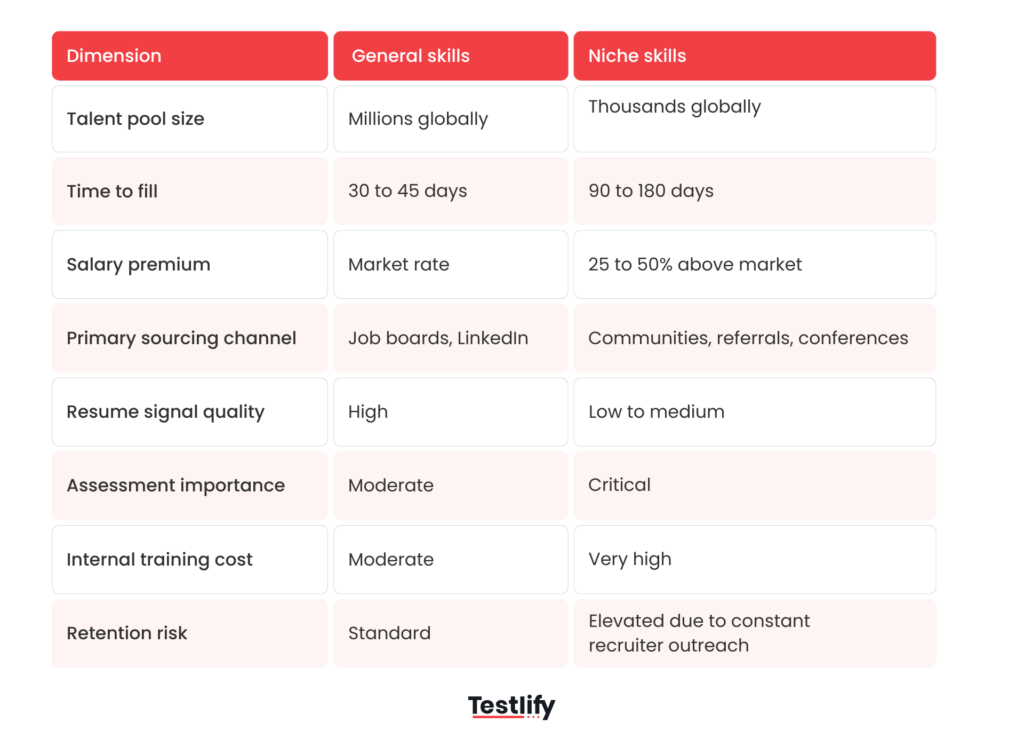
General hiring rewards volume and funnel optimization. Niche hiring rewards precision and patience.
Recruiters should adjust their recruitment metrics to reflect this split. Time-to-fill targets that work for general roles will frustrate every team chasing niche specialists.
Five mechanisms behind modern niche skill assessment libraries
Assessment libraries cover niche technical skills through five core mechanisms. Each mechanism solves a verification problem that resumes and interviews simply cannot.
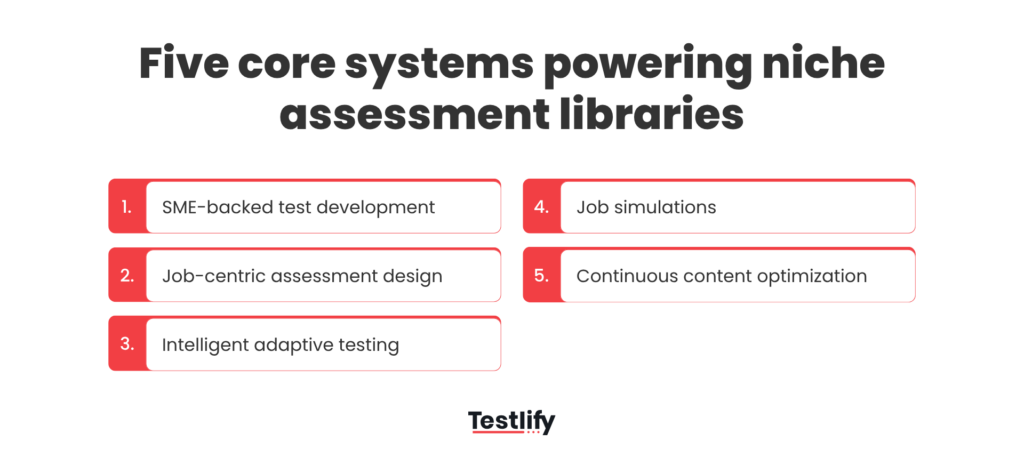
1. Subject-matter expert validation
Every niche assessment requires authorship from practitioners who ship code in that domain. Testlify partners with senior engineers and certified specialists to write and review each test.
This process catches gaps that generalist test writers miss. A Kubernetes operator test from an SRE looks nothing like one a textbook author would write.
2. Role-based test composition
Assessment libraries bundle multiple sub-skills into role-specific test packs. A Senior MLOps Engineer assessment combines Python, Docker, Kubernetes, MLflow, and CI/CD modules into one timed evaluation.
HR teams skip the work of designing custom batteries for every requisition. Recruiters launch role-fit assessments in minutes, not weeks.
3. Adaptive difficulty engines
Adaptive testing adjusts question difficulty based on candidate responses in real time. Strong candidates face harder questions, while struggling candidates face foundational ones.
This approach surfaces true skill ceilings within shorter test windows. Candidates also report better experience scores because the test fits their level instead of frustrating it.
4. Real-job simulations
Niche roles require proof of hands-on ability, not just theoretical knowledge. Top assessment libraries include code execution sandboxes, system design exercises, and debugging simulations.
This gives hiring teams visibility into how candidates think, troubleshoot, and deliver outcomes, making evaluations far more meaningful.
5. Continuous content refresh
Niche technical skills evolve every quarter. Assessment libraries that refresh content quarterly stay relevant, while static libraries decay within a year.
Testlify ships new assessments and updates existing ones based on hiring manager feedback and industry shifts. This cadence keeps tests aligned with the tools candidates actually use on the job.
How to use skill assessments to optimize hiring for niche skills
HR teams optimize niche hiring through a four-stage assessment workflow. Each stage filters candidates against criteria that resumes cannot validate.
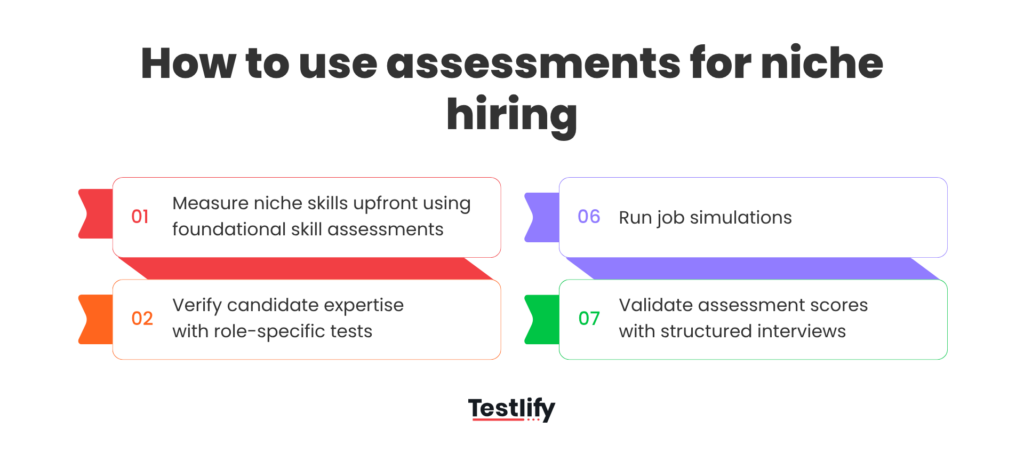
Stage 1: Screen with foundational skill assessments
Start every niche pipeline with a 30-minute screening test on core technical fundamentals. This filter removes 60 to 70% of applicants who lack baseline capability.
Recruiters save interview hours for verified candidates. Testlify’s pre-employment assessments library supports this stage across 1,500+ skills.
Stage 2: Verify domain expertise with role-specific tests
Move qualified candidates into 45 to 60-minute deep-dive assessments on the specific niche domain. These tests probe edge cases, anti-patterns, and architectural judgment.
A Rust systems candidate faces ownership and lifetime puzzles. An LLM engineer tackles prompt injection defenses and context window trade-offs.
The questions reveal real expertise instead of memorized syntax. Hiring managers see who actually built systems versus who only studied them.
Stage 3: Run realistic job simulations
Replace whiteboard interviews with take-home simulations or live coding exercises that mirror the actual job. Cap total time at 90 minutes to respect the candidate’s effort.
This stage surfaces problem-solving approach, code quality, and communication patterns. Hiring managers review work product before any human conversation happens.
Stage 4: Pair scores with structured interviews
Combine assessment data with a structured interview to probe how candidates approached the test. Ask them to walk through their reasoning and trade-offs.
This pairing reduces interviewer bias because every candidate faces the same conversation framework. Hiring decisions rest on evidence, not gut feel.
Track outcomes through your quality of hire dashboards. Teams that close this loop improve assessment ROI quarter over quarter.
Best practices for recruiting niche talent
Niche recruiting rewards discipline over volume. The teams that consistently attract niche talent follow a disciplined approach built around candidate experience, skill validation, and cultural fit.
Here are the seven practices that separate teams that win specialist talent from teams that keep losing it.
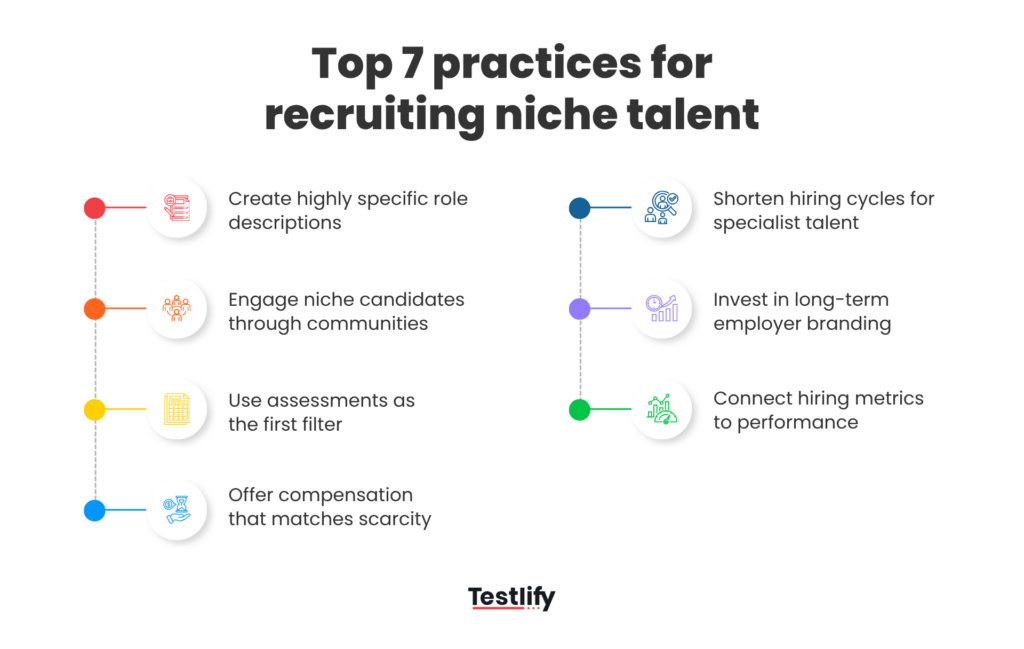
Write precise, technical job descriptions
Generic job descriptions repel niche specialists. Replace buzzwords with specific tools, problem domains, and team context.
Strong job descriptions name the languages, frameworks, and challenges the role involves. Candidates self-select faster, and recruiters waste fewer interview cycles.
Source from technical communities, not job boards
Niche specialists rarely browse generic job boards. Find them inside GitHub repositories, technical Discord servers, conference speaker lists, and open-source contributor graphs.
Build your talent pipeline through technical content, community sponsorships, and engineer-to-engineer outreach. Reference-based hiring outperforms cold sourcing by 5x for niche roles.
Lead with assessments, not resumes
Prioritize the results of skills assessments before resume screens whenever the role allows. Candidates appreciate the chance to prove their ability before navigating bureaucratic gates.
Assessment-first hiring also widens your pool to non-traditional candidates. Bootcamp graduates, self-taught engineers, and career switchers can demonstrate skills that paper credentials hide.
Pay market premiums and signal them early
Niche specialists know their market value. Hiding salary bands wastes everyone’s time when the role pays below market.
Publish competitive ranges directly in the job description. Top candidates engage faster when compensation respects their scarcity.
Respect candidates’ time
Niche specialists juggle multiple opportunities every week. Long assessment cycles, ghost periods, and panel marathons kill conversion rates.
Move qualified candidates through a complete loop within 10 business days. Speed wins offers more often than salary.
Build an employer brand for credibility
Niche talent joins teams whose work they respect. Publish engineering blogs, open-source projects, and conference talks that demonstrate technical depth.
Strong employer branding compounds over the years. Companies that invest now will own the next decade of specialist hires.
Measure the quality of hire across 12 months
Time-to-fill and cost-per-hire describe the funnel, not the outcome. Track ramp speed, performance reviews, retention, and peer feedback at 6 and 12 months.
This data closes the loop between assessment design and business impact. Tie recruitment KPIs to revenue generated and customer success wherever the role allows.
Conduct fair assessments with Testlify
Testlify delivers fair, validated niche skill assessments at scale. The platform combines an extensive assessment library of 3500+ role-specific tests with strong proctoring features that audit-conscious HR leaders need.
Testlify also supports custom test creation for proprietary skills your competitors cannot copy.
Fair assessment requires four design choices, and Testlify ships each one as the default behavior:
- Content review by subject matter experts (SMEs) in the candidate’s actual domain
- Bias audits that span question banks and scoring rubrics
- Proctoring controls that hold every candidate to the same standard
- Accommodation paths that include candidates with disabilities
HR teams running diversity hiring programs rely on these safeguards to defend hiring decisions. Audit-ready scoring data also protects against legal challenges in regulated industries.
The platform handles remote hiring workflows natively. Candidates take assessments from anywhere, while recruiters monitor for integrity violations through video recording and tab-switch detection.
Better assessments produce a better candidate experience. Candidates finish tests faster, receive feedback sooner, and report higher satisfaction even when they do not advance.
Final thoughts
Niche technical hiring will only get harder from here. The skills gap widens every quarter, and companies that crack assessment depth will own the specialist talent market by 2027.
Assessment libraries collapse the verification problem from months to hours. HR leaders who deploy them now will outpace competitors still stuck in resume-screening mode.
Run your skills gap analysis this quarter. Identify the three niche roles costing your business the most unfilled revenue, and build dedicated assessment pipelines for each one.
The teams that pair the right interview questions with validated skill data will hire faster, retain longer, and pay smarter.
Book your Testlify demo today
See how 3,500+ pre-built assessments can help you identify top niche talent. Test the platform against your real open roles, and measure how fast objective skill data changes your outcomes.

Related resources
View all
Candidate assessment
What’s the best way to combine psychometric tests with skills tests?

Candidate assessment
How to use AI to tailor assessments to job descriptions

Candidate assessment
Aptitude Tests in Hiring: The Complete 2026 Guide for Recruiters

Candidate assessment
AI features transforming HR support and leadership

Candidate assessment
Conversational Video AI interviews for sales hiring

Candidate assessment
Chat AI interviews for customer support hiring
Get started.
Hire on proof, not resumes.
Run your first skills-based assessment free — no credit card required.