
Conversational Video AI interviews for sales hiring
Check how Testlify’s AI-powered video, audio, and chat interviews transform sales hiring with faster, smarter, and bias-free candidate screening.

Hiring great sales talent has never been more critical or more difficult. Despite impressive resumes or polished interviews, many new hires don’t perform as expected once they’re on the job.
In fact, 89% of salespeople fail not due to technical gaps, but because of soft skill deficiencies like poor communication, lack of adaptability, or weak emotional intelligence.
That’s a major concern when one bad sales hire can cost your organization over $100,000 in lost revenue, missed opportunities, and time-consuming turnover.
Traditional hiring methods aren’t built to uncover the soft skills that make or break a salesperson. But newer approaches like conversational AI interviews are changing the game.
 ChatGPT
 Gemini
 Claude
 Grok
Grok Perplexity
Why does sales hiring need a new approach?
Sales isn’t like other roles. It’s dynamic, fast-paced, and deeply interpersonal. Success often comes down to how well someone can think on their feet, read a customer’s tone, and respond with empathy or persuasion.
Yet many sales hiring processes still rely on:
- Resume screens that emphasize experience over potential
- Unstructured interviews are prone to bias and inconsistency
- Gut feelings rather than data-driven decisions
And when you’re hiring at scale for SDRs, inside sales, or retail teams, speed becomes as important as accuracy. Delays or mismatches cost money.
This is where modern tools like conversational video AI interviews come in. They allow companies to screen faster while getting deeper insights into each candidate’s soft skills, sales instincts, and communication style.

What are conversational video AI interviews?
Unlike traditional one-way video interviews, conversational AI interviews are dynamic and adaptive. Candidates are presented with real-world scenarios like responding to a tough customer question or handling pricing objections, and their answers are assessed by AI models trained to evaluate tone, clarity, persuasion, and more.
Platforms like Testlify offer structured interviews that simulate sales conversations using video, audio, and chat. These tools don’t just record responses; they analyze them for key sales traits.
By using standardized prompts and AI-powered analysis, hiring teams can reduce bias, improve consistency, and spend more time with the candidates who are actually a great fit.
Key features of Testlify interviews:
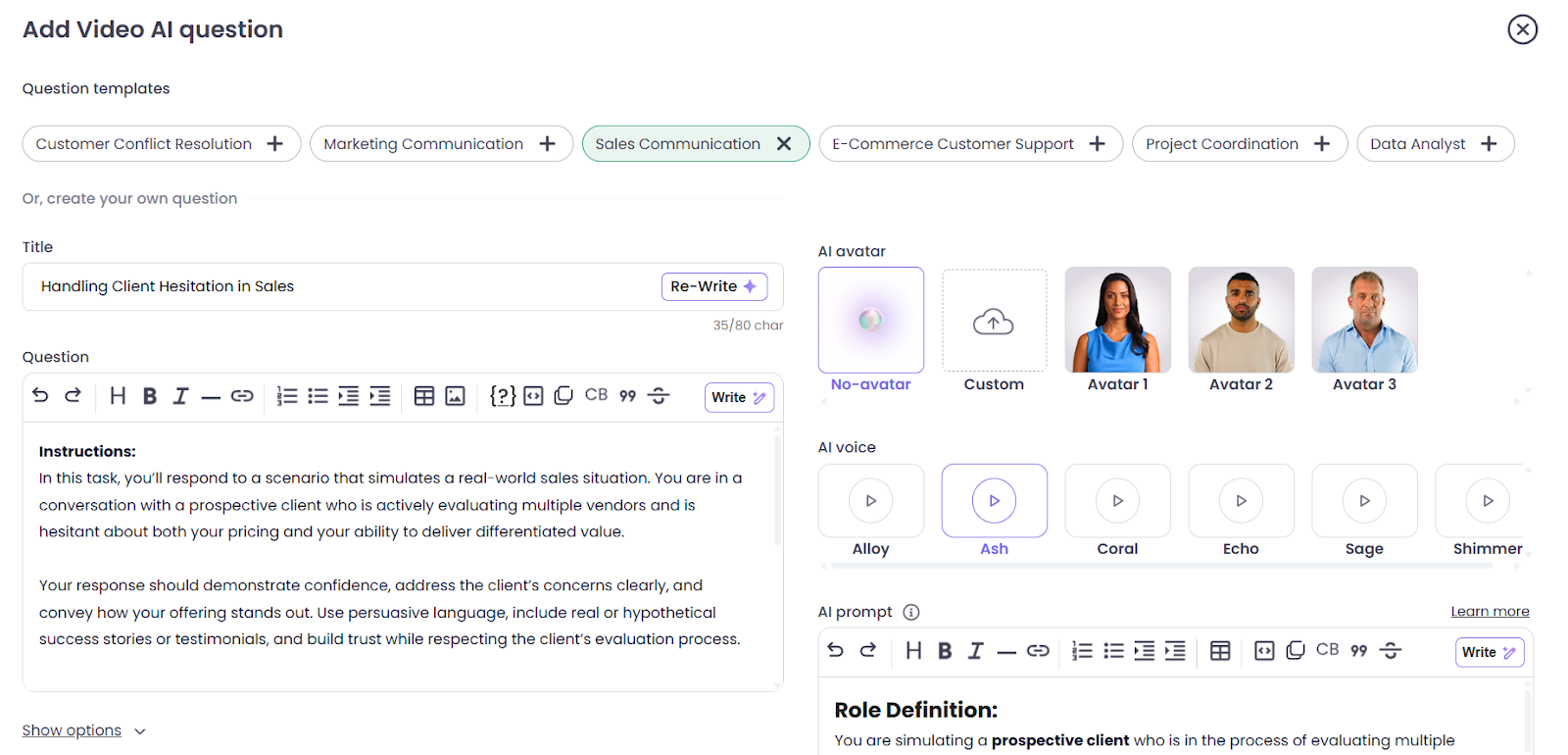
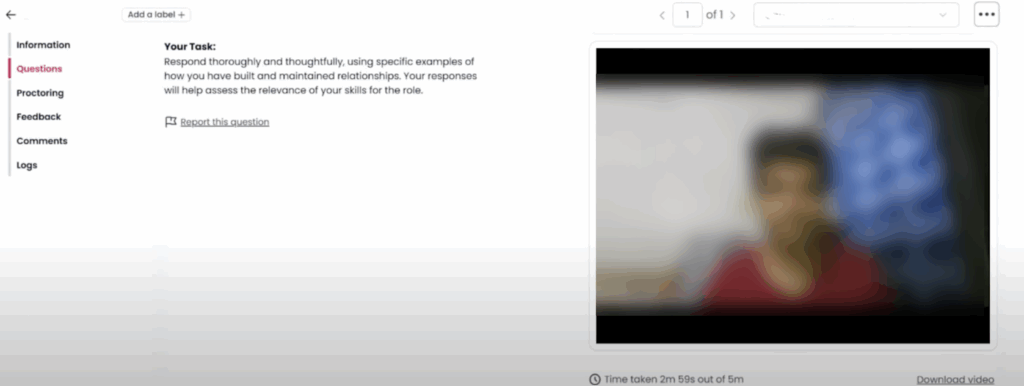
- Standard video interviews: Candidates can record responses to pre-set questions in a familiar, asynchronous video format ideal for basic screening or first-round evaluations.
- Scenario-based simulations: Candidates engage in realistic sales scenarios, showcasing their problem-solving and communication skills.
- Anti-cheating and remote proctoring: Built-in monitoring features ensure the authenticity of each interview by detecting suspicious behavior or external help.
- AI-powered analytics: The platform analyzes responses for key competencies like grammar, vocabulary, and comprehension, providing recruiters with detailed performance metrics.
- Customizable templates: You can tailor interview questions and scenarios to align with specific sales roles and requirements.
Benefits of using Video AI interviews for sales hiring
With Conversational Video AI Interviews, teams can assess these high-impact soft skills in a structured, scalable way.
Instead of relying solely on resumes or unstructured interviews, recruiters gain consistent, insight-driven data to make faster and more confident hiring decisions.
1. Enhanced candidate evaluation
Traditional interviews can be inconsistent, often relying on gut instinct rather than clear evidence of a candidate’s ability. Testlify’s AI-driven interviews provide a more structured approach by assessing candidates on real-time problem-solving, critical thinking, and communication under pressure.
Instead of generic questions, candidates respond to realistic scenarios that reflect actual sales challenges, allowing hiring teams to identify top performers based on how they think and react, not just what they say. This leads to more reliable, fair, and data-backed hiring decisions.
2. Time and cost efficiency
Manual screening of resumes and conducting multiple interview rounds can be time-consuming and costly. Testlify automates the initial stages of the hiring process, significantly reducing the time spent on candidate evaluation. This allows HR teams to focus on engaging with top-tier candidates, accelerating the overall hiring timeline.
And with seamless integration into popular Applicant Tracking Systems (ATS), results flow directly into your existing workflows. This means recruiters spend less time toggling between tools and more time engaging top candidates, speeding up decision-making without sacrificing quality.
3. Improved candidate experience
Testlify’s interactive video interviews give candidates a chance to demonstrate their skills in realistic, job-relevant scenarios far more engaging than answering generic questions. This not only helps them put their best foot forward but also creates a more authentic connection with your brand.
The platform is designed with candidate convenience in mind. Interviews can be completed asynchronously, on any device, and in any location no scheduling required. Features like mobile compatibility and timezone flexibility make it easy for candidates to participate on their own terms, reducing drop-off and improving overall satisfaction.
4. Data-driven decision making
Testlify provides real-time, AI-powered insights into each candidate’s performance from communication skills and critical thinking to behavioral indicators like confidence and clarity. Recruiters get structured analytics, including performance benchmarks, skill-specific scoring, and side-by-side comparisons to identify top talent more objectively.
These insights go beyond just pass/fail metrics; they highlight each candidate’s strengths, areas for improvement, and fit for the role. This enables HR teams to make faster, evidence-based decisions and reduce the risk of bad hires, ultimately improving team performance and lowering turnover rates.
Implementing Testlify in your sales hiring process
Integrating Testlify’s Conversational Video AI Interviews into your recruitment strategies is straightforward:
- Define role requirements: Collaborate with sales leadership to outline the key competencies and skills required for the sales role.
- Customize interview scenarios: Use Testlify’s customizable templates to create interview scenarios that reflect real-world sales challenges.
- Launch campaigns: Invite candidates in bulk or individually to take skills assessments and interviews.
- Analyze results: Review the results and analytics to assess candidate performance and identify top candidates.
- Engage with top candidates: Reach out to high-performing candidates for further interviews or job offers.
Expanding the toolkit: Audio interviews & chat simulations
While video interviews are powerful, Testlify doesn’t stop there. Sales conversations happen in many formats, including calls, emails, live chats, and LinkedIn messages, and each medium requires a different tone and skill set.
That’s why Testlify also offers audio interviews and chat simulations to give you a 360° view of your candidates.
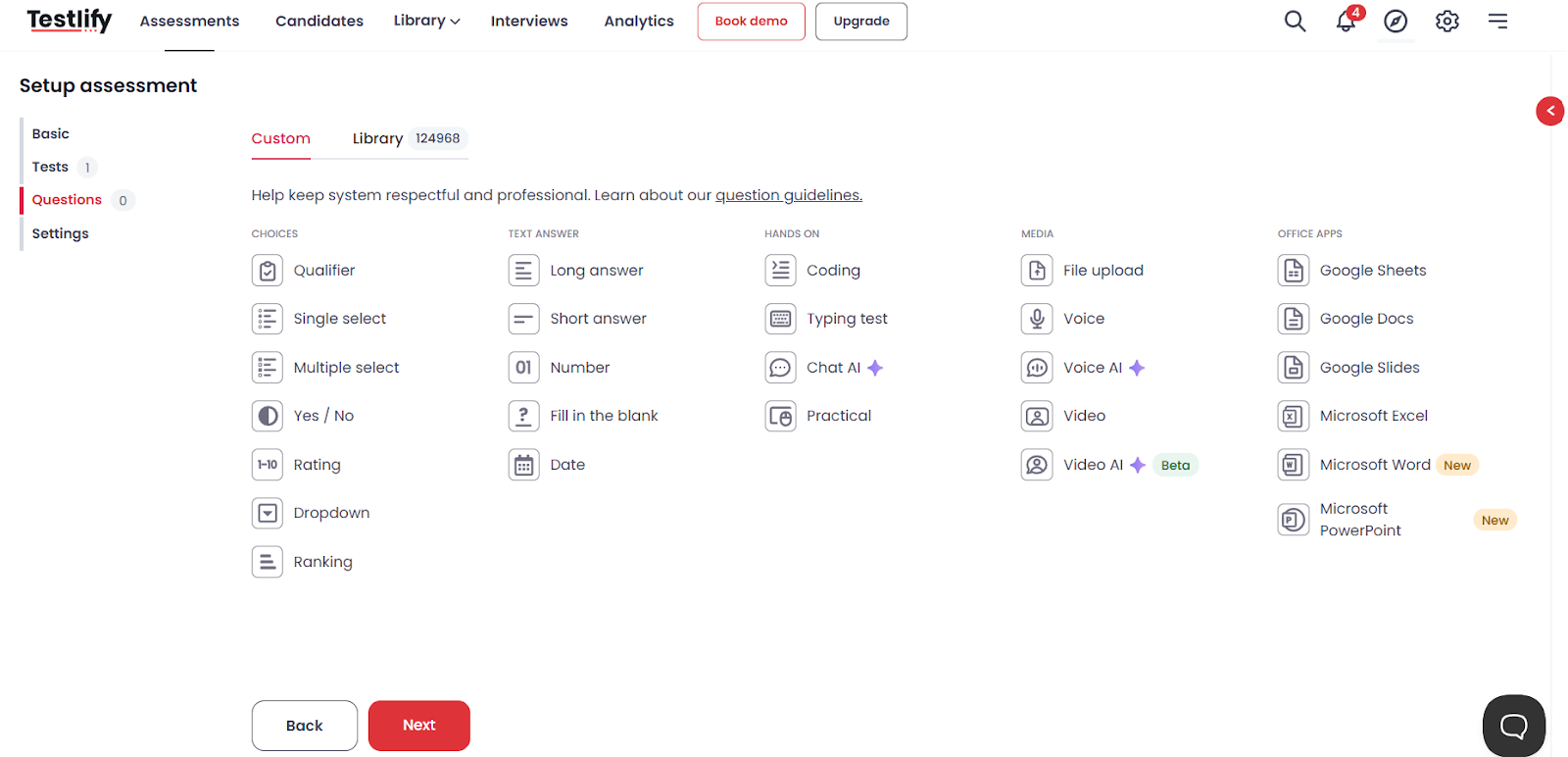
Audio interviews
For roles that are phone-heavy, like inside sales, SDRs, or BDRs, how a candidate sounds matters just as much as what they say. Audio Interviews allow candidates to respond to pre-set questions using just their voice, without the pressure of being on camera.
What you can evaluate:
- Vocal tone and confidence
- Listening comprehension (through follow-up questions)
- Articulation and pacing
- Handling customer objections or confusion
This is especially helpful for evaluating how a candidate will sound to your customers, which is a key part of the overall experience.
Chat simulations
Sales conversations often start with a message, not a meeting. Whether it’s email, live chat, or LinkedIn, great reps know how to write persuasively, clearly, and professionally.
With Testlify’s Chat Simulation feature, candidates engage in a simulated real-time messaging conversation with a virtual prospect. The simulation tests how they handle inquiries, pushback, or confusion, just like in a real chat.
What you can evaluate:
- Written communication skills
- Response speed and tone
- Ability to de-escalate, persuade, or inform via chat
- Grammar, structure, and clarity
Together, Audio Interviews and Chat Simulations add rich context to your candidate assessments. You’ll see how they pitch verbally, write professionally, and navigate real-world sales conversations across channels before you even pick up the phone.
Role-based skills assessments
Before the interviews even begin, you can filter for qualified candidates using Testlify’s pre-built skills assessments tailored specifically for sales roles. These tests evaluate real-world capabilities such as critical thinking, situational judgment, negotiation, and commercial awareness.
Popular assessments include:
- Sales executive test: designed to evaluate core sales competencies like lead qualification, relationship management, and objection handling.
- Sales manager test: tailored for candidates expected to coach teams, track KPIs, and build scalable strategies.
- Head of sales test: focused on leadership, pipeline forecasting, strategic thinking, and cross-functional collaboration.
These assessments help ensure you’re interviewing candidates with the right baseline skills for the role, saving time and improving match quality.
Reporting, analytics, and scoring
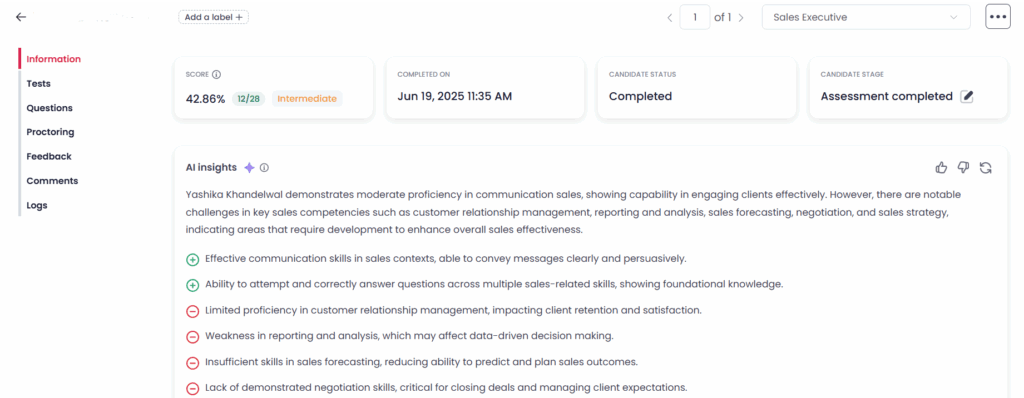
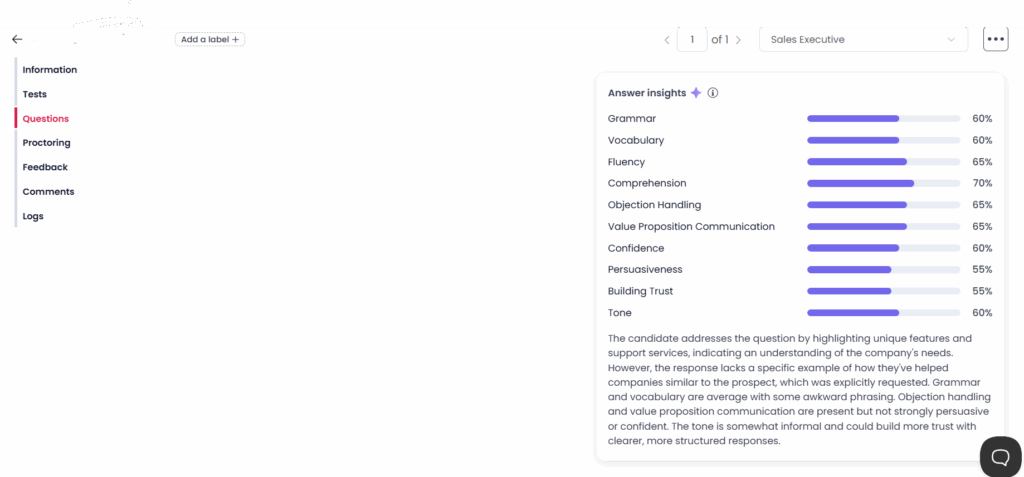
With built-in AI-powered scoring and customizable reporting tools, Testlify gives recruiters and hiring managers a high-resolution view of each candidate’s performance, not just a list of answers.
AI-powered scoring system
Testlify’s proprietary AI models evaluate candidates based on soft skills, communication ability, emotional tone, and response quality. Each response is scored against role-specific benchmarks, ensuring you’re not just hiring someone who sounds good, but someone good at selling. Scoring is:
- Transparent: Based on clearly defined criteria
- Consistent: Every candidate is evaluated against the same rubric
- Role-specific: Scores adjust based on competencies required for each sales role
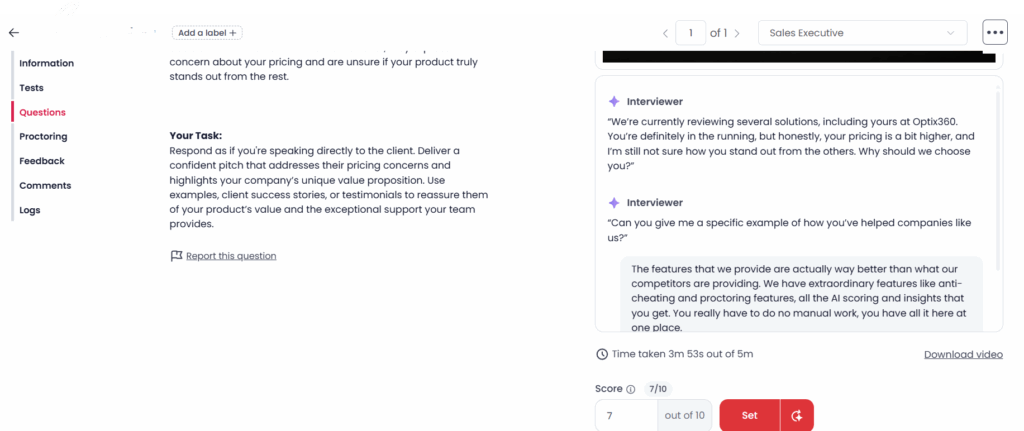
Skill-by-skill performance breakdown
Every candidate report includes a granular breakdown of key soft skills such as:
- Verbal clarity and persuasion
- Confidence under pressure
- Adaptability in dynamic scenarios
- Listening comprehension and response alignment
- Empathy and customer orientation These insights allow recruiters to pinpoint not just if a candidate performed well, but how and why.
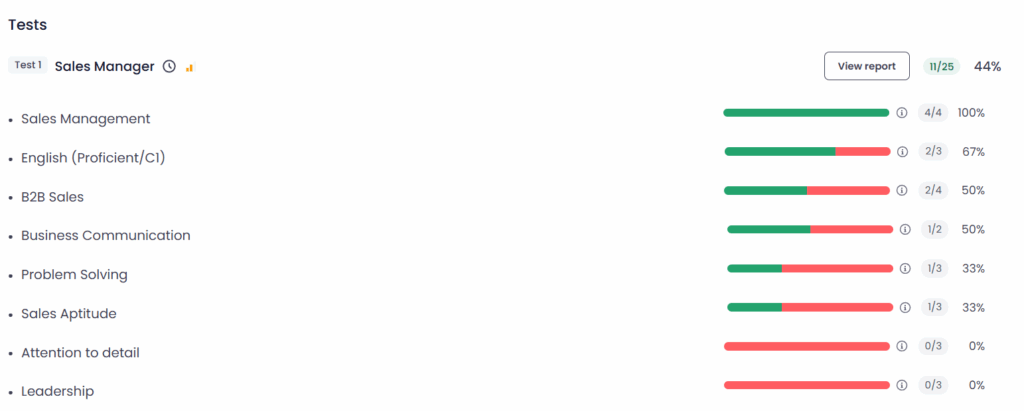
Benchmarking and leaderboards
Testlify aggregates scoring across all applicants to generate performance benchmarks, so you can easily identify top talent relative to your entire candidate pool. Use customizable leaderboards to:
- Compare top candidates across different territories or hiring campaigns
- Track how applicants stack up against ideal scores
- Ensure fairness and consistency in final shortlisting
Visual dashboards for faster decision-making
Testlify’s visual dashboards help you make sense of complex candidate data at a glance. Filter by role, score, skill, location, or interview type, then generate easy-to-share reports for stakeholders and hiring panels.
Addressing common concerns
Introducing AI into the hiring process can raise important questions about fairness, privacy, and compatibility. Testlify addresses these concerns head-on with a strong focus on data security, unbiased algorithms, and seamless integrations, ensuring a smooth and trustworthy experience for both HR teams and candidates.
Is AI bias-free?
At Testlify, reducing bias isn’t just a goal it’s built into the way our platform is designed. Our AI models are trained on continuously updated, diverse datasets to avoid the pitfalls of outdated or skewed information.
Candidate responses are scored using objective, standardized rubrics rather than subjective judgments. Every assessment and scenario is scientifically vetted by I/O psychologists and industry experts to ensure fairness, job relevance, and inclusivity.
How secure is candidate data?
Candidate data is handled with the utmost care and security. Testlify complies with GDPR and CCPA, SOC 2, and ISO 27001, ensuring that all personal information is stored and processed securely.
Can testlify integrate with our existing systems?
Yes, Testlify offers seamless integration with various Applicant Tracking Systems (ATS) and Human Resource Information Systems (HRIS), ensuring a smooth transition and minimal disruption to existing workflows.
Conclusion
Testlify’s Video AI Interviews represent a significant advancement in sales hiring. By combining AI-driven assessments with real-world scenarios, organizations can more effectively evaluate candidates, leading to better hiring decisions and stronger sales teams. Embracing this innovative approach not only enhances recruitment efficiency but also positions your organization as a forward-thinking leader in talent acquisition.
Adopting a skills assessment platform can be a strategic move towards building a more effective and efficient sales team. By leveraging technology to enhance the hiring process, you can ensure that your organization attracts and retains top sales talent, driving business success in an increasingly competitive market.
Frequently asked questions (FAQs)

Content Writer
Yashika Khandelwal is a Content Writer with 3+ years of experience creating research-backed content on hiring, talent assessment, and HR technology. She is a registered Organizational Psychologist and subject matter expert who combines behavioral science with practical recruitment insights to produce accurate, evidence-based content.
LinkedInRelated resources
View all
Candidate assessment
Chat AI interviews for customer support hiring

Candidate assessment
How to use the picOCEAN personality test in hiring?

Candidate assessment
Proxy Interview: How to Detect and Prevent Hiring Fraud

Candidate assessment
What Is Talent Development? Strategy, Plans, and Programs (2026)

Candidate assessment
Skills gap: How Testlify’s assessments can identify top talent
Candidate assessment
What is redundancy? Meaning, types, and examples
Get started.
Hire on proof, not resumes.
Run your first skills-based assessment free — no credit card required.