
How do ATS-integrated assessments streamline hiring workflows?
Discover how ATS-integrated assessments reduce hiring delays and help recruiters hire smarter.

Recruiters lose 44 days on average to fill one open role, according to SHRM’s benchmarking data. Most of that timeline disappears into manual handoffs between the applicant tracking system and the assessment platform. ATS-integrated assessments close that exact gap.
This blog explores how ATS-integrated assessments transform hiring workflows, which processes see the biggest efficiency gains, and what hiring leaders should look for in an assessment platform.
 ChatGPT
 Gemini
 Claude
 Grok
Grok Perplexity
Quick answer
ATS-integrated assessment tools streamline hiring workflows through five mechanics:
- Auto-triggered assessments: The ATS sends skills tests the moment a candidate hits a defined pipeline stage.
- Two-way score sync: Test results land in the candidate record without manual export or CSV uploads.
- Centralized ranking: Recruiters sort, filter, and shortlist candidates inside the ATS dashboard they already use.
- Unified candidate experience: Applicants move from application to assessment in one continuous flow.
Together, these shifts compress time-to-hire, lift candidate quality, and free recruiters to do strategic work.

What is an ATS-integrated assessment tool?
An applicant tracking system is software that manages job openings, applications, and candidate progression across hiring stages. An assessment tool is software that measures candidate skills, cognitive ability, or behavior through structured tests.
An ATS-integrated assessment tool connects both itself and the respective applicant tracking systems through an API so test invitations, scores, and status changes flow automatically between them.
Recruiters never touch a CSV file, and candidates never log into two separate platforms. The integration layer decides whether ATS becomes a productivity multiplier or just another data silo.
How do ATS-integrated assessments improve hiring?
Integration changes the mechanics of five core workflow stages. Each shift removes a specific bottleneck that throttles most hiring teams today.
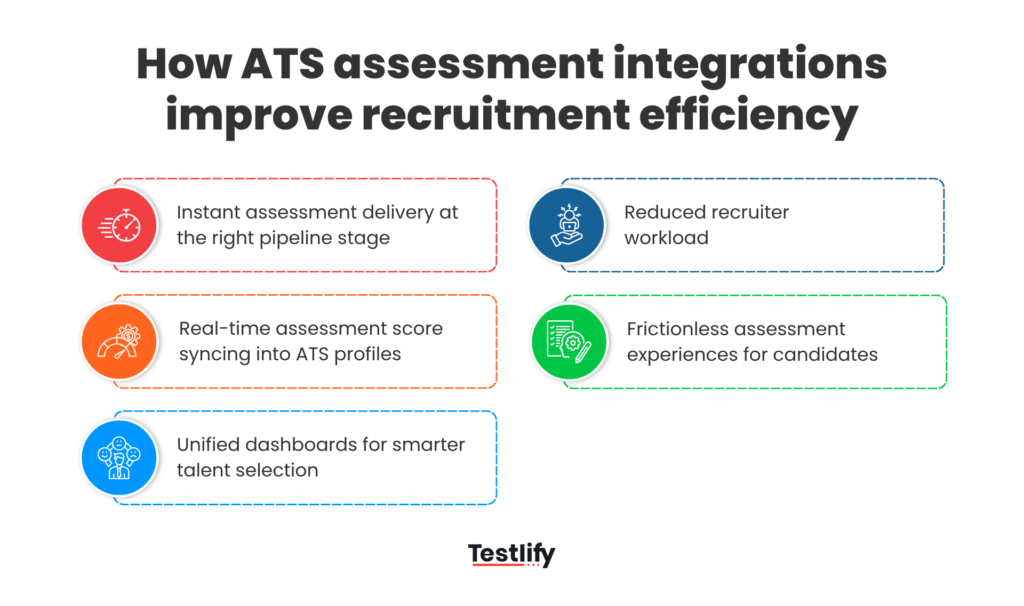
They auto-trigger assessments at the right pipeline stage
Recruiters configure the rule once inside the ATS. The system then sends an assessment invitation the moment a candidate moves from “applied” to “screening,” with zero manual clicks.
This automation eliminates the 30 to 60-minute gap most teams lose to manual invitation tasks per requisition.
It also prevents top candidates from going cold while they wait, which protects offer acceptance rates that candidate experience research links to a 70% lift in conversion.
They sync scores directly into the candidate record
Assessment results land inside the ATS profile within seconds of completion. Recruiters see the score next to the resume, not in a separate tab or inbox.
This sync removes the spreadsheet stage that 64% of hiring teams still rely on. It also creates an audit trail that protects every hiring decision against bias claims, which strengthens your hiring bias reduction strategy.
They centralize ranking and shortlisting in one dashboard
Hiring managers filter candidates by the score of their skill tests inside the ATS itself. They never switch tools, never re-key data, and never lose track of which score belongs to which candidate.
Centralized ranking compresses the shortlisting stage from days to minutes. It also forces every decision-maker to evaluate the same scoreboard, which boosts structured interview consistency.
They cut recruiter admin work by 60% to 70%
Integration kills the most expensive recruiter activity: copy-pasting between systems. Talentera’s 2025 research confirms that 70% of recruiters who automate screening report significantly better candidate quality.
That recovered time moves straight into stakeholder conversations and offer negotiations. Recruiters then operate as talent advisors, not data-entry clerks, which lifts recruiter productivity on every requisition.
They deliver one seamless candidate experience
Candidates click one link, complete the application, and finish the assessment in the same workflow. They never re-enter their name, email, or job preference across systems.
A unified flow lifts assessment completion rates by up to 40% based on integration benchmarks. Higher completion means richer data and a stronger talent pipeline.
Which hiring bottlenecks do they eliminate?
ATS-assessment integration removes four bottlenecks that throttle most hiring pipelines today. Each one carries a measurable cost when left unaddressed.
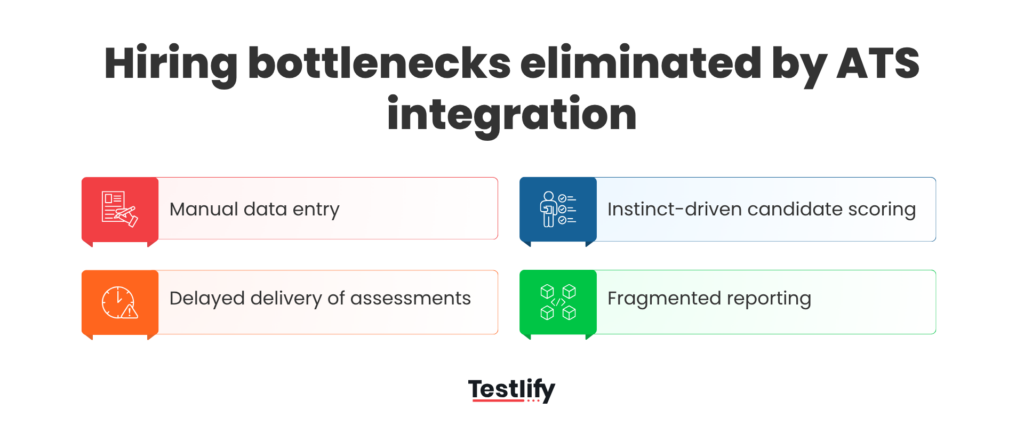
Manual data entry between systems
Recruiters spend up to 14 hours per week moving candidate data across disconnected tools, based on industry research. Integration deletes that entire workflow.
The recovered hours flow into sourcing, screening calls, and offer negotiations. This shift fuels broader recruitment automation gains.
Delayed assessment delivery
Manual workflows create lag between application submission and test invitation. Top candidates accept competing offers during that lag.
Stage-triggered automation sends invitations within seconds. Faster invitations protect your conversion rate at the most fragile pipeline stage.
Inconsistent candidate scoring
Without integration, hiring managers compare candidates using gut feel and incomplete data. It is reported that companies without standardized interview processes are five times more likely to make a bad hire.
Integration enforces one scoring framework across every requisition. Consistency turns hiring into a repeatable system, not a series of judgment calls.
Fractured reporting and analytics
Disconnected tools force recruiters to stitch metrics from multiple dashboards. Stitched reports delay decisions and obscure ROI.
Integrated systems surface funnel metrics in one view. Real-time data lets leaders correct course mid-quarter, not at the annual review.
Must-have ATS-assessment integration features
Hiring leaders should evaluate integrations against six features. Each feature maps to a specific risk that surfaces after the buying decision.
- Two-way data sync: Scores, status updates, and recruiter notes should sync automatically between the ATS and assessment platform without manual refreshes.
- Stage-triggered automation: The system should automatically send assessments based on configurable hiring-stage rules.
- Single sign-on (SSO): Recruiters should be able to access both systems through one secure login.
- Built-in anti-cheating controls: Look for features like webcam proctoring, plagiarism detection, browser monitoring, and randomized question banks.
- Configurable assessment library: The platform should include ready-to-use technical skills tests, cognitive ability tests, and remote hiring assessments, with customization options.
- Real-time analytics: Dashboards should track completion rates, score distributions, drop-offs, and pipeline impact in real time.
How to roll out ATS-integrated assessments?
Run a 30-day pilot on one high-volume role. Benchmark time-to-hire, quality-of-hire, and recruiter hours against your last three hires for the same role.
Once the pilot proves out, expand to one job family per quarter. This sequence protects active hiring while it builds the internal proof points that finance needs to fund a wider rollout.
Loop hiring managers into the design phase early. Their buy-in drives adoption, and hiring manager collaboration determines whether the integration becomes the default workflow or shelfware.
Common pitfalls hiring leaders should avoid
Three pitfalls derail most ATS-assessment integration projects. Each one is preventable with the right diligence upfront.
- Choosing assessments without predictive validity: Assessments that fail to predict real job performance create unreliable hiring signals and weaken decision-making.
- Over-assessing every candidate: Excessive testing lowers completion rates and damages candidate experience, especially during high-volume hiring cycles.
- Skipping change management: Without proper recruiter and hiring manager training, even strong integrations struggle to gain long-term adoption.
How does ATS-integrated assessment compare to standalone testing?
Standalone testing forces recruiters to manage two systems, two logins, and two data sets. Integrated assessment collapses all of it into one workflow.
Standalone setups still work for one-off senior hires where volume is low and bespoke evaluation matters more than speed. Integrated setups win for every other hiring scenario, including recruitment funnel optimization at scale.
The ROI gap widens as hiring volume grows. Teams running 50 or more requisitions per quarter recover their integration investment within the first hiring cycle.
Final thoughts
ATS-integrated assessment tools convert hiring from a logistics problem into a decision problem. They compress time-to-hire, lift quality-of-hire, and free recruiters to do the strategic work that drives business outcomes.
The teams that win the talent war in 2026 will not be the ones with the largest sourcing budgets. They will be the ones whose hiring stack moves candidates from application to offer without a single manual handoff.
Testlify integrates natively with every major ATS through pre-built connectors and a flexible API. Customers cut time-to-hire by an average of 55%, and they can successfully redeploy recruiter hours into high-value activities like strategic workforce planning.
Book a demo today and see how Testlify can transform your hiring workflow within 30 days.

Related resources
View all
Candidate assessment
How to assess financial modeling and accounting skills pre-hire?

Candidate assessment
How do assessment libraries cover niche skills?

Candidate assessment
What’s the best way to combine psychometric tests with skills tests?

Candidate assessment
How to use AI to tailor assessments to job descriptions

Candidate assessment
Aptitude Tests in Hiring: The Complete 2026 Guide for Recruiters

Candidate assessment
AI features transforming HR support and leadership
Get started.
Hire on proof, not resumes.
Run your first skills-based assessment free — no credit card required.