
Best practices for hiring data analysts using assessments?
Discover a proven assessment-driven hiring process that helps recruiters identify, evaluate, and hire top-performing data analysts with confidence.

Your last data analyst looked perfect on paper. Then the first dashboard arrived three weeks late, riddled with broken SQL queries and charts nobody could read. You trusted a resume, and the resume lied
That story repeats across thousands of hiring teams every quarter. SHRM data shows that 86% of HR professionals have caught lies on candidate profiles, while 70% of applicants admit they fabricate resume details. Skills assessments fix this problem by replacing guesswork with proof.
This guide shows you how to hire data analysts using structured, evidence-based assessments. You will learn the exact skills to test, the assessment sequence top employers follow, and the mistakes that quietly sink your hiring funnel.
 ChatGPT
 Gemini
 Claude
 Grok
Grok Perplexity
Direct answer
Hire data analysts by running a structured, multi-stage skills assessment that tests SQL, Python, data visualization, statistical reasoning, and business communication before any interview.
You combine role-specific skills tests, cognitive ability tests, and a practical work sample, then validate the top scorers through a structured interview.
The result is faster hiring, lower mis-hire risk, and a fairer process. Companies using pre-employment assessments cut time-to-hire by 20% to 30% easily

What is a data analyst?
A data analyst is a professional who collects, cleans, and interprets data to help organizations make informed business decisions. The role turns raw numbers into actionable recommendations leaders can act on to ensure the prosperity of their business.
Data analysts query databases, build dashboards, and translate statistical findings into plain business language. They sit close to business teams and answer questions like “which product drove last quarter’s growth?”
Demand for this role keeps climbing. The U.S. Bureau of Labor Statistics projects strong growth across analytics careers, and the global data analytics market is projected to reach $104.39 billion by the end of 2026.
Key responsibilities of a data analyst
Data analysts own the end-to-end process of transforming raw data into business recommendations, and every responsibility maps to a specific skill you can test before making the decision to hire.
The core responsibilities include the following:
- Collect and clean data: The analyst gathers data from multiple sources and removes errors, duplicates, and gaps.
- Query databases: The analyst writes SQL to extract precise datasets from relational systems.
- Analyze patterns: The analyst applies statistical methods to find trends, correlations, and anomalies.
- Build visualizations: The analyst creates dashboards in Tableau or Power BI that non-technical teams understand.
- Communicate insights: The analyst presents findings to stakeholders and recommends clear next steps.
- Automate workflows: The analyst uses Python or scripting to reduce repetitive manual reporting.
Each task demands proof, not promises. A SQL skills test confirms querying ability, and a visualization assignment confirms dashboard quality.
You can verify these responsibilities efficiently using a data analyst test that mirrors real work scenarios.
Skills and competencies recruiters must look for
A successful data analyst combines technical proficiency, statistical reasoning, and strong business communication. Top employers test all three categories rather than fixating on tools alone.
Core technical skills you must assess
The essential technical skills include the following:
- SQL: Candidates use SQL to extract, clean, combine, and analyze data from multiple sources, turning raw records into actionable insights.
- Python: Used to automate repetitive tasks, process large datasets, perform advanced analysis, and build data workflows that scale beyond spreadsheets.
- Excel: Used for organizing data, building models, creating reports, and quickly answering day-to-day business questions.
- Data visualization: Candidates use tools such as Tableau and Power BI to transform complex datasets into clear dashboards and visual reports that support decision-making.
- Statistical analysis: Enables analysts to identify patterns, validate assumptions, measure performance, and draw reliable conclusions from data rather than relying on intuition alone.
You can validate each skill independently. Run a SQL assessment for querying, a Python 3 test for scripting, and a data analyst Excel test for ascertaining spreadsheet mastery.
Cognitive and analytical competencies
Technical tools change, but reasoning ability lasts. Cognitive ability tests predict learning speed and adaptability across the entire career.
Schmidt and Hunter’s landmark research confirms cognitive ability ranks among the strongest predictors of job performance.
A cognitive ability test measures how quickly an analyst absorbs new problems and tools.
Business and communication competencies
Data analysis only creates value when insights lead to action. Analysts must be able to translate complex findings into clear recommendations that stakeholders can understand and trust.
Strong communication skills enable candidates to explain trends, present evidence, answer questions, and tailor their message to different audiences.
During the hiring process, assess how clearly candidates communicate their thinking, justify their conclusions, and connect data findings to business outcomes.
Best assessment process to hire top data analysts
The strongest hiring process runs assessments in a staged sequence that filters technical ability first, then validates cultural fit. This saves recruiter time and reduces unconscious bias at every step.
We will now discuss the five-stage process that leading teams must follow to identify and advance the strongest candidates for the role of data analyst.
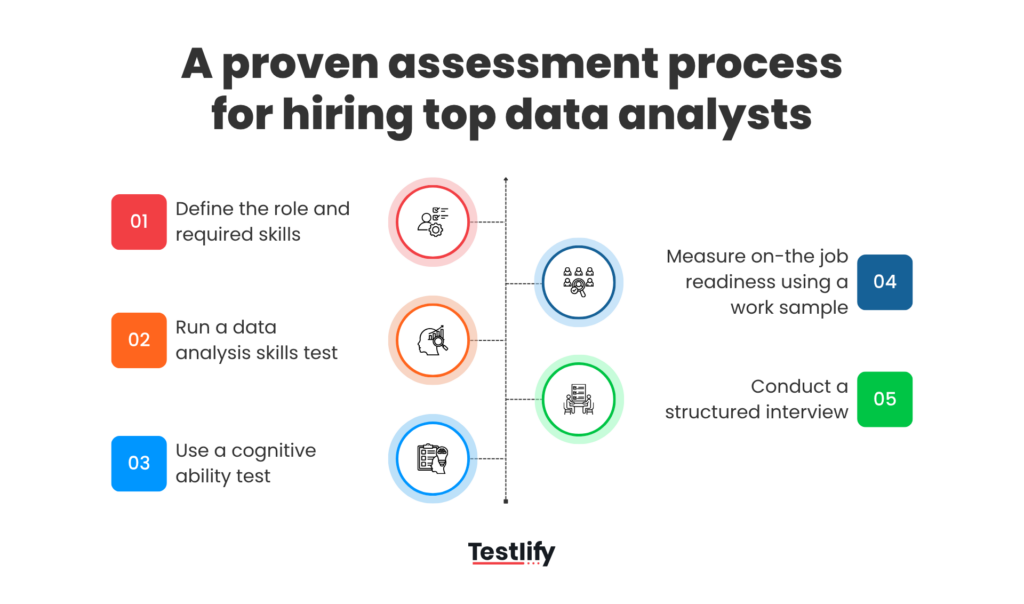
1. Define the role and required skills
Map the exact skills the role demands before you write a single test. A junior reporting role needs different skills than a senior predictive analytics role.
List your must-have competencies as measurable criteria. This step prevents the common error of testing skills the job never uses.
2. Run a role-specific skills test
Send every applicant a data analysis test as the first filter, giving every candidate an equal opportunity to demonstrate their skills and providing an objective measure of job readiness
This creates a fair and consistent screening process, making it easier to identify candidates with the skills required for the role while reducing the influence of subjective judgment.
3. Add a cognitive ability test
Layer a cognitive ability assessment on top of your skills screening process for shortlisted candidates. This approach helps identify not only who can perform the job today, but who can adapt, learn, and grow as the role evolves.
You’ll uncover candidates who can reason through unfamiliar challenges, connect disparate information, and solve new problems rather than relying solely on previously learned solutions.
4. Assign a practical work sample
Give finalists a realistic data assignment that mirrors your actual work. Unlike screening tests, work samples reveal how candidates approach ambiguous problems, analyze information, and communicate insights.
No hiring method provides a clearer view of on-the-job performance than seeing candidates perform the work itself.
5. Run a structured interview
Finish with a structured interview that asks every candidate the same scoring questions. Structured interviews predict performance twice as accurately as unstructured conversations, per Schmidt and Hunter.
Use a consistent set of interview questions for a data analyst tied directly to your scoring rubric. Consistency removes interviewer bias and improves comparison.
Best practices for hiring data analysts with assessments
The best practices treat assessment as a system, not a single test. These principles turn a one-time screen into a repeatable hiring engine that improves with every cohort.
Apply the seven practices below across every data analyst search.
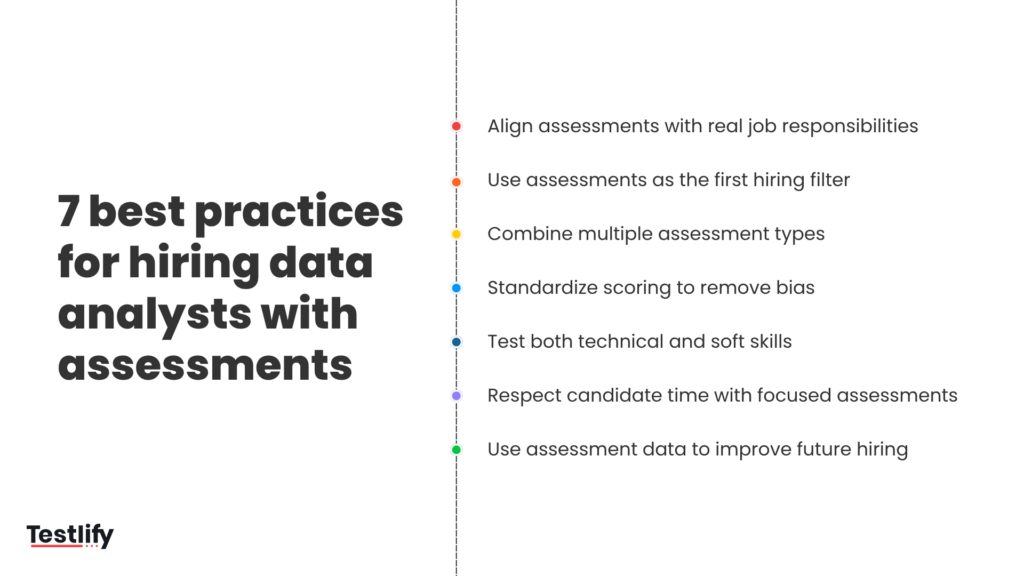
1. Anchor every test to a job task
Test only the skills the role actually uses each week. McKinsey found that hiring for skills predicts performance five times better than hiring on education, but only when the skills match the work.
Map each assessment to a concrete responsibility before you launch it. This alignment keeps strong candidates in and weak candidates out.
2. Assess early to filter at the top of the funnel
Place your skills screen before resume review, not after. Basic screening assessment removes subjective bias from your very first filter.
SHRM reports that 79% of HR professionals now value assessment scores as much as or more than traditional criteria. Early testing lets you act on that signal immediately.
3. Combine multiple assessment types
Pair a data analysis test with a cognitive ability test and a work sample. Each assessment type captures a different dimension of performance.
4. Standardize scoring to remove bias
Score every candidate against the same rubric on the same scale. Standardization is the mechanism that makes assessments fairer than interviews.
A consistent rubric lets you compare a self-taught analyst and a degree holder on identical terms. You judge ability, not pedigree.
5. Test soft skills alongside technical skills
Add a communication or stakeholder scenario to your technical screen. Analysts deliver value only when leaders understand their findings.
LinkedIn’s research shows that 91% of L&D professionals view soft skills as increasingly critical. Follow proven tips to evaluate data analysis skills that weigh storytelling beside SQL.
6. Keep the candidate experience short and respectful
Long, irrelevant assessments drive top talent away. Job posts that mention clear skills see a 19% higher view-to-apply rate, so respect the candidate’s time.
Cap your screen at the skills the role demands. A focused data analyst test protects both rigor and your employer brand.
7. Measure and refine your assessment data
Track which assessment scores predict your best performers over time. Treat your hiring funnel like any other dataset an analyst would optimize.
Review pass rates, score distributions, and post-hire performance each quarter. This feedback loop sharpens your data analyst assessment accuracy with every hire.
Common assessment mistakes employers make
Most assessment failures come from poor process design, not poor candidates. Each mistake below carries a measurable cost you can avoid.
1. Relying on resumes instead of skills
A resume is a marketing document, not a performance record. It tells you what a candidate has done, but not how well they can do the work your role requires today.
The most effective hiring teams validate skills using assessments before they invest time in interviews.
Skills assessments replace assumptions with evidence, helping you identify candidates who can perform rather than simply present themselves well on paper.
2. Hiring to solve an immediate problem
When a role has been open for weeks, speed can start to feel more important than accuracy. That pressure often leads teams to skip steps and make decisions based on incomplete information.
Strong hiring processes create structure, even when timelines are tight. Assessments help teams identify qualified candidates faster, allowing them to move quickly without compromising hiring quality.
3. Trusting gut feeling over data
Many hiring mistakes happen when recruiters or hiring managers form an opinion early and spend the rest of the process looking for evidence to support it.
The best hiring decisions come from consistent evaluation criteria. When every candidate is measured against the same benchmarks, decisions become more objective and defensible.
4. Testing the wrong skills
Not every data analyst position requires the same capabilities. Some roles focus heavily on SQL and data extraction, while others emphasize dashboard creation, stakeholder reporting, or business analysis.
Assessments should reflect the actual work candidates will perform after they are hired. When tests align with job responsibilities, hiring teams gain a much clearer picture of future performance.
5. Ignoring soft skills and communication
Data analysts do more than work with numbers. They explain findings, influence decisions, and help stakeholders understand what actions to take next.
Technical-only assessments miss half the role. An analyst who cannot communicate insights delivers little business value.
The strongest hiring processes evaluate both technical expertise and the ability to translate insights into clear, actionable recommendations.
The cost of getting it wrong
Bad hires drain budgets fast. SHRM estimates the cost of a bad hire reaches 33% of the employee’s annual salary, while independent studies push that figure to between 50% and 200% depending on role complexity.
The table below illustrates the financial gap between assessment-driven hiring and resume-driven hiring.
Mis-hire risk by hiring method (lower is better)
Hiring approach | Risk level | What it tells you |
|---|---|---|
Resume + unstructured interview | High risk | Relies on subjective judgment instead of proven financial modeling skills, making it an unreliable predictor of job performance |
Skills test only | Moderate risk | Measures technical skills but not how candidates solve business problems. |
Skills test + cognitive ability test + work sample | Low risk | Measures technical skills and problem-solving ability, making it the strongest predictor of on-the-job success. |
Structured, multi-stage assessments shrink this risk dramatically. You protect your budget and your team’s productivity at the same time.
Final thoughts
Hiring data analysts on resumes alone gambles your budget against a 33% bad-hire tax and a fabrication rate that touches most candidate profiles. Structured skills assessments flip that equation in your favor.
You now have the framework: define the role, screen for skills, layer cognitive testing, assign a real work sample, and close with a structured interview.
The teams that win the analytics talent race in 2026 will measure ability before they make offers. The teams that keep trusting resumes will keep paying the mis-hire tax.
Testlify gives you the assessment engine to make that shift today.
Book a demo with Testlify and start hiring data analysts you can trust from the first dashboard.

Related resources
View all
AI in recruitment
How to run role simulations through video interview prompts?

AI in recruitment
What tools offer AI-generated questions for custom assessments?

AI in recruitment
How does Testlify’s AI scoring handle open-ended answers and code quality?

AI in recruitment
How to use AI in recruiting using Testlify

AI in recruitment
AI recruitment platforms: Buyer’s guide

AI in recruitment
Will AI replace recruiters in 2026? The real answer
Get started.
Hire on proof, not resumes.
Run your first skills-based assessment free — no credit card required.