
How to assess financial modeling and accounting skills pre-hire?
Discover the best methods for evaluating accounting and finance skills of candidates pre-hire

Bad hires drain mid-market companies of up to 30% of a new hire’s first-year salary. One broken model misleads investors, and one missed accrual triggers an audit finding.
Smart finance leaders now assess financial modeling and accounting skills pre-hire by running job-specific skills tests on a pre-employment assessment platform such as Testlify. A pre-employment assessment platform is a software tool that delivers, scores, and benchmarks role-specific candidate tests at scale.
The proven funnel runs in four steps:
- Screen technical knowledge with timed tests on GAAP, IFRS, and modeling fundamentals.
- Test applied skill with Excel case studies on three-statement modeling, DCF valuation, and reconciliations.
- Score candidates against benchmarks set by your current top performers.
- Pair top scorers with structured interviews and a final paid case study.
This approach cuts mis-hires, shortens time-to-hire, and builds finance teams that deliver accurate numbers from day one.
 ChatGPT
 Gemini
 Claude
 Grok
Grok Perplexity
The hidden cost of a bad hire
Finance hiring failures cost more than most other functions. The damage runs through three channels at once. Direct costs include recruiter fees, signing bonus, severance, and replacement search. According to SHRM, the cost of replacing an employee can range from 50% to 200% of their annual salary
Opportunity cost includes the deals you misprice, the forecasts you miss, and the audit adjustments you absorb. Compliance cost includes restatement risk, control deficiencies, and SEC scrutiny for public companies. A single material weakness disclosure can cut market cap by 5% to 10%, according to Forbes coverage of restatement events.
The math is concerning. A $120,000 senior accountant who fails within 12 months costs the business between $180,000 and $360,000 once you load the channels.
Demand for this talent is climbing too: the U.S. Bureau of Labor Statistics projects about 29,900 financial and investment analyst openings each year through 2034, with a median wage of $101,350 (U.S. Bureau of Labor Statistics). Separately, McKinsey research finds skills-based hiring is roughly five times more predictive of job performance than hiring on education, and more than twice as predictive as hiring on experience (McKinsey) - one more reason to score the actual model, not the resume.

What strong financial modeling skills actually look like
Financial modeling is the practice of building Excel-based projections that forecast a company’s financial performance. Strong modelers combine accounting fluency, business judgment, and spreadsheet engineering into one auditable artifact.
Most candidates fail on one of those three dimensions. The assessment must test all three.
Judgment is the dimension employers say matters most right now: analytical thinking is the single most in-demand skill named by employers, cited by 70% of them in the World Economic Forum's Future of Jobs 2025 report (World Economic Forum). A model is only as good as the assumptions behind it, and pressure-testing those assumptions is a thinking skill, not an Excel one.
Three-statement modeling reveals structural rigor
Three-statement modeling links the income statement, balance sheet, and cash flow statement into one dynamic model. The test reveals whether candidates think in flows or only in numbers.
Sample assessment task: Build a five-year operating model for a SaaS business with $50M ARR growing 30% year over year, 75% gross margin, and 80% net revenue retention. Link revenue drivers to a full three-statement output and add a balance check row.
What strong answers look like: The candidate separates assumptions, calculations, and outputs into distinct tabs. The balance sheet balances every year, the cash flow statement reconciles to the change in cash, and named ranges replace hardcoded numbers.
What weak answers look like: The model hardcodes growth rates inside formulas. The balance sheet fails to balance by year three, and the candidate cannot diagnose the break in under five minutes.
DCF and valuation modeling test financial judgment
DCF stands for discounted cash flow, a valuation method that discounts projected free cash flows to present value. Free cash flow is the cash a business generates after capital expenditures.
Candidates should compute WACC, terminal value, and equity value per share without prompting. WACC stands for weighted average cost of capital, the blended rate a company pays to finance its assets.
LBO modeling matters for banking and PE roles
LBO stands for leveraged buyout, a transaction where a financial sponsor acquires a company primarily with borrowed money. Banking and private equity candidates must build an LBO model from scratch in 60 to 90 minutes.
The test reveals capital structure intuition. Strong candidates layer senior debt, mezzanine, and sponsor equity, then compute the internal rate of return (IRR) and multiple on invested capital (MOIC) on the exit.
Sensitivity, scenario, and Monte Carlo analysis test rigor
Sensitivity analysis measures how the output changes when one input changes. Scenario analysis models multiple input changes at once to show bull, base, and bear outcomes.
Monte Carlo analysis runs thousands of randomized simulations across input distributions to produce a probability curve. Senior FP&A and treasury candidates should know when each method applies.
Ask candidates to build a two-variable data table on EBITDA and revenue growth, then a three-scenario manager. EBITDA stands for earnings before interest, taxes, depreciation, and amortization. Their setup exposes Excel fluency and business thinking in 20 minutes.
Excel and spreadsheet engineering drive every output
Excel remains the universal finance language. Test candidates on INDEX/MATCH, VLOOKUP, dynamic arrays, named ranges, pivot tables, and conditional formatting for audit trails.
Modern roles also demand Power Query and Power BI fluency. Power Query is the data transformation engine in Excel and Power BI that lets analysts shape source data without manual rework.
What strong accounting skills actually look like
Accounting skills determine whether your team books transactions correctly and reports them accurately. Weak accounting fundamentals surface in audit adjustments, late closes, and SEC comment letters.
GAAP and IFRS knowledge tests technical foundations
GAAP stands for Generally Accepted Accounting Principles, the standard framework in the United States. IFRS stands for International Financial Reporting Standards, used in over 140 countries according to the IFRS Foundation.
Test candidates on revenue recognition under ASC 606, lease accounting under ASC 842, and impairment rules. ASC 606 is the FASB revenue recognition standard that requires a five-step model for recognizing revenue from customer contracts.
Journal entries and the close process test accuracy under pressure
Journal entries record financial transactions as debits and credits. Reconciliations confirm that two sets of records match.
The month-end close is the process of finalizing all transactions and producing financial statements for a period. Strong candidates know the close timeline, the common bottlenecks, and the controls that prevent post-close adjustments.
Give candidates ten transactions and ask them to book the entries. Then give them a sample bank statement and a ledger to reconcile within 30 minutes.
Reconciliations reveal investigation skills
Account reconciliation is the process of comparing two sets of records to confirm they agree. Variance analysis explains why actual results differ from the budget or forecast.
Test candidates with a $200K variance and ask for a five-minute explanation framework. Strong candidates separate volume, price, mix, and timing variances and propose corrective action.
Financial reporting and disclosures test communication skills
Financial reporting translates raw data into statements that stakeholders read. Analysts compute ratios such as gross margin, current ratio, and return on equity to interpret performance.
Ask candidates to analyze a sample income statement and explain three insights in 90 seconds. The exercise reveals whether the candidate can move from numbers to narrative.
Internal controls, SOX, and audit awareness test risk thinking
SOX, the Sarbanes-Oxley Act, governs internal controls over financial reporting for US public companies and demands segregation of duties. Strong accountants describe how a control prevents or detects a specific misstatement risk.
Test this with situational judgment questions on segregation of duties, journal entry review, and access controls. Learn more from our situational judgment tests blog.
Tax accounting fundamentals matter even for non-tax roles
Every senior finance hire should understand the effective tax rate, deferred tax assets, and the difference between book and tax depreciation. These concepts surface in every public company filing and every M&A diligence call.
A short five-question screen separates candidates who own tax fluency from those who outsource it entirely.
Competency matrix by finance role
Different finance roles need different skill weights. The matrix below maps skill priority by role.
Skill | Analyst | Manager | Controller | CFO |
|---|---|---|---|---|
Three-statement modeling | High | High | Medium | Medium |
DCF and valuation | Medium | High | Low | Medium |
LBO and M&A modeling | Low | High | Low | High |
ASC 606 revenue recognition | Medium | High | High | High |
Reconciliations and close | High | Medium | High | Low |
SOX and internal controls | Low | High | High | High |
FP&A forecasting | Medium | High | Medium | High |
Excel and Power Query | High | High | High | Medium |
Board and investor communication | Low | Medium | Medium | High |
Strategic judgment | Low | High | Medium | High |
The four-method framework to assess finance skills pre-hire
There are four reliable methods to assess finance and accounting skills before you extend an offer. Each method serves a different stage of the hiring funnel.
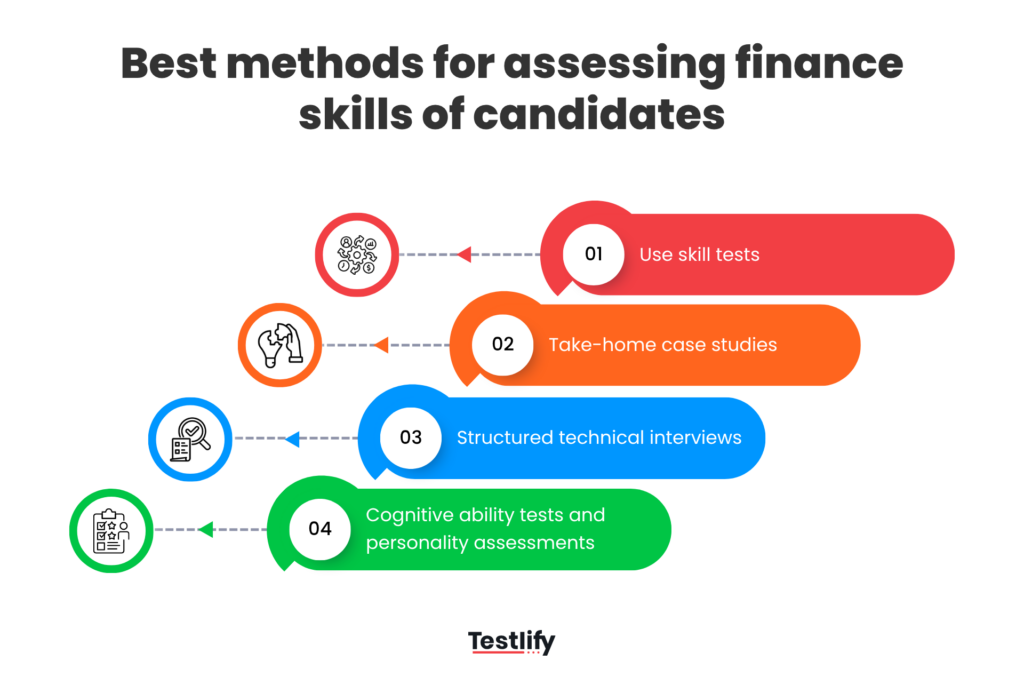
Method 1: Use skills tests on pre-hire assessment platforms
Pre-hire assessment platforms host job-specific tests that candidates complete in 30 to 90 minutes. Platforms such as Testlify offer ready-made tests for financial modeling, accounting, Excel, FP&A, and analytical reasoning.
These tests score automatically and rank candidates against role benchmarks. Recruiters then invite only the top quartile to interview, a topic our reduce time-to-hire guide covers in depth.
Method 2: Take-home case studies test applied judgment
Case studies measure applied judgment under time pressure. Send candidates a take-home model or run a one-hour live build to evaluate structure, accuracy, and speed.
Use anonymized client data and rotate prompts every quarter to prevent reuse across applicants.
Keep the take-home portion short: cap it at 45 minutes. Twenty minutes of focused, scorable work beats a lost weekend, and a three-hour case study filters for who has free time that week, not who can actually model - your strongest candidates, often the ones already holding other offers, tend to quietly drop out of the longer ones. It also helps to test auditing, not just building: hand candidates a model that contains deliberate, seeded errors and ask them to find and fix them. That single exercise reveals attention to detail and spreadsheet discipline faster than watching them build from scratch.
Method 3: Structured technical interviews reduce hiring bias
Structured interviews ask every candidate the same role-specific questions in the same order. Harvard Business Review research summarized on LinkedIn shows structured interviews have more than double the predictive validity over unstructured chats.
Pair each technical question with a follow-up that probes reasoning.
Method 4: Cognitive ability tests and personality assessments predict ramp speed
Cognitive ability predicts on-the-job learning speed. Personality predicts cultural fit and resilience, two signals that matter on high-pressure finance teams during close week and earnings cycles.
Add these layers through validated psychometric tests. Our blogs on cognitive ability tests and personality tests explain the science.
Method 5: Reference checks validate the signal
Reference checks confirm the picture your assessments paint. Ask references three specific questions tied to the competency matrix and triangulate against assessment scores.
Ask each reference to rate the candidate on a 1-to-5 scale on technical accuracy, communication, and judgment. Outliers between assessment scores and reference scores reveal interview blind spots.
How to configure assessment tests before you launch
Raw scores tell you nothing until you anchor them to your team’s reality. Calibration turns a generic test into a hiring signal.
Run three benchmark steps before you screen a single candidate. The work takes one week and saves you from six months of bad hires.
First, ask your three top current performers to take the assessment cold. Their scores set the upper bound on your benchmark distribution.
Second, ask three average performers to take the same assessment. Their scores set the middle bound, and the gap to top performers reveals what excellence looks like.
Third, set your pass threshold 10% above the average performer score. Candidates above this line warrant interview time, and candidates below it do not.
Once you have a benchmark, score consistently against a fixed rubric so two reviewers land on the same shortlist - a skill you can't score the same way twice isn't really being assessed. For a financial modeling task specifically, a 100-point split works well: Excel and model structure (30 points), accuracy and error-checking (25 points), valuation and forecasting logic (20 points), assumptions and judgment (15 points), and clarity of the walk-through (10 points). Weight the split to the actual job - an FP&A analyst leans on structure and accuracy, while a corporate development hire leans on valuation - but keep the point that every candidate is measured against the same bar. Re-check the bar every few hiring rounds, since roles and tools both drift over a year or two.
Anti-cheating playbook for finance assessments
Finance assessments face the risk of candidate malpractice. Candidates share Excel templates on GitHub, use AI tools to generate journal entries, and outsource models on freelance platforms.
Defend the assessment with five layers of control. Each layer raises the cost of cheating without hurting honest candidates.
First, lock the browser. Forcing full-screen mode prevents candidates from opening new tabs, copying questions, or pasting from external sources.
Second, monitor with a webcam and ID verification. Webcam proctoring and ID verification deter remote impersonation.
Third, randomize question banks. Rotating a pool of 200 questions across candidates prevents answer sharing.
Fourth, use original case data. Building cases from anonymized client situations prevents Google searches from returning ready-made answers.
Fifth, audit suspicious patterns. AI-flagged anomalies such as paste events, tab switches, and unusually fast completion times trigger manual review.
Related resources: Discover how Testlify’s anti-cheating features help maintain the integrity of your assessments
Legal and compliance considerations
Skills-based assessments must clear three legal bars in the United States and most jurisdictions. Skip these, and you invite EEOC scrutiny.
The EEOC is the US Equal Employment Opportunity Commission, the federal agency that enforces workplace anti-discrimination laws. The Uniform Guidelines on Employee Selection Procedures govern pre-employment testing.
First, validate the assessment. Validation proves the test predicts on-the-job performance for the specific role, and Testlify provides documented validation studies for every assessment.
Second, monitor the adverse impact. Adverse impact occurs when an assessment selects one demographic group at a lower rate than another, and the four-fifths rule defines the EEOC threshold.
Third, document your process. Audit-ready records of test administration, scoring, and decision-making protect you in a hiring discrimination claim.
How to evaluate a pre-hire assessment platform
Not every platform handles finance well. Six criteria separate the strong vendors from the weak ones.
- First, demand finance-specific test libraries. A vendor that sells generic aptitude tests cannot evaluate ASC 606 fluency or DCF accuracy.
- Second, demand Excel-based simulation. A modeling test that runs in a multiple-choice format does not measure modeling skill.
- Third, demand validation studies. Documented predictive validity protects your hiring program legally and operationally.
- Fourth, demand integration with your ATS. ATS stands for applicant tracking system, the software that manages candidates through your hiring funnel.
- Fifth, demand anti-cheating depth. Browser lockdown, webcam proctoring, and AI-flagged anomalies should ship as standard features.
- Sixth, demand customization. Your roles do not match a vendor’s template, and the platform must let you weigh skills, set thresholds, and brand the candidate experience.
Why Testlify is the best platform for finance assessments
Testlify is a pre-employment assessment platform that helps companies hire finance and accounting professionals through validated, role-specific tests. Over 1,800 companies trust Testlify to screen candidates at scale.
Testlify ships more than 3500+ role-specific tests in 16+s, helping recruiters identify top candidates for finance roles worldwide.
The platform combines auto-scored multiple-choice questions, scenario tasks, and Excel-based simulations. Every assessment maps to a competency framework that recruiters can customize by weight, threshold, and pass criteria.
Testlify includes 20+ anti-cheating tools such as webcam monitoring, copy-paste detection, AI assistance detection, and more. These features protect assessment integrity across remote and in-office candidates equally.
The platform integrates with 100+ applicant tracking systems, including Workday, Greenhouse, Lever, and BambooHR.
Related resources: for financial-analyst and modeling roles specifically, Testlify's financial analyst aptitude test and financial Excel modeling test score candidates on real spreadsheet work and plug directly into the four-method framework above.
How to launch finance assessments in less than 30 days
You can deploy a working assessment program in four weeks. The roadmap below assumes a finance team of 10 to 50 people.
Week 1: Define competencies and benchmarks
Map the role to the competency matrix and run benchmark assessments with three top performers. Our competency framework blog explains the mapping work.
Week 2: Configure the platform
Set up your Testlify assessment library, weigh the skills, customize the candidate landing page, and integrate with your ATS.
Week 3: Pilot on live candidates
Run the assessment on the next 20 applicants and review results with the hiring manager. Adjust thresholds based on calibration data.
Week 4: Roll out and train
Train recruiters and hiring managers on the new flow, publish the candidate communication plan, and launch across all open finance roles.
A worked example: what assessment-first screening looks like in practice
Picture a 300-person SaaS company hiring two financial planning and analysis (FP&A) analysts in a single quarter.
The old way: a recruiter screens 60 resumes, books 15 first-round interviews, and finds out in week three that the most polished interviewer can talk fluently about models but stalls the moment they have to build one. Weeks of calendar time, gone.
The assessment-first way runs the other direction. All 60 applicants get a 40-minute modeling task up front. By the next morning, the hiring manager is looking at a ranked shortlist of 12, each scored on the same rubric, and interviews go only to people whose work already cleared the bar.
Same two hires, but the screening loop shrinks from about six weeks to closer to ten days, and the hiring meeting argues about evidence instead of first impressions. This scenario is illustrative, but it tracks how assessment-first screening changes the math: the expensive human hours shift to the handful of candidates most likely to succeed.
Common mistakes hiring teams make
Six mistakes show up in nearly every finance hiring audit. Each one quietly destroys assessment value.
The first mistake is testing for memorization rather than reasoning. Strong candidates can Google a formula, so test how they apply it under realistic constraints.
The second mistake is over-relying on the interview. Interviewers anchor on first impressions, while well-designed assessments measure performance objectively.
The third mistake is skipping calibration. Raw scores tell you nothing until you benchmark them against current top performers.
The fourth mistake is running the same test for every level. An analyst test cannot screen a controller, and a CFO test wastes an analyst candidate’s time.
The fifth mistake is ignoring soft skills. Senior finance roles demand communication, influence, and judgment alongside technical accuracy.
The sixth mistake is treating the assessment as a one-time setup. Roles evolve, regulations change, and the assessment must evolve with them.
Final thoughts
Finance hires shape the numbers your business runs on. You cannot afford to hire on résumé claims and gut feel when the cost of one bad hire reaches three times the salary.
Pre-hire assessment platforms turn finance hiring into a data-driven process. They surface candidates who actually build models, post entries, and analyze statements at the level your business demands.
Testlify gives finance leaders the deepest library of validated assessments for modeling, accounting and CFO-track roles. Teams that switch to Testlify hire faster, spend less, and retain longer across every finance function.
Book a demo with Testlify today to see how our finance assessments shortlist your strongest candidates in record time.

Related resources
View all
Candidate assessment
How do assessment libraries cover niche skills?

Candidate assessment
What’s the best way to combine psychometric tests with skills tests?

Candidate assessment
How to use AI to tailor assessments to job descriptions

Candidate assessment
Aptitude Tests in Hiring: The Complete 2026 Guide for Recruiters

Candidate assessment
AI features transforming HR support and leadership

Candidate assessment
Conversational Video AI interviews for sales hiring
Get started.
Hire on proof, not resumes.
Run your first skills-based assessment free — no credit card required.