
Resume Fraud Verification: How to Detect Fake Resumes Before the First Interview (2026)
Resume fraud verification is no longer optional. This guide covers the 4 types of candidate fraud in 2026, a 5-step verification framework, and a free checklist for hiring teams.

 ChatGPT
 Gemini
 Claude
 Grok
Grok Perplexity
TL;DR
- Resume fraud has moved past exaggeration. The four kinds worth planning for are inflation, AI-written fabrication, someone else sitting the interview, and a fully invented identity.
- Gartner expects 1 in 4 candidate profiles to be fake by 2028, and 6% of 3,000 candidates it surveyed admitted to interview fraud already.
- A document screen cannot catch any of this. An AI-written resume reads better than a real one, so verification has to test the person, not the paper.
- The cheapest filter is a live skills task run before the phone screen. It takes about 20 minutes and fabrication falls apart fast.
- Two phone calls you place yourself, to numbers you found yourself, still catch more fraud than any tool on this page.
- Remote roles need one extra layer: where the laptop ships, where the person logs in, and whether the two agree.
Resume screening used to be a document problem. Check the dates, call a reference, move on. That process is now the weakest link in most hiring pipelines.
Verification is what replaces it. Not more screening, not a better applicant tracking filter, but a short sequence of checks that test whether the person on the call can actually do what the resume claims, and whether they are who they say they are. This guide covers the four fraud types now in circulation, the signals that expose each one, a verification sequence you can run before the first interview, and the eight red flags that slip past a document-only review every time.

What is resume fraud, and why is it harder to detect in 2026?
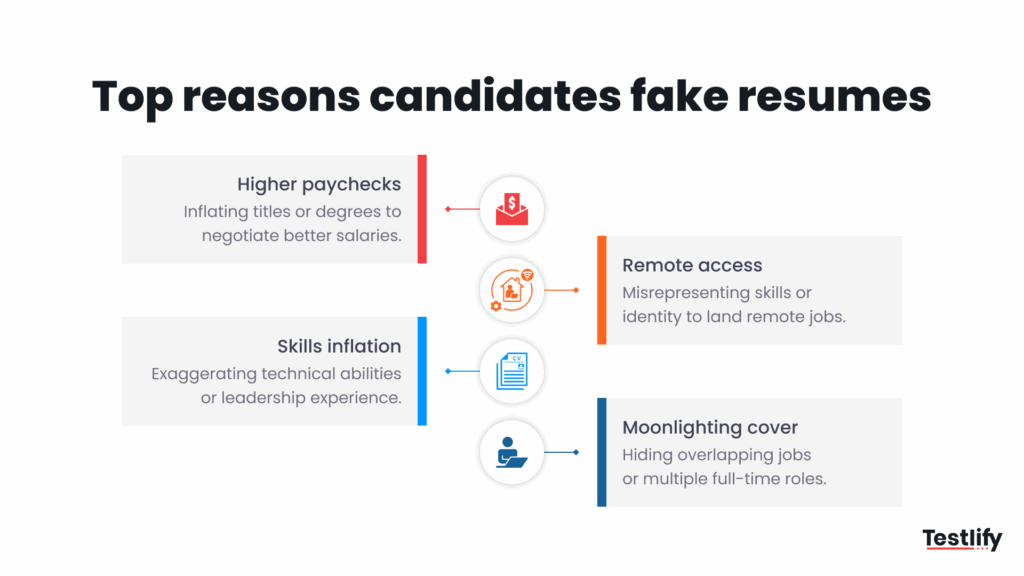
Resume fraud is any deliberate misrepresentation on a job application: an inflated title, a fabricated employer, a false credential, or an entirely invented work history. It has always existed. What changed is the price of committing it, which is now close to zero, and the quality of the output, which is now better than most genuine resumes.
The scale is not marginal. Gartner predicts that 1 in 4 candidate profiles will be fake by 2028, meaning profiles carrying material identity misrepresentation rather than candidates who rounded a job title up. In the same research, 6% of 3,000 candidates surveyed said they had taken part in interview fraud, either posing as someone else or having someone pose as them. Four in ten said they use AI somewhere in the application process.
Here is the part that breaks old screening habits. Pre-AI, a fabricated resume had tells: odd phrasing, implausible timelines, generic duty lists. Those tells are gone. A language model writes a cleaner, better-targeted resume than a real candidate writing about their own real job, because the real candidate is tired and the model is not. So the polish of a document now tells you nothing about whether the experience behind it happened.
Which means the question worth asking changed. The old one was whether the resume looks credible. The one that matters now is what independent evidence exists that any of it happened.
What are the 4 types of resume fraud HR teams face today?
The four types active in 2026 are traditional inflation, AI-generated fabrication, interview impersonation, and synthetic identity fraud. Each needs a different check. A process built only to catch the first will miss the other three completely, which is how a team can run a diligent-looking screen and still hire a person who does not exist.
1. Traditional inflation
The oldest form, and still the most common. Real people, stretched claims. A coordinator describes manager-level scope. An analyst rounds 12 months up to 18. A skills section lists expert proficiency in a tool opened twice. Every document screen passes it, because the underlying person is real and most of the resume is true. It surfaces only when someone verifies a specific with a former employer, or when the candidate has to use the skill live.
2. AI-generated fabrication
A candidate generates a whole work history: plausible employers, clean dates, quantified achievements, all tuned to your job description. Nothing underneath it happened.
The tell is never in the document. It is in the conversation. Ask for one project in specific detail, or the name of someone they worked with, or what went wrong on it, and the story runs out. Not because the candidate is nervous, but because there is nothing to remember. This usually collapses inside two minutes.
3. Interview impersonation
The 6% figure above is this. A stronger candidate sits the interview, or a face and voice filter runs on a live call, and the person who shows up on day one is not the person who was assessed. Remote hiring created the opening: most video interview tools verify nothing about who is in the frame. The mechanics of a stand-in attending an interview are worth understanding separately, because the countermeasures differ from document checks.
4. Synthetic identity fraud
The far end. A complete fabricated person, built to be hired. The U.S. Department of Justice has documented state-sponsored operations that place workers into remote roles at U.S. companies using stolen and invented identities, with U.S.-based facilitators running laptop farms, rooms of company-issued machines kept powered on at a U.S. address so the worker appears to be logging in from one. Prosecutors have described schemes touching well over a hundred companies. Most of those employers had a normal hiring process. It just was not built for this.
Fraud type | Detection difficulty | What actually catches it |
|---|---|---|
Traditional inflation | Low | A direct employer call on specifics |
AI-generated fabrication | Medium | A live skills task, plus one detailed follow-up question |
Interview impersonation | High | Identity checks at assessment time and a consistent interviewer panel |
Synthetic identity | Very high | Multi-source cross-check plus device, location and equipment signals |
What signals expose a fake candidate before an interview?
Four signal groups do most of the work: document consistency, digital history depth, live performance, and device or location context. Any one on its own produces false alarms. Two or more pointing the same way is worth acting on, and that pairing rule matters more than any single red flag.
The fourth group is the one HR teams skip, mostly because it feels like security work rather than recruiting. It is worth borrowing anyway. A candidate applying from a residential address three time zones from the one on the application, connecting through a commercial VPN for every interaction, whose equipment ships to an address that matches neither, is not automatically fraudulent. Plenty of people travel and plenty of people use a VPN. But that combination alongside a thin digital history is the exact shape the synthetic-identity cases take, and it is visible before you hire, not after.
The practical version for a recruiting team, none of which needs a security tool: note the location the candidate gives, note where equipment is meant to ship, and note whether the person can appear on camera on short notice without rescheduling. Then check whether those three agree.
The honest caveat: none of this is proof, and treating it as proof will cost you good candidates. Use it to decide who gets a closer look, never to reject.
What tools verify resume fraud online?
Effective verification pairs free direct-check registries, which confirm credentials and employment, with a live skills assessment, which confirms competence. No document screen covers both. And no paid tool replaces the two phone calls you place yourself, which remain the highest-yield check on this page.
The three free checks worth running every time:
Degree verification. For U.S. degrees, submit an individual verification request through the National Student Clearinghouse using the candidate's name, date of birth, institution and graduation year. It returns awarded, not awarded, or in progress, usually within minutes. If the institution is not in the database at all, it is not a U.S.-accredited school. For international credentials, World Education Services runs the equivalent evaluation over a few days.
Code history audit. A real developer's history is messy. Contributions spread over months, forks of other people's projects, issues raised and abandoned, code that visibly improves. Fabricated ones look tidy and recent: activity only in the week before the application, repositories with one or two commits and no discussion, tutorial code with the variable names untouched, an account opened in the last 90 days. Two of those together is worth a live technical task.
Profile cross-check. Read the public profile next to the resume, line by line. Flag any title that differs, any employer on one and missing from the other, and any profile edited within 48 hours of your first contact. That last one catches more than people expect, because fraudulent candidates tend to synchronise their story only once someone responds.
Check | Cost | What it catches | Time |
|---|---|---|---|
National Student Clearinghouse | Free | Fake or unaccredited U.S. degrees | 5 min |
International credential evaluation | Paid | Fake international degrees | 2-5 days |
Public profile cross-check | Free | Title mismatches, missing roles, late edits | 5 min |
Code or portfolio history | Free | Fabricated technical portfolios | 10 min |
Employer call you place yourself | Free | Title, dates and scope inflation | 10-15 min |
Background-check provider | Paid | Criminal record, identity, employment history | 1-3 days |
Free trial | Fabricated skills, impersonation | 20 min |
On using AI to catch AI: some screening tools now score a resume for how likely it is to be machine-written. Treat that score as triage, never as a verdict. False positives are common, and a candidate who used a model to tidy their own real experience is not committing fraud. Sorting who to verify first is a fair use of the score. Rejecting on it is not.
How does the Multi-Signal Talent Evaluation Model apply here?
The Testlify Multi-Signal Talent Evaluation Model combines multiple role-relevant signals, including assessments, interviews, simulations, references and reviewer feedback, to help teams make more confident hiring decisions. Applied to fraud, the logic is simple: a resume is one signal, and one signal is fragile. Advance a candidate when several independent signals agree, not when one document is persuasive.
Run these five in order, before the first real interview. The whole sequence costs about 30 minutes of team time.
Step 1: Document cross-check
Five minutes, before any call. Compare every role on the resume against the public profile: title, employer, start and end dates. Confirm each employer has a discoverable web presence, because dormant domains and shell companies are common cover for invented history. Flag anything edited within 48 hours of your first contact.
Step 2: Credential verification
Never accept a diploma scan. A convincing one takes minutes to produce. Go to the institution or a verification service directly, and for professional licences search the relevant state licensing board, most of which publish free lookup databases. Fake degrees and invented certifications are common enough to justify a standing process for qualification fraud rather than a check run only when something feels off.
Step 3: An employer call you place yourself
Find the company's main number independently, never from the candidate. Route through reception, ask for HR or the hiring manager's department, then ask four things: the candidate's exact job title, their start and end dates, whether they managed anyone, and whether they are eligible for rehire.
Any gap between those answers and the candidate's account is serious. If HR will only confirm dates, note it and ask for a manager callback. A company that genuinely employed someone will usually confirm the basics.
Step 4: Digital footprint depth
For technical roles, audit the code history using the signals above. For everyone else, look at how the profile accumulated rather than what it says. Genuine endorsements arrive over years. A burst of them in one week is a build, not a career. Connection counts far below what the claimed seniority would produce deserve a second look.
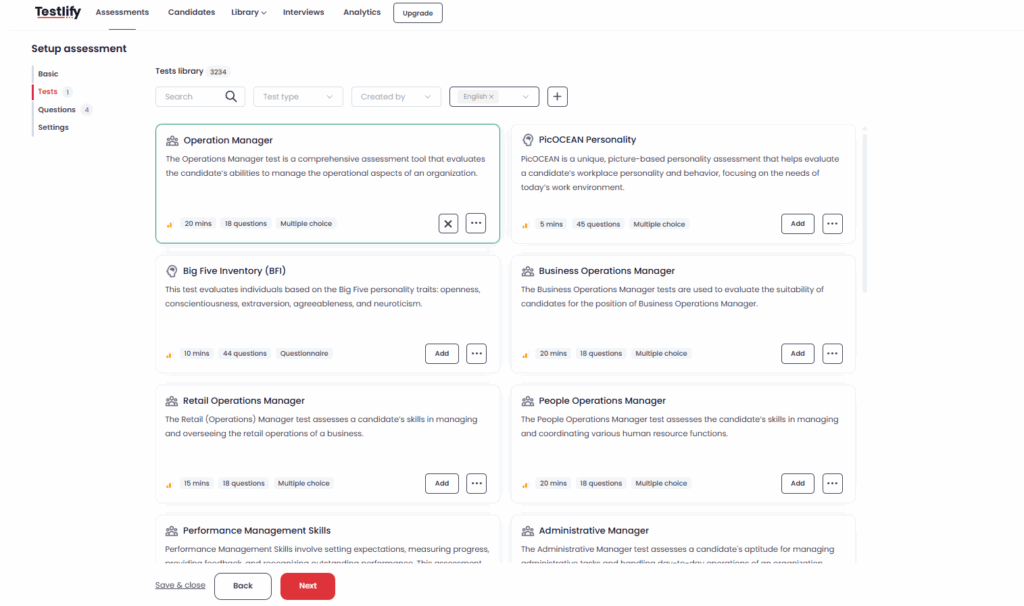
Step 5: A live skills task, before the phone screen
This is the highest-signal step, and the ordering is the point. Give a data analyst a messy dataset, a developer a real bug, a sales candidate a live objection. Someone who has done the work starts working. Someone who has not starts explaining.
Pro Tip: Run Step 5 before Step 3, not after. A candidate who cannot perform the core task does not need an employer call, and you find that out in 20 minutes instead of two interviews and a reference chase later.
What are the 8 red flags your verification process must catch?
These eight are the ones that survive a document-only review. Each maps to a step above, and each is a prompt to check something rather than a reason to reject.
1. Dates that do not add up
Do the arithmetic on every role. A stint listed as 2019 to 2022 that verifies as 18 months is date padding. Overlapping roles at different employers need an explanation before anyone advances.
2. Profile contradictions
A different title, a missing employer, or a profile updated hours after your first email. Fraudulent candidates often forget the public version until they have a reason to fix it.
3. Employers with no trace
A company name that returns nothing, has no registered address, and leads only to a parked domain. Investigate before advancing.
4. Achievements with no texture
Real accomplishments carry context: a timeframe, a method, a team size, something that went wrong. A line claiming 40% pipeline growth with nothing around it is thin, and it is thin in exactly the way both inflated and machine-written resumes are.
5. Skills that collapse under one question
Pick any claimed expert-level skill and ask one direct question about a basic concept in it. This takes 30 seconds and settles the matter more often than a full technical round.
6. A resume that mirrors your job description
If it reads like someone pasted your posting and changed the verbs, that is often what happened. Machine-written resumes are polished but lack individual voice, specific project names, and the team context real work leaves behind.
7. Degrees from unaccredited schools
Search the institution in the U.S. Department of Education accreditation database. Credential mills produce real-looking documents from institutions that are not accredited anywhere.
8. References who cannot get specific
A genuine reference names projects, describes the reporting line, and remembers at least one hard situation. A fake one stays vague and cannot name a single colleague. Always source reference contacts independently. Never use a number the candidate supplies.
What does failed resume fraud verification cost?
Start with replacement cost. Gallup puts the cost of replacing an employee at one-half to two times their annual salary, and calls that a conservative estimate. A fraudulent hire is a replacement you pay for early, on top of the hiring cycle you already spent.
The money is the visible part. Three costs usually run past it.
Legal exposure. In regulated work such as healthcare, finance, childcare and education, hiring someone unqualified who then causes harm opens the employer to negligent hiring claims. How little verification was run is exactly what gets examined.
Security exposure. The state-sponsored placement cases are the clearest version. The Justice Department's prosecution of two U.S. facilitators describes remote IT workers placed inside U.S. companies using false identities, generating millions in revenue routed abroad. One fraudulent hire holding normal system access is an insider threat by definition, and the access is granted on day one.
Team damage. Someone who cannot do the job still occupies it, and the team absorbs the gap quietly for months. When it surfaces, the people who covered for them lose confidence in how the company hires. That one is slow and hard to undo.
How do you verify identity for a fully remote hire?
Remote hiring removes the moment that used to do this work for free: a person walking into a building with a document in hand. Nothing replaces it automatically, so it has to be rebuilt on purpose, and the offer stage is the last cheap place to do it.
Three controls cover most of the gap. First, verify identity documents in a live video call where the person holds the document, rather than accepting an emailed scan. Second, ship equipment only to the address on file for the person you hired, and treat a late change of shipping address as a check to redo, not a logistics detail. The laptop-farm pattern in the Justice Department cases works precisely because nobody looks twice at where the machine goes. Third, make sure the person on the first day of work is visibly the person who was assessed, which is trivial when the same interviewer appears at both ends and surprisingly easy to lose when they do not.
The usual objection is that identity steps annoy candidates. Gartner's data points the other way: in its 2026 talent acquisition research, 62% of candidates said they were more likely to apply when a role required in-person interviews. Honest candidates have as much to lose from a market full of fakes as employers do.
None of this needs new software. It needs someone to own the check, which in most companies is the gap rather than the tooling. If your current answer is a background check at offer stage, it is worth testing whether background checks alone actually stop employment fraud, because they run late and they verify records rather than ability.
What should you do when you discover resume fraud post-hire?
Document everything before you speak to anyone. Gather the resume claim, the contradicting evidence, and the dates side by side. That record is what any termination or legal step rests on, and it is much harder to assemble after the conversation than before it.
Revoke access at or before the confrontation. For any role with system access, credentials go at the same moment, not afterwards. A person who knows they are being removed and still holds access is an active risk.
Have the conversation privately. Some discrepancies have dull explanations: a title that changed informally, a date the candidate genuinely misremembered. A private conversation without accusation surfaces that, and protects you if there is no innocent explanation.
For clear fabrication, terminate. Most jurisdictions allow immediate termination for material misrepresentation on an application. A falsification clause in the standard employment contract makes the grounds unambiguous before anyone needs them.
Then audit the process, not just the hire. Which step missed it? A post-hire discovery is only worth something if it closes the gap that let it through, and that is the part teams reliably skip because the immediate problem feels solved.
What does a complete verification checklist include?
Three stages: before the first call, before the first interview, and during reference checks. The rule that makes it work is boring but absolute. When a check fails, the candidate does not advance until the discrepancy is resolved or explained.
A failed skills assessment ends the process. An employer who will not confirm basic dates is a hold, not a pass. A reference who cannot answer one specific question is a flag, and you source a second reference independently before going further.
Stage | Check | What passing looks like |
|---|---|---|
Before first call | Dates consistent across resume and public profile | No unexplained gaps or overlaps |
Before first call | Every employer discoverable online | Active web presence and a registered address |
Before first call | Achievements carry specifics | Timeframes, methods and team size present |
Before first call | Resume is not a mirror of the job description | Individual voice and named projects |
Before first interview | Skills assessment completed for the role | Task performed live, at role level |
Before first interview | Top credential verified at source | Registry confirms awarded, not a scan |
Before first interview | One former employer confirmed independently | Number found by you, title and dates match |
During interview | One project walked through in full detail | Names, sequence and at least one setback |
During interview | One claimed skill tested live | Candidate works rather than describes |
Reference check | Contact sourced independently | Not a number the candidate supplied |
Reference check | Behavioral questions asked | Open questions, not yes or no |
Reference check | Vague or hesitant references followed up | Second reference sourced before advancing |
The sequence matters more than the tooling. Put the live task first and most fraud never reaches a human interview slot.
Start a free trial and run live skills verification on every candidate, no credit card required.
Key Takeaways
- A polished resume is now evidence of nothing. Language models write cleaner work histories than real candidates do, so the old quality tells are gone. Screening habits built on how a document reads need replacing with checks that test the person behind it.
- One signal is fragile, several agreeing are not. Any single red flag produces false alarms and will cost you good candidates. Act on pairs: a thin digital history plus a failed skills task, not either one alone.
- Sequence beats tooling. Running a live skills task before the phone screen removes fabricated candidates for about 20 minutes of effort, while the same task run after two interviews saves nothing. Nobody needs a new tool to reorder their own funnel.
- The free checks outperform the paid ones. Two phone calls to numbers you found yourself, plus a registry lookup, still catch more than most paid screening. Budget is rarely the constraint here; ownership is.
- Remote hiring needs an identity layer at the offer stage. Live document verification, equipment shipped only to the address on file, and the same interviewer present on day one close the gap that in-person hiring used to close for free.
- Verification failure is expensive twice. Gallup puts replacement at one-half to two times salary, and that is before legal exposure in regulated work or the access a fraudulent hire holds from day one. An hour of checks is the cheapest insurance in the hiring process.
Frequently Asked Questions

B2B SaaS Content Writer
Rishav Kumar is a B2B SaaS content writer with 4 years of experience. He loves crafting engaging content. Always exploring fresh ideas, he's passionate about helping businesses grow through impactful writing.
LinkedInRelated resources
View all
Hiring Risks & Safeguards
How to stop cheating in online tests?

Hiring Risks & Safeguards
How do platforms handle GDPR compliance for candidate data?

Hiring Risks & Safeguards
The real cost of a slow hiring process

Hiring Risks & Safeguards
Are traditional background checks enough for HR compliance?

Hiring Risks & Safeguards
Post-hire employee monitoring and behavioral analysis

Hiring Risks & Safeguards
How to prevent qualification fraud in hiring?
Get started.
Hire on proof, not resumes.
Run your first skills-based assessment free — no credit card required.