Demo
Demo
 +1 (844) 755 8378
 Contact


AI-powered proctoring is changing how we conduct online exams. From universities to certification bodies, an increasing number of organizations now rely on remote proctoring to scale online testing without compromising exam integrity.
Around 65% of institutions used remote proctoring systems for at least one major exam in recent years.
AI proctoring processes sensitive information, such as webcam feeds, facial recognition, and identity verification data, in real time. Therefore, AI compliance is vital in AI proctoring.
This blog breaks down AI proctoring compliance, as well as what to expect from a secure, user-friendly proctoring system.
Summarise this post with:
 Chatgpt
 Perplexity
 Gemini
 Grok
Grok Claude
Why compliance matters in AI proctoring
Different proctoring software collects very sensitive information, which may include data used for facial recognition, screen activity, or recordings via webcam, in order to monitor candidates’ behavior.
Without data protection laws, this kind of data may be misused or mishandled, jeopardizing candidate privacy.
“Privacy is not an option, and it shouldn’t be the price we accept for just getting on the Internet.” – Gary Kovacs
In fact, 91% of higher-education institutions in the UK reported detecting a data breach or cyberattack in the last 12 months, underscoring the real threat. For education boards, hiring teams, and certification bodies, compliance is not optional.
A compliant proctoring solution ensures:
- Secure storage and access of test-taker data
- Full transparency on how data is collected and used
- Controls for both admins and candidates
- Legal alignment with GDPR, FERPA, and local laws

Understanding GDPR & FERPA in context
When it comes to AI proctoring compliance, two data protection laws rank first: GDPR and FERPA. These laws define how personal information should be collected, stored, and used, particularly in sensitive settings such as online assessments.
If you are conducting a certification in Europe or remote certification exams in the U.S., the proctoring system must protect the privacy of the candidates. Let’s break them down.
GDPR: For European Candidates
The General Data Protection Regulation (GDPR) applies across the EU and plays a crucial role in how AI-powered proctoring platforms like Testlify collect and process data during remote proctoring.
Under GDPR:
- Candidates must give explicit, informed consent before their data is collected
- Data such as IP addresses, webcam snapshots, screen activity, and facial recognition metadata are considered personal or sensitive and therefore require additional protection.
- Individuals have the right to access, delete, or correct their data.
- Automated decisions, such as AI-based scoring, must be explainable and contestable.
- Any data breach must be reported to authorities within 72 hours.
Testlify acts as a data processor under GDPR and gives full control to clients over data retention, deletion, and portability.
Candidate data is stored in encrypted formats and processed in accordance with Standard Contractual Clauses (SCCs) for international transfers.
Clients can access audit logs, manage candidate consent, and define custom data deletion policies in the event of a white-label setup.
FERPA: Protecting education records in the U.S.
The Family Educational Rights and Privacy Act (FERPA), a United States federal law that protects the privacy of student education records, applies to all institutions that receive federal funds.
Under FERPA:
- Candidates’ test responses, video/audio recordings, and behavioral data are considered education records.
- Institutions must restrict access to this data and cannot share it without the candidate’s consent.
- Platforms must store and transmit data securely to prevent unauthorized access.
- Institutions are responsible for informing candidates about their data rights and privacy.
Testlify enables identity verification, real-time exam monitoring, and secure storage of assessment data, all while giving institutions full control over who accesses what. No student data is sold or shared, and all access is logged and auditable by the client.
GDPR vs FERPA – What’s the difference?
| Point | GDPR (EU/UK Law) | FERPA (U.S. Law) |
| Where it applies | Any company handling data of people in the EU or the UK | U.S. universities, colleges, and institutions that get federal funding |
| Who it protects | Anyone taking a test, job candidates, students, or employees. | Candidates and their academic records |
| What it protects | Personal info like email, IP, webcam data, or test recordings | Grades, test videos, and anything tied to a student’s performance |
| Is consent needed? | Yes, users must clearly agree before their data is used | Yes, universities must get permission before sharing student data |
| Can users see or delete data? | Yes, they can ask to view, fix, or even delete their data | Candidates can see and fix their records, but not always delete them |
| What happens in a breach? | The company must report it within 72 hours | Institutions should act quickly, but there’s no fixed time limit |
| What if you don’t follow it? | Heavy fines for companies | Institutions may lose funding if they break the rules |
| What does Testlify do? | Gives full control to clients, data stays secure and encrypted | Let’s institutions manage who sees data, how long it’s stored, and who can access it |
How proctoring systems ensure compliance
No AI, no human, no hybrid proctoring system exists that does not process sensitive data. To stay compliant with data protection regulations, such as GDPR and FERPA, modern proctoring solutions adhere to strict safeguards.
1. Data is collected with consent
Before any online exam begins, the candidate must provide clear and informed consent. This includes agreeing to webcam access, screen monitoring, or facial recognition, if used. Without permission, no data is recorded.
Testlify ensures candidates accept the Terms and Privacy Policy before starting any test. Sensitive data is only processed after opt-in.
2. Information is stored securely
All data, from test recordings to logs, is encrypted and stored securely. Only authorized personnel (like test admins or hiring managers) can access it.
Testlify uses industry-standard encryption and stores data in secure, region-specific locations. Clients can set their own data retention rules.
3. Real-time monitoring without compromising privacy
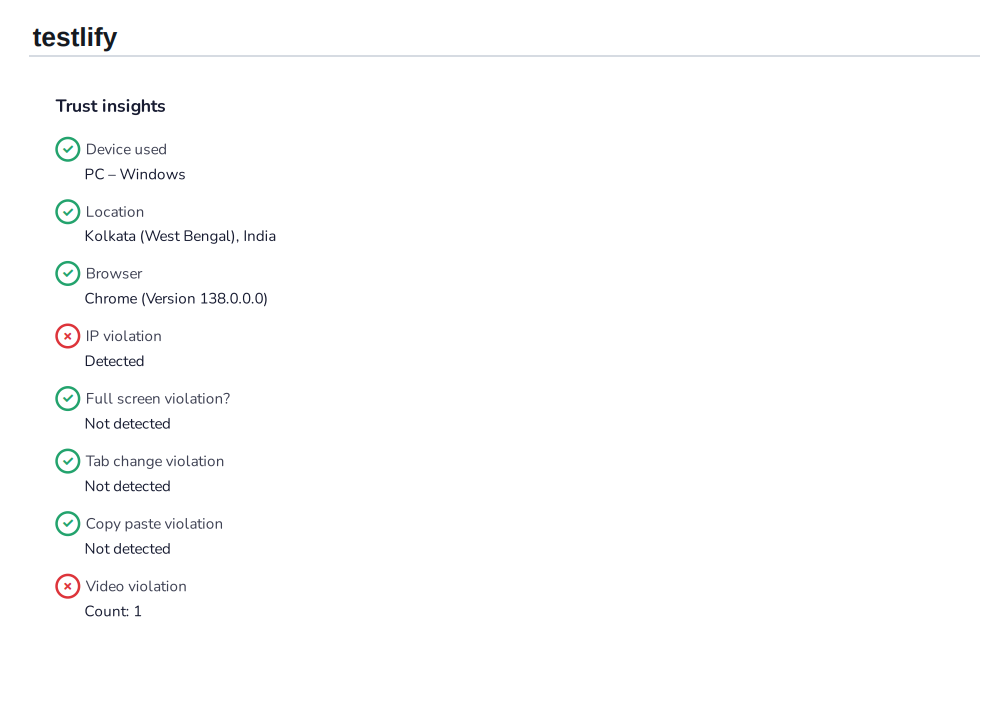
AI-powered proctoring monitor for red flags like tab switching, extra faces, or unusual behavior, without constant human watching. This protects both exam integrity and user privacy.
4. Full audit trails and access logs
Everything is tracked, who accessed what, when, and why. Logs help organizations comply with internal policies and meet the requirements of legal audits from certification bodies.
Testlify maintains detailed logs for every activity, from permission changes to question-level timestamps.

Test logs in Testlify are stored for 60 days post-completion, ensuring transparent and compliant recordkeeping.
5. Candidate rights are respected
Under laws like GDPR, candidates can request to see, update, or delete their data. A good proctoring solution makes that possible.
Testlify gives clients the tools to manage candidate data requests, whether it’s deleting session recordings or sharing results securely.
6. Human oversight where needed
Even the best AI proctoring platforms can’t replace human judgment. That’s why hybrid proctoring works best.

What to look for in a compliant proctoring solution
Not all proctoring systems are built the same. When it comes to AI proctoring compliance, you need a system that protects privacy, adheres to regulations, and delivers a seamless experience for both admins and candidates.
- Clear consent and transparency: The platform must ask candidates for permission before using their webcam, mic, or screen. It should also explain what data will be collected and why.
- Secure data storage and encryption: All test data, like screen activity, snapshots, and logs, should be encrypted both at rest and in transit.
- Real-time monitoring with privacy in mind: AI-driven monitoring should detect issues like tab-switching, extra faces, or background noise, without violating user trust.
- Role-based access & audit logs: Only authorized people should be able to see sensitive exam data. And every access or action must be logged.
- Candidate rights and data control: Candidates should be able to request access to their data or ask for it to be deleted. The system should support this easily.
- Support for human proctors and hybrid setups: Some tests may need human proctors alongside AI. The platform should support flexible modes based on exam stakes.
- User-friendly experience: Compliance is useless if the platform is too complex. The proctoring flow should be simple for admins and test-takers.
Testlify gently ticks all the boxes. From facial recognition permissions to real-time alerts and identity verification, all wrapped into a secure, compliant, and user-friendly platform trusted by global teams.
“Privacy is not a feature but a responsibility. In AI proctoring, compliance builds trust before anything else.” – Abhishek Shah, Founder, Testlify
Final thoughts: Choosing the right partner
Whether you’re running online exams, hiring assessments, or certification tests, your proctoring solution should do more than catch cheating.
It should protect candidate privacy, adhere to strict data protection regulations, and maintain audit readiness at all times.
Testlify brings it all together AI-driven proctoring, airtight compliance, and a user-friendly platform trusted by global teams. Start securing your assessments with confidence.