
How to build a talent pool in 2026
Build a strong talent pool by sourcing diverse candidates, updating profiles regularly, and engaging prospects for future hiring needs.

Recruiters entered 2026 facing a familiar reality where talent remains scarce, competition is intense, and hiring costs continue to rise. As recently as last year, 76% of employers worldwide reported difficulty filling open roles, underscoring how demand for skilled professionals continues to outpace supply across industries.
To keep up, forward-thinking HR teams are rethinking how they approach hiring by proactively building and maintaining a strong talent pool. This allows organizations to stay connected with qualified candidates long before a role opens, reduce time-to-hire, and minimize the costs associated with last-minute recruitment.
In this article, we will explore everything you need to know about talent pools, including how they work, why they matter in today’s labor market, and how HR teams can build and manage them effectively in 2026 and beyond.
 ChatGPT
 Gemini
 Claude
 Grok
Grok Perplexity
What is a talent pool?
A talent pool is a database of prequalified candidates amassed over time who have expressed interest in joining your company. Unlike a cold list of names, a talent pool consists of individuals who meet basic qualifications or have been vetted to some degree in advance.
By maintaining a pool of qualified talent, organizations can significantly reduce the time and effort required to fill a vacancy when it arises.

Who’s in a talent pool?
The talent pool is composed of people who have some connection to or familiarity with your organization. They can come from a variety of sources and touchpoints in the hiring process. Typically, a company’s talent pool will include:
- Silver-medalist candidates: Applicants who reached final interview stages in previous hiring cycles and demonstrated strong skills and role fit.
- Former employees: Alumni who left on good terms, as well as ex-interns, freelancers or contingent workers who know your business. These individuals are already vetted for culture fit and may be open to returning when the timing is right.
- Internal talent: Current employees interested in promotions, lateral moves, or transitioning into new roles through upskilling.
- Referrals: Candidates recommended by employees or sourced through professional and industry networks.
- Inbound leads and passive prospects: Individuals who’ve shown interest via career pages, social media, or events, including passive candidates open to the right opportunity.
- Underrepresented talent: Candidates engaged through diversity initiatives, academic partnerships, or niche talent communities.
In short, most, if not all, members of a talent pool are “known” to the organization in some way. They aren’t random applicants from a job ad; they’ve been identified as promising and kept engaged for future consideration.
Your talent pool is like a “rainy day fund” of human capital, and when a hiring need arises, you can draw on this reserve of pre-screened, interested candidates instead of casting a net anew.
Related resources: How to assess candidates for your talent pool
Talent Pool vs. Talent Pipeline
While the terms talent pool and talent pipeline are often used interchangeably, they serve distinct purposes in modern recruitment. The comparison table below breaks down how each approach supports different stages of the hiring lifecycle.
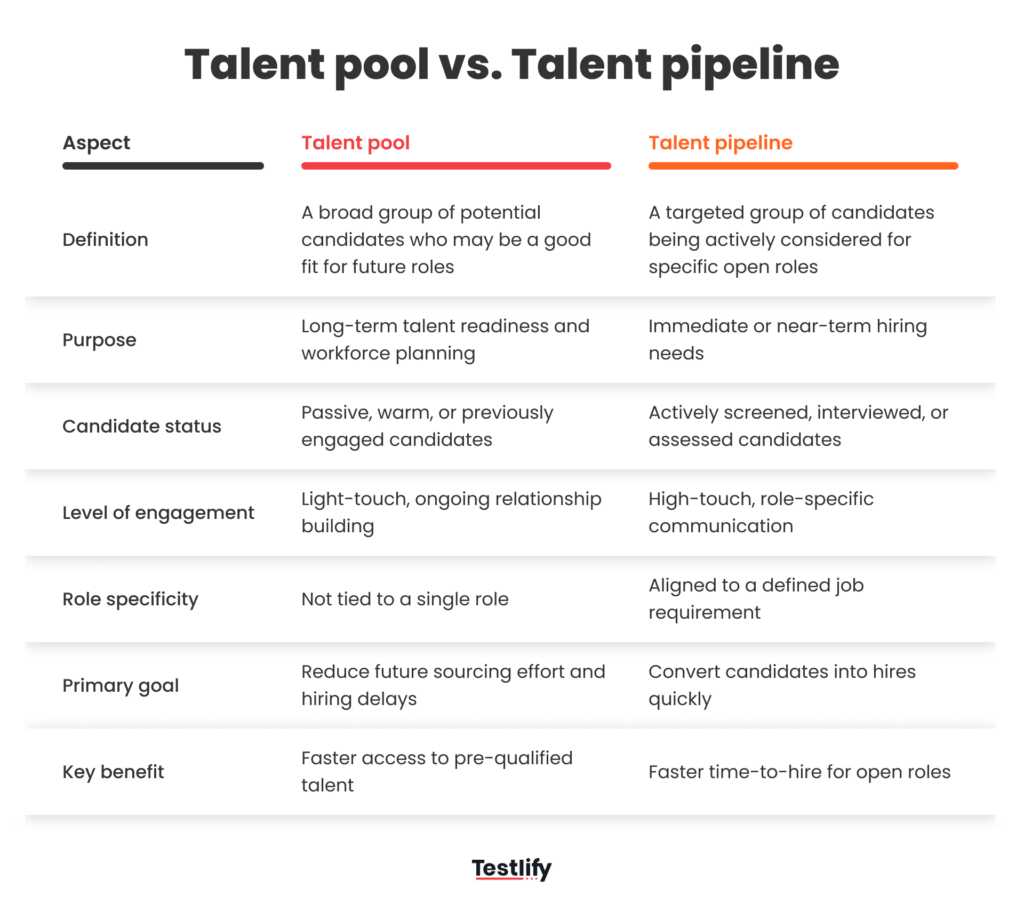
Used together, they improve hiring readiness: the talent pool ensures you have candidates to draw from, and the pipeline ensures you have relationships built with the best of those candidates so they can step into roles quickly.
The benefits of talent pools in 2026
Why invest the time to build a talent pool? In the coming year, talent pools are poised to deliver significant benefits to organizations that use them. Here are some of the key benefits of building a strong talent pool in 2026:
- Faster time-to-hire: With pre-qualified candidates already engaged, recruiters can fill roles quickly without starting sourcing from scratch.
- Lower sourcing and hiring costs: Reduced reliance on job boards, agencies, and paid ads helps control rising recruitment costs.
- Improved quality of hire: Talent pool candidates are already vetted for skills, culture fit, or past performance, leading to stronger hiring outcomes.
- Better access to passive talent: Talent pools help recruiters engage professionals who aren’t actively job searching but are open to the right opportunity.
- Stronger candidate relationships: Ongoing engagement builds trust and familiarity, increasing response rates and offer acceptance.
- More predictable workforce planning: Talent pools give HR teams visibility into available skills and readiness for upcoming roles.
- Support for internal mobility: Including internal candidates encourages promotions, reskilling, and career growth while improving retention.
- Increased diversity and inclusion: Proactively pooling candidates from underrepresented and specialized groups leads to more inclusive hiring outcomes.
- Greater hiring agility: Organizations can respond faster to sudden growth, attrition, or market changes.
- Reduced recruiter workload: Less repetitive sourcing allows recruiters to focus on relationship-building and strategic hiring initiatives.
Read more: What are the benefits of building a talent pool?
How to source candidates for your talent pool in 2026
Enterprise hiring teams need repeatable sourcing actions that consistently feed high-quality candidates into their talent pool. In 2026, effective talent pool sourcing is defined by clearly defined channels, ownership, and execution. Below are concrete strategies enterprises can operationalize at scale.
Deploy multi-channel social sourcing programs
Use LinkedIn Recruiter to run saved searches for priority roles and proactively connect with passive candidates. Post employer brand updates, role announcements, and hiring campaigns on LinkedIn company pages, X (formerly Twitter) for tech and leadership hiring, and GitHub for developer roles. Capture engaged candidates directly into your ATS or CRM for future outreach.
Run structured employee referral programs
Ask employees to submit referrals for specific skills, job families, or locations using a referral portal or ATS form. Offer referral bonuses tied to successful hires and communicate open skill needs monthly through internal emails or Slack.
Track referral source performance and add all qualified referrals to your talent pool, even if no immediate role exists.
Systematize internal mobility and alumni sourcing
Add employees who express interest in promotions, lateral moves, or reskilling into your internal talent database with updated skill profiles. Maintain an alumni database of former employees, interns, and contractors who left on good terms, and re-engage them through quarterly alumni newsletters or job alerts.
Institutionalize event-based sourcing
Collect candidate details at conferences, career fairs, hackathons, and university recruiting events using QR forms or ATS event modules. Tag profiles by skills, graduation year, or event source, and schedule periodic follow-ups. Include internship applicants and campus competition finalists in your long-term talent pool.
Target remote talent
Actively source candidates from specific geographies where your company is approved to hire remotely. Post remote-eligible roles on global job boards and add qualified international candidates to your talent pool for future hiring waves.
Embed AI and recruiting technology into sourcing operations
Use ATS and CRM tools to automatically tag candidates based on skills, experience, and past application status. Enable AI-powered matching to resurface previous applicants and silver-medalist candidates when new roles open. Deploy chatbots on your careers page to collect candidate information and feed it directly into your talent pool.
Read more: How to source candidates for your talent pool in 2026
How to build and manage your talent pool in 2026
In 2026, leading organizations no longer view talent pools as static databases, but as core talent infrastructure embedded into workforce planning, enabled by technology, and held accountable to measurable hiring outcomes.
Below are key steps to set up a talent pool and keep it running as a reliable talent engine for your organization:
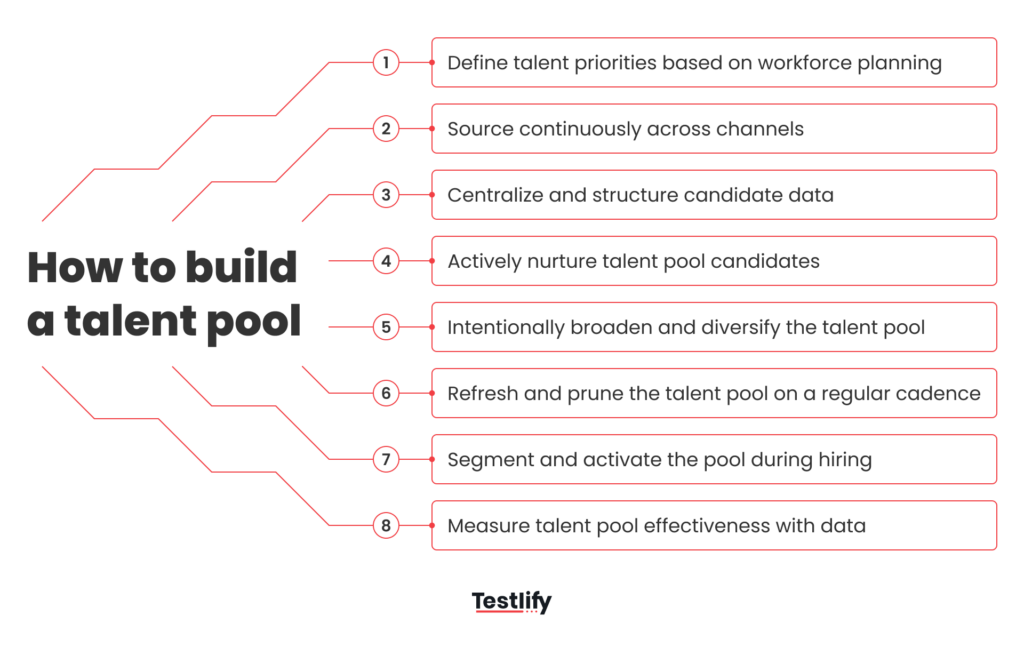
1. Define talent priorities based on workforce planning
- Identify roles that are consistently hard to fill or forecasted to grow.
- Align talent pool focus areas with workforce plans, expansion markets, and anticipated attrition.
- Document required competencies and emerging skill needs in partnership with hiring managers.
2. Source continuously across channels
- Add candidates to the talent pool on an ongoing basis, not only when roles are open.
- Pull from past applicants, silver-medalist candidates, referrals, internal employees, alumni, events, and direct sourcing.
- Set monthly or quarterly targets for adding qualified candidates to priority talent segments.
- Treat talent pool sourcing as a standing recruiter responsibility, not a one-time initiative.
3. Centralize and structure candidate data
- Store all talent pool candidates in a single ATS or talent CRM.
- Maintain complete profiles including skills, experience, location, source, and past interview feedback.
- Apply consistent tags for role family, skill set, seniority, geography, and availability.
- Enforce data hygiene standards, regular profile updates, and consent management for compliance.
4. Actively nurture talent pool candidates
- Share employer updates, hiring news, relevant content, and early job alerts to passive candidates
- Use personalized outreach for high-priority candidates rather than generic mass emails.
- Keep communication light but consistent to ensure candidates remain warm and responsive.
5. Intentionally broaden and diversify the talent pool
- Review talent pool composition regularly to identify gaps in skills, geography, or representation.
- Proactively source candidates from underrepresented groups, alternative career paths, and non-traditional backgrounds.
- Expand sourcing globally where remote or hybrid hiring is viable.
- Treat diversity sourcing as a talent pool input strategy, not a downstream hiring fix.
6. Refresh and prune the talent pool on a regular cadence
- Audit the talent pool at least twice a year.
- Reconfirm interest and availability with inactive candidates.
- Archive or remove profiles that are no longer relevant after attempted re-engagement.
- Continuously replenish the pool as older profiles are retired.
7. Segment and activate the pool during hiring
- Create predefined talent segments (e.g., senior engineers, sales leaders, campus talent, contractors).
- Require recruiters to review the talent pool before opening external sourcing for new roles.
- Use the talent pool to generate shortlists quickly and reduce time-to-fill.
8. Measure talent pool effectiveness with data
- Track hires made from the talent pool versus external sourcing.
- Compare time-to-fill, cost-per-hire, and retention for talent pool hires.
- Measure engagement metrics such as response rates and conversion to interviews.
- Use insights to refine sourcing channels, engagement frequency, and segmentation strategy.
By following these steps, you’ll create a sustainable system to continually attract, engage, and deploy talent as needed.
Recommended reading: What is talent lifecycle stages with the role of HR
Case studies of companies with successful talent pools
As competition for skilled professionals intensifies, talent pools have evolved from a hiring “nice-to-have” into a strategic necessity. Industry leaders have shown that well-managed talent pools directly fuel innovation, growth, and adaptability:
- Google builds large, diverse talent pools and continuously nurtures them through learning and development programs, ensuring candidates have the requisite skills and innovation never stalls.
- Amazon aligns talent pools with leadership principles and business scalability, enabling rapid expansion across industries.
- Apple focuses on internal development and succession planning, sustaining long-term innovation and leadership continuity.
- Microsoft keeps its talent pools agile through constant upskilling, reskilling, and cross-functional mobility.
- Tesla cultivates highly specialized talent pools to drive disruption in the electric vehicle and clean energy sectors.
- Netflix treats talent pools as long-term partnerships and nurtures strong relationships with creative talent, offering them creative freedom and opportunities to work on diverse projects
Read more: Case studies of companies with successful talent pools
Final thoughts
In 2026, organizations that invest in disciplined talent pool management hire faster, spend less on sourcing, and maintain greater resilience during hiring spikes or market shifts. A well-run talent pool transforms recruiting from role-by-role execution into a sustainable talent engine that supports long-term business growth.
Turn your talent pool into a hiring advantage
Building a talent pool is only effective when you can accurately evaluate and activate candidates at the right time. Testlify helps hiring teams assess real-world skills, screen talent at scale, and identify job-ready candidates from your talent pool before interviews begin.
Book a demo with Testlify to see how skills-based assessments and AI-powered interviews help you identify top talent from your talent pool who will grow to become future leaders within your organization.
FAQs

Content Writer
Yashika Khandelwal is a Content Writer with 3+ years of experience creating research-backed content on hiring, talent assessment, and HR technology. She is a registered Organizational Psychologist and subject matter expert who combines behavioral science with practical recruitment insights to produce accurate, evidence-based content.
LinkedInRelated resources
View all
Talent assessment
How to use talent assessment to improve employee performance

Talent assessment
The importance of data-driven hiring

Talent assessment
Future of talent assessment in the hiring process

Talent assessment
The benefits of using talent assessment in the hiring process

Talent assessment
25 best talent assessment tools for hiring in 2026

Talent assessment
What Is Talent Benchmarking? A 2026 Guide for Hiring Teams
Get started.
Hire on proof, not resumes.
Run your first skills-based assessment free — no credit card required.