Demo
Demo
 +1 (844) 755 8378
 Contact


Five years ago, for most organizations, hiring meant handshakes, office interviews, and face-to-face onboarding. Today, most of that happens on a screen.
A recent survey shows that about 74% of U.S. businesses now follow a hybrid or fully remote model, and remote roles attract over twice as many applicants as office-based ones.
That sounds exciting until you’re the recruiter buried under hundreds of resumes, juggling time zones, or waiting for candidates to show up on a video call.
Here, modern recruitment technology helps fill that gap. These tools reduce time-to-hire and help recruiters focus on what matters most.
In the next sections, we’ll look at why remote hiring requires a different approach and which remote hiring tools can help you build a scalable remote hiring process.
Summarise this post with:
 Chatgpt
 Perplexity
 Gemini
 Grok
Grok Claude
TL;DR – Key takeaways
- Remote hiring works best when technology supports people, not replaces them.
- A solid hiring stack balances structure, fairness, and flexibility.
- Tools like ATS, assessments, and video interviews save time and cut bias.
- Data protection and integration matter as much as efficiency.
- With Testlify, teams can assess skills, interview with AI, and hire remotely.

How remote hiring changes the rules for recruiters
The rules of hiring have changed more in the last five years than in the previous two decades. Recruiters are once hired within driving distance. Now, the talent pool stretches across continents, time zones, and cultures.
The first big change is reach. Remote work has erased geographic boundaries, meaning a single job post can attract hundreds of applications.
The second shift is communication. In an office setting, hiring managers and recruiters could discuss a candidate over coffee or a quick desk visit. In distributed teams, those casual moments are gone. Collaboration now depends on shared tools and documented feedback.
Then comes evaluation and fairness. In remote hiring, every candidate interacts through a screen. That increases the risk of bias or inconsistency.
Finally, onboarding and experience have become part of the hiring job itself. Getting an offer is no longer the finish line. Recruiters now think about how a new hire will integrate into a digital workplace.
Recommended: Employee onboarding checklist: Process & templates
Success today depends on how well hiring teams use technology to manage complexity and keep the human touch alive.
How does technology drive efficiency and fairness in remote hiring?
When the talent pool is global, recruiters need more than intuition to stay organized and fair. That’s where technology quietly does the heavy lifting.
The biggest shift comes from automation. Repetitive tasks like job postings, resume screening, and interview scheduling no longer need hours of manual work.
A 2024 Paperform study found that 76% of companies already use automation to simplify daily workflows.
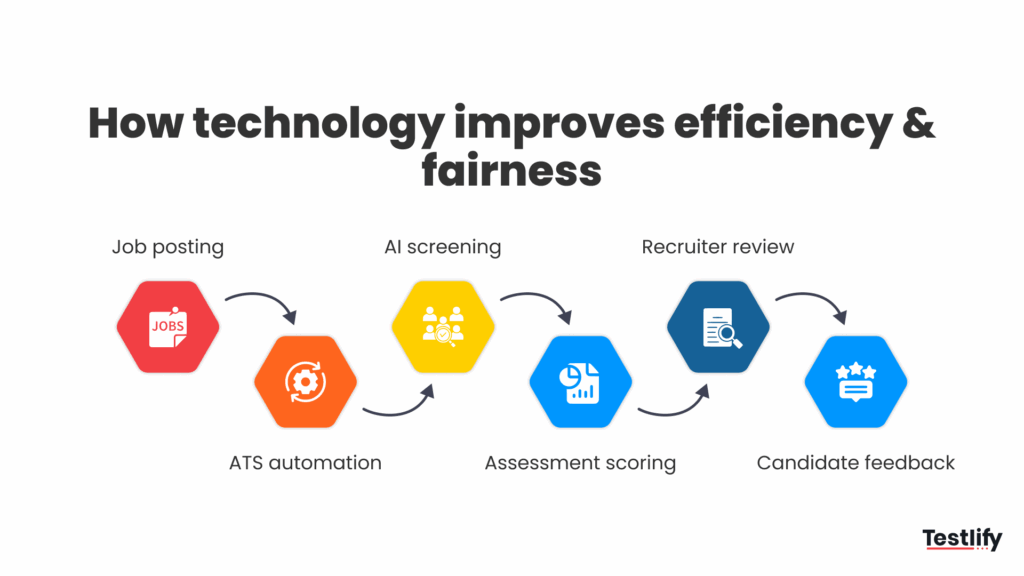
Then there’s the data layer. Modern applicant tracking systems (ATS) and recruitment technology turn hiring into a measurable process. You can track how long each stage takes, where candidates drop off, and how well your sources perform.
Fairness is another reason technology matters. In remote hiring, you can’t rely on body language or informal impressions. That’s why online assessments and AI-driven interview tools are becoming standard.
In practice, technology doesn’t replace human judgment; it amplifies it. Recruiters still make the final calls. Tools help them handle the volume and protect objectivity.
What are the essential tool categories for remote hiring?
Remote hiring doesn’t run on a single platform. It runs on a connected stack of tools that handle everything.
Each category addresses a specific part of the hiring process, but together they form a consistent, scalable system. Let’s break down the essentials every hiring team should know.
1. Applicant Tracking Systems (ATS): The control center
An ATS is the recruiter’s command post. It keeps job listings, candidate applications, interview notes, and hiring decisions in one place.
A good system like Greenhouse, Workable, or Recruitee reduces human error and makes collaboration across hiring teams easier.
Research shows that 79% of recruiters find better candidates using an ATS, while 86% say it helps them hire faster.
| Tool | Best for | Key benefit |
| Greenhouse | Mid to large teams | Structured interview scorecards & integrations |
| Workable | SMBs & startups | Easy job posting & one-click sourcing |
| Recruitee | Collaborative teams | Visual pipelines & team comments |
| Zoho Recruit | Growing firms | Built-in AI resume parsing |
| Breezy HR | Remote hiring | Automation for outreach & scheduling |
2. Skill assessment platforms: Hiring beyond the résumé
Remote hiring removes face-to-face interaction, so testing actual ability becomes vital. Skill assessment tools such as Testlify evaluate technical and soft skills through skill-based online assessments.
The platforms help hiring managers make fair, data-backed decisions instead of relying on resume keywords or guesswork.
3. Video interviewing tools: Real conversations, no time zones
A video interview tool breaks the distance. Live platforms like Zoom or Microsoft Teams make it easy to meet candidates face to face, even across time zones.
Asynchronous tools like Willo or SparkHire let candidates record responses at their convenience, saving hours for both sides and eliminating scheduling chaos.
But where traditional tools stop, AI-powered interviews take the process further. Testlify combines one-way video interviews with an AI evaluation that reviews tone, clarity, confidence, and communication patterns.
Recruiters still make the final call, but AI helps them spot soft skills that might otherwise be missed. For distributed hiring teams, this makes shortlisting faster and fairer without losing the human element.
| Tool | Type | Key benefit |
| Testlify | AI + Asynchronous | Analyzes communication & soft skills with AI insights; saves hours of screening time |
| SparkHire | One-way & live | Flexible recording and branded interview experience |
| Willo | Asynchronous | Simple setup for candidates and hiring teams |
| Zoom | Live | Reliable live interviews with easy access |
| Microsoft Teams | Live | Integrates with calendars and internal workflows |
4. Talent sourcing and job boards: Finding people where they are
Niche job boards like We Work Remotely, Himalayas, and FlexJobs focus on global remote talent. They’re useful when you need professionals who are already comfortable working outside traditional offices.
Many also include salary benchmarking and built-in filters for time zones and experience, helping recruiters target more effectively.
| Platform | Region/Focus | Key benefit |
| We Work Remotely | Global | Pre-vetted remote-ready professionals |
| FlexJobs | U.S.-heavy | Curated remote and hybrid listings |
| Himalayas | Asia & global startups | Transparent pay data & filters |
| LinkedIn Recruiter | Global | Smart filters & AI recommendations |
| AngelList Talent | Tech startups | Direct access to founders & early-stage hires |
5. Global payroll and compliance tools: Hiring anywhere, staying lawful
When your team spans borders, compliance gets complex. Tools like Deel and Remote.com handle contracts, payroll, and local tax rules so that companies can hire globally without legal risk.
Some also offer Employer of Record (EOR) services, letting you onboard talent legally in countries where you don’t have a local entity. For HR leaders, this turns a logistical nightmare into a manageable process.
| Tool | Core feature | Key benefit |
| Deel | Global payroll & EOR | Hire legally in 100+ countries |
| Remote.com | Payroll & contractor management | Tax compliance & localized benefits |
| Papaya Global | Cross-border payments | Automated global payroll system |
| Rippling | HR & IT automation | Combines HR, payroll, and device management |
| Oyster | Global hiring | Transparent cost calculator & compliance guardrails |
6. Onboarding and collaboration tools: Keeping new hires connected
A good hire is only the start. Platforms such as BambooHR, Notion, or Slack make onboarding structured and engaging. They centralize documents, automate checklists, and help new employees connect virtually with their teams.
| Tool | Use case | Key benefit |
| Notion | Team documentation | Custom onboarding pages & wikis |
| Slack | Daily communication | Channels for culture & connection |
| ClickUp | Task management | Visual progress tracking |
| Hubstaff | Remote workforce | Time tracking & productivity analytics |
7. Engagement and scheduling tools: Keeping candidates warm
Finally, engagement tools close the communication gap. Software like Calendly, GoodTime, or Harver automates scheduling, reminders, and follow-ups so candidates don’t feel forgotten. These tools reduce ghosting and keep both sides informed at every stage.
In a market where communication shapes your employer brand, these small touches make a lasting difference.
| Tool | Function | Key benefit |
| Calendly | Scheduling | Auto time-zone detection & invites |
| GoodTime | Interview coordination | Smart interviewer matching |
| Harver | Candidate engagement | Automated updates & feedback |
| Paradox Olivia | AI recruiting assistant | Chat-based scheduling & reminders |
| Zapier | Automation bridge | Connects all tools for instant updates |
How to choose the right stack for your organisation?
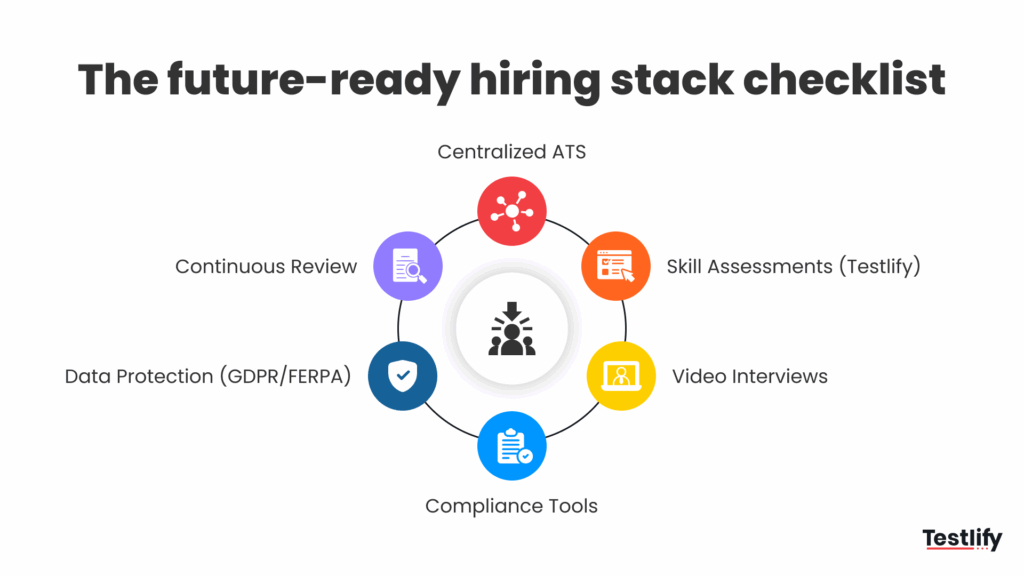
Opting for the right remote hiring tools isn’t about chasing trends or adding more software to your workflow. It’s about balance.
1. Start with your bottlenecks, not the market
Before buying anything, identify what slows your hiring down. Is it screening, scheduling, or collaboration between recruiters and hiring managers?
A LinkedIn survey found that 40% of companies improved their quality-of-hire and reduced time-to-fill by 20% after addressing bottlenecks through automation and tracking systems.
2. Match tools to your hiring volume
- Startups and SMBs: Choose lean, easy-to-integrate tools that don’t require heavy setup. Free or affordable platforms like Workable, Calendly, and Slack can handle end-to-end hiring at this stage.
- Mid-market and growing teams: Add structure with a central applicant tracking system (ATS) such as Recruitee or Greenhouse, and pair it with a reliable assessment tool like Testlify for role-based evaluations.
- Enterprises: Focus on integration and compliance. Larger teams benefit from unified suites that connect ATS, HRIS, and payroll systems for smoother reporting and audit control.
| Company Size | Recommended Focus | Example Tools |
| Startup / SMB | Flexibility & ease | Workable, Calendly, Slack |
| Mid-Market | Structure & fairness | Recruitee, Greenhouse, Testlify |
| Enterprise | Compliance & scale | SAP SuccessFactors, Deel, Remote.com |
3. Prioritise integration and data flow
In remote hiring, disjointed tools can cause more harm than help. Look for software that shares data automatically across systems.
For instance, if your assessment platform (like Testlify) feeds results directly into your ATS, recruiters won’t waste time toggling between dashboards or manually copying data. Seamless integrations not only save time but also ensure consistent candidate records.
4. Don’t ignore data protection and ethics
With most hiring now digital, compliance is non-negotiable. Choose platforms that are transparent about how they handle candidate data, support GDPR and FERPA standards, and give you control over retention settings.
AI-powered tools should come with explainable logic, not black-box scoring. The goal is to improve fairness, not replace judgment.
5. Build gradually and review annually
A hiring stack isn’t permanent. It should evolve as your hiring needs and team size change. Schedule a yearly audit to ask simple questions: Are our tools still saving time? Are candidates happy with the experience? Are we using data effectively?
If the answer to any of these is no, it’s time to refine or replace. Technology should serve your recruiters, not the other way around.
Conclusion on building a future‑ready remote hiring stack
The best hiring stacks aren’t built overnight. They grow with your team. Technology can’t replace human judgment, but it can sharpen it. The right mix of systems keeps your process fast, organized, and fair for every candidate.
If you’re ready to build that kind of hiring experience, Testlify can help. From skill assessments to AI interviews, it brings everything you need to hire confidently and remotely.