
HR Benchmarking: Types, benefits and challenges
Learn key metrics, benefits, challenges, and future trends to optimize your HR strategies effectively wit HR benchmarking.

Today’s business environment is rapidly changing; hence, HR is critical to ensuring organizational success. But do you know whether your HR practices are good enough?
That is where HR benchmarking comes in: by comparing your HR metrics and practices to industry standards or those of similar companies, you will be provided with actionable insight into where to refine your strategies and improve outcomes.
This blog provides an in-depth look at HR benchmarking, from its significance to practical steps for implementation and overcoming challenges.
 ChatGPT
 Gemini
 Claude
 Grok
Grok Perplexity
What is HR benchmarking?
At its core, HR benchmarking is a strategic tool for evaluating and comparing your organization’s human resources (HR) performance. It collects and analyses data related to HR practices, processes, and outcomes, which are measured against those of an industry or best practices.
For example, if your company’s time-to-fill metric is 50 days while the industry average is 35 days, benchmarking highlights this discrepancy, helping you identify inefficiencies in your recruitment process.
Why is HR benchmarking important?
Here’s why HR benchmarking is essential for organizations:
- Identifying strengths and weaknesses: By comparing metrics, you can uncover areas where your organization excels or lags.
- Driving continuous improvement: Benchmarking enables you to implement better practices and monitor progress over time.
- Enhancing competitiveness: Staying aligned with or ahead of industry standards ensures your organization remains competitive in the talent market.
- Supporting strategic decisions: Data-driven insights from benchmarking empower HR leaders to make informed decisions.

What can you benchmark?
HR benchmarking extends to nearly every area of people management within your organization, provided you have reliable data to support the comparisons. Some key areas include the following:
1. Organizational structure
The design and structure of an organization are instrumental in turning business strategies into actionable outcomes. Compared to industry standards, the internal setup could determine whether your current setup works to your advantage.
2. Compensation and benefits
Compensation and benefits benchmarking analyzes how your pay scales and benefits stack up within your industry or region. It is a useful exercise to keep your organization competitive and avoid underpaying or overpaying employees.
3. HR operational costs
The cost of running the HR department and such specific metrics as cost-per-hire provide critical data points for benchmarking. With the same figures compared to similar organizations, you can decide whether your spending is sensible and within the best practices. However, ensuring consistency while collecting the data allows for meaningful comparisons.
Benefits of HR benchmarking
Benchmarking in HR has many benefits. Now let’s take each one of these step-by-step:
1. Improved recruitment strategies
Human resource recruitment is an important function. Benchmarking can help identify inefficiencies in your hiring process. For instance, if your offer acceptance rate is considerably lower than industry averages, you may need to reassess your compensation packages or candidate engagement strategies.
2. Enhanced employee retention
The underlying patterns that are causing attrition rates to be high are something that an organization can discover with the help of benchmarking of employee turnover rates and work accordingly.
3. Better workforce planning
The comparison of industry trends in hiring, training, and attrition can do workforce forecasting by benchmarking.
4. Increased ROI on training
Comparison of metrics such as training completion rates and training ROI ensures that your learning and development programs focus on employee needs and organizational goals.
What are the different types of benchmarking?
Benchmarking will get the utmost value only if the different approaches are understood.
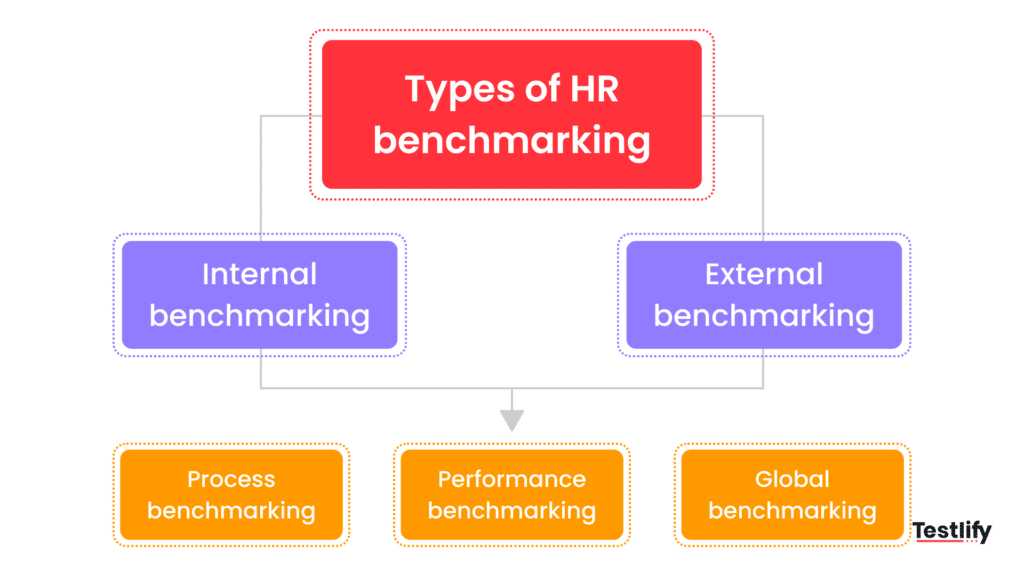
1. Internal benchmarking
Internal benchmarking is compared within the organization. Example: How does the time-to-fill differ between departments? This type helps identify internal best practices and areas for improvement.
2. External benchmarking
External benchmarking involves comparing your metrics to those of competitors or industry leaders. This broader perspective highlights your standing in the market and identifies areas where you can gain a competitive edge.
3. Process benchmarking
This approach analyzes specific processes, such as performance appraisals or onboarding, against the best practices in other organizations. It’s particularly useful for improving efficiency.
4. Strategic benchmarking
Strategic benchmarking can relate to aligning HR strategies to the organizational goals and long-term visions. For instance, which other companies’ HR strategies support the branding effort?
5. Global benchmarking
For multinational organizations, global benchmarking compares HR metrics across regions or countries. This type of practice is necessary to understand cultural differences and tailor practices accordingly.
Key metrics for HR benchmarking
HR benchmarking can cover various metrics, depending on your organizational priorities. Here are some key areas:
Recruitment metrics
Metric | Definition | Formula | Average industry rate |
|---|---|---|---|
Time-to-fill | Average number of days to fill an open position. | (Date position is filled – Date position is posted) | 30-45 days (varies by role/industry) |
Cost-per-hire | Total hiring cost divided by the number of hires. | (Total hiring costs) ÷ (Number of hires) | $4,700 per hire (SHRM average) |
Offer acceptance rate | Percentage of job offers accepted by candidates. | (Number of accepted offers ÷ Total offers extended) × 100 | 89% (varies by company/industry) |
Employee engagement metrics
Metric | Definition | Formula | Average industry rate |
|---|---|---|---|
Employee Net Promoter Score (eNPS) | Indicates how likely employees are to recommend your organization. | % Promoters – % Detractors | 10 to 40 (positive score is good) |
Absenteeism rate | Average days employees are absent per year. | (Total days absent ÷ Total workdays) × 100 | 1.5% to 3% annually |
Engagement survey scores | Measures overall employee satisfaction and engagement. | Aggregate score of survey responses | 70%-85% engagement rate |
Retention metrics
Metric | Definition | Formula | Average industry rate |
|---|---|---|---|
Turnover rate | Percentage of employees leaving over a specific period. | (Number of employees who left ÷ Average number of employees) × 100 | 18% annually (varies by industry) |
Retention rate | Percentage of employees staying within the company. | (Number of retained employees ÷ Total employees) × 100 | 80%-90% |
Exit interview insights | Key reasons for employee exits. | Not applicable (qualitative metric) | Common reasons: better pay, growth |
Learning and development metrics
Metric | Definition | Formula | Average industry rate |
|---|---|---|---|
Training participation rate | Percentage of employees enrolled in training programs. | (Number of employees in training ÷ Total employees) × 100 | 70%-90% |
Training ROI | Benefits achieved versus costs incurred for training initiatives. | (Training benefits – Training costs) ÷ Training costs × 100 | 150%-200% (varies by program) |
Skill progression metrics | Improvement in skills after training completion. | (Post-training skill level – Pre-training skill level) ÷ Pre-training skill level × 100 | 20%-40% improvement |
Steps to implement HR benchmarking
HR benchmarking is a long process, but breaking it down into steps makes it manageable:
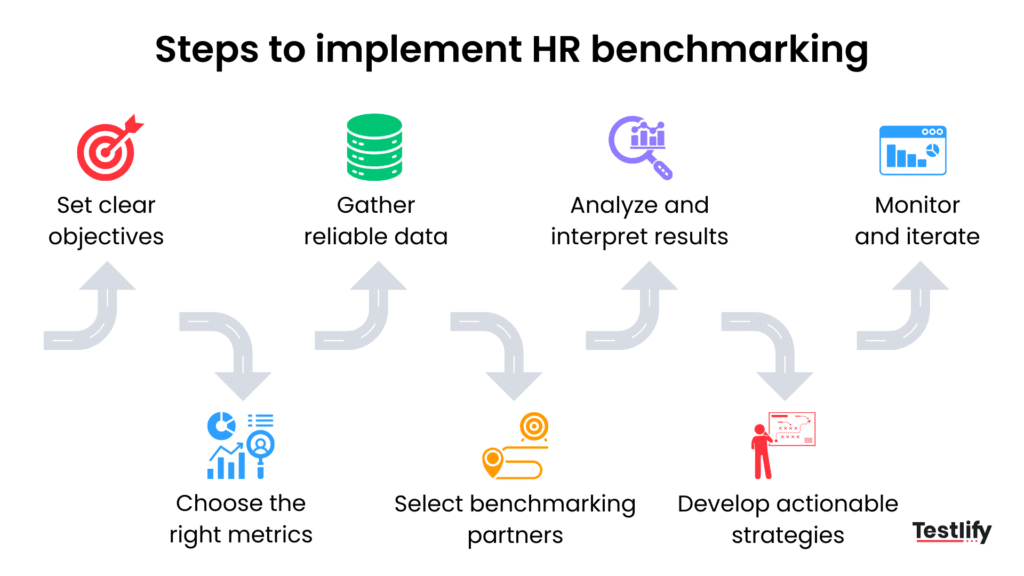
1. Set clear objectives
Define the purpose of benchmarking. Do you want better recruitment outcomes, less turnover, or more engagement? It can keep your efforts focused.
2. Choose the right metrics
Not all metrics are the same. If, for example, you need to lower recruitment costs, pertinent metrics could include cost-per-hire and time-to-hire.
3. Gather reliable data
Data from internal HR systems, employee surveys, and industry reports will be gathered. Tools such as HRIS or analytics platforms may be used for accuracy.
4. Select benchmarking partners
Appropriate organizations, competitors, or industry standards will be identified for benchmarking from outside. They should compare meaningful organizations of a size similar to your organization or belonging to the same industry.
5. Analyze and interpret results
Compare your metrics against the benchmark. Identify gaps, areas of excellence, and opportunities for improvement.
6. Develop actionable strategies
Create strategies to address areas needing improvement using your findings. These should be structured within the context of your organization’s overall goals.
7. Monitor and iterate
HR benchmarking is a continuing process. Regularly review metrics and benchmarks to track progress and make adjustments regarding industry changes.
Challenges in HR benchmarking
While HR benchmarking offers numerous benefits, it is not without challenges. Here’s how to address common roadblocks:
1. Data inconsistency
Ensure your data collection methods are standardized and reliable, as inconsistent data skews results, rendering comparisons meaningless. Regular audits and validation checks can help maintain data accuracy and ensure benchmarking delivers actionable insights. Additionally, using a secure residential proxy can help overcome location-based restrictions, enabling more accurate and comprehensive HR data collection across different regions.
2. Limited access to benchmarking partners
Accessing external benchmarking data can be challenging due to confidentiality concerns or data-sharing restrictions. Partnering with trusted benchmarking organizations or leveraging detailed industry reports can provide valuable alternatives to address this limitation.
3. Resistance to change
Employees or managers may resist changes driven by benchmarking insights, which can bog down progress. Clear communication, transparency about benefits, and active stakeholder involvement can ease the transition process and foster buy-in.
4. Contextual differences
Every company operates in a different environment, so what is true for other companies cannot be applied directly to you. Use benchmarks as guidelines but not as blueprints. Tailor them according to your organization’s specific goals, culture, and circumstances.
The future of HR benchmarking
As times change, so do the thinking patterns regarding technology and workplace change. Here’s a peek into the future:
1. AI-powered insights
AI would focus on generating near-real-time benchmarking insights against vast datasets and providing predictive insights to help organizations make proactive decisions. So, the organization can quickly identify gaps, forecast trends, and adjust strategies to stay competitive and ahead of the curve.
2. Custom benchmarks
Organizations will shift from one-size-fits-all benchmarking to bespoke metrics that reflect specific objectives and context. This may enable them to benchmark against peers with more akin structure or needs, hence getting at more relevant and actionable comparisons.
3. Focus on diversity and inclusion
Benchmarking will focus on DEI metrics, and organizations will increasingly use this information to increase representation and enhance workplace culture. Benchmarks will help track progress on equity initiatives, identify hotspots, and pinpoint areas that require immediate attention to create a more inclusive workplace.
4. Real-time monitoring
With real-time benchmarking in HR analytics, organizations will be better placed to respond quickly to the emerging trends, and hence it can bring dynamism in staying aligned with ever-changing market conditions and becoming nimble in decision-making.
Conclusion
HR benchmarking is a transformative tool where recruiters and HR leaders identify gaps and help in practice improvement and competitiveness. Organizations can unlock the full potential of their HR departments by knowing the right metrics to use, leveraging technology, and fostering a culture of continuous improvement.
Remember, benchmarking is not just checking industry performance but also a tool to be superior and set benchmarks. The first step is very small-scale; it will work like magic for your HR practices if done consistently.
Frequently asked questions (FAQs)

Content Writer
Yashika Khandelwal is a Content Writer with 3+ years of experience creating research-backed content on hiring, talent assessment, and HR technology. She is a registered Organizational Psychologist and subject matter expert who combines behavioral science with practical recruitment insights to produce accurate, evidence-based content.
LinkedInRelated resources
View all
HR & recruitment
Agile recruitment: Step-by-step process and benefits

HR & recruitment
Job Crafting: Types, Examples, and How to Do It (2026)

HR & recruitment
Best practices to ensure authenticity in candidates’ skills assessment tests
HR & recruitment
Purple squirrel in recruitment: Are they worth the hype?

HR & recruitment
What is human resource development: Guide for recruiters
HR & recruitment
What Is an HR Toolkit? Components, Tools, and How to Build One
Get started.
Hire on proof, not resumes.
Run your first skills-based assessment free — no credit card required.