
Remote hiring statistics 2026: Assessment & global hiring trends
Explore the latest remote hiring statistics and trends shaping 2026, from hybrid work adoption to modern recruitment and assessment strategies.

Remote hiring statistics from early 2025 show that just 9 percent of U.S. job listings offer remote work. That’s a noticeable drop from the early pandemic years.
But, don’t be surprised, this doesn’t mean companies are reverting to office-first models. What we’re seeing instead is a steady move toward hybrid work models.
In fact, according to research from WFH Map and Lightcast, hybrid roles in the U.S. jumped from 15 percent in early 2023 to 24 percent by mid-2025.
For HR leaders and recruiters, this shift raises new questions.
- Which roles stay remote?
- How do we evaluate performance across time zones?
- Or, how do we ensure fair hiring without in-person meetings?
This report can provide you with all the answers related to this shift. It is backed by verified data and focuses solely on what talent leaders need to know right now.
 ChatGPT
 Gemini
 Claude
 Grok
Grok Perplexity
TL;DR – Key takeaways
- Remote hiring has become a long-term strategy, not a temporary fix, and hybrid work now leads in most regions.
- Skill-based assessments are replacing degree filters, helping recruiters hire fairly across borders.
- Hybrid and remote setups improve balance and retention while keeping productivity strong.
- HR teams are reworking pay, benefits, and reviews to match flexible work patterns.
- Using platforms like Testlify helps organizations hire with data, consistency, and confidence anywhere in the world.

What does recent data tell us about remote hiring in 2026?
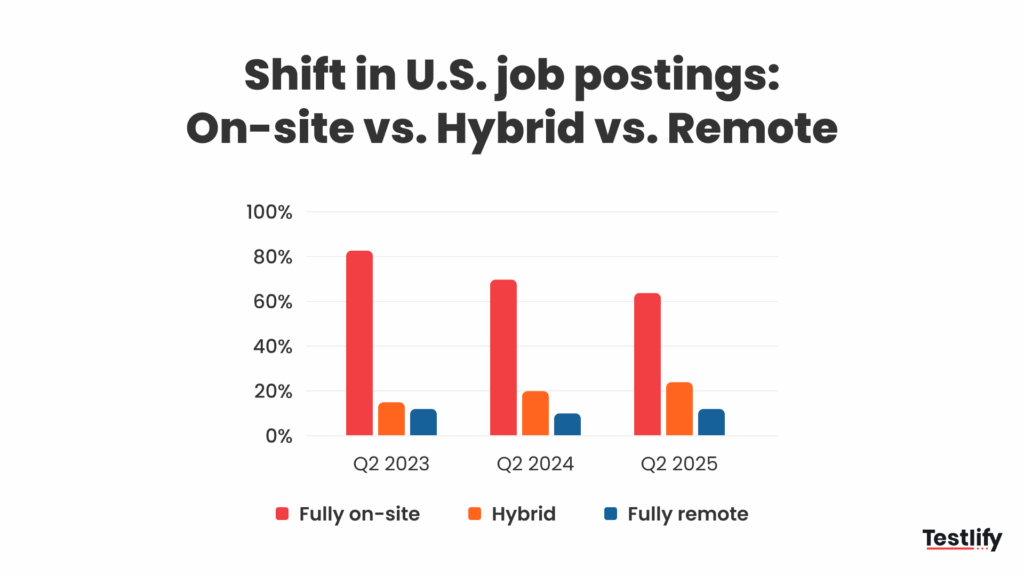
Remote hiring is settling into a new rhythm. The number of U.S. job postings for fully on-site roles dropped from 83% in 2023 to just 64% by mid-2025, based on data from Robert Half.
During the same period, hybrid listings climbed steadily while fully remote roles held near 12 percent. It shows that companies are finding a middle ground between structure and flexibility rather than choosing one over the other.
LinkedIn’s 2024 report supports the same trend: hybrid jobs now outnumber remote ones across major markets. In the U.S., 13.4 percent of job ads were hybrid, while just 8.5 percent were fully remote.
Gallup’s polling paints a similar picture. Among workers with remote-capable roles, 52 percent now work in a hybrid model and 26 percent are fully remote.
Overall, remote hiring has reached a steady point. Hybrid work is now the main way organizations manage flexibility.
Why are hybrid and remote models on the rise?
After looking at the numbers, one thing should be clear to you: remote hiring is not going anywhere, but it’s evolving!
Instead of going fully remote, most companies are now trying to balance flexibility with in-person collaboration. Let’s figure out the common reasons why these workforce models are on the rise.
Access to a wider talent pool
Hiring is no longer limited by geography. A Robert Half report shows that 88 percent of U.S. employers now offer hybrid work options, and about one in four make them available to every employee.
In practice, it helps fill hard-to-hire roles in fields like software development, design, and marketing, where demand often exceeds local supply.
Lower costs for both sides
Remote hiring statistics also show that flexibility is cost-efficient. Employers save around $11,000 per year for each hybrid or remote worker by reducing office space and overhead costs.
Workers benefit too. A person working from home half the time saves close to $6,000 a year on fuel, food, and commuting. These savings make hybrid and remote work a long-term financial win for both employers and employees.
Employee preference and retention
Flexibility is now a top priority for most workers. Surveys show that 98 percent of employees want to work remotely at least part of the week. Gen-Z professionals, in particular, value freedom and work-life balance more than high salaries.
Gallup’s latest poll found that six out of ten U.S. employees in remote-capable jobs prefer hybrid work, while a third still choose to stay fully remote. That shift means retention strategies must account for flexibility as a key factor in job satisfaction.
Recommended: Top benefits and challenges in remote hiring
How are companies adapting recruitment for remote hiring?
Recruitment has changed more in three years than in the previous decade. The rise of remote and hybrid work has pushed hiring teams to rebuild their process from the ground up.
Virtual hiring is now normal
Remote interviews are no longer a temporary fix. Forbes cited that 93 percent of employers plan to keep using video interviews.
Recruiters now depend on digital tools for screening and shortlisting. For example, a hiring manager might use an online coding test or a structured skill quiz before the first call.
Online pre-employment assessment platforms like Testlify make this easier by combining skill tests, AI-video interviews, and proctoring in one place. It saves time and keeps hiring consistent for remote candidates.
Skills-first recruitment is replacing degree filters
Companies are realizing that where someone studies matters less than what they can do. More than 80% of U.S. employers now focus on skills over degrees. HR teams use data from online assessments to fairly compare applicants.
Onboarding and culture go digital
Hiring remotely also means rethinking how people settle into their roles. Many HR teams now run virtual orientation sessions, pair new hires with mentors, and set up clear communication rules from day one.
Testlify has highlighted that companies with planned digital onboarding see fewer dropouts in the first 90 days.
Know More: Employee onboarding process: A complete guide
What assessment trends are shaping remote recruitment?
Hiring teams are becoming smarter about how they test skills online. As remote hiring grows, companies are using data and automation to make assessments faster and more engaging for candidates.
Using AI for faster and fairer hiring
Artificial intelligence is changing how skill tests are built and checked. Assessment platforms now use AI to customize questions based on the role and requirement.
Remote assessments provide a clearer picture of a candidate’s actual skills. It also saves recruiters time by grading tests automatically and flagging strong candidates early.
Making tests short and easy to access
Lengthy tests often push good candidates away. To solve that, companies are turning to short, app-based quizzes and game-style tests. These are simple to take on any device and keep people engaged.
A marketing recruiter, for example, might use a 10-minute interactive test instead of a long-form exam. It’s faster for candidates and yields better completion rates for hiring teams.
Looking beyond technical skills
Working remotely needs more than just technical knowledge. Recruiters now test candidates’ communication, time management, and self-motivation.
Video-based and scenario-style assessments, or SJTs, help recruiters understand how a person handles real work situations.
Testlify’s internal data shows more companies combining soft-skill assessments with technical ones to ensure new hires fit remote roles better.
Explore More: How remote assessments help HR in remote hiring?
How is remote hiring affecting employees and workplace culture?
Remote hiring is reshaping how teams work together. For most employees, it means getting back the time they once spent commuting.
Many managers say their teams perform better when there’s space for quiet, independent work. Setting clear goals, keeping check-ins short, and writing down updates helps everyone stay aligned.
Team structures are shifting, too. Many companies now use flexible schedules, project-based contracts, and part-time specialists. HR teams are updating pay, benefits, and reviews to match these new patterns of work.
In practice, a healthy remote culture doesn’t need to be complex. Share calendars, agree on overlap hours, and document decisions.
Are U.S. trends unique, or is the shift global?
Remote hiring began as a U.S.-driven trend, but it has quietly become a global movement. Organizations everywhere are rethinking how work is structured, and most are settling somewhere between full office and full remote.
In North America and Europe, hybrid work is now the most common setup. LinkedIn’s 2024 Global Report found that 13.4 percent of U.S. job listings were hybrid, while the numbers were even higher in the United Kingdom at 38.3 percent and France at 29.7 percent.
In Asia, change is slower but steady. Large companies in India, Singapore, and the Philippines are experimenting with partial remote policies for roles in tech, design, and customer service.
Internet access and digital tools have made it easier to manage cross-border teams, even in regions that once relied heavily on office work.
The direction is clear. The United States may have led the shift, but flexibility is now part of the global hiring language.
Whether in New York, London, or Bangalore, organizations are learning that people value control over where and how they work, and that, in turn, is shaping how businesses hire and retain talent.
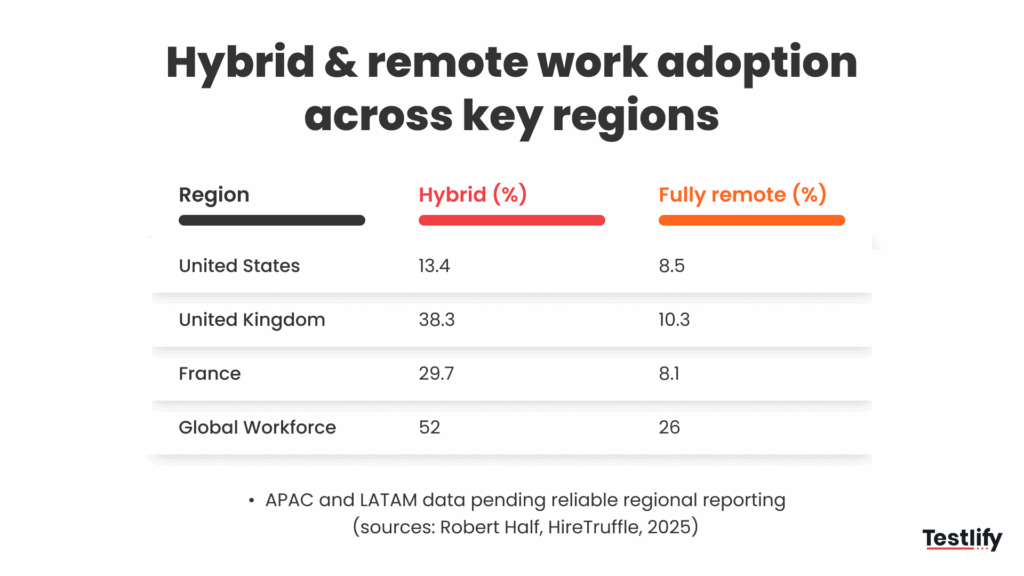
Verified data shows that hybrid work dominates in developed economies. In the U.K. and France, hybrid job listings outnumber remote ones by a wide margin, while in the U.S., the rise is slower but steady.
Globally, Gallup data confirms that most remote-capable employees now split their week between home and office. These patterns confirm that flexible work is no longer a temporary fix but a stable part of global employment structures.
How can HR leaders utilize these insights?
Remote hiring has become a permanent part of how organizations grow and how people choose where to work. Flexibility, skill-based hiring, and digital assessments now define modern recruitment.
For HR leaders, this means adapting faster. Policies, assessments, and team habits must now fit a workforce that works from anywhere. Fair hiring, consistent data, and good communication are what keep remote teams strong.
Platforms like Testlify make that easier. They help HR teams assess candidates by skill, run proctored interviews, and maintain hiring standards across borders.
If you’re rethinking your hiring strategy for 2026, start with what matters most: data, fairness, and trust.
Explore how Testlify can help you hire better, wherever your talent is.
Frequently asked questions (FAQs)

B2B SaaS Content Writer
Rishav Kumar is a B2B SaaS content writer with 4 years of experience. He loves crafting engaging content. Always exploring fresh ideas, he's passionate about helping businesses grow through impactful writing.
LinkedInRelated resources
View all
Remote hiring
How remote assessments help HR in remote hiring?

Remote hiring
How to conduct system compatibility check to prevent assessment failure?

Remote hiring
Top tools for running a system requirement check

Remote hiring
How to foster team cohesion and engagement in a remote workforce

Remote hiring
How remote hiring is reshaping the global workforce landscape

Remote hiring
Remote Hiring Tools: Build Your 2026 Hiring Stack
Get started.
Hire on proof, not resumes.
Run your first skills-based assessment free — no credit card required.