
Employee onboarding checklist: Steps, templates and best practices (2026)
Build an effective employee onboarding checklist covering every phase from pre-boarding through 12 months. Backed by SHRM, Gallup, and Glassdoor data on what drives new hire retention.

According to SHRM, approximately 20% of employee turnover occurs within the first 45 days of employment. A structured employee onboarding checklist is the most direct way to close that gap.
What is an employee onboarding checklist? An employee onboarding checklist is a structured document that guides HR teams and managers through integrating new hires – covering paperwork, IT setup, role training, team introductions, and 30-90 day milestones. It standardizes the process across departments and ensures nothing critical is missed from pre-boarding through the first year.
In my work with HR teams at fast-growing companies, the single most common onboarding failure is not having a structured checklist that spans all five phases. Most organizations front-load onboarding into the first week and leave new hires to figure out the rest themselves.
TL;DR
- 20% of employee turnover occurs in the first 45 days (SHRM)
- Only 12% of employees strongly agree their company onboards new hires well (Gallup)
- Organizations with structured onboarding programs see 55% higher new hire retention (Glassdoor)
- Effective onboarding increases new hire productivity by up to 70% (SHRM)
- Onboarding should last a minimum of 90 days – best practice extends to 12 months
- This guide covers the Testlify 5-Phase Onboarding Assessment Framework: pre-boarding, day one, week one, 30-90 days, and 12 months
 ChatGPT
 Gemini
 Claude
 Grok
Grok Perplexity
What is employee onboarding?
Employee onboarding is the structured process of integrating new hires into a company. It ensures each new employee understands their role, the workplace culture, and what is expected of them – from their first day through their first year.
The workforce has shifted its definition of onboarding. It is no longer just paperwork and compliance forms. It is a strategic program that sets the foundation for long-term performance and retention.
During onboarding, employees build relationships with teammates, learn about the company mission, and get access to the tools, policies, and resources they need to do their jobs well.
Much of that first week comes down to a welcome deck covering team structure, company history, and key policies in one clear walkthrough. HR teams increasingly start with an outline or existing document, run it through Decksy AI presentation generator to turn it into a structured slide deck, and save the manual formatting time for something more useful. Once that foundation is in place, the rest of onboarding can move from guides toward something more relational.
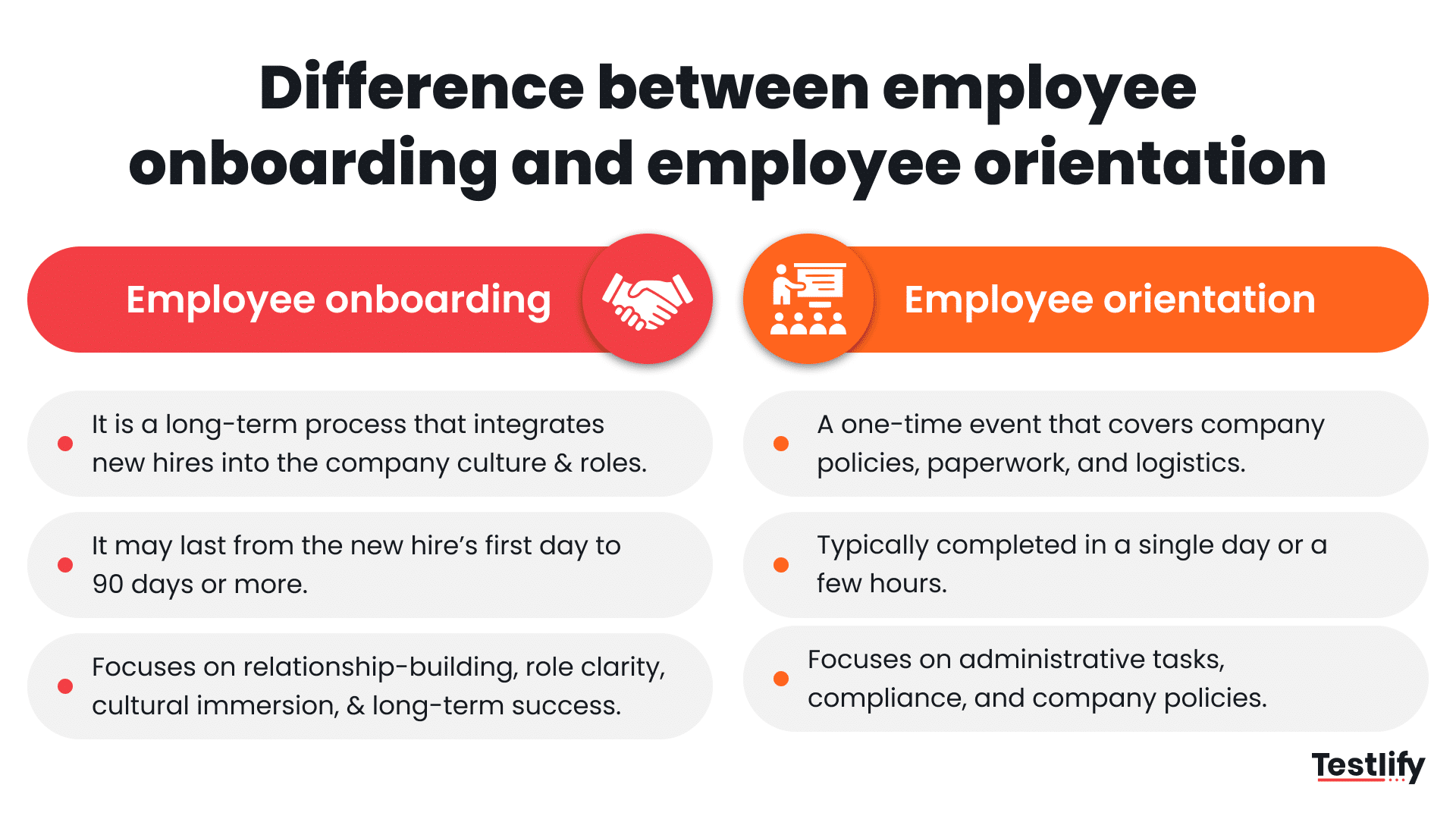
Many companies confuse onboarding with orientation. Orientation is a single event – typically a one-day introduction to the company. Onboarding is a structured multi-month program that builds on that introduction.
One thing that consistently separates high-performing onboarding programs: onboarding is never treated as an HR-only function. It requires coordination across HR, hiring managers, IT, team leads, and leadership. Each role plays a distinct part.
Role | Onboarding Responsibilities |
|---|---|
HR Team | Handles paperwork, payroll information, compliance, and policies. |
Hiring Manager | Provides role-specific training and sets performance expectations. |
Team Members | Help new hires feel welcomed and integrated into the culture. |
IT Department | Ensures access to necessary tools, software, and systems. |
Mentor/Buddy | Acts as a go-to person for questions and social integration. |
Leadership Team | Reinforces company values and mission through direct engagement. |

What is an employee onboarding checklist?
An employee onboarding checklist is a structured document that guides HR and managers through the full integration of a new hire – from pre-boarding tasks before day one through 12-month development milestones.
It serves three core purposes. First, it standardizes the process so every new hire gets a consistent experience regardless of department or hiring manager. Second, it ensures nothing is missed – from payroll documentation to IT access to compliance training. Third, it creates accountability by assigning specific tasks to specific owners with clear timelines.
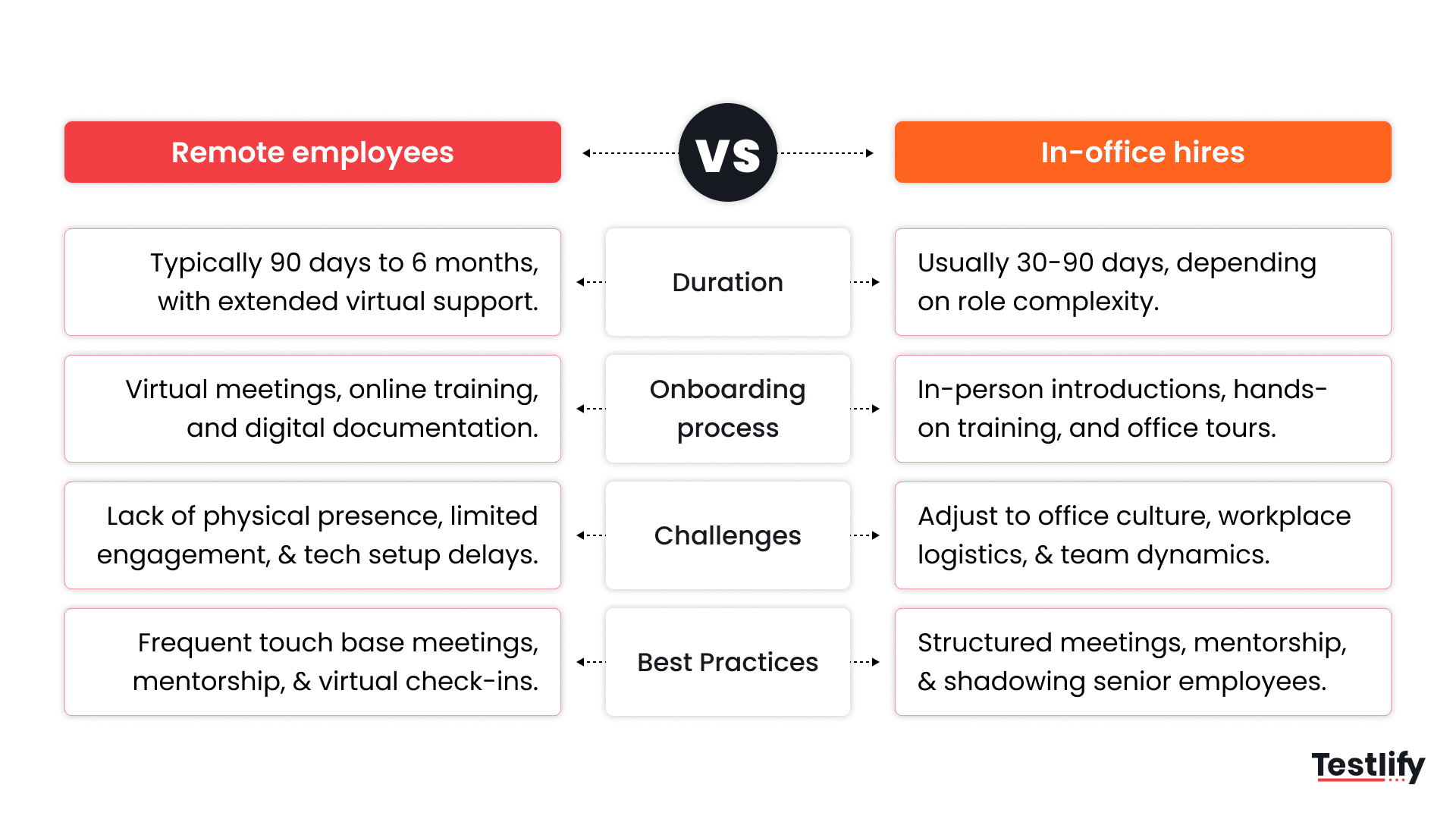
A detailed onboarding checklist is especially valuable when managing both in-office and remote employees. Remote new hires face additional challenges: no physical office tour, less organic team interaction, and a greater reliance on digital tools. A structured checklist ensures remote employees receive the same quality of onboarding as their in-office counterparts.
Also Read: HR checklist: Key steps you cannot miss
Why does structured onboarding matter for retention?
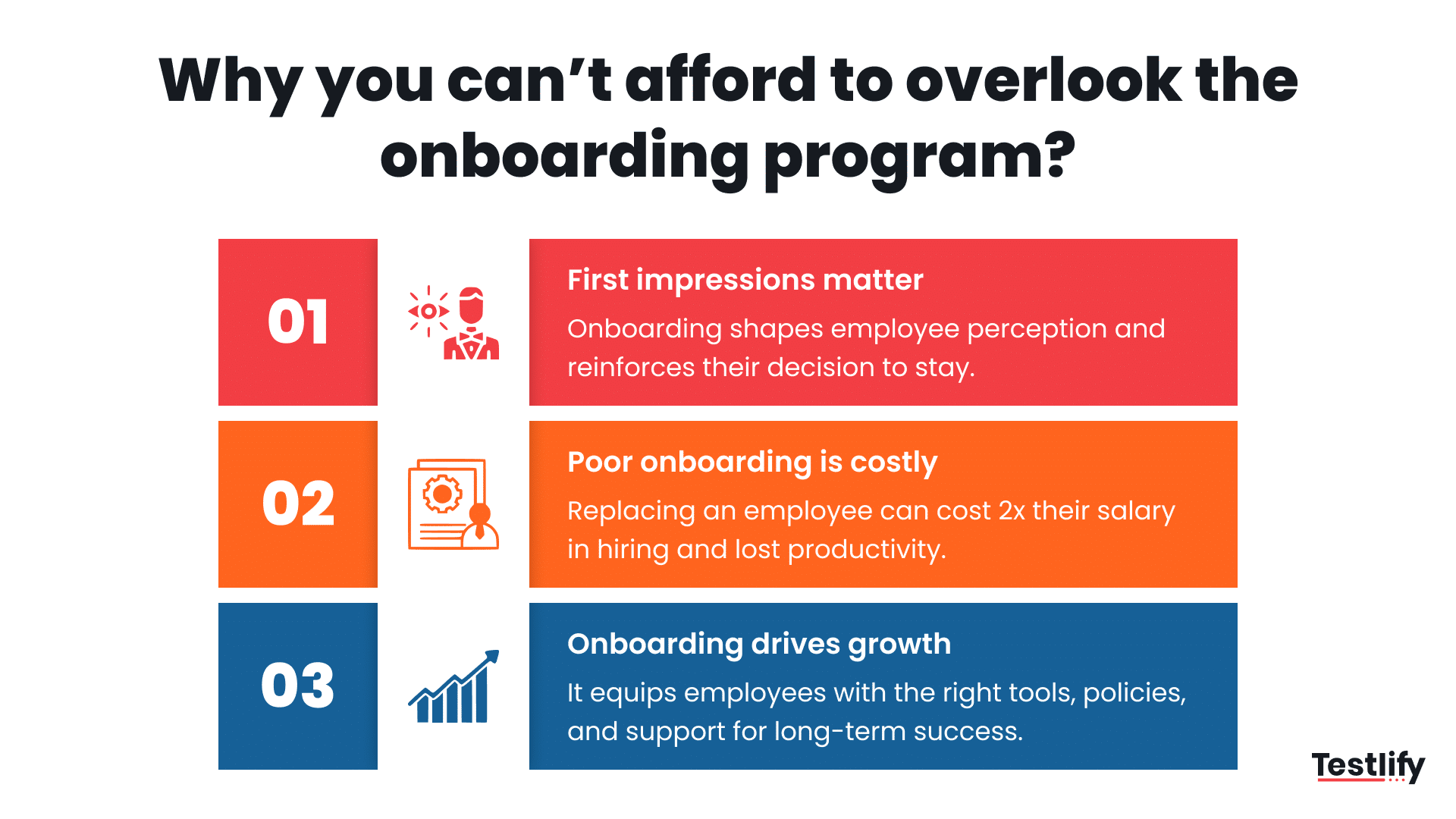
Structured onboarding reduces early-tenure turnover by giving new hires the role clarity, cultural context, and ongoing support they need to stay and perform. Organizations with structured programs report 55% higher new hire retention (Glassdoor), 70% faster time to productivity (SHRM), and 69% higher likelihood of 3-year retention (SHRM) compared to unstructured approaches.
Consider this: a highly skilled new hire joins your company. Within three weeks they feel disconnected, unclear about expectations, and unsure who to ask for help. By month two they are actively looking for other roles. The cost lands entirely on the organization.
According to Gallup, only 12% of employees strongly agree their company onboards new hires well. That leaves 88% of organizations delivering onboarding that falls short of what new hires need to stay and perform.
The financial case is equally clear. Replacing an employee costs between 50% and 200% of their annual salary depending on role and seniority. A structured employee onboarding process is one of the lowest-cost retention investments available to HR teams.
Pro Tip: Assign a dedicated onboarding buddy on day one – someone outside the direct management chain. In teams I have worked with, this single change consistently reduces 30-day disengagement. LinkedIn Talent Solutions data shows employees with a buddy report feeling productive faster and are more likely to recommend the company as a great place to work.
Key Takeaway: Structured onboarding directly reduces early-tenure turnover. The investment pays back through lower replacement costs, faster time to productivity, and stronger team culture across departments.
How long should employee onboarding last?
Effective onboarding lasts a minimum of 90 days. Best practice extends it to 12 months. Organizations that limit onboarding to the first week are leaving significant productivity and retention value unrealized.
SHRM research indicates that most employees take 8 to 12 months to reach full productivity in a new role. Cutting onboarding off at week one means withdrawing support long before the new hire has reached that benchmark.
The right onboarding duration varies by role complexity, industry, and hire level:
Industry | Recommended Duration | Key Factor |
|---|---|---|
Technology / SaaS | 90 days to 6 months | Complex tooling, rapid product iteration |
Healthcare | 6 to 12 months | Compliance requirements, patient safety protocols |
Retail / Hospitality | 30 to 90 days | High volume, procedural focus |
Financial Services | 90 days to 12 months | Regulatory requirements, client trust-building |
Professional Services | 90 days to 6 months | Client relationship building, methodology training |
A phased approach – pre-boarding, day one, week one, 30-90 days, 12 months – is the most practical structure for most organizations. The checklist tasks differ at each stage. The next section walks through each phase in detail.
What steps should an employee onboarding checklist include?
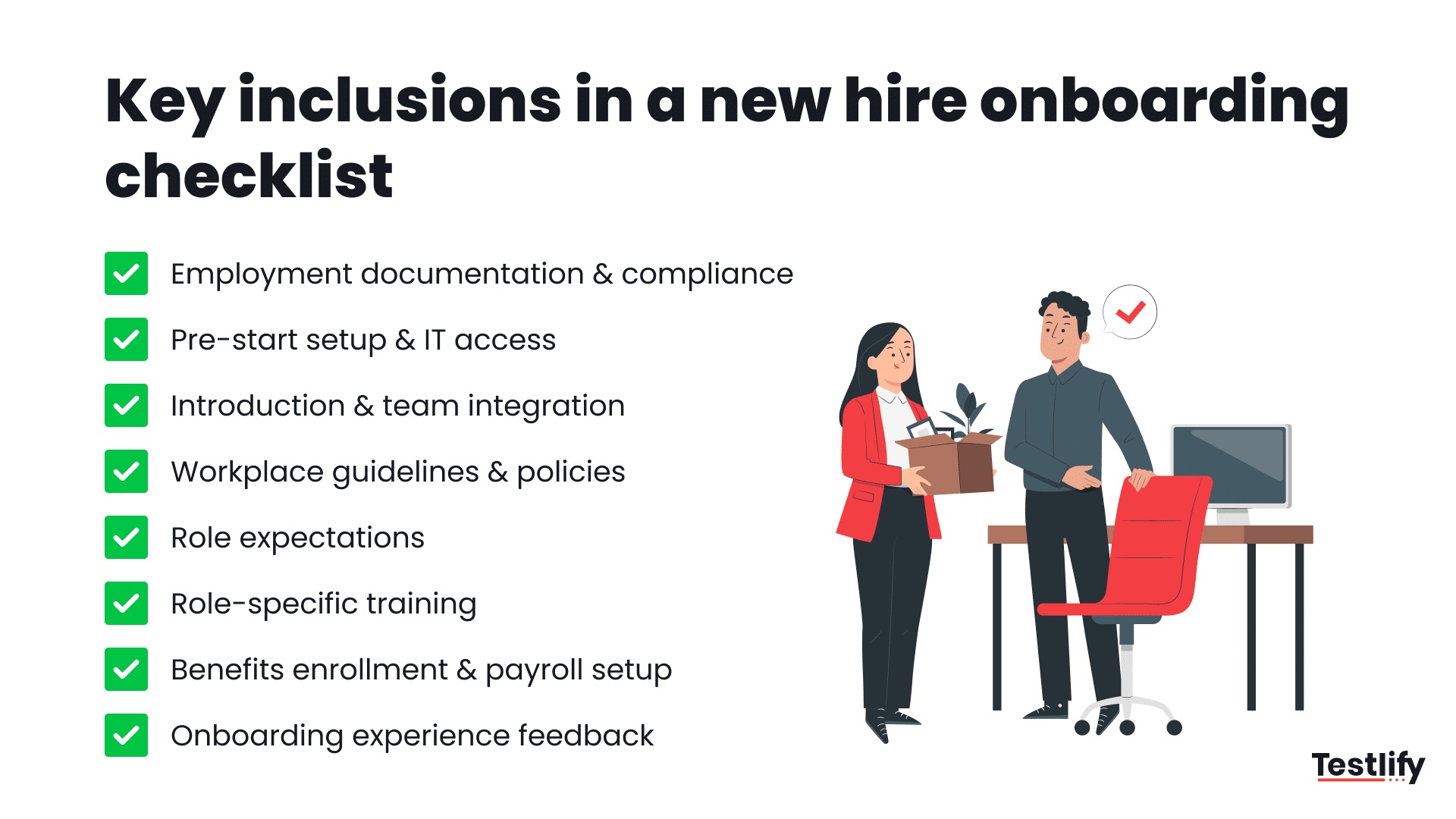
Every employee onboarding checklist should cover six core areas, regardless of industry or role level:
- Employment documentation – contracts, tax forms, direct deposit details, compliance paperwork
- IT and tool setup – email access, hardware, software licenses, system permissions
- Pre-boarding welcome – first-day itinerary, employee handbook, benefits overview sent before day one
- Role clarity – job expectations, 30-60-90 day goals, key stakeholder introductions
- Cultural integration – team introductions, communication norms, company values
- Ongoing support – regular check-ins, buddy assignment, structured performance milestones
These six areas map directly to the Testlify 5-Phase Onboarding Assessment Framework: a structured approach that uses pre-hire assessment data to personalize onboarding at each stage.
The core insight behind this framework: your pre-hire assessment results already contain onboarding inputs. A candidate who scored high on technical skills but lower on collaboration should receive an onboarding plan that weights team integration activities more heavily in the first 30 days. Testlify’s library of 3,500+ assessments across 4,500+ job roles gives HR teams the baseline data to do exactly this.
What does each onboarding phase look like in practice? [+templates]
The Testlify 5-Phase Onboarding Assessment Framework structures onboarding from pre-boarding through 12 months. Each phase has specific goals, activities, and measurable success signals.
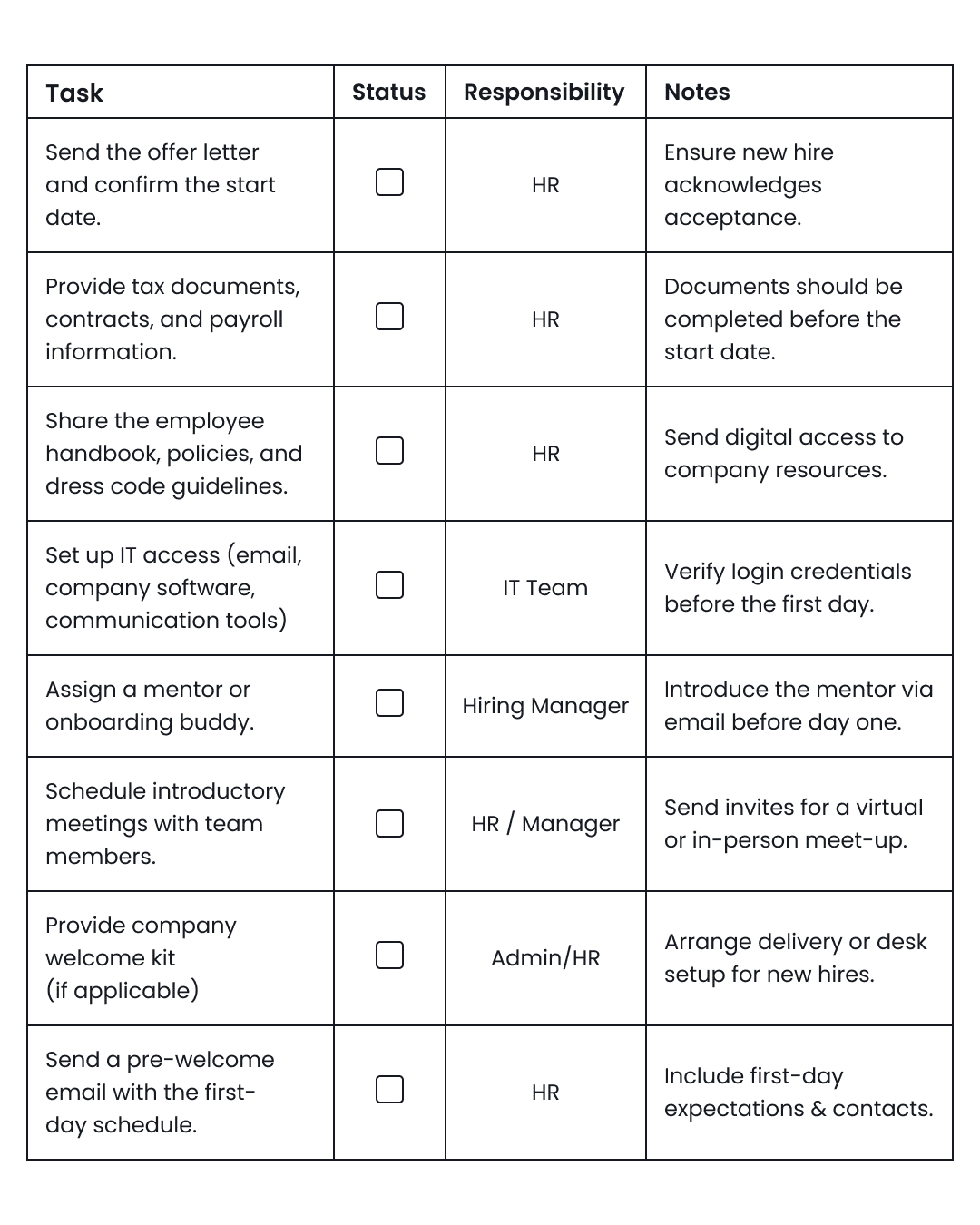
Pre-boarding (before the start date)
Pre-boarding starts the onboarding journey before day one. The goal is to ensure the new hire arrives informed, prepared, and already connected to the team.
- Send employment contracts, tax documents, and payroll forms for completion before day one
- Share a first-day itinerary: start time, location or login details, dress code, and who to contact on arrival
- Set up the email account, laptop, and role-specific software before the start date
- Provide access to the employee handbook, benefits overview, and workplace policies
- Send a welcome message from the hiring manager introducing the team and what to expect in week one
Template: Pre-boarding checklist
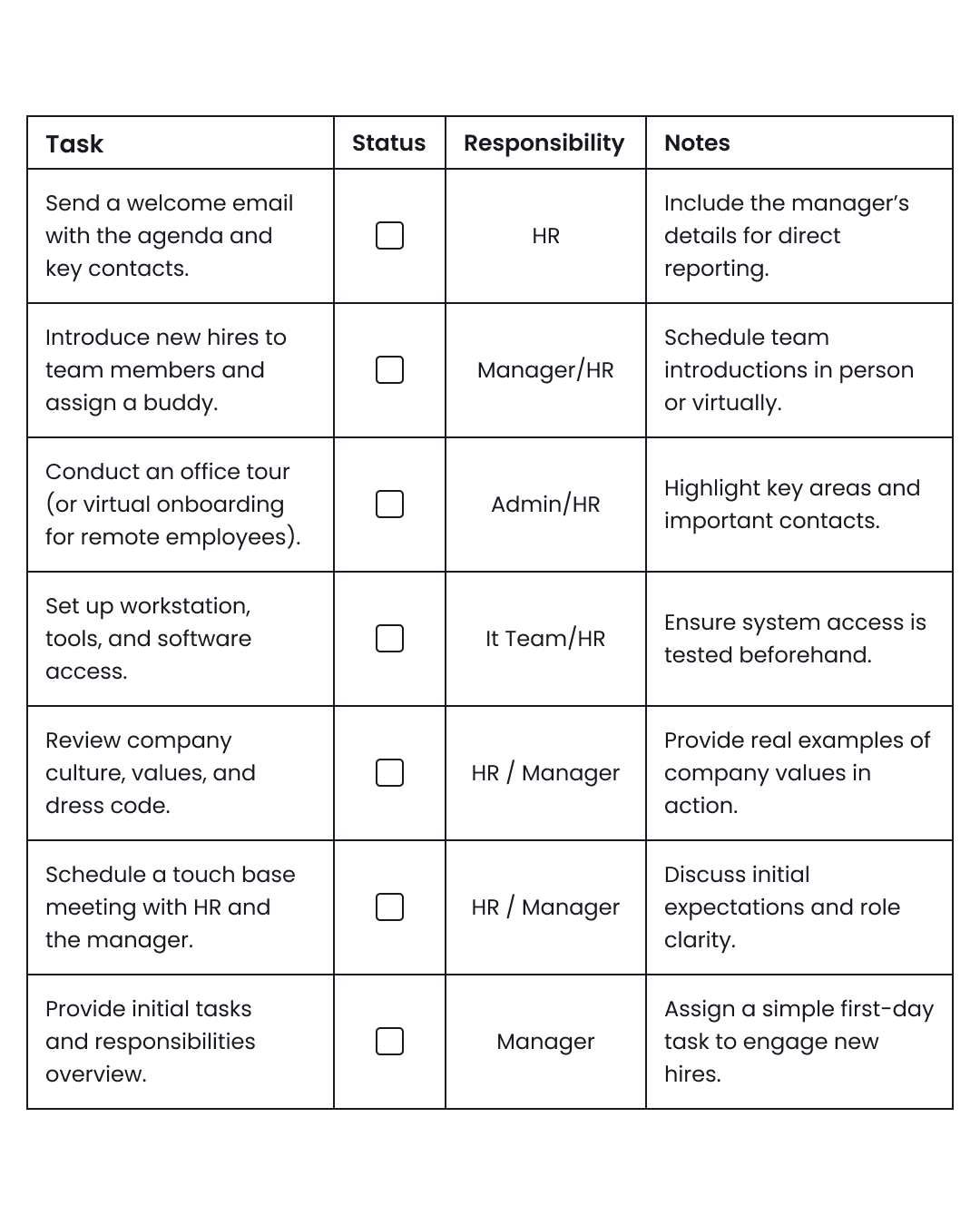
First day: Setting the right tone
The first day sets the tone for the entire employment relationship. Focus on making the new hire feel welcome, not on loading them with information.
- Introduce the new hire to the team and schedule an informal meet-and-greet (in-person or virtual)
- Walk them through their workstation and give an office tour – or a virtual walkthrough for remote hires
- Cover company values, job expectations, and key workplace policies at a high level
- Give a brief role overview and a simple first task to build early confidence
- Confirm IT access is working and all tools are accessible before end of day one
Template: First-day onboarding checklist
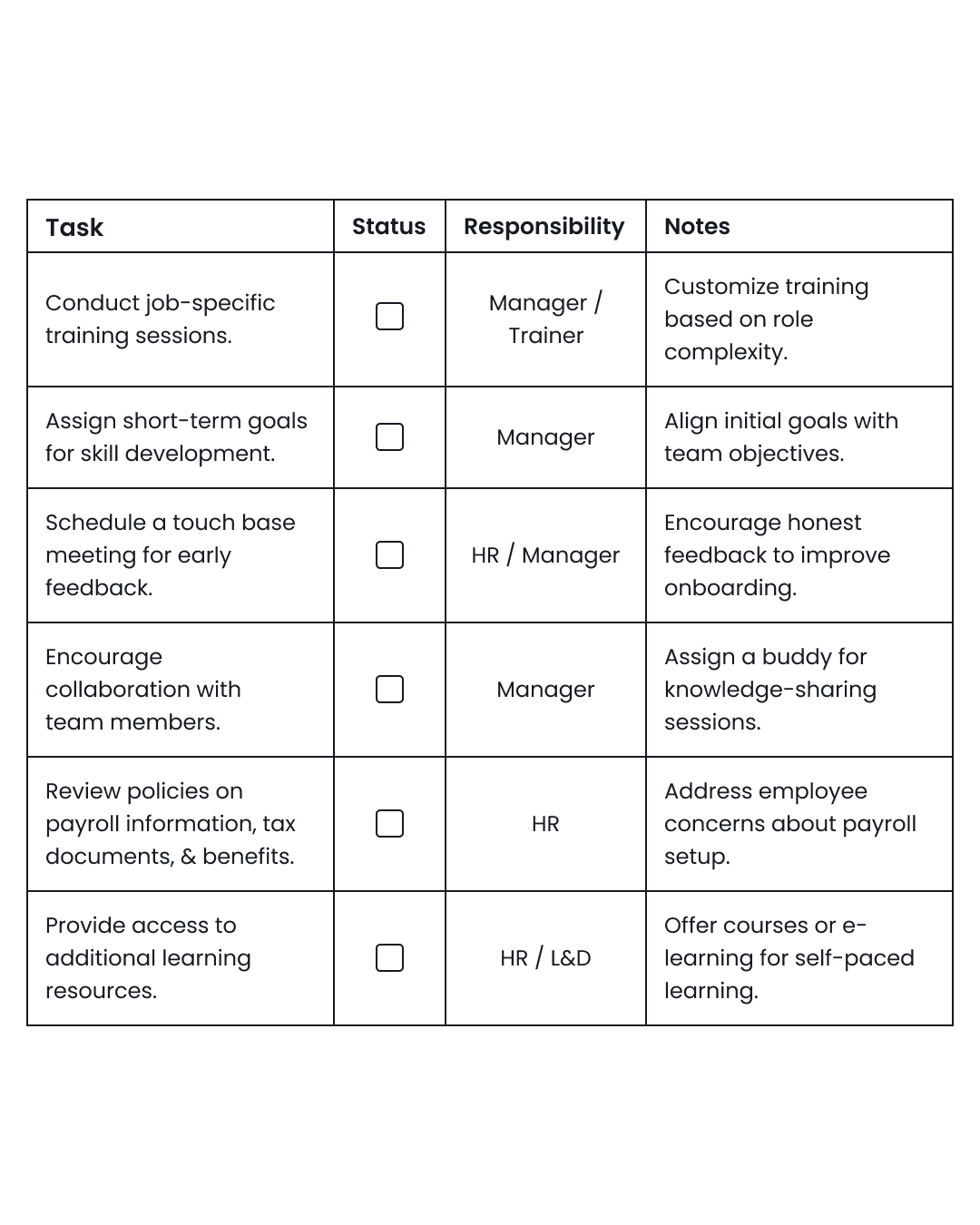
First week: Integration and training
Week one moves from orientation to integration – helping the new hire build relationships and gain confidence in their role through structured activities and clear expectations.
- Start job-specific training and provide clear short-term goals for the first 30 days
- Set up team meetings and introduce the new hire to key stakeholders across departments
- Assign an onboarding buddy from outside the direct team for informal support and cultural guidance
- Schedule an end-of-week check-in to address questions and gather early feedback
- Confirm benefits enrollment status and verify payroll is set up correctly
Template: First-week onboarding checklist
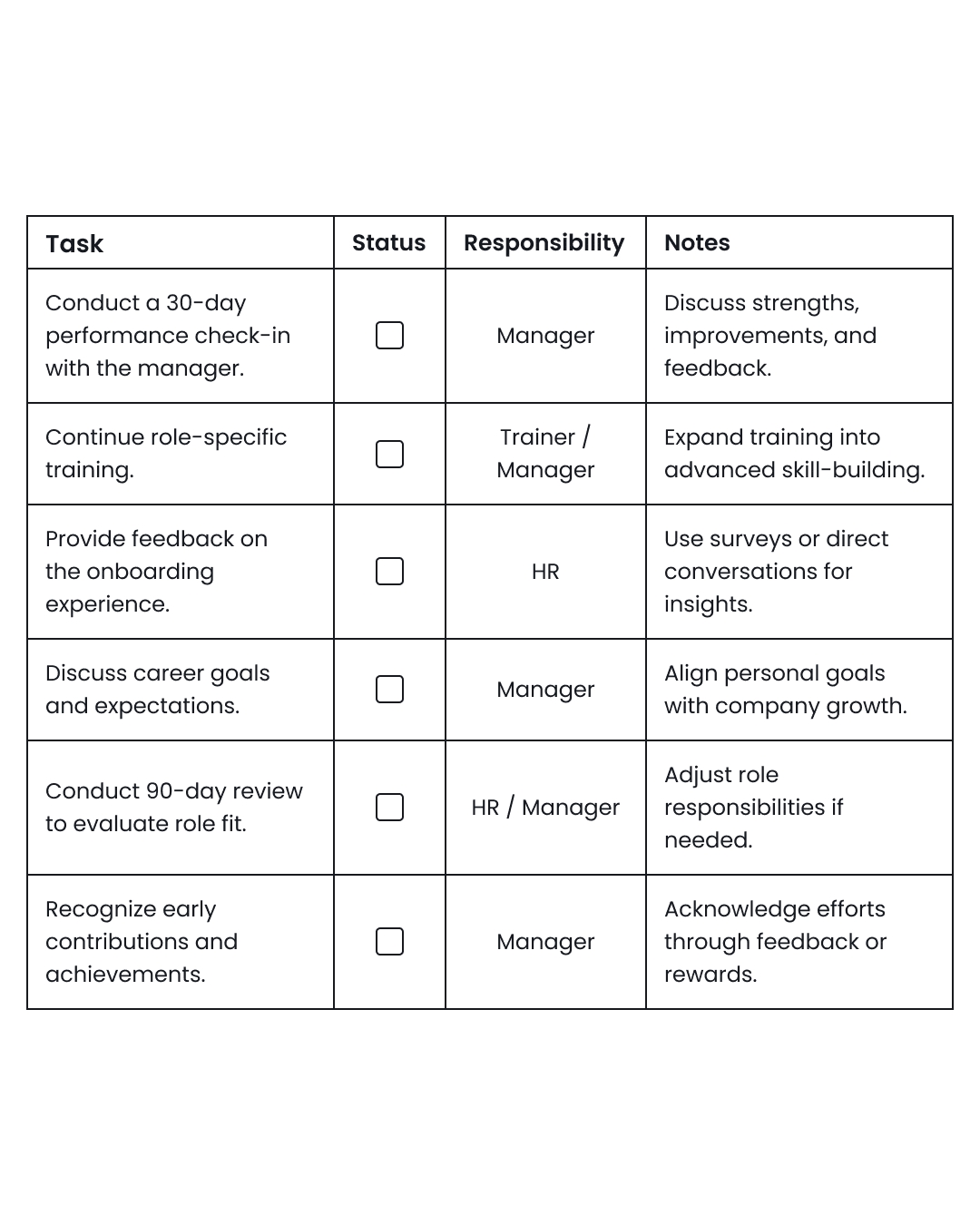
First 30-90 days: Performance and development
This phase transitions the new hire from learning mode to contributing mode. The 30-90 day window is where onboarding shifts from HR-managed to manager-managed – with structured milestones replacing daily hand-holding.
- Set formal 30, 60, and 90-day goals aligned to role responsibilities and team priorities
- Conduct structured feedback sessions at each milestone – not just informal check-ins
- Encourage cross-department exposure to build a broader understanding of the business
- Ask the onboarding buddy to check in at least once per week through the 60-day mark
- Identify skill gaps early and connect the new hire to learning resources before they affect performance
A pattern I keep seeing in high-performing teams: the 30-day review is not a performance evaluation. It is a two-way conversation about what the new hire needs to succeed. Teams that frame it this way see significantly higher 90-day retention compared to those that treat it as a one-way status check.
Template: First 30-90 days onboarding checklist
First 12 months: Long-term retention and growth
Reaching the 90-day mark does not mean onboarding is complete. The first 12 months are where organizations either convert a new hire into a long-term contributor or lose them to disengagement.
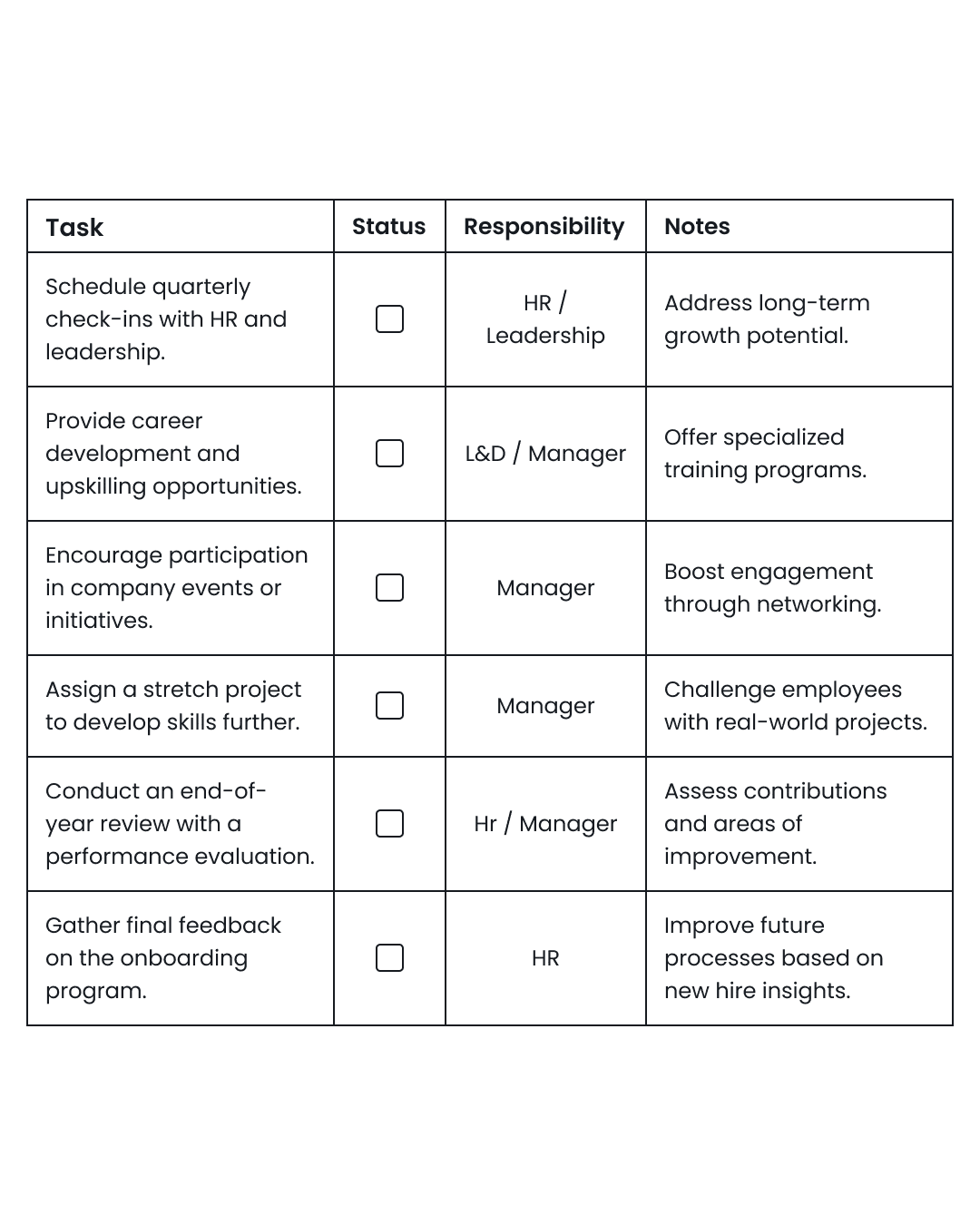
- Schedule quarterly check-ins for the full first year – not just monthly in the first 90 days
- Assign meaningful projects that challenge the new hire and increase their visibility within the team
- Connect new hires to upskilling resources aligned to their development goals and career path
- Gather structured feedback at the 6-month and 12-month mark to improve future onboarding programs
- Recognize early milestones: 30-day completion, first project delivery, and the 90-day review
Template: First 12 months onboarding checklist
How do you measure onboarding success?
Most organizations treat onboarding as done once a new hire completes their paperwork and first-week tasks. Companies that outperform on retention treat it as a program with trackable outcomes at every phase.
1. 90-day retention rate
The percentage of new hires still active at 90 days. SHRM benchmarks this at 85% or higher. If your 90-day retention falls below this, the onboarding program itself is likely a contributing factor – not just hiring decisions.
2. Time to full productivity
How many days it takes for a new hire to perform at the expected level for their role. SHRM research suggests 8 to 12 months is typical. Tracking this against a department benchmark identifies exactly where the onboarding program is causing delays.
3. New hire satisfaction score (eNPS)
Survey new hires at 30, 60, and 90 days: how likely are you to recommend this company as a place to work? An onboarding eNPS above 40 signals a healthy program. Below 20 requires immediate review of the onboarding structure.
4. Onboarding completion rate
The percentage of new hires who complete all scheduled onboarding tasks on time. A completion rate below 95% indicates tasks that are being skipped, delayed, or not communicated clearly.
Metric | What to Track | Target Benchmark |
|---|---|---|
90-day retention rate | % of new hires active at 90 days | Above 85% (SHRM) |
Time to full productivity | Days from start to meeting role performance standard | 30-90 days (role-dependent) |
New hire eNPS | Satisfaction survey at 30, 60, 90 days | Above 40 |
Onboarding completion rate | % completing all tasks on schedule | Above 95% |
With Testlify, HR teams can add a fifth layer: comparing pre-hire assessment scores to 90-day performance data to identify whether assessment results predicted onboarding success. Over 1,500 hiring teams globally use this feedback loop to continuously improve both their assessment criteria and their onboarding design.
Pro Tip: Run your 90-day retention data by department, not just company-wide. A company average of 80% can mask a single team at 55% – which usually points to a specific manager gap or a broken onboarding handoff, not a company-wide program failure.
What are the risks of poor onboarding?
A poorly structured onboarding process creates compounding problems. New hires who lack clear role expectations, proper tool access, or structured training take significantly longer to contribute at the level they were hired for.
Compliance risk compounds this. New hires who are not clearly briefed on workplace policies, payroll procedures, and regulatory requirements create legal exposure – especially in healthcare, financial services, and any regulated industry where documentation gaps carry direct liability.
The long-term cost is employer brand damage. According to the Bureau of Labor Statistics, US employers spend over $1 trillion annually on employee turnover. A meaningful portion is driven by poor onboarding experiences – employees who leave before 90 days rarely do so because of the role itself. They leave because they never received the support they needed to succeed.
Glassdoor data confirms the downstream recruiting impact: employees with a frustrating onboarding experience are significantly more likely to post negative employer reviews. Organizations that gain a reputation for poor employee retention see higher cost-per-hire and longer time-to-fill on subsequent roles – turning one onboarding failure into a recurring recruiting cost.
Key Takeaway: Poor onboarding is not just a retention problem. It is a recruiting problem, a compliance problem, and a productivity problem simultaneously. A structured checklist addresses all three at a fraction of the cost of replacing one employee.
How does Testlify help assess and support new hire performance?
In my work with HR teams, the most common onboarding blind spot is treating pre-hire assessment and post-hire onboarding as separate programs. They are not. The skills and behavioral data collected during hiring are the most accurate baseline available for personalizing onboarding.
A candidate who scored high on autonomous problem-solving may need less structured guidance in week one and more stretch assignments in weeks two through four. A new hire who demonstrated strong technical ability but lower cross-functional communication should receive team integration activities earlier in the onboarding timeline. This kind of personalization is only possible when hiring and onboarding share a data layer.
Testlify connects these two phases directly. With 3,500+ assessments across 4,500+ job roles and 50+ industries, HR teams build pre-hire baselines that flow into onboarding plans. The platform connects with 100+ ATS tools so assessment data reaches your existing HR stack without manual transfer. Teams using Testlify report a 55% reduction in time-to-hire and a 94% candidate satisfaction rate.
If you want to see how Testlify assessment data can reduce your 90-day turnover, explore Testlify’s assessment library and build your onboarding baseline from your next hire forward.
Frequently asked questions (FAQs)

Content Writer
Yashika Khandelwal is a Content Writer with 3+ years of experience creating research-backed content on hiring, talent assessment, and HR technology. She is a registered Organizational Psychologist and subject matter expert who combines behavioral science with practical recruitment insights to produce accurate, evidence-based content.
LinkedInRelated resources
View all
HR & recruitment
On-demand recruitment: what it is, how it works, and when to use it (2026)
![Employee evaluation forms: How to create one [Free templates]](/api/media/file/Employee-evaluation-forms-2.png?dpl=dpl_9Ai1hrmD1YZ8yPSLhy5MhtJd5zy3)
HR & recruitment
Employee evaluation forms: How to create one [Free templates]

HR & recruitment
Writing Assessments for Hiring: Identify Top Talent

HR & recruitment
Affiliative leadership: Importance, tips and benefits

HR & recruitment
HR hiring cycle: steps, tools, and best practices

HR & recruitment
Understanding Key Responsibility Areas in recruitment
Get started.
Hire on proof, not resumes.
Run your first skills-based assessment free — no credit card required.