
Interview to hire ratio: A complete guide for hiring teams
Discover how to calculate, improve, and optimize your interview to hire ratio. Learn industry benchmarks, common mistakes, and proven recruitment strategies.

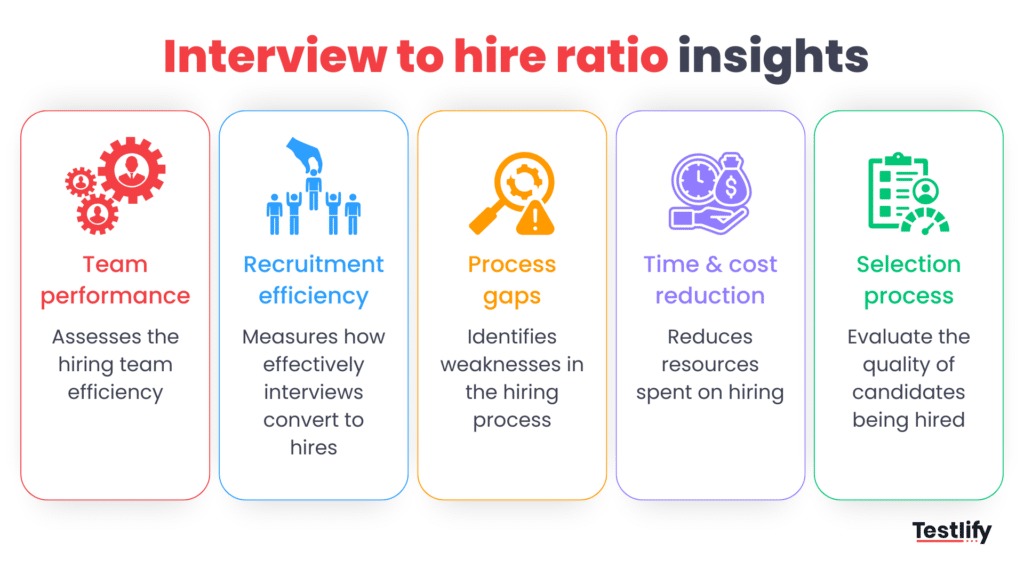
Recruiters feel a bad interview to hire ratio long before they measure it: back-to-back interviews, a hiring manager who keeps saying “close, but no,” and a role that will not close. The interview to hire ratio is the number that puts that pain into a figure. It is the total interviews your team runs divided by the hires you actually make, and it tells you how much interviewing effort each hire really costs.
Track it well and it becomes an early warning system for a broken funnel. Ignore it and you keep paying for interviews that were never going to end in a hire. This guide covers the formula, what a good and average ratio looks like, industry benchmarks, the related ratios most teams confuse, and the moves that bring a high ratio back down.
 ChatGPT
 Gemini
 Claude
 Grok
Grok Perplexity
TL;DR
- The interview to hire ratio is total interviews divided by total hires. Run 40 interviews for 8 hires and your ratio is 5:1.
- A good ratio for most roles sits between 3:1 and 5:1. Technical and leadership roles run higher, and that is normal.
- A rising ratio is rarely an interview problem. It is usually weak screening upstream, so fix the shortlist before you touch the interview loop.
- Interview to hire, interview to offer, applicant to hire, and selection ratio each measure a different stage. Confusing them hides where candidates actually drop.
- Assessments that score skills before the first call are the single biggest lever for running fewer interviews per hire.

What is the interview to hire ratio?
The interview to hire ratio is a recruiting efficiency metric that shows how many interviews your team conducts for every person you hire. You write it as interviews to hires, so a team that runs 30 interviews to land 6 hires has a 5:1 ratio. The lower the first number, the less interviewing effort each hire costs, and the tighter your screening is working.
Think of it as a fuel gauge for the middle of your funnel. It does not tell you why interviews are being wasted, but it tells you, fast, that they are. A team hiring at 4:1 one quarter and 9:1 the next has not suddenly forgotten how to interview. Something upstream changed: the sourcing, the job description, or the bar the shortlist is held to.
How do you calculate the interview to hire ratio formula?
Divide the total number of interviews conducted by the number of hires made in the same window. The formula is simple, and that is the point: interview to hire ratio equals total interviews divided by total hires. Keep the interview count consistent, so decide up front whether a two-round loop counts as one interview or two, and apply that rule every time.
The formula is: Interview-to-Hire Ratio = Total Interviews ÷ Total Hires
Here is a worked example. Say a mid-market SaaS company spends a quarter hiring for a customer success team. They run 45 first-round interviews and 30 second-round interviews, so 75 interviews in total, and they close 10 hires. The math is 75 divided by 10, which is a 7.5:1 ratio. That is high for a customer success role, and it points straight at a shortlist that was not screened hard enough before people reached a live interview.
Track the ratio per role and per quarter, not as one company-wide average. A single hard-to-fill engineering search at 15:1 can drag the whole number up and hide the fact that every other team is hiring cleanly at 4:1.
What is a good interview to hire ratio?
A good interview to hire ratio for most roles sits between 3:1 and 5:1, meaning three to five interviews for every hire. Below 3:1 and you may not be evaluating candidates thoroughly enough. Above 5:1 and you are probably interviewing people who should have been screened out earlier. The honest answer, though, is that a “good” number depends on the role.
Interview Rate = (Number of candidates interviewed ÷ Number of applicants) × 100
Senior, technical, and leadership roles carry a higher ratio because they need more evaluation, and that is fine. A 3:1 target on a VP search would mean rushing a decision you should not rush. The better test is direction of travel: is a given role’s ratio falling quarter over quarter as your screening improves? That trend matters more than hitting a textbook number.
What is the average interview to hire ratio?
Across most industries the average interview to hire ratio lands between 3:1 and 5:1. Technical and executive roles push well past that, often 8:1 or higher, while high-volume frontline hiring tends to run leaner. For a sense of scale on the offer stage, NACE’s 2025 college recruiting benchmarks put the interview to offer rate near 47.5 percent, which works out to roughly two interviews per offer before a candidate even decides.
Averages are a starting point, not a target. Your own past quarters are the more useful benchmark, because they hold your roles, your markets, and your hiring bar steady. An outside average cannot do that, so use it to sanity-check, then compare each role against its own history.
What are good interview to hire ratio benchmarks?
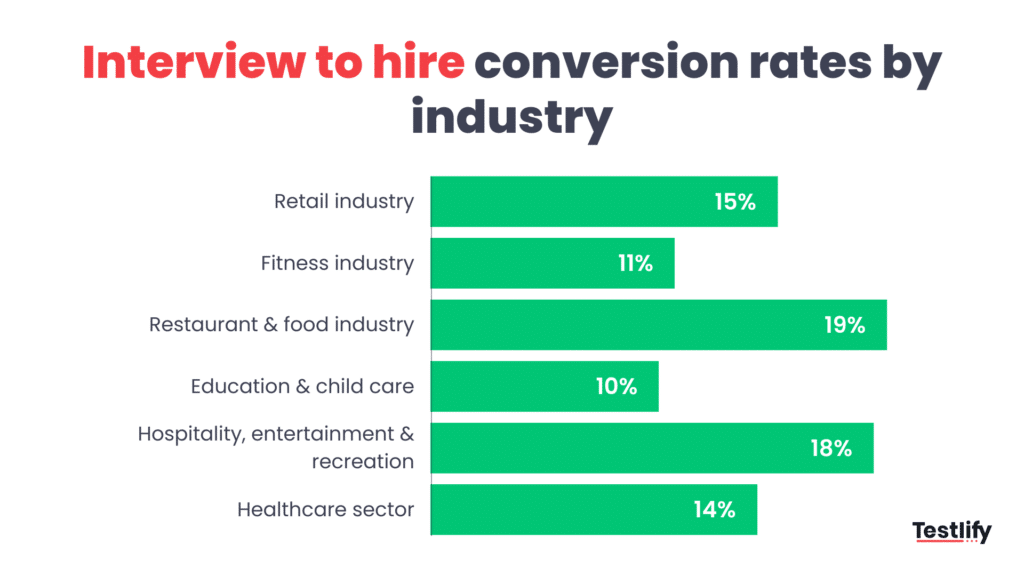
Benchmarks shift by sector because the work, the talent supply, and the number of evaluation rounds differ. Labor-market pressure moves them too. When the U.S. Bureau of Labor Statistics reports 7.6 million job openings against 5.2 million hires in a month, candidates have options, offers get declined, and ratios climb. Use the table below as a directional guide, then anchor to your own data.
Sector | Typical interview to hire ratio | Why it lands there |
|---|---|---|
High-volume frontline (retail, food service) | 2:1 to 3:1 | Fast decisions, fewer rounds, broad candidate pools |
Healthcare and personal care | 3:1 to 5:1 | Credential checks add steps but demand is steady |
Education and childcare | 3:1 to 5:1 | Structured vetting, background and reference heavy |
Corporate and professional services | 4:1 to 6:1 | Multiple stakeholders and panel rounds |
Technical and engineering | 6:1 to 10:1 | Skill screens plus system and culture rounds |
Executive and leadership | 8:1 and up | High stakes, many decision-makers, longer loops |
Which related hiring ratios should you track?
The interview to hire ratio is one number in a family of recruiting ratios, and teams routinely mix them up. Each one measures a different stage of the funnel, so the gaps between them are where the real diagnosis lives. Track them together and you can pinpoint whether candidates drop at screening, at the offer, or after the offer.
Applicant to hire ratio explained
The applicant to hire ratio measures how many applications it takes to make one hire, covering the whole top of the funnel rather than just the interview stage. A role that pulls 300 applications for 2 hires has a 150:1 applicant to hire ratio. A high number here is not always bad, but paired with a high interview to hire ratio it usually means your sourcing is wide but not well-targeted, so unqualified applicants are reaching interviews they should never have reached.
Selection ratio: definition and formula
The selection ratio is the number of people hired divided by the number who applied, so it is the mirror image of the applicant to hire ratio. The selection ratio formula is hires divided by applicants: hire 5 out of 100 applicants and your selection ratio is 0.05. It matters because a lower selection ratio gives assessments more room to add value. When you are choosing a small number from a wide pool, the quality of your selection process is what separates a strong hire from an average one.
What factors influence your interview to hire ratio?
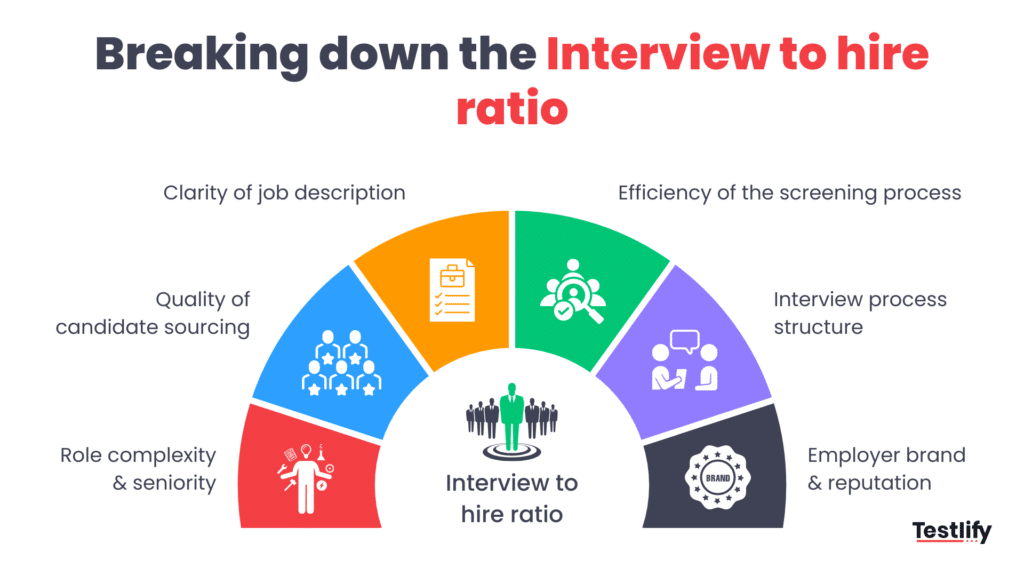
A high ratio is a symptom, and several upstream factors cause it. Knowing which one is driving your number tells you where to spend your effort instead of guessing.
- Role complexity and seniority. Senior and specialized roles genuinely need more rounds, so a higher ratio here is expected, not a red flag.
- Quality of sourcing. Wide, untargeted sourcing floods the top of the funnel and pushes weak candidates into interviews.
- Clarity of the job description. A vague description attracts mismatched applicants and wastes interview slots on the wrong people.
- Strength of pre-interview screening. Weak screening is the most common cause of a bloated ratio, because unqualified candidates reach a live interview.
- Interview structure. Inconsistent, unstructured interviews produce mixed signals, so teams add more rounds to feel sure.
- Employer brand and market conditions. In a tight market, more offers get declined, which quietly inflates the ratio without any drop in your interviewing.
How do you run fewer interviews per hire?
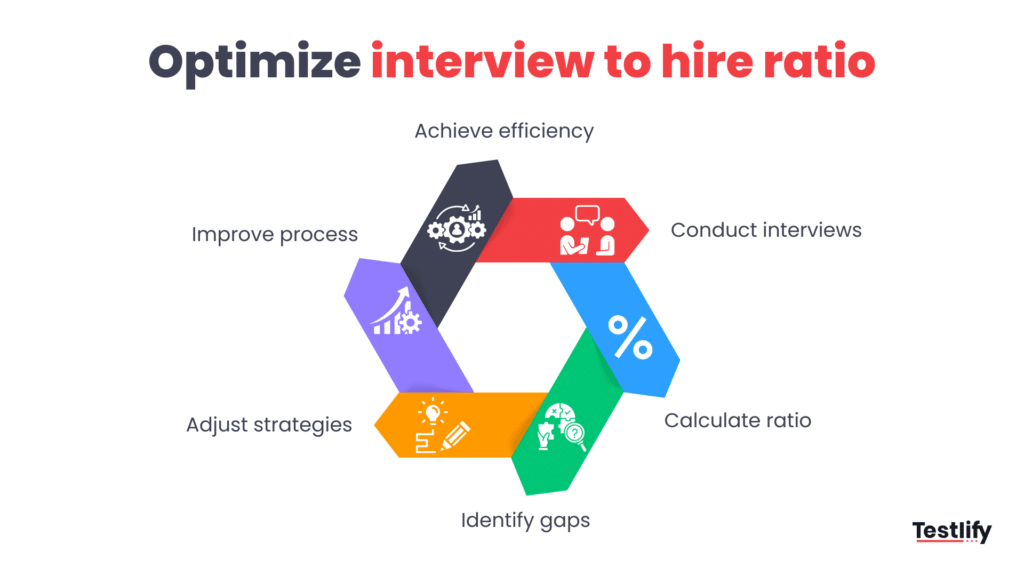
Running fewer interviews per hire is not about interviewing faster. It is about making sure the people who reach an interview are genuinely worth the hour. The single biggest lever is moving your evaluation earlier, so the shortlist is already ranked on evidence before anyone joins a call. These steps, in order, do the most work:
- Screen skills before the first interview. A short, role-specific assessment filters out candidates who cannot do the core work, so interviews are spent on real contenders. This one change moves the ratio more than anything else.
- Write the job description around evidence. State the two or three skills that actually predict success, then screen for exactly those. Clear roles attract better-matched applicants.
- Structure every interview. Ask the same core questions and score against the same rubric, so one strong round replaces two fuzzy ones.
- Target sourcing over volume. Fewer, better-fit applicants beat a flood of loosely-matched ones every time.
- Standardize scoring across reviewers. When everyone rates against shared criteria, the team reaches a confident decision in fewer rounds.
This is where the Testlify Competency-to-Evidence Matrix earns its place. Instead of starting with a test, it starts with the role: map each competency that matters to a measurable piece of evidence (an assessment, a work sample, a structured interview question), then hold every candidate to that same map. The interview stops being a discovery exercise and becomes a confirmation of evidence you already have, which is exactly how you run fewer rounds without lowering the bar.
Pro tip: Before you add an interview round to feel more certain, ask what specific question that round answers that an assessment could answer better. Most “extra” rounds exist to catch a skills gap that a 20-minute skills test would have caught for free. Add evidence upstream, not interviews downstream.
What mistakes inflate your interview to hire ratio?
Some habits push the ratio up without anyone noticing, because each one feels responsible in the moment. These are the usual culprits worth auditing first.
- Treating the interview as the first real filter. If the interview is where you first check whether someone can do the job, you will interview a lot of people who cannot.
- Adding rounds to buy confidence. A fourth interview rarely tells you more than a well-designed second one did. It just costs more time.
- No shared scorecard. Without common criteria, reviewers disagree, and the fix teams reach for is another round.
- Chasing volume in sourcing. More applicants is not the goal. More of the right applicants is.
- Ignoring the offer stage. If offers keep getting declined, the ratio rises even though your interviewing is fine. Read it alongside the offer-acceptance rate.
The cost of getting this wrong is real. The Society for Human Resource Management puts the average cost per hire near 4,700 dollars, and every wasted interview loop stacks recruiter and hiring-manager hours on top of that. Turnover from a rushed, low-evidence hire costs far more: Gallup estimates that replacing an employee runs from one-half to two times that person’s annual salary. A tighter ratio is not a vanity metric. It is money and hours you keep.
Screen for the skill before you book the interview
The fastest way to fix a bloated interview to hire ratio is to stop interviewing people who were never a fit. Testlify scores candidates on the exact skills a role needs before the first call, so your shortlist is ranked on evidence, not a resume. Start free and cut the interviews you never needed to run.
Key takeaways
- The ratio is a diagnostic, not a scoreboard. Interviews divided by hires tells you how much interviewing effort each hire costs, and a rising number is your earliest signal that the funnel is leaking upstream. Watch the trend per role, because that is what you can actually act on.
- Aim for 3:1 to 5:1, but respect the role. Frontline hiring should run leaner and executive searches will run higher. A ratio falling quarter over quarter beats hitting any textbook figure.
- The fix is almost never in the interview room. A bloated ratio usually traces back to weak screening, loose job descriptions, or untargeted sourcing. Fix the shortlist and the interview count drops on its own.
- Read the ratios as a set. Interview to hire, interview to offer, applicant to hire, and selection ratio each expose a different stage. The gaps between them tell you exactly where candidates fall out.
- Evidence before conversation is the biggest lever. Skills assessments that rank candidates before the first call are the most reliable way to run fewer, better interviews and protect the roughly 4,700 dollars each hire already costs.
Frequently asked questions
What is selection ratio and what is its formula?
Selection ratio is the percentage of applicants who are selected or hired from the total number of applicants considered for a role. It helps recruiters understand how selective their hiring process is.
Formula:
Selection Ratio = (Number of Candidates Selected ÷ Total Number of Applicants) × 100

B2B SaaS Content Writer
Rishav Kumar is a B2B SaaS content writer with 4 years of experience. He loves crafting engaging content. Always exploring fresh ideas, he's passionate about helping businesses grow through impactful writing.
LinkedInRelated resources
View all
HR & recruitment
Revenue per FTE: Formula, Benchmarks, and How to Improve It

HR & recruitment
What is job restructuring and how to do it?

HR & recruitment
Cost-effective employee training solutions: using SCORM-compliant authoring tools to create E-learning courses

HR & recruitment
7 tips on recruiting students for HR professionals

HR & recruitment
HR budget 101: A comprehensive guide for 2026

HR & recruitment
16 innovative recruitment strategies in 2026
Get started.
Hire on proof, not resumes.
Run your first skills-based assessment free — no credit card required.