
What is 360 recruitment? A guide for recruiters and TA teams
360 recruitment puts one recruiter in charge of a hire from intake to onboarding. See the stages, 360 vs 180, and when the model fits.
Every handoff in a hiring process is a place where context gets lost. 360 recruitment removes those handoffs by giving one recruiter ownership of a role, from the first intake conversation to the new hire's first weeks.
This guide explains how 360 recruitment works, how it compares with 180 and 270 models, and when it fits your team. You will get the stages, the metrics and the tools that keep a full desk manageable.
TL;DR:
- 360 recruitment gives one recruiter ownership of a hire from intake to onboarding, so context from the first brief is never lost in a handoff.
- The difference from 270 and 180 models is scope: a 360 recruiter also wins the client or requisition, while 180 and 270 recruiters start later in the process.
- The six stages are preparing, sourcing, screening, selecting, hiring and onboarding. Agencies add winning the client before them.
- One owner per hire improves candidate experience and accountability, but it raises the risk of burnout and a single point of failure.
- The model fits complex, senior or niche roles with a manageable requisition load. Split the work for high-volume hiring or new recruiters.
- Track one metric per stage, and use skills tests and automation at screening so a full desk stays manageable.
 ChatGPT
 Gemini
 Claude
 Grok
Grok Perplexity
What is 360 recruitment?
360 recruitment is full cycle recruitment: one recruiter, or one small recruiting pod, runs every step of a hire instead of passing the candidate between specialists. The name comes from the full circle the recruiter covers, from the hiring need back to a settled new employee.
Other names for the same model are full cycle recruiting, full desk recruitment and life cycle recruiting.
The term means slightly different things depending on where you sit:
- In a recruitment agency, a 360 recruiter does business development (finding and winning clients) and delivery (finding and placing candidates). The client relationship and the candidate relationship sit with the same person.
- In an in-house talent acquisition team, there is no client to win. Full cycle recruiting means the recruiter owns the requisition from the intake meeting with the hiring manager to onboarding, without separate sourcers or interview coordinators.
In both cases the defining feature is the same: one accountable owner, and no handoffs inside the process.

What does a 360 recruiter do?
A 360 recruiter manages every task a hire needs and is the single point of contact for both the hiring side and the candidate. In practice the job splits into relationship work and process work.
Area | Agency 360 recruiter | In-house full cycle recruiter |
|---|---|---|
Winning the work | Prospects, pitches and signs clients, agrees fees | Takes the requisition from the hiring manager |
Intake | Takes the job brief from the client | Runs the intake meeting, agrees must-haves |
Sourcing | Database, job boards, LinkedIn, referrals | Careers site, ATS talent pool, referrals, outreach |
Screening | Calls, CV review, skills checks | Resume review, qualifier questions, skills tests |
Interviews | Preps candidates, books client interviews | Schedules panels, collects scorecards |
Offer | Negotiates salary and terms for both sides | Builds the offer with the hiring manager and HR |
After the start | Checks in during the guarantee period | Hands over to onboarding, checks in at 30 and 90 days |
The skills follow from that list: sales and negotiation, sourcing, interviewing, organization across many open roles, and steady communication. LinkedIn's Future of Recruiting 2025 report found employers were 54 times more likely to list relationship development as a required recruiter skill than a year earlier, which is the core of the 360 role.
What is the difference between 360, 270 and 180 recruitment?
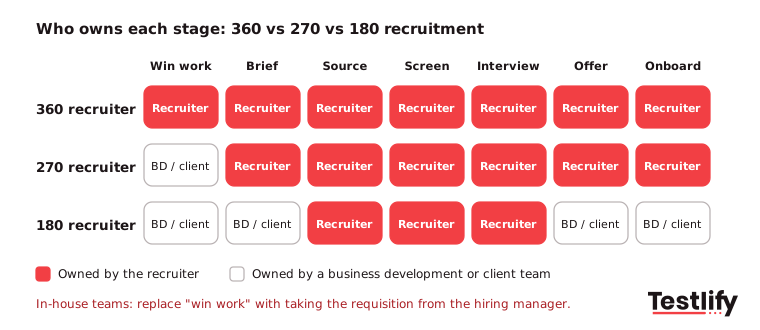
360, 270 and 180 recruitment differ in how much of the process one recruiter owns. A 360 recruiter owns everything from winning the work to onboarding.
A 180 recruiter owns one half, usually candidate delivery while someone else handles clients. A 270 recruiter takes over after a business development lead has won the client and owns the rest.
Factor | 360 recruitment | 270 recruitment | 180 recruitment |
|---|---|---|---|
Who wins the client or requisition | The recruiter | A BD lead or account manager | A separate BD or client team |
Who works with candidates | The recruiter | The recruiter | The recruiter (delivery) |
Handoffs per hire | None | One, at the job brief | One or more |
Client or hiring manager relationship | Deep, direct | Shared | Indirect |
Workload per recruiter | Highest | High | Lower, more focused |
Best for | Niche desks, senior and complex roles, small agencies | Agencies with a sales team, mid-size TA teams | Large agencies, high-volume hiring, new recruiters |
Main risk | Burnout, single point of failure | Gaps between BD and delivery | Lost context between client and candidate |
In-house teams use the same idea under different labels. A "180" setup there means a sourcer finds candidates and a recruiter or coordinator takes them from screening onward, while a full cycle recruiter keeps the whole requisition.
What are the stages of the 360 recruitment process?
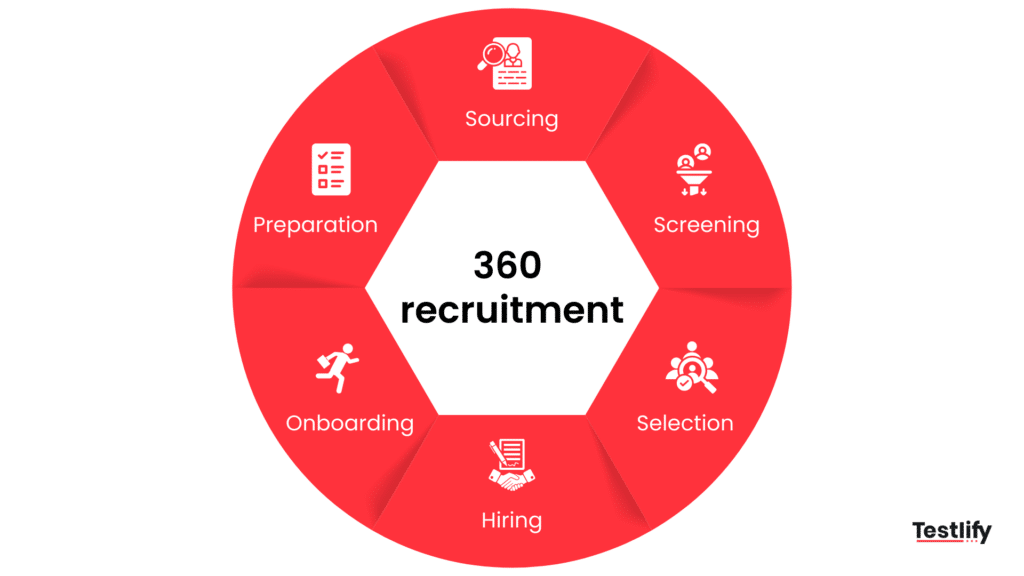
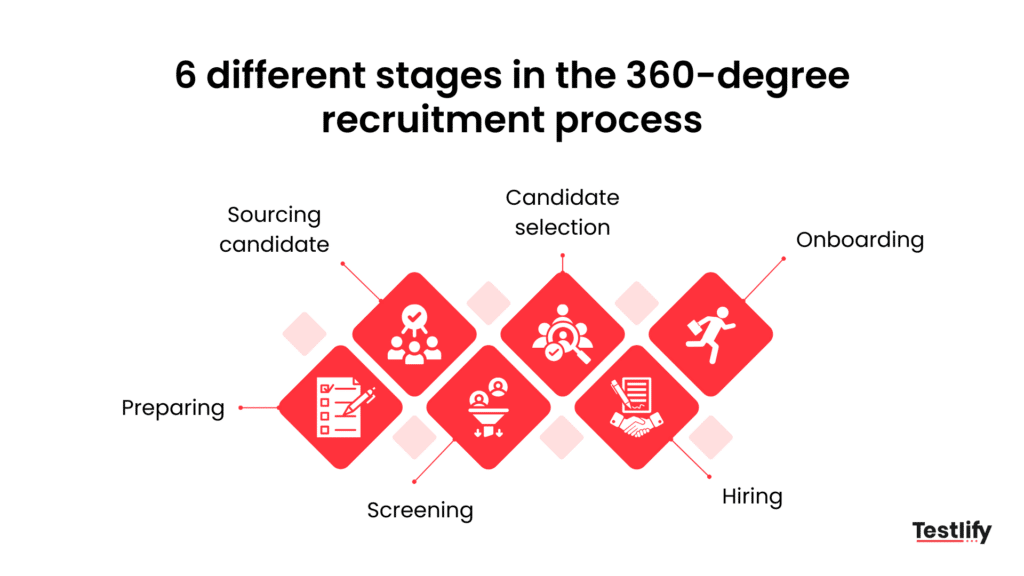
The 360 recruitment process has six stages: preparing, sourcing, screening, selecting, hiring and onboarding. Agency recruiters add a stage before these, winning the client, and many teams add a short review after the hire to feed lessons into the next role.
1. Preparing
Preparing turns a vague need into a clear brief. Sit with the hiring manager or client and agree the outcomes of the role, three to five must-have skills, the salary range and the interview plan before anything is posted.
Then write the job post from that brief. Free job description templates help you start fast.
2. Sourcing
Sourcing builds the pool. Post the role, search your ATS for past applicants who came close, ask for employee referrals and reach out directly on LinkedIn for scarce skills.
Internal candidates often move fastest. Our guide on how to source candidates for your talent pool covers each channel.
3. Screening
Screening cuts the pool to people who can do the job. Start with qualifier questions on hard requirements, then review resumes against the brief and add a short skills test so the shortlist rests on evidence, not on how polished a CV looks.
See resume screening tips for recruiters.
4. Selecting
Selecting compares the shortlist fairly. Use structured interviews with the same questions and a shared scorecard for every candidate, collect feedback within a day, and run reference and background checks before the decision.
Keep every candidate updated, including the ones who will not move forward.
5. Hiring
Hiring is the offer and the close. Put salary, benefits, hours, location and start date in writing, expect some negotiation, and keep the runner-up warm until the offer is signed.
Tell unsuccessful finalists personally and keep them in your talent pool for the next opening.
6. Onboarding
Onboarding is where the 360 recruiter's continuity pays off, because the new hire already knows and trusts them. Hand over the context you gathered to the manager, check in during the first week, then at 30 and 90 days, and flag problems early.
The employee onboarding process guide has a full checklist.
Pro tip: At the end of every hire, write three lines in the requisition: what slowed it down, which source produced the hire, and what the hiring manager would change. A full cycle recruiter is the only person who sees the whole process, so those notes are the cheapest process improvement you will get.
What are the benefits of 360 recruitment?
360 recruitment gives each hire one accountable owner, which removes handoff delays and keeps context from the intake meeting all the way to the first day. Candidates and hiring managers deal with one person who knows the full story.
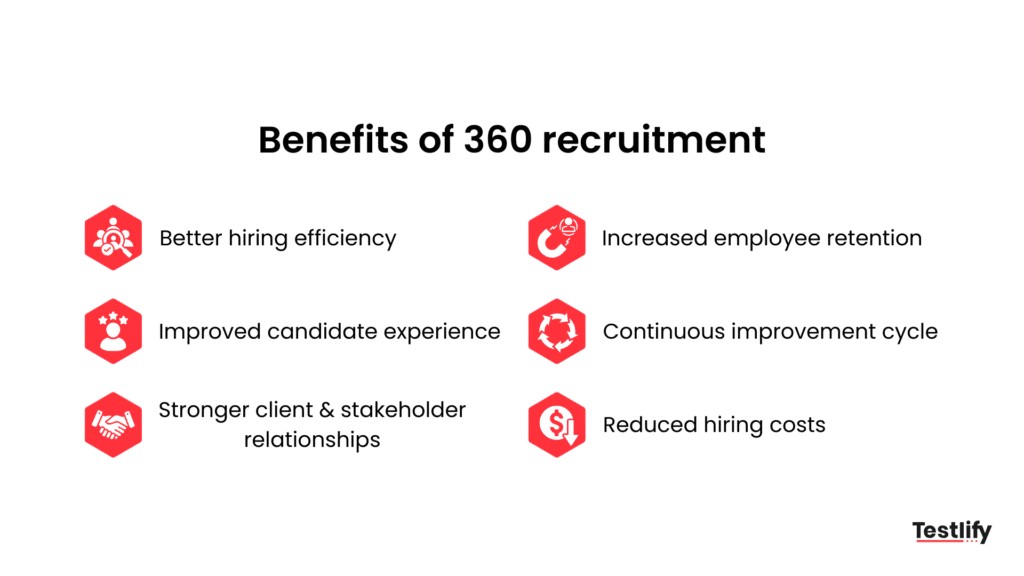
- Better hiring efficiency: 360 recruitment simplifies the hiring process under a single recruiter, which improves communication, reduces delays and speeds up the hiring timeline.
- Improved candidate experience: With one point of contact throughout, candidates get a more personal and cohesive experience. This builds engagement and makes it easier to assess suitability.
- Stronger client and stakeholder relationships: Consistent communication helps recruiters understand the needs and preferences of clients and stakeholders. This leads to more productive partnerships and better placements.
- Increased employee retention: Being involved from sourcing to onboarding helps identify culture-fit candidates. This supports higher retention and lower turnover.
- Continuous improvement cycle: 360 recruitment encourages regular feedback and review of hiring practices. Those lessons refine future recruitment efforts.
- Reduced hiring costs: One recruiter managing the whole process can cut the costs of involving multiple recruiters or external agencies, which makes better use of resources.
What are the challenges of 360 recruitment?
360 recruitment concentrates a lot of work and judgment in one person, so its weak points are workload, depth and consistency. Most of them grow as the number of open roles per recruiter rises.
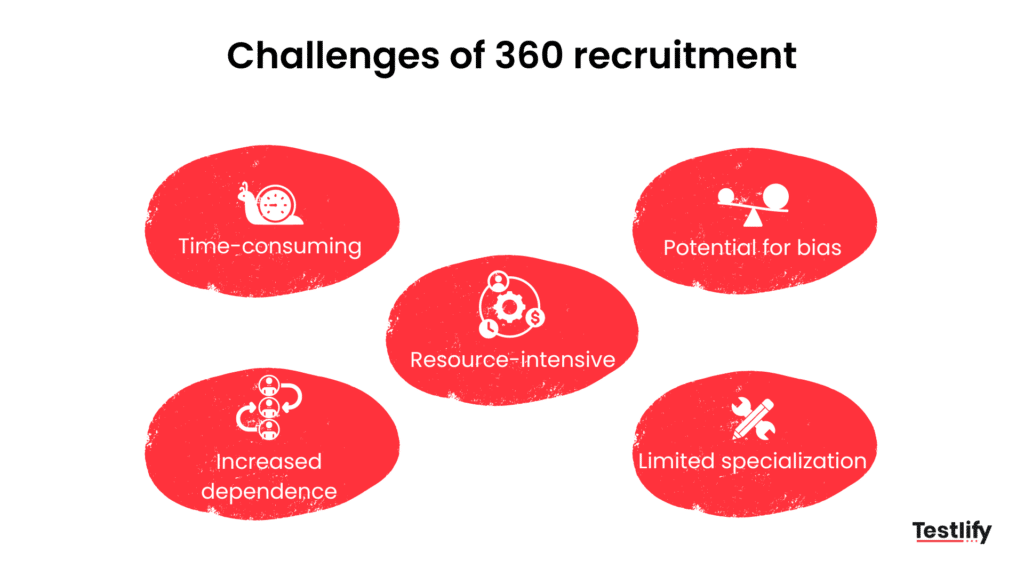
- Time-consuming: Handling the whole recruitment process from start to finish takes a lot of time. This is especially true for challenging roles or when you need to hire many people at once.
- Resource-intensive: A 360 recruiter needs skills in everything from sourcing and interviewing to negotiating offers and onboarding. This takes significant training and resources to do well.
- Potential for bias: When one person runs every stage, unconscious bias can creep in. It can affect who gets interviewed or hired and weaken diversity and inclusion efforts.
- Limited specialization: A 360 recruiter is often a generalist and may lack deep knowledge of specific roles. Hiring for highly technical positions such as data scientists can need specialist knowledge, which can affect hiring quality.
- Increased dependence: Relying on a single person creates bottlenecks. If that recruiter is overloaded or away, the hiring timeline slips and the team or organization feels the delay.
When does 360 recruitment make sense?
360 recruitment makes sense when roles are complex, the hiring manager relationship matters, and each recruiter carries a manageable number of open requisitions. A split model makes more sense for high-volume hiring of similar roles or when recruiters are new to the job.
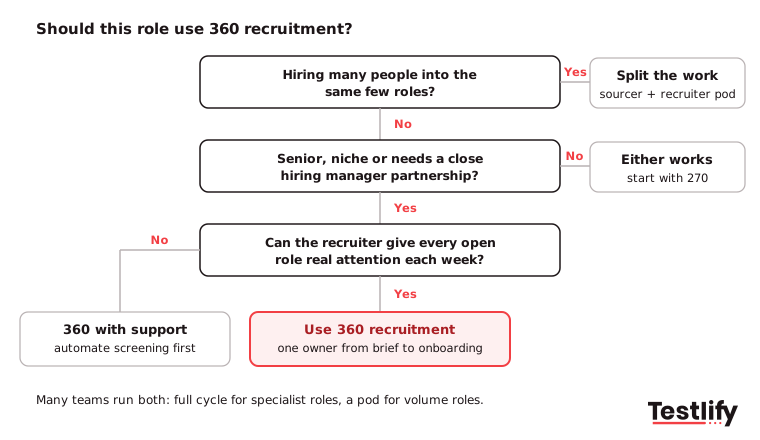
Use full cycle recruitment when:
- Roles are senior, niche or hard to fill, and the brief needs a lot of judgment.
- The hiring manager or client wants one trusted partner.
- Each recruiter can give every open role real attention each week.
Split the work (180 or a sourcer plus recruiter pod) when:
- You hire many people into the same few roles, such as contact center or retail.
- Requisition loads keep climbing and time-to-fill is slipping.
- Your team has new recruiters who need to learn one stage well first.
Many teams run both: full cycle for specialist and leadership roles, and a pod with shared sourcing and automated screening for volume roles.
Which metrics show 360 recruitment is working?
360 recruitment is working when hires happen faster, offers are accepted, and new hires stay and perform. Because one person owns the whole hire, you can track a small set of metrics per recruiter and per stage.
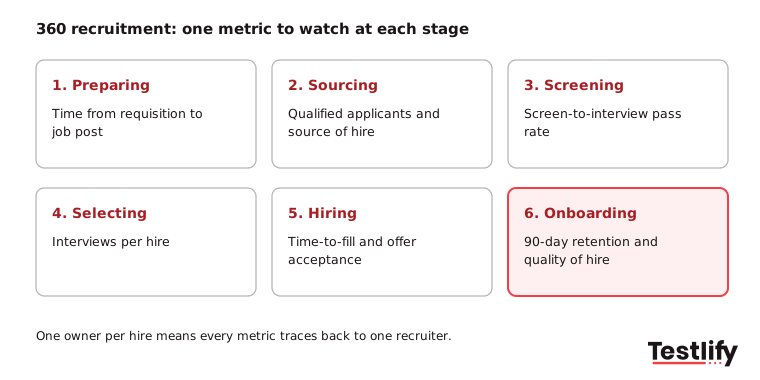
For a baseline, SHRM puts the median time-to-fill for nonexecutive roles at 39 calendar days. Quality of hire is harder: LinkedIn reports 89% of talent acquisition professionals expect it to matter more, yet only 25% are highly confident they can measure it.
The quality of hire calculator gives you a starting score.
How can technology make 360 recruitment workable at scale?
Technology makes 360 recruitment workable by taking the repetitive tasks off the recruiter's desk, so the time goes to briefs, judgment and relationships. Screening, scheduling and first-round evaluation are the stages that gain the most.
AI use is rising fast. SHRM's 2025 Talent Trends found AI use in HR tasks rose to 43% in 2025 from 26% a year earlier, while 69% of organizations still struggle to fill full-time roles.
LinkedIn reports that recruiters using generative AI save about 20% of their work week, and 93% of talent acquisition professionals say accurately assessing skills is crucial for quality of hire.
For a full cycle recruiter, the useful tools are:
- An ATS with a shared talent pool, so past finalists are one search away for the next role.
- Skills assessments at the screening stage, so the shortlist is ranked on evidence. Testlify offers 3,500+ tests across technical and non-technical roles, with 20+ proctoring checks and support for 15+ languages. Browse the test library.
- AI resume screening, which scores applicants against the role and labels them as high, medium or low fit, with the recruiter making the final call. See the AI resume screener.
- Integrations, so scores and stages sync back to the ATS instead of living in spreadsheets. Testlify connects with 100+ ATS and HRIS tools through its integrations.
## Final thoughts
360 recruitment works best when one recruiter keeps the relationships and the judgment, and tools carry the repetitive volume.
Give each full cycle recruiter a manageable requisition load, the same structured checks for every candidate and one metric per stage. The model then scales further than most teams expect.
Ready to see it in action? Find out how Testlify supports full cycle recruiters with skills tests and AI interviews. Book a demo with our team.
Frequently asked questions (FAQs)

Related resources
View all
HR & recruitment
What is a competency framework and how to develop one?
HR & recruitment
HR Digital Transformation: A 2026 Guide for HR Leaders
HR & recruitment
Talent Lifecycle: 5 Stages and HR’s Role (2026 Guide)
HR & recruitment
The five main responsibilities of a human resources director

HR & recruitment
100 key recruitment statistics to hire better in 2026
HR & recruitment
What is an internal talent marketplace and how does it work?
Get started.
Hire on proof, not resumes.
Run your first skills-based assessment free — no credit card required.