
OpenAI interview process: Steps, timeline, and questions
OpenAI hires top 1% talent. With multiple interview rounds, hands-on tasks, & skill tests, learn OpenAI’s interview process.
The OpenAI interview process is a multi-stage, skills-first hiring loop: a resume screen, a short recruiter call, a role-specific skills assessment, then a final loop of 4 to 6 interviews, usually wrapped up in about 2 to 4 weeks. It rewards what you can actually build, not where you went to school. And the best part for hiring teams is that the structure is copyable.
OpenAI runs a small, highly selective team and competes for the same researchers and engineers as Meta, Google, and xAI. So the bar is high. But the moves underneath it, structured stages, practical skills tests, and a values check, are the same moves any recruiter can run with the right tools. This guide breaks down each stage, the questions OpenAI asks, and how to rebuild the loop for your own roles.
TL;DR
- OpenAI’s hiring runs in 4 core stages: resume screen, recruiter call, role-specific skills assessment, and a 4 to 6 interview final loop, in roughly 2 to 4 weeks.
- It is skills-first by design. Demonstrated ability beats credentials, which is why a take-home or live task sits at the center of the loop.
- Mission and values alignment is a real gate, not a formality. A culture, or founder, loop closes most processes.
- The model is repeatable: structured stages plus practical assessments plus a values check. You do not need OpenAI’s brand to run OpenAI’s method.
- Skills-first hiring pays off broadly. LinkedIn found teams running the most skills-based searches are 12% more likely to make a quality hire.
 ChatGPT
 Gemini
 Claude
 Grok
Grok Perplexity
What is OpenAI’s interview process?
OpenAI’s interview process is a decentralized, skills-first hiring loop. It starts with an online application and resume screen, moves to a recruiter call, then a role-specific skills assessment, and ends with 4 to 6 final interviews over 1 to 2 days. Teams own their own loops, so the exact steps flex by role.
That decentralization is the point. Each team tailors its assessments and interviews to the job instead of forcing every candidate through one fixed funnel. Recruiters push candidates to show skills over credentials: technical projects, research contributions, or measurable results in their domain. OpenAI hires from elite labs and top schools, but the screen is built around what you can do, not the logo on your resume.
Why does this matter for your own hiring? Because the labor market is moving the same way. The World Economic Forum’s Future of Jobs Report 2025 estimates 39% of workers’ core skills will change by 2030. When the skills underneath a role keep shifting, a resume tells you less every year, and a well-built assessment tells you more.
Beyond raw ability, mission alignment is a genuine filter. OpenAI weighs whether a candidate cares about building safe artificial general intelligence (AGI) and works well with others. The recruitment process often runs over a month for senior roles, with multiple stages testing both hard and soft skills. This mirrors Testlify's offering, instead of betting on one resume or one strong interview, you advance a candidate only when several role-relevant signals (a skills test, a coding task, a system-design round, a values conversation) point the same way. More signals, fewer bad calls. AI helps summarize and structure the evidence; people still make the decision.
Read: How to assess technical skills for tech roles
Some factors OpenAI recruiters look for across roles:
- Mission alignment and value fit. Recruiters probe for collaboration, openness to feedback, and commitment to AI safety.
- A problem-solving mindset that goes beyond textbook technical skills.
- Strong written and verbal communication and the ability to work collaboratively.
- For technical roles, strong coding, machine-learning depth, and system design, checked through hands-on tasks.
- For non-technical roles, strategic thinking, domain knowledge, and stakeholder management.
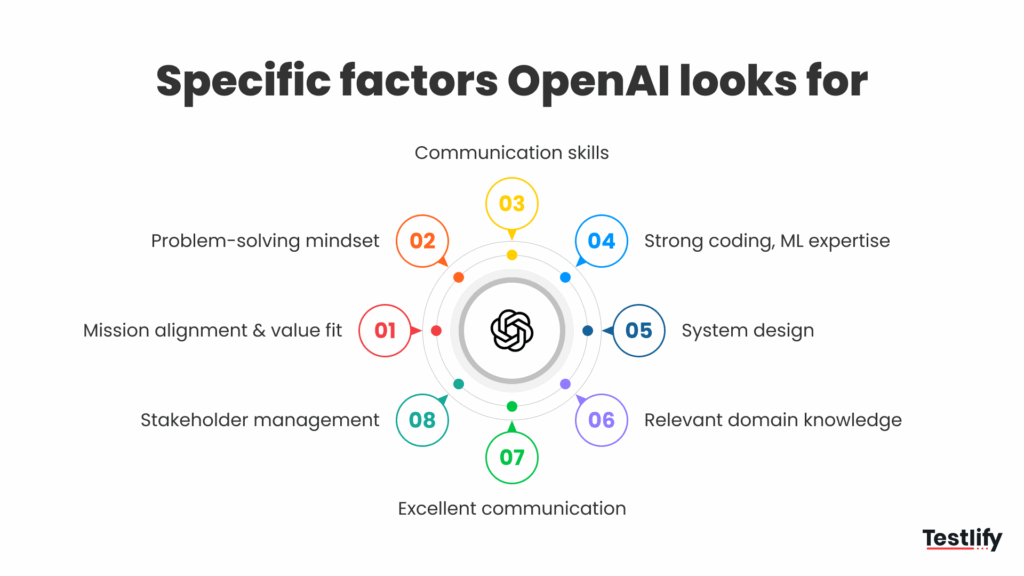
Each of these is checked with different types of skills tests and multiple interview rounds. Any recruiting team can run the same playbook by pairing skills testing with structured interview simulations.

How many stages are in the OpenAI interview process?
OpenAI’s interview process has 4 core stages: an online application and resume screen, an introductory recruiter call, a role-specific skills assessment, and an on-site or virtual final loop. Technical roles often add a separate coding or system-design round. Here is the loop at a glance before the stage-by-stage detail.
Stage | Format | Typical length | What it screens for |
|---|---|---|---|
Application and resume screen | Async review | About 1 week | Relevant experience, real projects, measurable results |
Recruiter call | Phone or video | 30 minutes | Motivation, role fit, mission understanding |
Skills assessment | Take-home, pair coding, or timed test | 1 to 2 hours | Hands-on, role-specific ability |
Final interview loop | 4 to 6 interviews, on-site or virtual | 4 to 6 hours over 1 to 2 days | Depth, system design, collaboration, values fit |
Online application and resume screening
OpenAI’s recruiting team screens resumes for relevant experience and in-hand expertise. It usually takes about a week to review applications and reply by email. Strong applications lead with proof: shipped projects, research, or numbers, not job titles.
Introductory recruiter call (30 minutes)
A recruiting coordinator schedules a 30-minute call with the recruiter or hiring manager. It covers your background, why OpenAI, your fit for the role, and how well you understand the mission. OpenAI weighs mission and values alignment heavily, often above raw credentials, so come ready to talk about why the work matters to you.
For technical roles, a separate technical phone screen of about an hour may follow. It tests data structures and algorithms, but the questions lean practical and job-relevant rather than pure LeetCode puzzles.
Pro Tip: Put the practical task before the panel, not after. A short take-home or live exercise early in the loop can filter a field of 60 applicants down to the 10 worth a live round, and it saves your interviewers hours of low-signal screening. Score it against a fixed rubric so 2 reviewers grade the same work the same way.
Skills assessment
Within about a week of applying, candidates get a short, timed skills assessment. The format varies by team: pair-coding interviews, a take-home project, or a technical test. This stage is tailored to the role and gets more domain-specific as you advance. Some teams ask for more than one assessment, and recruiters reach out to candidates who pass within a week.
On-site or virtual final loop
The final loop runs 4 to 6 hours with 4 to 6 interviewers over 1 to 2 days, virtual by default with an on-site option in San Francisco. The rounds usually include:
- Behavioral interview with a senior manager (45 minutes): your experience and how you handle hard problems.
- Presentation (45 minutes): a deep dive on a past project, its technical and business impact, the trade-offs you made, and your role versus your team’s.
- Coding interview (1 hour): in your own IDE with screen-sharing, or on a coding-assessment platform.
- System design interview (1 hour): design and architecture, often whiteboarded on a shared canvas.
- Team behavioral interview (30 minutes): collaboration and how you work with others.
OpenAI designs these rounds to go deep into your area of expertise and to test how you think under pressure, not just what you know. For engineering roles, interviewers look for well-structured solutions, clean and maintainable code, good performance, and solid testing habits.
Read: OpenAI’s official interview guide
What are the top OpenAI interview questions?
OpenAI’s interview questions are practical and role-specific. Technical rounds focus on real coding and system-design problems; non-technical rounds lean on case work, writing, and mission fit. Here is what comes up most by track.
Coding interviews
OpenAI’s coding interviews are work-relevant rather than purely algorithmic. You pick your language, and the focus is code that is efficient and scalable. Topics include time-based data structures, versioned data stores, concurrency and coroutines, object-oriented concepts like abstract classes, iterators, and inheritance, plus standard structures like trees, graphs, DFS, BFS, and recursion. The goal is to see how you approach problems you would actually hit on the job.
Test coding skills for developer hiring
System design interviews
Candidates may face 1 or 2 system-design rounds, often one before the onsite and one during. Questions are practical, like designing a social network or a notification system. Follow-ups probe how deeply you understand the trade-offs, and you are expected to reason about them rather than name-drop tools. Some rounds add a coding task based on the design.
Research and development roles
For R&D, interviewers test whether you can turn theory into working applications: research methods, problem-solving, and the judgment to know which ideas are worth pursuing. Common questions include:
- “Describe a challenging project and how you got past the obstacles.”
- “How do you keep your research aligned with the company’s goals?”
- “What approaches do you use to push innovation on your team?”
- “Give an example of research you took from idea to real-world use.”
Marketing and related roles
For marketing and other non-technical roles, OpenAI leans on functional and behavioral-based interviews plus take-home assignments, case studies, and writing samples. A culture, or founder, loop usually closes the process, checking alignment with the mission and values. Sample questions:
- What draws you to OpenAI, and how does this work fit your goals?
- Which part of the mission to make AGI benefit everyone resonates most, and why?
- How would you explain ChatGPT to a non-technical audience?
- What is the hardest part of marketing AI products today, and how would you tackle it?
What core values does OpenAI hire for?
OpenAI screens for values as hard as it screens for skills. Five show up again and again in how the company hires and evaluates people:
- Humanity first. Build technology that genuinely helps people and society.
- Lead with humility. Stay open-minded; no one has all the answers, so learn from others.
- Embrace the spirit of AGI. Pair scientific rigor with imagination and a sense of responsibility for the future.
- Create work that brings joy. Build products that improve lives and inspire optimism.
- Always find a way. Persistence and creativity, with anyone free to contribute ideas.
How does OpenAI reduce hiring bias?
OpenAI leans on a skills-first approach to cut bias: it de-emphasizes traditional credentials and evaluates candidates on demonstrated ability instead of school or past job titles. Judging people on what they can do, rather than where they have been, opens the door to talent a credential filter would miss.
OpenAI is also candid that AI systems can carry bias of their own. In 2024, a Bloomberg analysis found that GPT models ranked resumes in ways that disadvantaged candidates based on names tied to certain racial groups. The honest lesson for recruiters: AI can speed up screening, but it cannot be trusted as the sole judge. Use it to organize and surface evidence, then keep a human accountable for the call. That is the difference between AI-assisted hiring and AI-only hiring.
How does OpenAI hire fast without lowering the bar?
OpenAI keeps speed and quality together with a few repeatable moves any team can copy:
- Skills-first screening with AI support. Automated, role-specific assessments do the early filtering, so interviewers spend time only on candidates who already cleared a real bar.
- Decentralized, team-owned loops. Each team runs and tunes its own process, which removes a central bottleneck and keeps assessments relevant to the role.
- Structured scorecards. Interviewers grade against fixed criteria instead of gut feel, which keeps decisions consistent across reviewers and roles.
- A ready bench of trained interviewers. Pulling in vetted interviewers when demand spikes keeps scheduling from stalling, so strong candidates do not drift to a faster competitor.
- Fast, structured onboarding. A clear first-month plan and a named buddy get new hires productive quickly. See our guide to the employee onboarding process.
Put together, these let OpenAI grow headcount without lowering the bar or drowning hiring managers in scheduling. The economics back the effort: SHRM puts the average cost per hire at nearly $4,700, and a single mis-hire can cost multiples of that once you count lost productivity and a re-run search. A tighter, skills-first loop is cheaper than getting it wrong twice.
Copy OpenAI’s interview process with Testlify
OpenAI’s process comes down to practical, skills-based assessment backed by structured, human-led decisions. You can run the same loop with Testlify. Pick from a library of 3,500+ ready-to-use technical and non-technical assessments, add structured interview scorecards, and screen candidates on what they can actually do, before the first live interview.
Build a skills-first hiring loop like OpenAI’s. Start free with Testlify and run role-specific assessments in minutes, or book a demo to see how structured, evidence-based hiring works for your team.
Key takeaways for recruiters
- Make a practical task the spine of the loop. OpenAI puts coding, system design, and take-home work at the center because it predicts on-the-job performance far better than a polished resume. Add one role-specific assessment before your first panel and you will cut weak candidates early and protect your interviewers’ time.
- Let teams own their loops, within guardrails. Decentralized, team-run hiring keeps assessments relevant and speeds decisions. The catch is consistency, so give every team the same structured scorecard so a “yes” means the same thing across roles.
- Screen for values as deliberately as skills. A culture or founder loop is a real gate at OpenAI, not a rubber stamp. Define the 3 or 4 behaviors that actually matter for your company and ask every finalist about them, so mission fit is measured, not assumed.
- Use AI to assist, never to decide. The Bloomberg finding on biased resume ranking is the warning label: AI can organize and surface evidence, but a human owns the hire. That keeps your process both faster and defensible.
- Widen the top of the funnel. OpenAI’s paid residency brings in strong people without conventional backgrounds. A skills-first screen does the same thing at any company: it surfaces capable candidates a credential filter would have skipped, which matters more every year as core skills keep shifting.
Frequently asked questions (FAQs)

Related resources
View all
Enterprise hiring process
Walmart hiring process: A complete guide
Enterprise hiring process
Apple Interview Process: Rounds, Timeline and Questions
Enterprise hiring process
Netflix Hiring Process 2026: Stages, Timeline, and What Recruiters Can Steal
Enterprise hiring process
How FedEx hires at scale (what recruiters can learn)
Enterprise hiring process
Microsoft hiring process: Interview rounds and questions
Enterprise hiring process
Google Hiring Process: What Recruiters Should Know in 2026
Get started.
Hire on proof, not resumes.
Run your first skills-based assessment free — no credit card required.