
Apple Interview Process: Rounds, Timeline and Questions
Learn how Apple hires, from resume screening to interviews, and what makes its recruitment strategy stand out.
The Apple interview process timeline is a multi-stage hiring run that usually takes 4 to 6 weeks and moves a candidate through resume screening, a recruiter call, one or more skills or coding tests, technical and behavioral interviews, and a long on-site loop. What makes it different from other big tech firms is that each team runs its own version, so the exact rounds and questions change depending on who you interview with.
This guide breaks down every stage, the questions Apple tends to ask, how the final decision gets made, and what your own hiring team can copy from it.
 ChatGPT
 Gemini
 Claude
 Grok
Grok Perplexity
TL;DR: the Apple interview process at a glance
- Apple runs 4 to 6 main stages and takes about 4 to 6 weeks, longer for senior roles.
- The process is decentralized: each team designs its own questions, rounds, and bar, so it feels less standardized than Google or Amazon.
- The on-site loop is the heavy part, often 6 to 8 interviews and sometimes up to 10, including a lunch that is quietly part of the evaluation.
- The final call sits with the hiring manager, decided in a same-day group discussion rather than a central hiring committee.
- For recruiters, the lesson is simple: test for real skills early, make culture fit a formal step, and decide faster with a structured scorecard.
Pro Tip: If you are studying Apple to improve your own hiring, copy the front end, not the chaos. Apple screens hard for skills before the expensive interview rounds. Put a short, role-specific skills test right after resume screening so your team only spends interview time on people who can actually do the work.

Overview of Apple
Apple was founded in 1976 by Steve Jobs and Steve Wozniak and is headquartered in Cupertino, California. It is one of the Big Five American technology companies, alongside Alphabet, Amazon, Meta, and Microsoft. In its fiscal 2024 fourth quarter, Apple posted record quarterly revenue of 94.9 billion dollars, up 6 percent year over year, which gives you a sense of the scale the hiring machine has to keep up with.
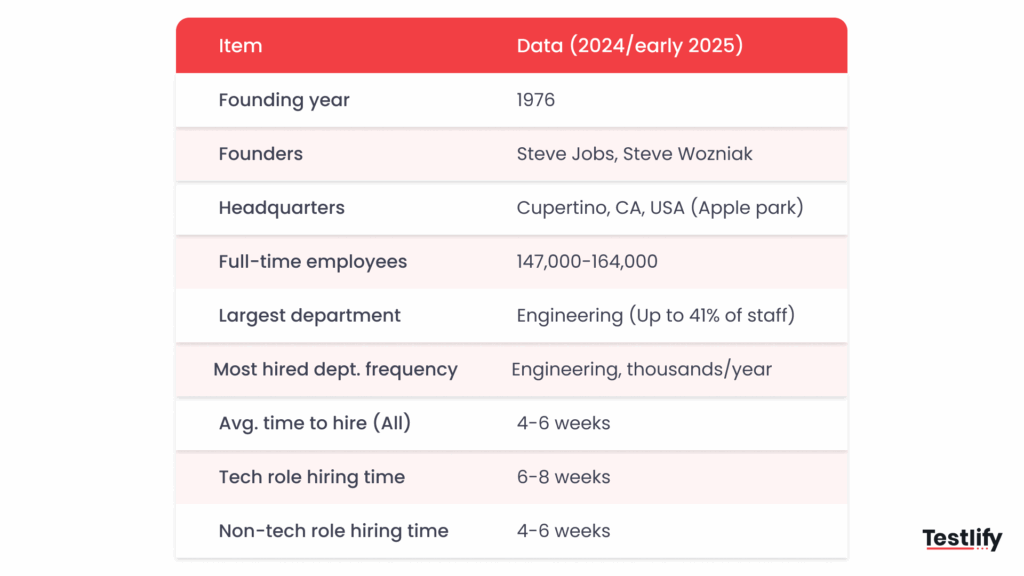
The engineering team is the largest and fastest-growing group inside the company, but Apple hires across retail, design, operations, marketing, and support too. Average time-to-hire sits around 4 to 6 weeks. For technical roles, Apple leans on coding tests and coding assessments before the interview loop; for non-technical roles, it tests communication, judgment, and culture fit.
How long is the Apple interview process?
For most roles the Apple interview process takes 4 to 6 weeks from the first recruiter call to an offer. Senior, managerial, and leadership roles run longer, often 8 weeks or more, because they add interview rounds and extra internal approvals. The timeline also stretches when you interview with more than one team at once, which Apple allows.
Pace depends on the team and how fast recruiters reply. After the on-site loop, the final discussion and Apple interview response time usually happen within a week, and offer negotiation adds another 1 to 2 weeks.
What are the steps in the Apple interview process?
Apple’s hiring is rigorous for both technical and non-technical roles, and each stream has its own stages and skill expectations. The company does not follow one fixed protocol. Instead each team works almost like its own startup, deciding what to ask and how to judge answers. Most candidates still move through these stages.
Stage | What happens | Typical length |
|---|---|---|
Resume screening | ATS keyword scan, then a manual review for role skills and culture signals | 1 to 3 days |
Recruiter phone screen | Background, motivation, and fit; overview of next steps | 15 to 30 minutes |
Skills test or take-home | Coding test or role task to check real ability before live rounds | 30 to 90 minutes |
Technical or hiring-manager interview | Role-related knowledge, problem solving, live coding | 30 to 60 minutes |
On-site loop | 6 to 8 back-to-back rounds with future teammates, plus a lunch | Up to a full day |
Final decision | Same-day group discussion; hiring manager decides | Within 1 week |
Resume screening
Apple gets hundreds to thousands of applications per role, so recruiters start with an Applicant Tracking System to screen resumes for the right keywords, experience, and qualifications. A manual review follows, where recruiters look for quantified achievements, clear writing, role-specific skills, and signs of culture fit. For technical roles, they prioritize relevant projects and the right tech stack; for non-technical roles, measurable results and communication.
Recruiter phone screen (15 to 30 minutes)
Next is a recruiter call, which is standard across teams. You get resume-based and behavioral questions about your experience, your wins, and why you want Apple specifically. The recruiter is checking overall fit and whether you are likely to clear the later rounds. Because the process is less standardized than other big tech firms, what comes after this call varies by team.
Skills test or take-home assignment
For many technical roles, and some non-technical ones, Apple adds a skills test or a take-home task. This is where a candidate proves they can actually do the job before anyone spends an hour interviewing them. Apple uses coding platforms and structured assessments here; the hiring manager decides whether a take-home project is worth the candidate’s time.
Technical interviews (30 to 60 minutes)
The first live interviews run 30 to 60 minutes over video or phone with a hiring manager or team member. They focus on role-related knowledge and dig into your past work. For technical roles, expect a shared coding environment, data structures and algorithms, and questions about the time and space complexity of your solution. Apple does use LeetCode-style problems, but it cares more about depth in your domain than puzzle tricks.
On-site loop (up to 10 rounds)
There is no fixed number of on-site interviews. On average it is a loop of 6 to 8 rounds, sometimes up to 10, run in person or virtually. Many rounds are with people who would be your future teammates rather than recruiters. Apple often uses group and role-specific tests here to see teamwork, problem solving, and how you handle real on-the-job situations. For in-person loops, one round may be a lunch on campus, and that lunch is not a break. It is part of the read on how you work with people.
Behavioral interview
Most loops include a focused behavioral round, sometimes a shorter final session with a senior team member to close any gaps from earlier interviews. Apple weighs behavior heavily: it wants to know the “what” and the “how” behind your decisions, not just the result. Common behavioral questions include:
- Tell me about a time you worked with someone difficult. What did you do to make it work?
- Share a time you found a creative solution to a hard problem.
- Describe a time you had to learn a new tool or process fast. How did you handle it?
- Talk about a project that went off track. What went wrong, and what did you learn?
- Give an example of a big decision you made without all the information. What was your approach?
How does Apple screen technical and non-technical roles?
For technical roles, recruiters screen resumes for the right languages, frameworks, and core skills, then run online coding tests or technical quizzes before a deeper interview that can include whiteboard coding and system or design discussion tied to the team’s real work. For non-technical roles, Apple looks at operational wins, quantifiable business results, leadership, communication, and culture fit, and often uses situational judgment tests plus structured talks about past projects like a product launch or a marketing campaign.
How does Apple make its final hiring decision?
Apple decides through live, same-day discussion rather than written scorecards or a central hiring committee. After the on-site loop, the interviewers usually meet that day to share feedback, vote, and argue it out until they agree. This means a strong advocate in the room can fight for a borderline candidate, and a quiet doubt can sink one. Consensus matters, but the final authority rests with the hiring manager for that role, so their read of you carries the most weight.
The upside is speed and a human touch. The cost is consistency: when impressions drive the call, two equally good candidates can get different outcomes depending on who interviewed them. That tradeoff is exactly where a structured assessment helps, which is the part most worth borrowing.
How does Apple assess culture fit?
Apple checks culture and leadership fit through behavioral interviews, not a standalone culture test. Recruiters use structured conversations and the STAR method (Situation, Task, Action, Result) to see whether you live the company’s values: teamwork, attention to detail, user-first thinking, and a genuine obsession with the product. Three things they probe:
- Values in action: how you show teamwork, ownership, and care for the end user in real situations.
- Soft skills: communication, problem solving, and collaboration, tested through targeted questions.
- Storytelling: clear, specific accounts of how you handled a challenge, framed with STAR so the answer is concrete and outcome-driven.
Culture fit done well means fit with how the team works, not hiring people who all look and think alike. Used badly, “culture fit” becomes a cover for bias, so the goal is a structured read of values and behavior, not a vibe check.
How is Apple’s process different from other FAANG firms?
Apple stands out through decentralization, a heavy behavioral focus, and real-time decisions. Rather than one uniform pipeline, each team designs its own questions, formats, and bar, so the experience can feel more like interviewing at a startup. You can interview with several teams at once and see very different styles. Technical skills still matter, but Apple puts unusual weight on passion for its products and brand.
The decision style is the biggest contrast. Where Google and Amazon lean on written feedback, rubrics, bar-raisers, and hiring committees, Apple gathers interviewers for a same-day debate and reaches consensus on the spot. That makes it faster and more human, but also more variable, since group dynamics and individual impressions carry more weight.
What can recruiters learn from how Apple hires?
You do not need Apple’s brand to use Apple’s best habits. The pattern worth copying is simple: prove skills early, make culture a real step, and decide quickly with structure so speed does not cost you fairness. Skills-based hiring has become one of the biggest shifts in recruiting, and LinkedIn’s Future of Recruiting research puts skills and internal mobility near the top of what talent teams are betting on.
This is where the Testlify Multi-Signal Talent Evaluation Model fits. Instead of trusting one resume, one test, or one interviewer’s gut, you combine several role-relevant signals (a skills test, a coding task, a behavioral interview, reviewer scores) so a candidate moves forward when the evidence lines up, not because one round went well. AI helps summarize and structure that evidence; your team still makes the call. Apple already works this way in practice, just without the tooling to keep it consistent. Strong culture and engagement are not soft extras either; Gallup’s research on workplace culture ties an aligned, engaged team directly to performance and retention.
Hire like Apple with Testlify
Apple’s edge is not a secret formula; it is testing for real skills and fit before the expensive interview rounds, then deciding with the whole team. Any company can do that. With a library of 3,500+ ready-to-use skills tests, plus coding, cognitive, and culture-fit assessments, Testlify helps you screen for both ability and alignment before the first call.
Start free with a technical and culture-fit assessment, or book a demo to see how Testlify fits your hiring workflow.
Key takeaways for recruiters
Test skills before you interview. Apple checks ability early so interview time goes only to people who can do the job. A short, role-specific skills test right after resume screening cuts wasted rounds and shrinks bias, because everyone is measured on the same task instead of a recruiter’s first impression.
Make culture fit a formal step, not a gut call. Apple uses structured behavioral interviews and the STAR method to read values and behavior. Writing your own scorecard for teamwork, ownership, and communication keeps “culture fit” from sliding into bias and makes the decision defensible.
Decentralize, but keep one shared bar. Letting teams run their own loops makes interviews more role-relevant and faster, which is why Apple does it. The risk is inconsistency, so give every team the same evidence framework even if the questions differ.
Decide faster with structure. Apple’s same-day discussion removes weeks of delay. You can copy the speed without the randomness by combining multiple scored signals into one decision, so a quick call is still an evidence-based one.
Why it matters: a hiring process that is fast, skills-first, and structured wins better candidates and protects you from costly mis-hires. That is the real lesson behind the Apple interview process, and it is one any team can put to work this quarter.
Frequently asked questions (FAQs)

Related resources
View all
Enterprise hiring process
Netflix Hiring Process 2026: Stages, Timeline, and What Recruiters Can Steal
Enterprise hiring process
How FedEx hires at scale (what recruiters can learn)
Enterprise hiring process
Microsoft hiring process: Interview rounds and questions
Enterprise hiring process
Google Hiring Process: What Recruiters Should Know in 2026
Enterprise hiring process
JP Morgan recruitment process: An ultimate guide
Enterprise hiring process
NVIDIA interview process & questions 2026
Get started.
Hire on proof, not resumes.
Run your first skills-based assessment free — no credit card required.