
JP Morgan recruitment process: An ultimate guide
Discover JP Morgan’s recruitment process insights, perfect for recruiters to understand assessments, interviews, and top talent selection.
The JP Morgan recruitment process runs through five stages: a resume screen, an online assessment, one or two technical or competency interviews, a final-round interview (a Superday for many graduate and front-office roles), and an HR or offer conversation. Most candidates move from application to offer in about three to six weeks, though competitive graduate and analyst tracks can take a few months.
Here is the part most guides skip. The online assessment, not the interview, does the heavy filtering. It scores candidates on role-relevant skills before a recruiter ever joins a call, which is exactly how good hiring is supposed to work: collect a few independent signals, then let a human decide. This guide walks through each stage, the real timelines, and what your team can copy from how one of the world’s largest banks screens at scale.
TL;DR
- JP Morgan hires in five stages: resume screen, online assessment, technical interviews, a final-round Superday, and an HR or offer conversation.
- Online assessments do the screening work. They can filter out a large share of applicants before anyone spends time on a live interview.
- Budget three to six weeks for most roles, and up to a few months for graduate and investment-banking programs.
- The advantage is structure, not the brand on the door. Scoring people on real skills early is what keeps the process fast and fair.
- Any team can copy the model: skills assessments and structured interviews up front, with the final call kept human.
- Every JP Morgan stage has a direct AI-hiring stack equivalent, so any team can run the same five-stage structure with an ATS, a skills-assessment platform, and structured video interviews instead of a banking budget.
 ChatGPT
 Gemini
 Claude
 Grok
Grok Perplexity
What is the JP Morgan recruitment process?
The JP Morgan recruitment process is a five-stage hiring funnel that moves a candidate from application to offer using assessments first and interviews second. After a resume passes screening, applicants take an online assessment, then sit one or two interviews, a final-round Superday for many roles, and an HR or offer step. The same shape holds across most divisions, with the depth tuned to the job.
What makes it work is the order. Skills and judgment get measured early, so the live interviews focus on fit and depth rather than basic screening. For a bank that can receive thousands of applications per opening, that order is the difference between a process that scales and one that drowns recruiters in resumes.

About JP Morgan
JP Morgan (JPMorgan Chase & Co.) is the largest bank in the United States by assets and one of the largest in the world. It traces back to a firm founded by financier J. P. Morgan in 1871, and the modern company formed in 2000 through the merger of J.P. Morgan & Co. and Chase Manhattan. Its hiring volume matches its scale, which is why assessment-led screening is a practical necessity, not a nice-to-have.
The bank runs four main business segments, each with its own hiring patterns and skill demands:
- Consumer and community banking: retail branches, cards, lending, and the bulk of frontline roles. Hiring here runs highest volume and leans hardest on the online assessment to filter at scale before any interview slot opens up.
- Corporate and investment banking: advisory, markets, and the graduate analyst tracks with the well-known Superday rounds. This is the most competitive division by applicant volume, and the one where a Superday performance carries the most weight in the final call.
- Commercial banking: relationship and credit roles serving mid-sized and large companies. Interviews weight client-facing judgment and credit reasoning over the pure technical drills used in markets roles.
- Asset and wealth management: portfolio, advisory, and client-facing investment roles. Assessments here weight relationship-building and communication alongside the standard cognitive and technical screens.
How does JP Morgan source talent?
JP Morgan sources talent through campus pipelines, university and nonprofit partnerships, workforce analytics, and skills-based programs that look past degrees. The goal is a steady, diverse pipeline rather than a scramble each time a role opens. A few moves stand out for any recruiter trying to build the same kind of pipeline.
- Campus and early-career programs: rotational analyst tracks, mentorship, and real project work to grow future leaders in finance, operations, and technology.
- Partnerships and local pipelines: work with universities, nonprofits, and community colleges to train and reach candidates. JP Morgan committed 350 million dollars over five years to prepare workers for the future of work.
- Data-driven hiring: workforce analytics and labor-market data to forecast skill demand and plan recruiting ahead of need.
- Digital campaigns: targeted outreach on social platforms to reach younger and more diverse audiences early.
- Skills-based and inclusive hiring: priority on veterans, women in STEM, and returnees, scored on what they can do rather than where they studied.
Pro Tip: Copy the sequence, not the budget. You do not need a 350 million dollar program to source like JP Morgan. Define the three or four skills a role actually needs, score every applicant on them with a short role-specific assessment, and your shortlist is ranked before the first call.
What are the JP Morgan interview rounds?
The JP Morgan interview process has five rounds for most roles: a recruiter and resume screen, an online assessment, a first technical or competency interview, a second interview or Superday, and an HR or offer conversation. The bank describes its own approach on its careers site. Here is what each round actually involves.
Recruiter and resume screen
A 20 to 30 minute call confirms eligibility, walks through your background, and checks the basics for the role. Volume gets cut here on fit and must-have requirements before any skills test.
Online assessment
This is the real filter. Candidates complete game-based aptitude exercises, recorded video responses, and, for technical roles, a coding or skills test. These score cognitive ability, judgment, and job skills, and they screen out a large share of applicants, often up to 80 percent for popular roles, because of application volume.
Technical or competency interview (30 to 40 minutes)
A 30 to 40 minute interview, online or onsite, digs into domain knowledge, past projects, and problem-solving. For engineering roles this means data-structure and algorithm questions; for finance roles it means market sense and case reasoning.
Second interview or Superday
Front-office and graduate candidates reach a Superday: three to five back-to-back interviews of 30 to 60 minutes in a single day, some one-on-one and some with two interviewers. Expect a mix of behavioral, technical, and market or case questions designed to test consistency under pressure.
HR round and offer (25 to 30 minutes)
A final 25 to 30 minute conversation covers motivation, values alignment, compensation, and logistics. A verbal offer often follows within a few days, with the written offer close behind.
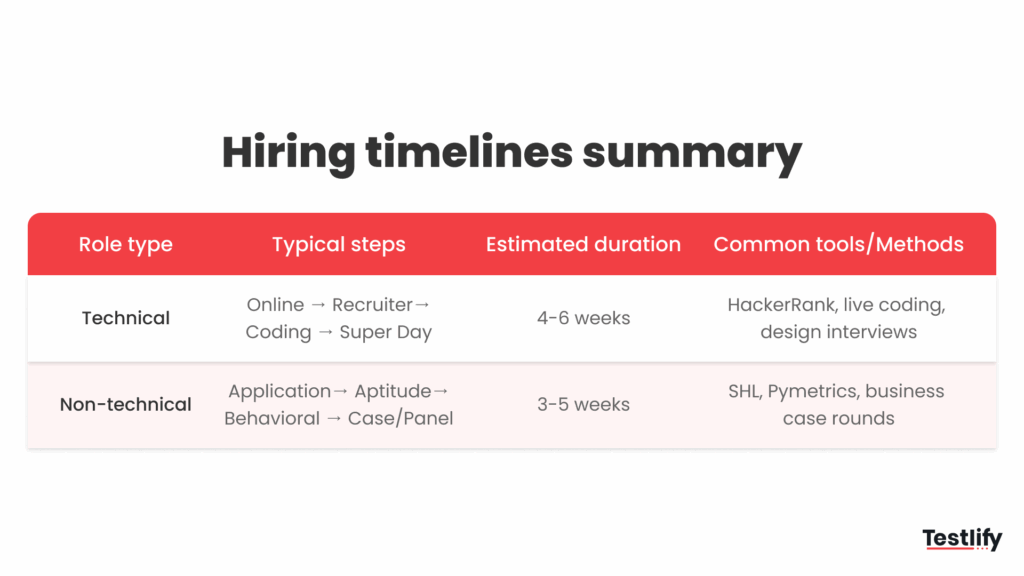
How long does the JP Morgan hiring process take?
The JP Morgan hiring process takes about three to six weeks from application to offer for most roles. Graduate, analyst, and investment-banking tracks can run a few months because of application volume and scheduled Superday rounds. The table below maps each stage to what happens and a typical time window.
Stage | What happens | Typical timeline |
|---|---|---|
Resume screen | Recruiter call, eligibility and fit check | Week 1 |
Online assessment | Games, video responses, skills or coding test | Week 1 to 2 |
Technical interview | 30 to 40 minute domain and problem-solving round | Week 2 to 4 |
Superday or second round | 3 to 5 back-to-back interviews, 30 to 60 minutes each | Week 3 to 5 |
HR round and offer | Motivation, values, compensation, logistics | Week 4 to 6 |
How competitive is it to get hired at JP Morgan?
JP Morgan’s summer analyst and associate programs are the most competitive entry point, with applicant volume in the hundreds of thousands against only a few thousand available seats, pushing the accepted share to a small fraction of one percent for the most sought-after tracks. Roles outside the flagship graduate programs, including technology, operations, and experienced hires, see materially higher conversion because volume and brand pull are both lower.
Program or role type | Typical applicant volume | Approx. conversion to offer |
|---|---|---|
Summer analyst and associate programs (all divisions) | Hundreds of thousands of applicants for a few thousand seats | A small fraction of one percent |
Graduate and experienced technology roles | Tens of thousands | Single digits to low teens |
Experienced or lateral hires (non-flagship programs) | Role-dependent | Meaningfully higher than campus programs |
The scale is the real story for recruiters. Screening that volume of applications for a few thousand seats is not realistic with any headcount of human reviewers, which is exactly why JP Morgan pushes the filtering work to online assessments before a recruiter reads a single application in depth. The same math applies at a fraction of the scale to any team fielding a few hundred applications for one role: an assessment-first funnel is what keeps that volume workable.
JP Morgan business divisions and roles
Hiring criteria shift by division, but the assessment-first sequence stays the same. Technical roles lean on coding and numerical reasoning tests; client-facing roles lean on situational judgment and communication; analyst tracks weight cognitive ability heavily. Match the test battery to the division and the signal gets cleaner.
How does JP Morgan’s hiring funnel compare to a modern AI-hiring stack?
JP Morgan’s five-stage funnel maps directly onto a modern AI-hiring stack: the resume screen becomes AI-powered ATS parsing, the online assessment becomes a skills-testing platform, and the Superday becomes structured, scored video interviews. The stages have not changed. The tooling running them has. The table below lines up each stage against its modern equivalent.
JP Morgan stage | Modern AI-hiring stack equivalent | What changes |
|---|---|---|
Resume screen | AI-powered ATS parsing and scoring | Manual resume review drops from hours to minutes |
Online assessment (games, video, coding) | Skills-assessment platform (cognitive, coding, personality tests) | Same 60 to 80 percent pre-interview filter, no travel or proctor booking needed |
Technical or competency interview | Structured video interview, AI-assisted scoring | Every candidate scored on the same rubric, not just on Superday |
Superday (3 to 5 back-to-back interviews) | Async video rounds plus one live final interview | Removes the single-day scheduling bottleneck for candidates and panels |
HR round and offer | ATS-integrated offer workflow | Offer generation in hours instead of a follow-up call cycle |
The shift is not about replacing judgment with software. It is about running the same five-stage structure with less manual overhead. Enterprise teams that adopt an assessment-first, AI-supported hiring stack cut time-to-hire by an average of 55 percent, and SHRM’s 2026 Talent Trends research shows structured, technology-supported hiring is now standard practice at scale, not an experiment.
What does JP Morgan’s assessment and interview prep process reveal for recruiters?
JP Morgan publishes practice materials, sample assessment formats, and interview guidance directly on its careers site before candidates ever sit a test. That transparency is a recruiting decision, not a courtesy: it standardizes what candidates prepare for, which reduces the anxiety-driven noise that makes an unprepared, otherwise strong candidate score poorly for reasons that have nothing to do with the job.
Three parts of that prep process carry directly into how any HR team should run its own assessment-first funnel:
- Format transparency before the test. JP Morgan tells candidates what the assessment measures and roughly how long it takes. Candidates who know the format perform closer to their true ability; candidates guessing blind add noise to the score.
- Practice materials, not just instructions. Sample questions let candidates calibrate effort and pacing ahead of time, so the live assessment measures the skill being tested rather than unfamiliarity with the tool itself.
- Consistent rubric communication into the interview stage. Superday interviewers work from comparable question sets, so prep guidance that says “expect behavioral, technical, and case questions” holds true across candidates instead of varying by which interviewer a candidate happens to draw.
Key Takeaway: An assessment-first funnel only works if candidates know what to expect. Publishing format and practice guidance up front is not a candidate-experience nicety, it is what keeps a high-volume assessment score measuring the job instead of measuring familiarity with the test.
Teams running their own assessment-first process can copy this directly: publish what the test measures and roughly how long it takes, share one or two sample questions, and describe the interview format before the call. None of it changes the difficulty of the assessment. It changes whether a low score means “not a fit” or “did not know what to expect,” and only one of those is a signal worth acting on.
What can recruiters learn from JP Morgan?
The lesson is not the brand, it is the structure. JP Morgan measures skills early, uses multiple independent signals, and keeps the final decision with the hiring team. That is the core of the Testlify Human+AI Evidence-Based Hiring Framework: combine AI-assisted evaluation with human judgment, using structured evidence instead of resumes, intuition, or inconsistent interviews. AI helps sort and surface; people decide.
The data backs the order. Almost two-thirds of employers now use skills-based hiring to identify candidates, and decades of selection research show that structured interviews and work-sample tests are among the strongest predictors of job performance, well ahead of unstructured chats, in the 2022 update to the classic validity studies. The cost of getting it wrong is real too: Gallup puts the price of replacing one employee at 0.5 to 2 times their annual salary. Screening on skills early is cheaper than fixing a bad hire later.
Here is the honest caveat. Assessments rank candidates, they do not hire them. A test score tells you who is worth a conversation, not who to send the offer to. Across the hiring teams we work with, the failures come from treating a score as a verdict. Use the evidence to build a better shortlist, then let a human read the person.
Hire like JP Morgan with Testlify
You do not need a bank-sized budget to run an assessment-first process. Testlify gives you a large library of skills, cognitive, coding, and personality tests, plus video interviews and reviewer scoring, so you can screen for role-relevant skills before the first live round, the same order JP Morgan uses. Testlify sits at the assessment and screening slice of your stack and plugs into the ATS and interview tools you already run.
Set up a role-specific assessment, send it to every applicant, and your shortlist arrives ranked on the skills that matter, with the final decision still yours.
Screen candidates on skills, not resumes. Build a role-based assessment in minutes and rank your shortlist before the first interview.
Key takeaways for recruiters
- Assess before you interview. JP Morgan filters on an online assessment first, which is why its interviews stay focused. Put a skills test ahead of the first call and you stop spending senior time on candidates who were never a fit.
- Use more than one signal. Games, video, and a technical round each measure something different. One score is fragile; several pointing the same way give you a decision you can defend to a hiring manager.
- Structure the interview. The Superday works because every candidate faces comparable questions. Structured interviews predict performance far better than free-form chats, so write the questions before, not during, the call.
- Keep the decision human. Evidence ranks the shortlist; people make the hire. Treating an assessment score as an automatic yes or no is the most common way teams misuse it.
- Match the test to the role. Coding and numerical reasoning for technical jobs, situational judgment for client-facing ones. A generic test battery gives you a noisy signal.
- Move fast on purpose. A three to six week process is a feature, not luck. Front-loading assessments is what lets a high-volume pipeline stay quick without cutting corners.
Frequently asked questions (FAQs)

Content Writer
Yashika Khandelwal is a Content Writer with 3+ years of experience creating research-backed content on hiring, talent assessment, and HR technology. She is a registered Organizational Psychologist and subject matter expert who combines behavioral science with practical recruitment insights to produce accurate, evidence-based content.
LinkedInRelated resources
View all
Enterprise hiring process
NVIDIA interview process & questions 2026
Enterprise hiring process
OpenAI interview process: Steps, timeline, and questions
Enterprise hiring process
Walmart hiring process: A complete guide
Enterprise hiring process
Apple Interview Process: Rounds, Timeline and Questions
Enterprise hiring process
Netflix Hiring Process 2026: Stages, Timeline, and What Recruiters Can Steal

Enterprise hiring process
How FedEx hires at scale (what recruiters can learn)
Get started.
Hire on proof, not resumes.
Run your first skills-based assessment free — no credit card required.