
Google Hiring Process: What Recruiters Should Know in 2026
Recruiters can’t miss this: Learn Google’s playbook to scale hiring, cut bias & land world-class engineers.
Google hires tech talent by trusting evidence over instinct: skills tests and structured, rubric-scored interviews, capped at four rounds, with the final call made by a committee instead of one manager. For recruiters, that is the real lesson. You do not need Google’s budget to copy the method.
Here is how the process actually works, stage by stage, and the parts any hiring team can borrow.
TL;DR
- Google screens on skills first, then runs structured interviews scored against a fixed rubric, so every candidate is judged the same way.
- Its “Rule of Four” caps most candidates at four interviews because internal data showed four interviewers predict a hire with about 86% confidence.
- Google dropped brainteasers after finding they had zero link to job performance; structured interviews roughly double the accuracy of unstructured ones.
- A hiring committee, not the recruiter or one manager, makes the final decision, which strips out individual bias.
- Smaller teams can copy the method: assess skills before interviews, use a shared rubric, cap the loop, and let a panel decide.
 ChatGPT
 Gemini
 Claude
 Grok
Grok Perplexity
What are Google’s core hiring practices?
Google’s hiring process is a sequence of evidence checks: resume screen, a technical phone screen, skills assessments, four onsite interviews, a values check it calls “Googleyness,” and a hiring committee that signs off. Google’s own careers team describes the goal as predicting how you will perform, not cataloguing what you have already done.
Google is one of the most selective employers in tech, which forces a process built for scale and consistency. The thread running through every stage is the same: collect role-relevant evidence, score it against a standard, and keep any single person from owning the decision.
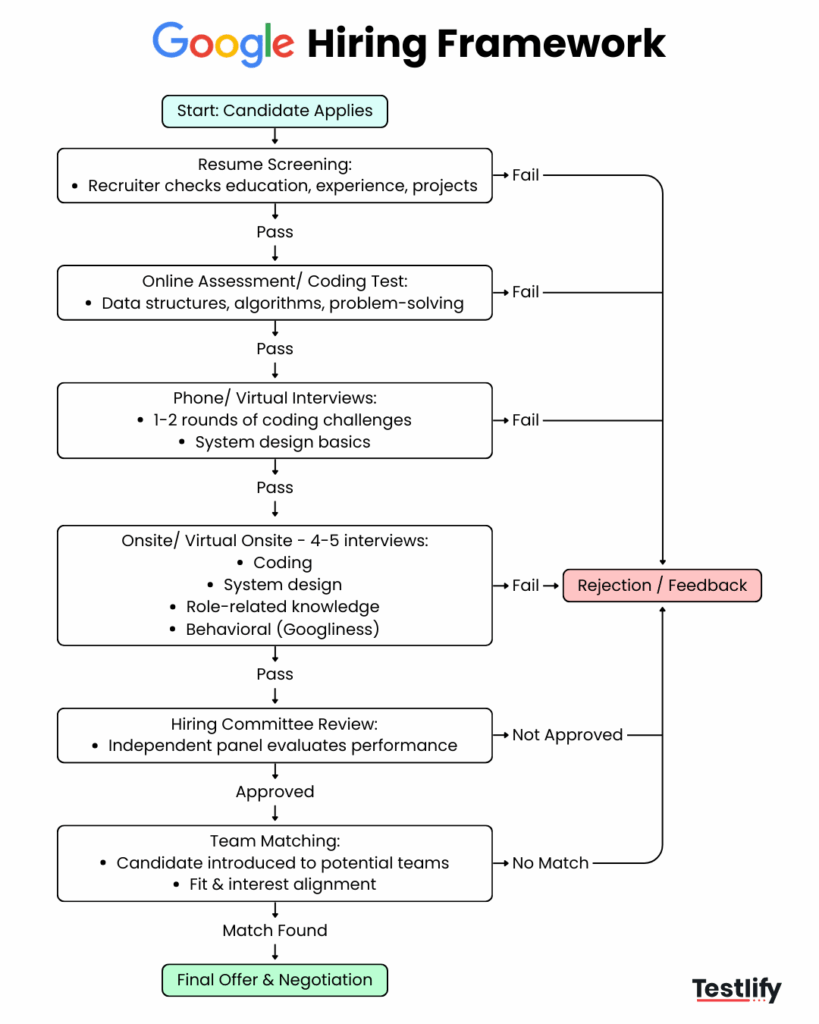
Most technical candidates move through screening, assessment, structured interviews, and committee review in four to eight weeks. The general flow includes resume screening, a phone screen, skills tests, onsite interviews, the committee, team matching, and an offer.

How does Google recruit software engineers?
Google hires software engineers in seven stages, each designed to test a different signal. The table below maps each stage to what it measures and the part a smaller team can copy. The stages then break down one by one.
Stage | What it tests | What recruiters can borrow |
|---|---|---|
Resume screen | Role-relevant projects and outcomes | Score resumes on evidence, not pedigree |
Phone screen | Core data structures and fundamentals | Use a short, consistent technical screen |
Skills assessment | Practical coding and problem-solving | Test skills before, not after, interviews |
Onsite interviews (4) | Depth across role knowledge and reasoning | Cap the loop and use a fixed rubric |
Googleyness | Collaboration and values fit | Ask structured behavioral questions |
Hiring committee | Bias-checked final review | Let a panel decide, not one person |
Team matching | Fit with a specific team | Match on need after the yes/no call |
Resume screening
Candidates apply through Google’s portal, and recruiters reach out to the strongest profiles. Google favors resumes that show measurable outcomes and real projects over school names. For new graduates, relevant coursework and class projects count. The filter here is evidence of doing the work, not where you studied it.
Technical phone screen
A 30 to 45 minute call tests core data structures and basic algorithms. The interviewer is checking fundamentals and how a candidate responds to feedback under light pressure. Strong engineers still get cut here if the basics are shaky, which is the point: it is a cheap, early signal before anyone invests in a full loop.
Skills assessments
For technical roles, candidates complete coding exercises and role-specific tasks, often across three to four short rounds. Google teams build in languages like C++, Java, Python, Go, TypeScript, and SQL. Recruiters do not need to code, but a working grasp of the stack makes their conversations with hiring managers more credible. Skills-based assessments give a cleaner read on practical ability than a resume ever will.
The four onsite interviews
Most candidates face four interviews of 45 to 60 minutes each, virtual or onsite. This is the “Rule of Four.” Each interviewer scores against the same rubric and covers a distinct area: role-related knowledge, general cognitive ability, leadership, and Googleyness. Standardizing the questions and scoring is what keeps four separate opinions comparable.
Per research surfaced by Wharton, four interviewers predict a hire/no-hire call with roughly 86% confidence, and a fifth round barely moves the number. Capping the loop cut Google’s time-to-hire to about 45 days from closer to six months.
The Googleyness check
After the technical rounds, a behavioral interview tests collaboration, comfort with ambiguity, and how candidates handle real situations. Interviewers use structured situational questions, often in STAR format (Situation, Task, Action, Result). What matters is self-awareness and how someone works with a team, not a rehearsed perfect answer. The STAR method keeps these answers comparable across candidates.
Hiring committee and team matching
All interviewer feedback, scores, and notes go to a hiring committee of Googlers who did not interview the candidate. They weigh four attributes (role knowledge, cognitive ability, leadership, and Googleyness) and reach a decision in one to two weeks. Recruiters keep candidates informed but do not vote. If the role is not tied to a team yet, team matching connects the approved candidate with a manager who has open headcount.
Why did Google drop brainteasers?
Google dropped brainteasers because they did not work. When the company compared interview scores against actual job performance, it found no relationship. As Laszlo Bock, Google’s former SVP of People Operations, told the New York Times in 2013, “brainteasers are a complete waste of time. They don’t predict anything. They serve primarily to make the interviewer feel smart.”
What replaced them holds up under research. A 2022 re-analysis of decades of selection studies, summarized by the Society for Industrial and Organizational Psychology, ranks structured interviews among the very strongest predictors of job performance, roughly double the accuracy of unstructured ones. The difference is the rubric: same questions, same scoring, every candidate.
Pro tip: The fastest structure win for any team is a written rubric agreed before interviews start. Without it, “structured interview” just means everyone asks different questions and rates on gut feel, which is the exact problem Google’s data exposed.
What can recruiters copy from Google?
The copyable part of Google’s process is the method, not the scale. Skills disruption makes that method more useful, not less: the World Economic Forum’s Future of Jobs Report 2025 projects that 39% of workers’ core skills will change by 2030. When the skills themselves keep shifting, testing for them beats screening on a five-year-old credential. The same rubric-first discipline shows up at other high-volume tech employers, including how Netflix hires and NVIDIA’s own structured interview loop.
This is where the Testlify Human-Led Decision Scorecard fits. It turns scattered evidence (assessment scores, structured interview notes, reviewer ratings) into one consistent decision view, while the final judgment stays with the hiring team. AI helps organize and surface the evidence; people still make the call, which is the same principle behind Google’s committee. Pair it with custom technical assessments to test skills before the first interview, and a small review panel to replace one manager’s instinct.
Hire on evidence, like Google
Testlify lets you assess candidates on real skills across 3,000+ roles, score structured interviews against a shared rubric, and bring AI-assisted insights into a human-led decision. You get Google’s discipline without Google’s headcount.
Start free or book a demo to see how it fits your hiring process.
Key takeaways for recruiters
- Skills beat pedigree. Google weighs problem-solving and role-related ability over university brand because grades stop predicting performance after the first couple of years. For recruiters, that means scoring candidates on demonstrated skill, which widens the qualified pool and cuts mis-hires tied to credential bias.
- Structure is the real lever. A shared rubric roughly doubles interview accuracy versus winging it. Write the questions and scoring before interviews start, and four interviewers stay comparable instead of each chasing a different impression.
- More interviews do not mean better decisions. Google capped its loop at four because the fifth round added almost nothing but delay. Trimming rounds speeds up offers and protects candidate experience, which matters when good engineers have options.
- Take the decision off one desk. A committee that did not run the interviews catches bias a single hiring manager misses. Even a two or three person review panel gives a smaller company most of that benefit.
- Test skills before you interview. Front-loading a skills assessment filters on practical ability early, so interview time goes to candidates who can actually do the work, not to sorting resumes in the room.
How long does Google’s hiring process take?
Google’s hiring process usually runs four to eight weeks, though senior roles can take longer. After Google adopted its “Rule of Four” interview cap, average time-to-hire fell to roughly 45 days, down from closer to six months earlier.
What is the “Rule of Four” in Google interviews?
It is Google’s decision to cap most candidates at four interviews. An internal analysis found four interviewers predict a hire/no-hire call with about 86% confidence, and a fifth interview adds almost nothing. Fewer rounds means faster decisions and a better candidate experience.
Does Google still use brainteaser interview questions?
No. Google dropped brainteasers like “how many golf balls fit in a bus” years ago after finding zero link between them and job performance. It now uses structured behavioral questions and work-sample style problems scored against a fixed rubric.
What is “Googleyness” in the hiring process?
“Googleyness” is Google’s term for behavioral and values fit: comfort with ambiguity, collaboration, and intellectual humility. It is checked through structured situational questions (often STAR format), not a personality vibe check, and it carries real weight in the final decision.
Can a smaller company copy Google’s hiring process?
Yes, the principles scale down. Any team can use a structured rubric, skills assessments before interviews, a four-interview cap, and a small review panel instead of one manager’s gut call. You do not need Google’s budget to hire on evidence rather than instinct.

Related resources
View all
Enterprise hiring process
JP Morgan recruitment process: An ultimate guide
Enterprise hiring process
NVIDIA interview process & questions 2026
Enterprise hiring process
OpenAI interview process: Steps, timeline, and questions
Enterprise hiring process
Walmart hiring process: A complete guide
Enterprise hiring process
Apple Interview Process: Rounds, Timeline and Questions
Enterprise hiring process
Netflix Hiring Process 2026: Stages, Timeline, and What Recruiters Can Steal
Get started.
Hire on proof, not resumes.
Run your first skills-based assessment free — no credit card required.