
Walmart hiring process: A complete guide
Walmart hires 500K+ people yearly. Learn its skills-based, automated hiring process to scale recruitment.

Walmart isn’t just the world’s largest retailer; it’s also #1 on the Fortune Global 500 and hires over 500,000 people a year. How does a company hiring at that scale stay #1? In this blog, we break down Walmart’s hiring process so your company can do it too.
 ChatGPT
 Gemini
 Claude
 Grok
Grok Perplexity
Overview of Walmart
Walmart is one of the world’s largest multinational retail corporations, operating chains of grocery stores, hypermarkets, and warehouse clubs. Founded by Sam Walton and Bud Walton in 1962, with about 2.1 million employees globally, it is the largest private employer.
Annually, the company hires approximately 500,000 associates, primarily for frontline hourly roles, technology positions, pharmacy roles, and management positions. Walmart also offers financial services and runs an e-commerce business, striving to become a tech-driven omnichannel retailer.
Known for its mass recruitment efforts, Walmart conducts large-scale hiring drives numerous times throughout the year, demonstrating its expertise in hiring employees at scale. Specifically, for its U.S. retail stores, the company hires thousands of employees each year.
In 2023, for example, Walmart hired about 40,000 seasonal associates for the holiday period, down from as many as 150,000 new hires during peak seasons in previous years.
At times of heightened demand, such as during the pandemic or holiday shopping surges, Walmart has hired up to 500,000 workers in a single year to meet both in-store and online fulfilment needs.
The company also conducts large-scale hiring drives for tech and supply chain roles globally, regularly hosting “off-campus drives” and recruitment events for both freshers and experienced candidates.
One of the primary steps that screens out candidates is via a skills test. Walmart uses skill testing platforms like Testlify to hire at scale.
For screening technical and non-technical roles, recruiters can use skills assessment and interviewing platforms like Testlify. These assessments allow recruiters to create on-the-job specific tests to evaluate thousands of candidates simultaneously.
Testlify features include built-in tools such as plagiarism detection, anti-cheating measures, auto-grading, and AI-powered scoring, ensuring fair and unbiased results.
Also read: [INTERNAL LINK: Types of skills assessment tests → Testlify skills assessment tests page]

How does Walmart hire?
Walmart’s recruitment and selection process is highly automated for frontline roles, where high-volume recruitment is essential, and rigorous for technical positions that involve coding, designing, and other specialised tasks.
The recruitment process at Walmart is efficient but lengthy for some roles, and straightforward for others, particularly in frontline positions.
The lengthy hiring process is due to multiple automated and manual screening processes, which create unnecessary delays for high applicant volume roles.
Also read: [INTERNAL LINK: 5 high-volume recruitment strategies to adopt in 2025 → Testlify high-volume recruitment page]
The average time-to-hire at Walmart is 2-3 weeks for non-technical roles (store and hourly) and takes 3-6 weeks for technical positions. The discrepancy in hiring time stems from the fact that non-technical roles fill much faster due to fewer interview rounds and high automation. In contrast, technical hires require multiple assessments and interview rounds.
Regardless of technical or non-technical roles, Walmart places a huge emphasis on its culture and tends to hire people who align most closely with the company’s values and mission.
“We’re going to make shopping with us faster, easier, and more enjoyable. We’ll do more than just save customers money, and you, our associates, will make the difference. Looking ahead, we will compete with technology, but win with people. We will be people-led and tech-empowered.”
Doug McMillon, Walmart CEO
The quote shows Walmart’s emphasis on people and talent as a core driver of business success, alongside technology.
How does Walmart hire for store and non-technical roles?
Walmart hiring process for non-technical roles is easy and heavily automated. The process for hiring for store and entry-level positions includes:
Online application
Candidates apply online on their official website, a process that takes 15-20 minutes and is mostly automated.
Assessment test
Recruiters use an immediate, automated test, which screens for reliability, availability, and basic skills.
For non-technical roles, Walmart uses the Retail Associate Assessment (RAA) for testing candidates on customer service skills, basic maths, logic, and situational judgments.
This assessment is typically conducted online with parts evaluating work orientation, personal attributes, and interpersonal skills.
Through scenario-based role-specific tests, recruiters assess and benchmark candidates globally.
Interview rounds
Typically, one or two brief rounds for entry-level positions. First, there is a screening, followed by a meeting with the hiring manager.
Offer & onboarding
Following background and internal reviews, orientation commences. However, it may be delayed if hiring volumes are high or orientations are infrequent.
For recruiters, this stage serves as a critical quality and integrity filter, typically adding a few days to the overall hiring timeline. Candidates can expedite this stage and avoid surprises by running a background check on themselves beforehand to catch and fix any data errors.
Total hiring time: Ranges from a few days to three weeks, with a potential duration of up to 30 days during busy seasons.
How does Walmart hire for technical roles?
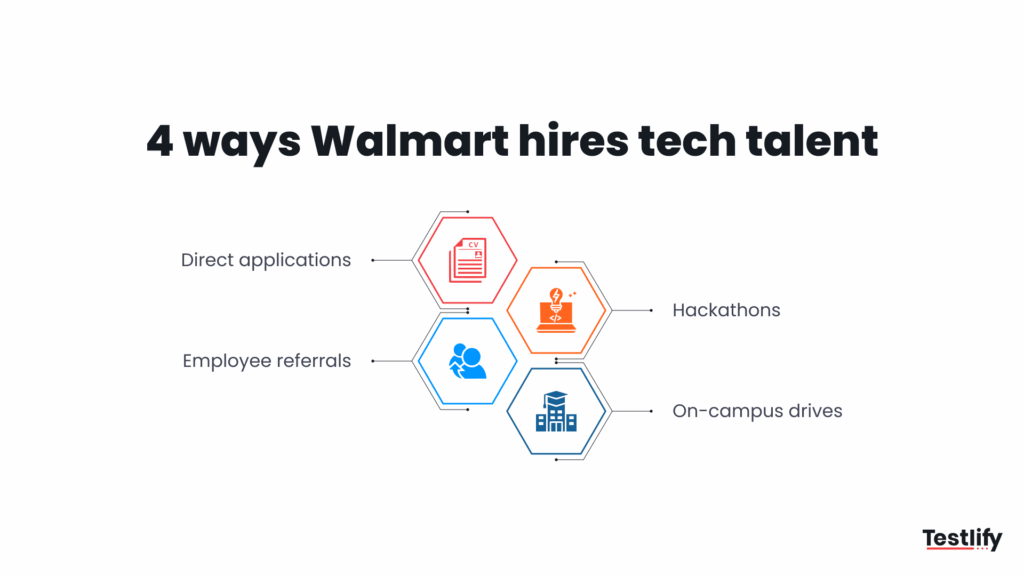
There are four different ways in which Walmart hires for technical roles.
- Direct applications: Walmart regularly posts open positions on its official careers site. Candidates can apply directly, sign up for job alerts, and track new opportunities in real-time by entering their email address on job listings of interest.
- Hackathons: Walmart Labs runs hackathons like Wonder Coder and CodeHers to tap into diverse tech talent, especially women coders. Winners often receive prizes, and some are offered direct hiring opportunities after the event.
- Employee referrals: Walmart encourages employees to refer others. Networking with Walmart associates on LinkedIn and requesting recommendations or referrals can increase your chances of landing an interview.
- On-campus drives: Walmart conducts campus placement drives at universities, especially for engineering and tech talent. These drives often come with competitive salary packages for high-performing students.
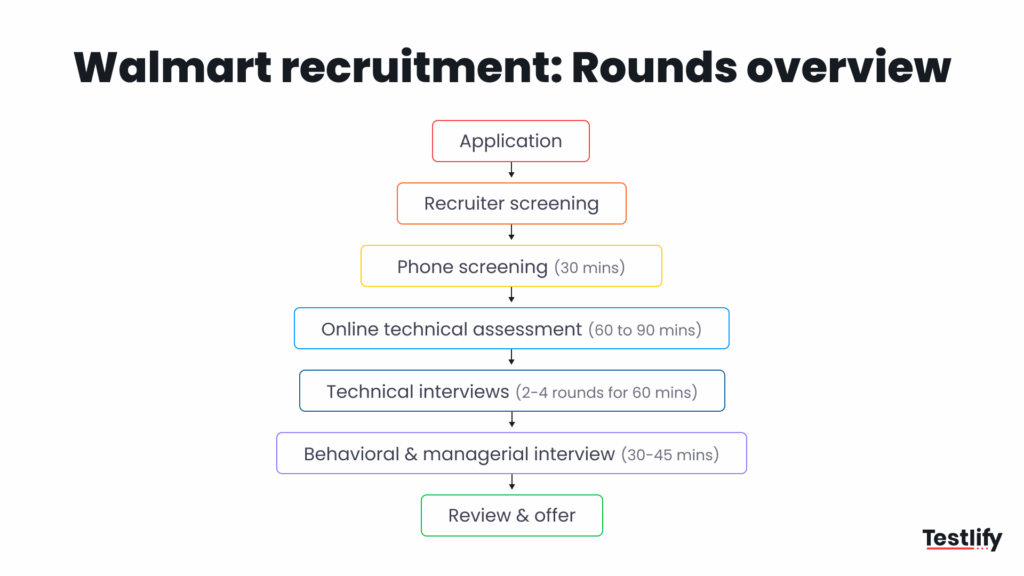
Technical hiring at Walmart is more detailed, with assessment rounds focusing on both technical and cultural fit. For tech and corporate roles, the recruitment step involves:
Application
Candidates apply online through Walmart’s careers portal. Job descriptions are precise and skill-specific, attracting the right talent from the start.
Recruiter screening
Dedicated recruiters screen resumes for relevant experience, technical expertise (languages, tools, platforms), and key career achievements, filtering fast and accurately at the top of the funnel.
Phone screening (30 mins)
Typically scheduled within one week after resume screening, the first step involves a phone screening with recruiters or talent acquisition specialists. Hiring specialists often ask general questions related to job fit, past work experience, background, motivation, and experience.
Online technical assessment (60 to 90 mins)
Shortlisted candidates undergo skill-based tests that cover coding, algorithms, data structures, and situational judgment, allowing recruiters to validate skills before interviews objectively.
For software developer roles, there would be a mix of coding questions (3) and aptitude-related multiple-choice questions (10).
The aptitude test will evaluate candidates’ knowledge of mathematics and logical reasoning. Coding questions will be based on the candidates’ preferred programming language.
Apart from these, situational judgment, behavioral, and cultural questions might also be asked.
The overall online assessment is quite comprehensive, lasting about 60-90 minutes on platforms like Testlify, which also has all the above-mentioned tests.
Technical interviews (2-4 rounds for 60 mins)
Senior engineers or hiring managers conduct a secondary technical interview, which typically lasts 2-4 rounds. However, this stage could vary based on position and seniority.
Technical interviews include live coding challenges, system or product design scenarios, and in-depth reviews of past projects, providing recruiters with rich, structured data to inform their decisions. Each round typically lasts 45 to 60 minutes.
Behavioral & managerial interview (30-45 mins)
The final step emphasises teamwork, communication, adaptability, and cultural fit, which are essential for Walmart’s collaborative and fast-paced environment.
Once candidates successfully demonstrate cultural alignment, problem-solving ability, and other key competencies, their profiles are reviewed by the hiring committee before an offer is extended.
Timeline: Conducted after technical rounds, generally in the same interview phase or shortly after.
Review & offer
A panel or hiring manager reviews combined feedback, and offers are extended to successful candidates. The average time-to-hire for technical roles ranges from 3 to 6 weeks.
This process enables recruiters to scale hiring for niche, high-skill roles while maintaining quality, fairness, and speed, a valuable lesson for any high-volume recruiting team.
Why is the Walmart hiring process lengthy?
Walmart’s hiring process is often seen as lengthy due to the high volume of applications, which necessitates multiple manual approval stages.
Additionally, for technical roles, recruiters also need to schedule separate orientation sessions. Corporate roles also include additional interview rounds, which adds to interview complexity.
Most technical roles at Walmart don’t require drug testing, but for roles involved with machinery and heavy lifting, a pre-employment drug test is mandatory.
How Walmart became a tech giant?
Walmart became a tech giant by steadily investing in technology, data, and supply chain innovation. It was one of the first retailers to use UPC barcodes for product tracking and establish a private satellite network in the 1980s to connect its stores, warehouses, suppliers, and headquarters.
Later, it created Walmart Labs, now Walmart Global Tech, by acquiring companies like Kosmix to bring research, engineering, and digital expertise in-house. Over time, Walmart built advanced systems for inventory management, predictive analytics, and real-time pricing.
Today, it operates more than 10,500 stores in 19 countries, serving approximately 255 million customers each week, and generating over USD 600 billion in annual revenue.
These moves have helped Walmart shift from a traditional retailer into a tech-powered omnichannel business that competes with digital-first companies.
Walmart is also an excellent example of a company that depends heavily on skills-based hiring. One study found that by partnering with skills assessment platforms, Walmart saw a 40% increase in candidate test completion rates. Such a skills-first approach reduced time to hire and improved cost per hire.
How does Walmart use AI?
Walmart uses AI across nearly every aspect of its business to enhance speed, accuracy, and personalisation. For customers, it runs its own generative AI platforms like Wallaby to improve customer experience and power personalized search, virtual shopping assistants, and immersive shopping experiences in its app and online store.
For employees, AI tools handle scheduling, pre-employment testing, task management, and provide real-time guidance, reducing manager planning time and enhancing communication across dozens of languages.
In its supply chain, Walmart uses AI for demand forecasting, order picking, routing, inventory tracking, robotics partnerships, such as Symbotic, and loss prevention systems, including missed scan detection.
It has also built machine learning platforms, such as Element, and uses cloud-based AI to enhance product search relevance and conversion. All of this makes Walmart’s operations faster, more efficient, and better suited to an AI-driven omnichannel retail strategy.
What are the hiring challenges faced by Walmart recruiters?
Walmart recruiters face significant challenges managing the enormous volume of applications, especially for frontline and hourly positions where turnover is high.
The reliance on automated resume screening to efficiently filter candidates can sometimes create a detached experience, leaving applicants feeling overlooked.
Additionally, Walmart’s process-driven and standardized culture can be perceived as rigid and less appealing to candidates seeking creative or entrepreneurial roles.
The decentralized hiring practices across various locations add complexity, making it difficult to maintain consistency and efficiency in recruitment.
Another major challenge lies in attracting and retaining specialized technical talent amid intense competition from other tech giants.
Walmart has launched initiatives like coding challenges and innovation contests to engage skilled technologists, but competing for these candidates remains difficult due to the demand for specialized skills and the company’s retail-centric reputation.
Moreover, the multi-stage interview processes, especially for technical roles, can sometimes extend timelines, causing candidate drop-off and frustration.
Balancing high-volume hiring needs with quality and candidate experience remains a constant challenge for Walmart’s talent acquisition teams.
Also read: [INTERNAL LINK: How enterprises can reduce candidate drop-off with smarter assessments → Testlify candidate drop-off page]
Hire like Walmart with Testlify
Walmart’s hiring process relies heavily on skills assessments, as it often conducts mass recruitment. This is a practice any recruiter from any company can adopt.
For cultural alignment, technical roles, or retail roles, Testlify helps you build your team with a ready-to-use library of 3000+ solid assessments.
Try our mass recruitment for free. Or book a free demo with us to discover how Testlify can help you hire better.
Key takeaway for recruiters
How Walmart hires people may seem complex, but recruiters can easily learn from its high-volume hiring strategy.
- Start by building a strong pipeline with a careers portal and precise job descriptions. Walmart attracts millions of applicants annually by clearly stating the skills, locations, and role expectations upfront.
- Prioritize skills-based assessments for both frontline and technical roles. Walmart screens thousands of candidates simultaneously using tests for reliability, availability, coding, and situational judgment, thereby reducing bias and speeding up the selection process.
- Culture fit is key. Walmart’s behavioral interviews and teamwork-based questions ensure candidates align with its collaborative, fast-paced environment. Make cultural alignment a formal part of your screening process.
- Automate wherever possible. Walmart’s use of online applications, instant assessments, and recruiter dashboards streamlines mass hiring without sacrificing quality.
- Keep decisions fast. For non-technical roles, Walmart can complete hiring in a matter of days. Recruiters can replicate this by removing unnecessary review layers and scheduling assessments and interviews back-to-back.
FAQs

Related resources
View all
Enterprise hiring process
Apple Interview Process: Rounds, Timeline and Questions

Enterprise hiring process
Netflix Hiring Process 2026: Stages, Timeline, and What Recruiters Can Steal

Enterprise hiring process
How FedEx hires at scale (what recruiters can learn)
Enterprise hiring process
Microsoft hiring process: Interview rounds and questions

Enterprise hiring process
Google Hiring Process: What Recruiters Should Know in 2026

Enterprise hiring process
JP Morgan recruitment process: An ultimate guide
Get started.
Hire on proof, not resumes.
Run your first skills-based assessment free — no credit card required.