
NVIDIA interview process & questions 2026
Learn how NVIDIA’s recruitment process works, from technical and behavioral rounds to final managerial interviews, and guide candidates effectively.
The NVIDIA interview process runs 4 to 7 rounds and takes about 3 to 8 weeks, from a recruiter phone screen to a final panel of technical, domain, and behavioral interviews. NVIDIA hires on what you can actually build, not where you studied.
For technical roles, a coding or skills assessment sits in the middle of the loop, and each final-round panelist scores you on a 1 to 5 scorecard. Many candidates never meet a manager until that last “real deal” round.
This guide breaks down every stage, the questions NVIDIA asks, how hard the process really is, and what recruiters at any company can copy from it. NVIDIA builds the chips behind most AI work, so its skills-first loop is a useful template for hiring in an AI era.
TL;DR
- NVIDIA runs 4 to 7 rounds over 3 to 8 weeks: a recruiter screen, a technical or coding assessment, an optional hiring manager call, and a multi-interview final round.
- The process is skills-first. NVIDIA has hired candidates on the strength of side projects, paid or unpaid, over people with a strong resume but no proof of skill.
- Coding rounds are practical and project-focused (data structures, algorithms, and C++ for CUDA roles), rated medium difficulty.
- You interview directly with the team you would join, so domain depth matters more than general experience.
- Each final-round panelist scores you 1 to 5; one weak round can sink an otherwise strong candidate.
- For recruiters: copy the multi-signal structure, not the round count. Combine an assessment, a technical round, and a structured behavioral round so no single interview decides the hire.
 ChatGPT
 Gemini
 Claude
 Grok
Grok Perplexity
What is the NVIDIA interview process?
The NVIDIA interview process is a 4 to 7 round hiring loop that mixes technical assessments with behavioral and cultural-fit interviews. It starts with a 30-minute recruiter screen, moves through a coding or skills assessment and an optional hiring manager call, and ends in a final panel that scores each candidate on role-specific skills.
NVIDIA was founded in 1993 and is led by CEO Jensen Huang. It designs the GPUs that train and run most modern AI models, and that focus shapes its hiring: deep technical skill and genuine curiosity about the field beat a polished resume.
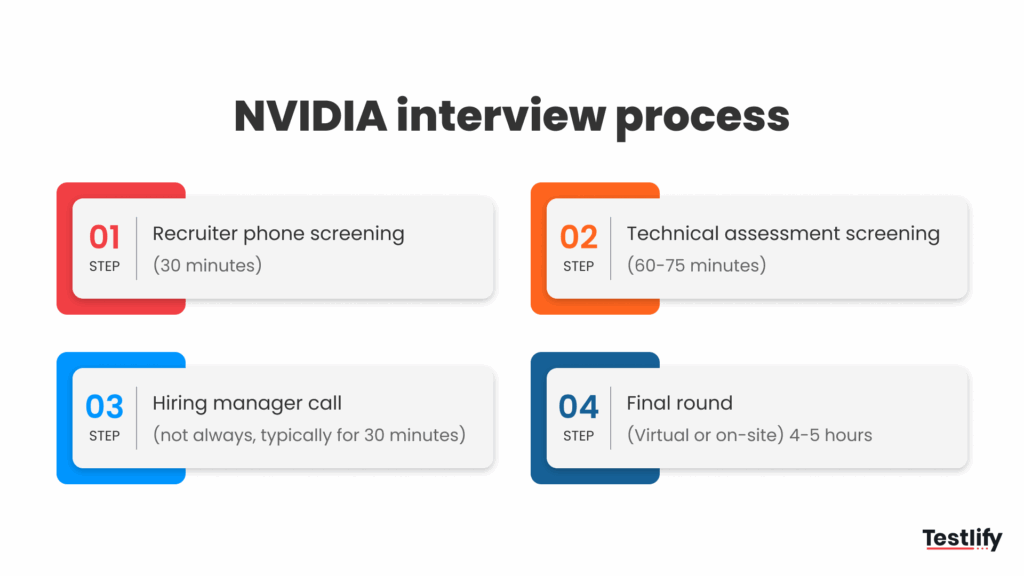
Stage | Format | Length | What it tests |
|---|---|---|---|
Recruiter screen | Phone call | 30 minutes | Fit, motivation, basic skills |
Technical assessment | Coding challenge | 60 to 75 minutes | Data structures and algorithms |
Hiring manager call (optional) | Call | 30 minutes | Background and team fit |
Final round | 3 to 4 interviews, onsite or virtual | 4 to 5 hours | Coding, domain, system design, behavioral |

How many rounds does NVIDIA have?
Most candidates go through 4 to 7 rounds. Non-technical roles sit at the lower end. Software and hardware engineering roles run 4 to 7, and senior or managerial tracks can stretch to about 12 screening touchpoints. The core sequence stays the same: recruiter screen, technical assessment, an optional manager call, then a 3 to 4 interview final round.
For software roles, the final loop usually splits into one or two coding rounds, a domain-specific round, and a behavioral round with the hiring manager. Each interview runs about an hour.
How long does the NVIDIA interview take?
From application to offer, NVIDIA’s process takes about 3 to 8 weeks, though senior and principal roles run longer. The recruiter screen and assessment usually land in the first two weeks. The final round and the offer decision add a few more, because each panelist submits a scorecard before the team aligns on a call.
Pro tip for candidates: ask your recruiter for the exact round order and the languages each team uses. NVIDIA’s process varies by team, so matching your prep to that specific team beats generic algorithm grinding.
What are the NVIDIA interview stages?
NVIDIA’s loop has four stages. The middle two flex by role, but the shape holds across most teams.
Recruiter phone screen
The first step is a 30-minute phone call with a recruiter. They check your background, your interest in NVIDIA and the specific role, and a few basics. Expect a “Why NVIDIA?” question to gauge whether the interest is real, plus a quick note on timelines and next steps.
Technical and coding assessment
The second step is a technical screen, usually a 60 to 75 minute coding challenge on a platform like Testlify. It leans on data structures and algorithms and runs at medium difficulty. Most teams use one or two coding rounds that are practical and project-focused rather than puzzle-style. For the recruiter view of how these screens work, see Testlify’s guide to technical assessments.
Hiring manager call (optional)
Some roles add a 30-minute hiring manager call. The first half covers your background and how you work; the second half is the manager selling the role and team, so you understand what the job is really like day to day.
Final round
The final round is 3 to 4 interviews, run onsite or virtually, each about an hour. A panel of up to five people probes your skills, experience, and team fit through a mix of technical and behavioral questions. A nice NVIDIA touch: you can book a 15-minute Insider Chat with a community resource group member to ask about culture before you decide.
What questions does NVIDIA ask?
NVIDIA blends practical coding, system design, and behavioral questions. The exact mix depends on the team, since you interview with the people you would actually work with.
Coding questions
Coding rounds test core computer-science skills plus domain-specific problems. Roles touching CUDA usually want strong C++; other teams use other languages. Commonly reported problems include:
- Implement an LRU cache
- Return the k most frequent numbers from a stream
- Check whether two strings are isomorphic
- Find the longest palindromic subsequence (dynamic programming)
- Detect a cycle in a directed graph
Expect arrays, strings, binary trees, graphs, and dynamic programming. The difficulty skews medium, and interviewers care how you reason through tradeoffs, not just whether you reach the answer.
System design questions
System design rounds vary by team. You might be asked “How would you design Twitter, Uber, or a website chatbot?” alongside role-specific challenges. For hardware-adjacent teams, brushing up on CPU and GPU architecture pays off.
Behavioral questions
The hiring manager round is more conversational and usually follows the STAR method. Expect questions like “What would your 30-60-90 day plan look like?” and prompts about past projects and how you solved hard problems. NVIDIA also checks alignment with its core values:
- Innovation
- Intellectual honesty
- Speed and agility
- Excellence
- One team
How hard is the NVIDIA interview?
NVIDIA interviews are moderately hard. Software engineering candidates rate the difficulty around 3.2 out of 5 on Glassdoor, and coding rounds sit mostly at medium level. The harder part is not the algorithms. It is showing real depth in the specific domain the team works on, because you interview directly with that team, not a random engineer who routes you later.
How does NVIDIA make hiring decisions?
After the final round, each panelist (up to five per loop) submits a 1 to 5 scorecard. Perfect scores are not required, but a single low score in any round can sink an offer. Managers and HR review the scorecards together, so the call is evidence-based and human-led rather than one gatekeeper’s gut feel.
What can recruiters learn from NVIDIA?
NVIDIA’s process is a clean example of skills-first, multi-signal hiring. Three moves are worth copying, whatever you hire for.
First, test current skills, not credentials. The World Economic Forum’s Future of Jobs Report 2025 found that employers expect 39% of workers’ core skills to change by 2030, so a resume can be out of date before the offer is signed. NVIDIA gets around this by hiring people who have built things and can prove it. (Source: World Economic Forum, 2025.)
Second, combine signals instead of trusting one interview. This is the idea behind Testlify’s Multi-Signal Talent Evaluation Model, which blends a skills assessment, a technical interview, a structured behavioral round, and reviewer scorecards so no single round decides the hire. NVIDIA’s loop is exactly that: each stage is a separate signal, and the 1 to 5 scorecards combine them into a human-led decision.
Third, prioritize practical, AI-era skills. The same WEF report ranks AI and big data as the fastest-growing skills, with more than 90% of employers in the top sectors expecting their use to rise. Screening on demonstrated skill also widens your funnel: LinkedIn found that a skills-first approach expands talent pools by nearly 10x on average.
The catch: a long multi-round loop only helps if every round measures something different. Copy NVIDIA’s structure, not its round count. Five interviews that all ask “tell me about yourself” add cost, not signal. You can run the same idea on a smaller scale with one assessment, one technical round, and one structured behavioral round, each scored on a rubric. For more on why structure matters, see structured versus unstructured interviews, and how peers do it in how Google hires tech talent and the Netflix hiring process.
Run NVIDIA-style skills assessments
Want to screen for real skills the way NVIDIA does? Testlify gives you 3,500+ ready-made coding, technical, and behavioral assessments so you can score candidates on the job before the first call. Start free or book a demo to see it on your own roles.
Key takeaways
- Skills first, not resume first. NVIDIA has hired on the strength of side projects because demonstrated ability predicts performance better than credentials. Ask candidates to show work, not just describe it.
- The loop is multi-signal by design. A recruiter screen, a coding assessment, technical rounds, and a behavioral round each measure something different, and the scorecards combine them. One signal is fragile; several pointing the same way build confidence.
- Candidates interview with the team they will join. Domain depth beats general prestige, so prep candidates for that specific team’s stack and problems instead of a generic loop.
- Difficulty is medium, but the bar is depth. Coding rounds are practical and project-focused rather than puzzle-style, which rewards engineers who understand tradeoffs over those who memorize patterns.
- Decisions are human-led and evidence-based. Panelists score 1 to 5, managers review together, and a single weak round matters. Structure protects against one loud opinion carrying a hire.
- Skills change fast. With 39% of core skills expected to shift by 2030, testing current, role-relevant skills beats trusting a resume that may already be out of date.
Frequently asked questions (FAQs)

Related resources
View all
Enterprise hiring process
OpenAI interview process: Steps, timeline, and questions
Enterprise hiring process
Walmart hiring process: A complete guide
Enterprise hiring process
Apple Interview Process: Rounds, Timeline and Questions
Enterprise hiring process
Netflix Hiring Process 2026: Stages, Timeline, and What Recruiters Can Steal

Enterprise hiring process
How FedEx hires at scale (what recruiters can learn)
Enterprise hiring process
Microsoft hiring process: Interview rounds and questions
Get started.
Hire on proof, not resumes.
Run your first skills-based assessment free — no credit card required.