
Performance review best practices: a 2026 guide for HR teams
How HR teams and managers can run fair, useful reviews: timing, preparation, goals, feedback phrasing, bias checks and follow-up steps.

Performance review best practices are the habits that make a review fair, specific and useful: clear expectations set in advance, evidence gathered all year, a two-way conversation, goals the employee can act on, checks against rating bias, and follow-up after the meeting. Done well, a review becomes a planning conversation instead of a verdict.
TL;DR / Key takeaways
- Good reviews set expectations early and use evidence from the whole year. They run two-way, agree SMART goals, check for bias and follow up.
- Trust is low: in Deloitte's 2025 research, 64% of workers called reviews a complete waste of time.
- Hold a formal review once or twice a year, backed by 15 to 30 minute check-ins every month or quarter.
- Book 45 to 60 minutes and share the written review in advance. The employee should talk for at least half the meeting.
- Give every manager the same template and rating definitions, and calibrate ratings to catch recency, halo and leniency bias.
- Discuss pay in a separate meeting, or employees tend to hear only the number.
- Send a written summary within a day and schedule the first check-in, or the next review repeats this one.
 ChatGPT
 Gemini
 Claude
 Grok
 Perplexity
Why do employee reviews need clear best practices?
Employee reviews need clear best practices because most people no longer trust the process. In Deloitte's 2025 research, 61% of managers and 72% of workers could not say they trust their organization's performance management process, and 64% of workers called reviews a complete waste of time.
The problem is rarely the idea of a performance review itself. The problem is how it is run: vague criteria, feedback saved up for one annual meeting, ratings based on the last few weeks, and no follow-up. Deloitte's 2025 Human Capital Trends report also found that only 26% of organizations rate their managers as very or extremely effective at enabling their team's performance, and that managers spend about 13% of their time developing people.
For HR teams in mid-sized and large companies, that gap shows up as uneven ratings across departments, promotion decisions that are hard to defend, and good people leaving after a review that felt unfair. A small set of shared practices, applied by every manager, fixes most of it.

What are the core best practices at a glance?
The core best practices fit in one table: set expectations early, keep notes all year, prepare with evidence, make the meeting two-way, agree on SMART goals, check ratings for bias, separate pay from development, and follow up. Each one prevents a specific failure that makes reviews feel unfair.
Best practice | What it looks like | The failure it prevents |
|---|---|---|
Set expectations early | Written goals and standards at the start of the period | "I never knew that was expected of me" |
Keep notes all year | A short log of wins and misses, updated monthly | Ratings based only on the last few weeks |
Prepare with evidence | Results, project outcomes, peer and customer feedback | Opinions with no examples behind them |
Make it two-way | Self-assessment first, questions, time for the employee to respond | A lecture the employee tunes out |
Agree on SMART goals | Specific, measurable goals with a date | Goals nobody can check |
Check for bias | Calibration across managers, the same template for all | Ratings that depend on who your manager is |
Separate pay from development | Compensation discussed in a different meeting | Employees who stop listening after hearing the number |
Follow up | A dated action plan and regular check-ins | A review that changes nothing |
Pro tip: Give every manager the same review template and the same rating definitions. Consistency across managers does more for fairness than any single change to the form.
How often should you review employee performance?
Employee performance is best reviewed with one formal review a year or every six months, backed by short check-ins every month or quarter. The formal review records results and agrees on goals. The check-ins catch problems early, so nothing in the formal review comes as a surprise.
Rhythm | Works best for | Watch out for |
|---|---|---|
Annual review only | Stable roles with long project cycles | Recency bias, issues raised months too late |
Semi-annual review | Most salaried roles | Still needs informal feedback in between |
Quarterly review | Fast-moving teams, sales, new hires | Review fatigue if each one is long |
Continuous check-ins | Every role, alongside a formal review | No written record unless notes are kept |
Instead of waiting for an annual review, many HR teams schedule quarterly or bi-monthly check-ins of 15 to 30 minutes. Some also stagger formal reviews across the year, for example on each employee's work anniversary, so managers are not writing 20 reviews in the same two weeks.
How should managers prepare before the review meeting?
Managers should prepare by collecting evidence, not impressions. Good preparation means reviewing the goals set last time, gathering results and feedback, reading the employee's self-assessment, and writing a draft review that cites specific examples. Reviews are won or lost before the conversation starts.
- Set clear objectives for the meeting: Both the manager and the employee should know what will be discussed and what outcomes are expected.
- Gather data and documentation: Collect task and project results and feedback from co-workers or clients, so the review rests on evidence rather than memory.
- Ask for a self-assessment: Employees who rate their own work first come to the meeting ready to talk, and managers learn how the employee sees their own progress. Self-assessment also builds a more engaged workforce.
- Add other views where they help: A 360 degree feedback assessment gives input from peers, direct reports and clients, which balances a single manager's view.
- Share the written review in advance: Sending it a day or two before lets the employee absorb it, so the meeting becomes a conversation.
- Schedule enough time: Rushing risks skipping important issues. Book 45 to 60 minutes for a formal review.
- Pick the right setting: Hold the review in a private, quiet place, or a video call with cameras on, free of interruptions.
How do you set goals employees can act on?
Goals employees can act on are specific, measurable, tied to company objectives and reviewed regularly. The SMART format (Specific, Measurable, Achievable, Relevant and Time-bound) is the simplest test: if a manager cannot say how and when a goal will be checked, the goal is not ready.
Clear goals matter more than most managers think. A Gallup survey cited by Deloitte found that less than half of workers (47%) know what is expected of them at work.
Compare two versions of the same goal:
- Vague: "Improve sales."
- SMART: "Increase new-customer sales by 10% in Q3, measured in the CRM, by adding two outbound campaigns a month."
Goals also need to line up with team and company goals, so the employee can see how their work contributes. Agree on two to four goals per period, write them down where both sides can see them, and review progress at each check-in rather than once a year. If priorities change mid-year, change the goals too, and note why.
How do you run the review conversation step by step?
The review conversation works best in six steps: open warmly and state the purpose, review the last period's goals, discuss strengths with examples, discuss areas to improve, agree on goals and support for the next period, and close with a written summary. The employee should talk for at least half the meeting.
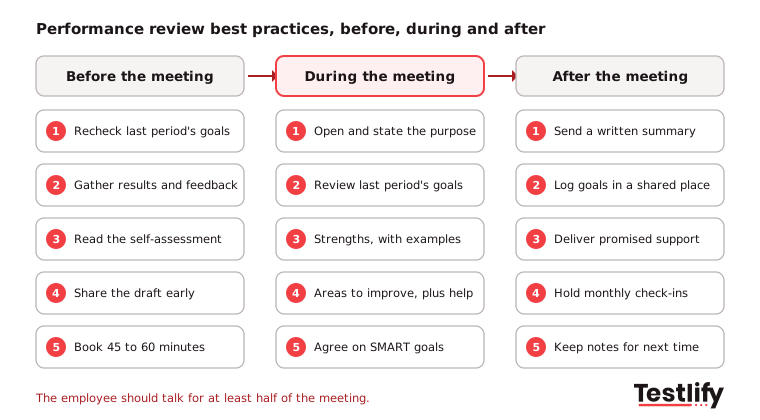
- Open the discussion: Thank the employee for their work, explain why the review is happening and what will be covered.
- Look back at last period's goals: Go through the goals and next steps agreed last time, what was achieved and what got in the way.
- Discuss strengths: Start with what the employee did well, using specific examples and the impact each one had.
- Discuss areas to improve: Focus on actions and results, not personality. Offer help and resources for each point.
- Agree on goals and support: Set SMART goals together, and name the training, mentoring or tools the employee needs.
- Close and confirm: Summarize what was agreed, invite final questions, and send a written summary within a day.
Throughout the meeting, ask open questions that need more than a yes or no answer, such as "What would help you hit this goal next quarter?" Then listen. Employees who feel heard are far more likely to act on the feedback. For more on keeping the dialogue open between reviews, see these tips for employee feedback and communication.
What should managers say, and what should they avoid?
Managers should say specific, behavior-based things tied to results, and avoid vague praise, labels about personality, and judgments without evidence. Feedback works when the employee can picture exactly what to repeat or change. "Your report was well organized and helped the client decide" beats "good job" every time.
Say this | Not this | Why |
|---|---|---|
"Your Q2 report was clear and the client approved it in one round." | "Good job this quarter." | Specific praise tells the employee what to repeat |
"Three of the last five deadlines slipped by two or more days." | "You are always late." | Facts are hard to argue with; labels start a fight |
"How did the handover go from your side?" | "You clearly didn't care about the handover." | Questions get context; guesses about intent damage trust |
"Let's agree on one change for next month." | "You need to fix everything we discussed." | One clear action is more likely to happen |
"What support would help you here?" | "Figure it out." | Offering help turns criticism into a plan |
A few rules make this easier. Use examples to illustrate every point. Acknowledge progress, not only results. Mention what the employee does well before areas to improve, but do not hide the real message inside praise. Never compare the employee with a named colleague.
How do you reduce bias and keep reviews fair?
Bias in reviews is reduced by using the same template and rating definitions for every employee, basing ratings on notes from the whole period, calibrating ratings across managers, and recording the evidence behind each rating. Fair reviews also protect the company, since reviews feed pay, promotion and discipline decisions.
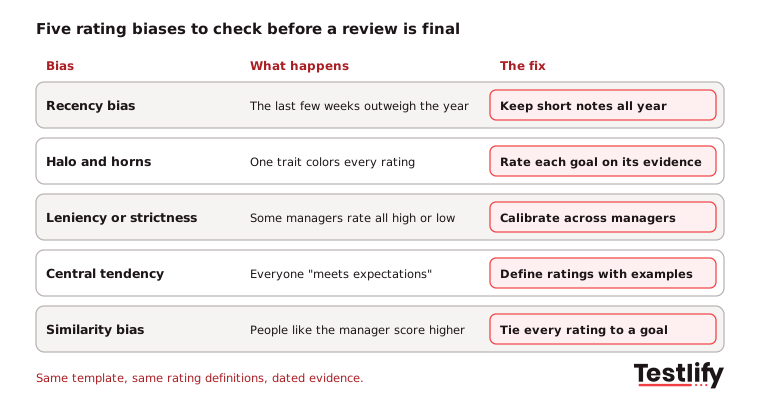
The most common rating biases are easy to name and easy to check for:
- Recency bias: the last few weeks outweigh the rest of the year. Fix it with notes kept all year.
- Halo and horns effect: one strong or weak trait colors every rating. See how the halo effect works, and rate each goal on its own evidence.
- Leniency or strictness: some managers rate everyone high, others everyone low. Calibration meetings bring ratings into line.
- Central tendency: everyone gets "meets expectations." Clear rating definitions with examples help managers use the full scale.
- Similarity bias: people who think like the manager get better ratings. Ask for evidence tied to the goal, not to style.
Documentation matters for legal reasons too. Under rules enforced by the US Equal Employment Opportunity Commission, it is illegal to discriminate in promotion, pay, discipline and other terms of employment based on race, color, religion, sex, national origin, age, disability or genetic information. A review backed by dated examples is far easier to defend than one built on impressions.
One more practice helps fairness: keep pay out of the development review. When salary is decided in the same meeting, employees tend to hear only the number. Hold the compensation conversation separately, after the review.
How do you handle difficult conversations about underperformance?
Difficult conversations about underperformance go best when the manager prepares, sticks to facts, stays calm and turns the discussion into joint problem-solving. The goal is a plan the employee believes in, with realistic goals, deadlines and support, not a list of complaints.
- Prepare mentally and emotionally: The conversation may feel awkward. Know the three or four facts you will raise and the outcome you want.
- Stick to facts: Use dated examples. Do not guess at motives or judge without evidence.
- Stay calm and show empathy: If the employee becomes upset, pause, acknowledge how they feel and continue when they are ready.
- Solve the problem together: Ask the employee for their own ideas on how to improve, agree on realistic goals and deadlines, and offer support such as extra training or mentoring.
- Escalate with a plan, not a surprise: If performance does not improve after support, involve HR early and move to a structured performance improvement plan with clear milestones.
How do you recognize high performers and support growth?
High performers are recognized best with specific praise, visible credit and real growth options, not only a higher rating. Reviews should celebrate achievements, then turn to the employee's career goals: what they want to learn, which projects would stretch them, and what the company can offer.
Recognition does not always have to be monetary. Public acknowledgment, new responsibilities, a seat on a key project or a development budget can matter as much as a raise. The review is also the right moment for a two-way conversation about career plans, so employees can say where they want to go and ask for guidance. When employees see the company investing in their growth opportunities, loyalty and engagement tend to follow.
Deloitte's research found that only 54% of managers feel confident coaching for career development, so HR teams should give managers a short guide or training on how to run this part of the conversation.
What should happen after the review?
After the review, the manager should send a written summary within a day, log the agreed goals where both sides can see them, schedule the first check-in, and deliver the promised support. Follow-up is what turns a review into better performance. Without it, the next review repeats this one.
Managers should give regular feedback between reviews and stay available for guidance. Open lines of communication, where employees feel free to ask for help, keep the momentum going between formal review cycles.
Manager engagement makes this harder than it sounds. Gallup's State of the Global Workplace reports that manager engagement fell to 22% in 2025, from 27% a year earlier. Disengaged managers skip check-ins first, so HR should make follow-up easy: calendar reminders, short check-in templates, and a simple view of open goals.
For how reviews fit into the wider planning, coaching and rating process, see the stages of the performance management cycle.
How can technology and skills data support reviews?
Technology supports reviews by keeping goals, notes and feedback in one place all year, and skills data adds objective evidence of what an employee can do today. HR software makes scheduling, tracking and documenting reviews simpler, while analytics show trends across teams and flag managers whose ratings sit far from the rest.
A central record matters beyond day-to-day tracking. Documented reviews become the formal history HR and managers rely on when they make decisions about promotions, salary increases and development. Because this data is sensitive, choose tools that meet privacy law and limit who can see each record.
Skills assessments add something most review forms lack: a measured view of skills, not only a manager's opinion. Teams use them to find skill gaps before a development plan, to check readiness for a promotion, and to compare progress over time. Testlify's library of 3,500+ tests covers technical, cognitive, language and role-specific skills, with a per-skill breakdown in every report. See how teams use skill assessment results to improve performance.
Key takeaway: The best reviews are short on surprises and long on evidence. Set expectations early, keep notes all year, check ratings for bias, and follow up. The form matters far less than the habits around it.
Ready to bring skills data into your next review cycle?
Pair your next review with a measured view of each employee's skills. Browse the Testlify test library or start a 7-day free trial of Testlify, no credit card required, and run a skills or 360 feedback assessment before your next review cycle.
Frequently asked questions
Related resources
View all
HR & recruitment
5 successful pre-boarding strategies for HR’s in 2026

HR & recruitment
What HR teams can do during a hiring freeze: a week-by-week plan
HR & recruitment
9 Outbound recruiting strategies to hire faster

HR & recruitment
How to onboard and train blue-collar workers

HR & recruitment
How to measure and improve blue-collar worker productivity and engagement

HR & recruitment
5 common HR compliance landmines and how to avoid them
Get started.
Hire on proof, not resumes.
Run your first skills-based assessment free — no credit card required.