
Inbound Recruiting: How to Attract Top Talent in 2026
Learn inbound recruiting and its step-by-step process! Learn how to attract, engage, and convert top talent through effective strategies.
Inbound recruiting is a hiring approach that attracts candidates to your company through employer brand, content, and reputation, so they show up already interested instead of being chased through cold outreach. You build a place people want to join, then you let that pull do the work that outbound sourcing usually grinds out by hand.
Here is why it matters right now. In SHRM’s 2024 Talent Trends research, the top three recruiting headaches were a low number of applicants (60%), competition from other employers (55%), and candidate ghosting (46%). Recruiting difficulty has eased from its 91% peak in 2022, but more than 75% of organizations still struggled to fill full-time roles in 2024. You cannot fix a thin applicant pool by sending more cold messages. You fix it by becoming a company people seek out, which is the whole point of inbound and the reason it keeps gaining ground in 2026.
This guide covers what inbound recruiting is, why it works, the five-step process to run it, how it differs from outbound, and how to tell if it is paying off. Plus, where do skills assessments fit, because attracting people is only half the job? You still have to pick the right ones.
 ChatGPT
 Gemini
 Claude
 Grok
Grok Perplexity
TL;DR
- Inbound recruiting attracts candidates with brand, content, and reputation instead of cold outreach, so applicants arrive warm and pre-sold on you.
- It directly answers the biggest 2024 hiring problems SHRM found: too few applicants and stiff competition for the ones who exist.
- Run it in five steps: build the employer brand, publish real content, fix the career page, nurture a talent community, and turn employees into referrers.
- It is a slow burn. Expect a few months before the pipeline fills, so pair it with outbound for roles you need filled this quarter.
- Attraction without screening just gives you more resumes. Use skills assessments to score the warm inbound traffic before the first call.

What is inbound recruiting?
Inbound recruiting attracts candidates to your open roles through your culture, mission, content, and reputation, rather than reaching out to them first. The same way inbound marketing pulls customers toward a brand, inbound recruiting pulls talent toward your jobs. By the time you talk, they already know who you are and want in.
Think of it as the difference between knocking on doors and having people knock on yours. Outbound recruiting is the knock: cold messages, sourcing, follow-ups. Inbound is the porch light. You make the company visible and worth approaching, and interested people find their way to the application on their own.
The catch worth naming up front: inbound does not fill a seat tomorrow. It builds a pipeline that fills seats for years. So it is a long game that rewards patience, not a cold-outreach replacement you switch on for an urgent role.
Why does inbound recruiting matter?
Inbound recruiting matters because it attacks the exact problems most teams are stuck on: not enough applicants, too much competition, and slow hiring. When candidates already trust your brand, you spend less time convincing and more time choosing. The pool gets bigger and warmer at the same time.
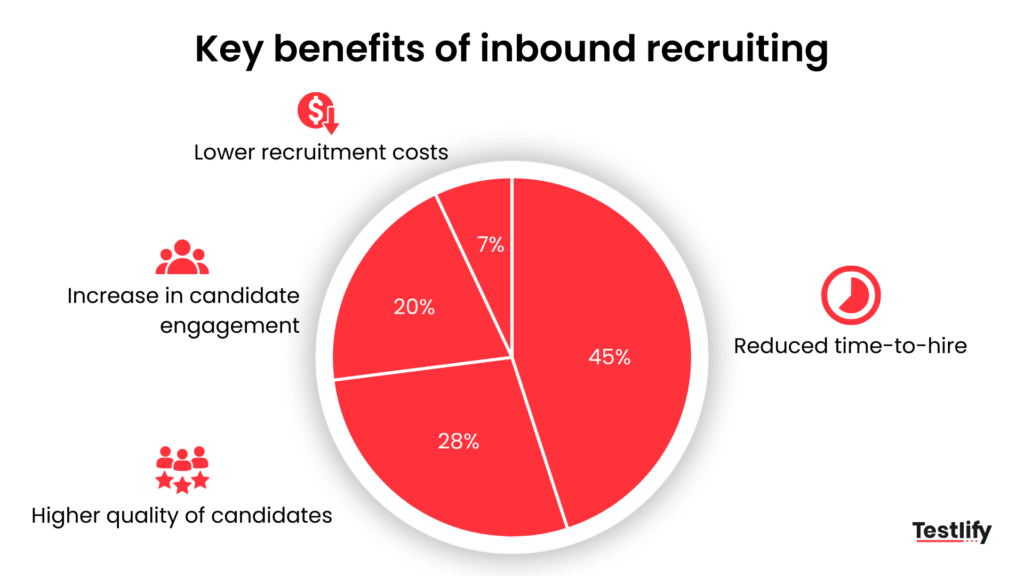
It builds warmer relationships with candidates
People who come to you through your content and culture are not strangers. They have read your blog, watched a team video, and maybe followed you for months. That head start shows up later as faster yeses, fewer dropouts, and new hires who actually wanted this job, not just a job. It is a different quality of candidate from the start.
It cuts time to hire
Warm candidates skip the warm-up. They have already pre-qualified themselves on values and fit, so you compress the early stages that usually take weeks. A 6-week screening process can shrink to 10 days when candidates are pre-qualified for skills before the first call, rather than being evaluated after multiple interview rounds.
It reaches passive talent you would otherwise miss
The best person for your role probably is not job hunting. LinkedIn Talent Solutions puts passive candidates at 39% of the talent pool: people who are not applying but would move for the right opportunity. A strong, visible brand is how you reach them, because they will never answer a cold message, but they will notice a company that keeps showing up with something worth reading.
How does the inbound recruiting process work?
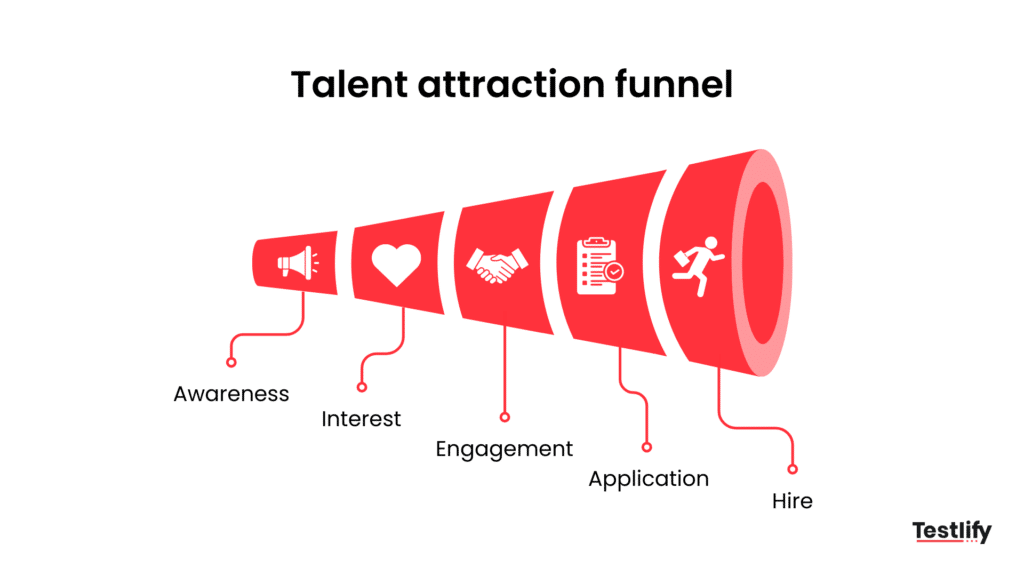
The inbound recruiting process runs in five steps: build your employer brand, create content people want, turn your career page into a conversion engine, nurture interested candidates, and tap your employees for referrals. At Testlify, we group these into a simple loop we call the Testlify Attract-Screen-Nurture framework: attract with brand and content, screen with skills assessments, and nurture the pipeline so good people stay close until a role opens.
Step 1: Build your employer brand
Your employer brand is your reputation as a place to work, and it decides who bothers to apply. Be specific about what you stand for, because vague values attract nobody. Share real employee stories over polished slogans. Keep the message consistent across your site, social, and interviews so the company a candidate meets in week six matches the one they fell for in week one. For a deeper playbook, see our guide on building a strong employer brand.
Step 2: Create content that earns attention
Content is how strangers get to know you before they ever apply. The useful kind is honest and specific, not a brochure. A few formats that pull their weight:
- Posts about how your team actually works, what a project looks like, and the parts of your company culture people would not guess from the outside.
- Short behind-the-scenes video: a real day, an unscripted team moment, an engineer explaining a hard call they made.
- Social updates that show progress and personality, not just open roles and award badges.
- The occasional podcast or webinar that proves you know your field, which pulls in the professionals already working in it.
Pro Tip: One honest story about a challenge your team solved will attract more candidates than ten generic culture posts. People remember specifics. They don’t remember polished slogans.
Step 3: Build a career page that converts
Your career page is where interest turns into an application or quietly dies. Make every role easy to understand and easy to apply to. The essentials:
- Clear job descriptions that say what the person will actually do, who they work with, and why the role exists.
- Real photos, short video, and employee quotes, so the culture is shown, not just claimed.
- An application that a busy person can finish in a couple of minutes. Long forms are where good candidates quit.
- Plain language and the terms people search so the page shows up and reads fast.
Step 4: Nurture candidates over time
Most people who like your company are not ready to switch jobs the day they discover you. Don’t let that interest go cold.
Stay visible until the timing is right:
• A genuinely useful newsletter about your team, industry, and occasional opportunities.
• Real engagement on professional networks, not a recruiter message that appears only when there’s a vacancy.
• Helpful content with no immediate ask attached—career insights, industry trends, lessons learned, and honest perspectives.
The goal isn’t to convince someone to apply today. It’s to be the company they think of when they’re ready.
Step 5: Turn employees into a referral engine
Your team knows people you will never reach with a job ad. Referrals are consistently a top source of hires, and the quality holds up. In one Gallup analysis of a large internship program, internal referrals were more than 40% more likely to land an interview and an offer than people who applied through the company’s own channels. To get there, make referring easy and worth it:
- Reward successful referrals with a bonus, extra time off, or both, and pay out when it counts.
- Tell everyone the program exists and how it works. A referral program nobody remembers is not a program.
- Make the act of referring take two minutes, not a form and a meeting.
Key Takeaway: The five steps compound. Brand makes content land, content fills the career page, the career page feeds the talent community, and a warm community makes referrals easy. Skip a step and the loop leaks. Run all five, and inbound starts carrying your pipeline.
Inbound vs outbound recruiting: what’s the difference?
Inbound attracts candidates to you through brand and content, so they arrive interested; outbound reaches out to candidates directly to fill a role fast. Inbound is patient and builds a pipeline; outbound is active and targets specific people now. Most teams should run both, leaning inbound for the long game and outbound for urgent or niche seats. Here is the side-by-side comparison:
Inbound recruiting | Outbound recruiting |
|---|---|
Attracts candidates through employer brand and content | Reaches out directly through cold calls, email, and sourcing |
Builds long-term relationships and a talent pipeline | Fills immediate or hard-to-fill roles |
Candidates arrive already interested in your brand | Recruiters find and engage talent one by one |
Passive: a brand that pulls talent in over time | Active: direct, person-by-person contact |
Lower outreach effort, heavier on content and brand | High effort per candidate, faster to start |
Channels: content, social media, career pages, referrals | Channels: cold calls, email, job boards, sourcing tools |
The honest answer to “which one” is rarely one. Inbound without outbound leaves urgent roles open while the pipeline warms up. Outbound without inbound means you start every search from zero. The teams that hire well use inbound to lower the cost and effort of every future search, then aim outbound at the few seats that cannot wait. If you want the outbound side in depth, here are strategies to attract top talent directly.
Best practices for inbound recruiting
Inbound works best when you treat candidates like people, screen with real evidence, and let data tell you what to repeat. Three habits separate teams that fill a pipeline from teams that just post content into the void.
Put candidate experience first
Every step of inbound is candidate experience, from the first blog post to the rejection email. Reply fast. Tell people where they stand. Make the process feel human even when the answer is no, because the person you reject this year refers a friend or applies again the next. A bad experience does the opposite, quietly, for a long time. Treat it as part of the culture you are known for, not a back-office task.
Screen with skills, not just resumes
Here is the trap nobody warns you about: inbound works, the applicants pour in, and now you are drowning in resumes with no fast way to tell who can actually do the job. Skills assessments fix that. SHRM found 56% of organizations use pre-employment assessments, and 78% of them say the assessments improved their quality of hire. Score the warm inbound traffic on the actual skills the role needs before the first call, and your shortlist is built on evidence instead of a gut read of a CV.
Let data tell you what to repeat
You cannot improve what you do not track. Watch source of hire, time to hire, application completion rate, and quality of hire by channel. If a single blog post or one referral path keeps producing strong hires, do more of that and cut what produces nothing. Inbound rewards the teams that treat it like an experiment, not a vibe.
How do you measure inbound recruiting success?
You measure inbound recruiting success with five metrics: source of hire, time to hire, application completion rate, quality of hire, and the size of your talent pool. When warm applicants and referrals climb while time to hire falls, inbound is working. Tie every metric back to the channel that produced it, so you know what to scale and what to drop.
- Source of hire: which channels actually produce hires, not just clicks. Understand more about the different types of recruitment sources.
- Time to hire: the days from application to offer, which inbound should shorten as candidates arrive warmer.
- Application completion rate: how many people who start your form finish it, a direct read on career-page friction.
- Quality of hire: how your inbound hires perform and stay, which is where assessments earn their keep.
- Talent pool growth: how fast your nurtured community is growing, since that is next quarter’s pipeline.
Start attracting better candidates with Testlify
Inbound recruiting gets the right people to your door. Skills assessments make sure you pick the right ones once they arrive. That is the part Testlify owns: a large library of role-based, cognitive, and personality tests you can put in front of warm inbound applicants to score them on what the job actually needs before you spend a single interview slot. If a thin or unqualified applicant pool is your real bottleneck, fix the attraction with inbound and the selection with assessments.
See how skills-first screening works for your roles. Start for free with the Testlify test library, or book a demo and we’ll help map the right assessments to the roles you’re hiring for next.
FAQs

Content Writer
Yashika Khandelwal is a Content Writer with 3+ years of experience creating research-backed content on hiring, talent assessment, and HR technology. She is a registered Organizational Psychologist and subject matter expert who combines behavioral science with practical recruitment insights to produce accurate, evidence-based content.
LinkedInRelated resources
View all
HR & recruitment
What is a talent gap and how to address one?

HR & recruitment
What Is Resume Parsing? How It Works, Types, and Tips (2026)
HR & recruitment
What is 360 recruitment? What recruiters should know
HR & recruitment
What is a competency framework and how to develop one?
HR & recruitment
HR Digital Transformation: A 2026 Guide for HR Leaders
HR & recruitment
Talent Lifecycle: 5 Stages and HR’s Role (2026 Guide)
Get started.
Hire on proof, not resumes.
Run your first skills-based assessment free — no credit card required.