
How to hire top talent using deductive reasoning test: a 2026 guide
A hiring team's guide to deductive reasoning tests: sample questions, which roles need one, how to set a cut-off and keep the test fair.
To hire top talent using deductive reasoning test results, give every applicant the same short, timed set of logic problems, compare scores against people who already do the job well, and send the strongest candidates to a structured interview. A deductive reasoning test measures whether a candidate can take a set of facts or rules and reach the only conclusion that follows from them, without guessing or bringing in outside knowledge.
 ChatGPT
 Gemini
 Claude
 Grok
 Perplexity
TL;DR
- Hire top talent with a deductive reasoning test by using it early, on roles that apply rules to cases, and setting the cut-off from 10 or more of your own strong performers.
- A deductive reasoning test gives candidates rules or facts and asks which conclusion must be true; most employer versions take 12 to 25 minutes.
- The test suits analysts, auditors, compliance and legal staff, developers, QA and project managers. Give it low weight where empathy or craft matter more.
- Analytical thinking is the core skill employers rate highest: the WEF Future of Jobs Report 2025 says seven in 10 companies call it essential.
- A score should narrow the field, never make the final call. Pair it with a role skills test and a structured interview, and have a person review every rejection near the cut-off.
- Tell candidates the format, time limit and how to ask for an accommodation, and share sample questions. Familiar formats cut drop-off without making the test easier.
- Check pass rates across candidate groups every quarter and switch on proctoring, because short text-based logic questions are easy to paste into an AI tool.

What is a deductive reasoning test?
A deductive reasoning test is a timed cognitive ability assessment that gives candidates premises, such as rules, facts or conditions, and asks which conclusion must be true. Candidates score only for answers that follow strictly from the information given. Most employer versions run 12 to 25 minutes with about 18 to 22 questions.
Deductive reasoning works from the general to the specific. If every invoice over $10,000 needs two approvals, and this invoice is $12,000, it needs two approvals. The value of deduction is certainty: when the premises are true and the logic is sound, the conclusion cannot be wrong. The test checks whether a candidate reaches that answer reliably and quickly, and whether they can tell when the facts are not enough to decide.
That last point matters more than people expect. Many questions have a "cannot say" option, and strong candidates pick it when the premises leave the answer open. Weak candidates fill the gap with assumptions, which is the same habit that causes errors in audit, compliance and code review work.
Most tests cover a handful of skills:
- Conditional reasoning: Applying "if this, then that" rules to a new case.
- Categorical reasoning: Working out what follows when one group sits inside or outside another.
- Ordering and constraints: Placing people, tasks or dates in a sequence that satisfies every rule.
- Spotting missing information: Recognising when no conclusion is guaranteed.
The test is narrower than a general aptitude test. A deductive reasoning test does not measure maths, vocabulary or job knowledge. For a broader read on thinking skills, see the guide to cognitive ability tests.
What do deductive reasoning test questions look like?
Deductive reasoning test questions come in four main formats: syllogisms, ordering and arrangement, grouping, and assumption questions. Each one gives a short set of facts and asks for the one answer those facts guarantee. The examples below are written for this guide and show the format and the reasoning behind each answer.
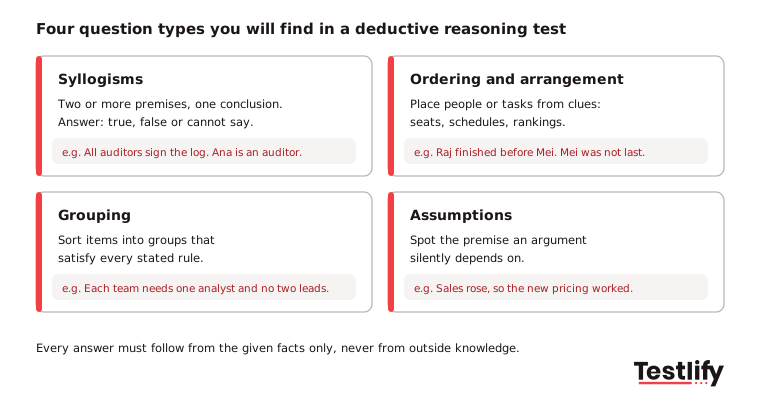
1. Syllogism: All analysts on the risk team passed the compliance course. Priya is on the risk team but is not an analyst. Conclusion: Priya passed the compliance course. True, false or cannot say?
Answer: Cannot say. The rule covers only analysts, so the facts do not tell you whether Priya passed.
2. Ordering: Four interviews take place Monday to Thursday, one a day. Tom's interview is on Thursday. Lee's is on Wednesday. Kim's is before Lee's, and Sara's is not on Monday. Who is interviewed on Monday?
Answer: Kim. Lee and Tom fill Wednesday and Thursday, which leaves Monday and Tuesday for Kim and Sara. Sara cannot take Monday, so Kim does.
3. Grouping: Six people split into two teams of three. Ana and Ben cannot be on the same team. Cy must be on the same team as Dee. Eli is on Ana's team. Which statement must be true? A. Cy is on Ana's team. B. Fay is on Ben's team. C. Ben, Cy and Dee are on the same team. D. Eli and Dee are on the same team.
Answer: C. Ana's team already holds Ana and Eli, so only one seat is left there. Cy and Dee must sit together, so the only team with room for both is Ben's.
4. Assumption: "Time-to-hire fell after we introduced a screening test, so the test reduced time-to-hire." Which assumption does this argument rely on?
Answer: That nothing else explains the drop, such as a hiring freeze or a new recruiter. Timing alone does not prove the test caused it.
Be wary of tests that label number series ("3, 6, 9, 12, ?") or word analogies ("hand is to glove as foot is to ?") as deductive. Those items test pattern spotting and vocabulary, which are inductive and verbal skills. They are useful, but they do not tell you whether a candidate applies rules correctly.
Pro tip: Ask your test provider for sample questions and share them with candidates before they start. Familiar formats reduce anxiety and drop-off, and they do not make the test easier to pass, because each live question is new.
Why should you hire top talent using deductive reasoning test scores?
Hiring teams use deductive reasoning test scores because analytical thinking is the skill employers rate highest and the hardest to judge from a resume. A short test gives every applicant the same problems under the same conditions, so the shortlist rests on shown ability instead of job titles, school names or interview confidence.
The demand is clear in recent data. The World Economic Forum's Future of Jobs Report 2025 found that analytical thinking remains the top core skill, with seven out of 10 companies calling it essential. NACE's Job Outlook 2025 survey found that nearly 90% of employers look for evidence of problem-solving ability when they review graduate resumes, yet a resume can only claim that skill.
Testing skills directly also pays off in hire quality. LinkedIn's Skills Signal report (June 2025) found that companies using skills-based talent searches are 12% more likely to recruit high-quality hires, and that workers matched on skills rather than titles qualify for more than three times as many roles.
For TA teams, the practical benefits are:
- Faster first screens: A 20-minute test replaces hours of resume reading for high-volume roles.
- Lower screening cost: Candidates who cannot apply rules leave the process before they reach a hiring manager's calendar.
- A wider talent pool: Career switchers and graduates without the "right" background get a fair shot. See the benefits of skills-based hiring.
- Consistent evidence: Every candidate answers the same problems, which makes decisions easier to explain to hiring managers.
- Better interviews: Scores show where to probe, so interviewers spend time on the gaps.
Which roles should take a deductive reasoning test?
Roles that apply rules, policies or logic to new cases every day should take a deductive reasoning test. The skill matters most for analysts, auditors, compliance and legal staff, developers and QA, and project managers. For roles where speed, empathy or craft matter more, give the test a low weight or skip it.
Role | Why deductive reasoning matters | Suggested weight | Pair it with |
|---|---|---|---|
Financial or business analyst | Draws conclusions from rules, data and stated conditions | High | Numerical reasoning, Excel skills test |
Auditor or compliance analyst | Checks whether records meet each stated rule | High | Role knowledge test |
Risk manager or investigator | Tests whether the evidence supports a finding | High | Critical thinking test |
Legal professional or paralegal | Applies clauses and statutes to a set of facts | High | Verbal reasoning test |
Software developer or QA specialist | Traces conditions step by step to find the fault | Medium | Coding test |
Project manager or strategic planner | Schedules work under fixed constraints | Medium | Situational judgment test |
Operations or support team lead | Applies policy to individual cases | Low to medium | Situational judgment, chat simulation |
The weights above are a starting point, not a rule. Move them once you see how scores line up with performance in your own teams. For entry-level roles where few candidates have work history, the test often carries more weight because there is less other evidence to go on.
For roles that also need pattern spotting in unfamiliar material, add an abstract reasoning test. For roles that read dense documents, add a verbal reasoning test.
How do you hire top talent using deductive reasoning test results, step by step?
Hiring with a deductive reasoning test takes six steps: define where the role uses rule-based decisions, choose the test and a role skills test, set a cut-off, invite and proctor candidates, review scores alongside a structured interview, and check outcomes. Teams that skip the cut-off or outcome steps usually end up with a test nobody trusts.
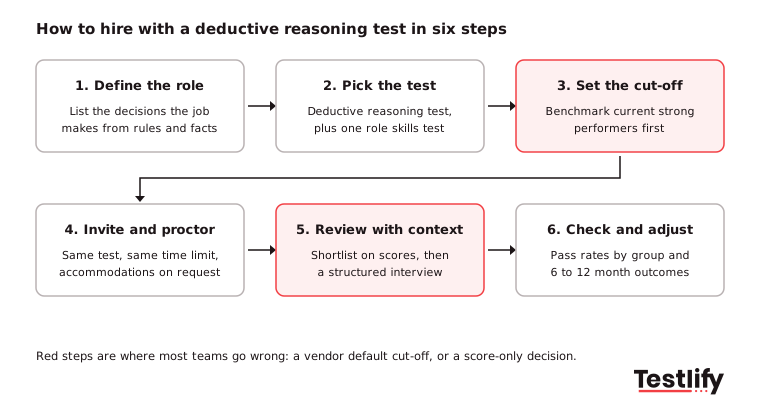
- Define the role: List three to five decisions the person makes from rules and facts, such as approving claims, checking contracts or fixing failed builds. If you cannot list any, the test is the wrong tool.
- Pick the tests: Use a deductive reasoning test for the reasoning skill and one role-specific test for job knowledge. Keep the total under 45 minutes to protect completion rates.
- Set the cut-off: Benchmark current strong performers before you go live (see the scoring section below).
- Invite and proctor: Send every candidate the same test and time limit, explain the format, and state how to ask for an accommodation.
- Review with context: Use scores to build the shortlist, then run a structured interview that probes the same reasoning with real work cases.
- Check and adjust: Every quarter, compare pass rates across candidate groups and look at how hires perform after 6 to 12 months.
Where does a deductive reasoning test fit in your screening workflow?
A deductive reasoning test fits best right after the application and any knockout questions, and before the first interview. At that point the pool is still large, so a 20-minute test saves the most recruiter time, and every candidate who reaches an interview has already shown the reasoning the role needs.
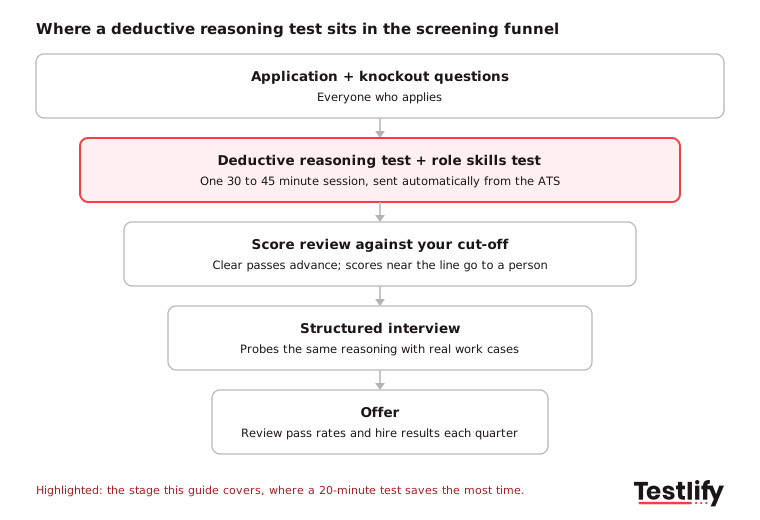
Three set-up choices make the test easy to run at volume:
- Connect it to your ATS: Candidates should get the invite automatically when they reach the assessment stage, and scores should flow back to the candidate record. Testlify connects to 100+ ATS and HRIS tools through two-way integrations.
- Use one assessment, not three invites: Bundle the reasoning test with the role skills test so candidates sit one session in one place.
- Automate the clear cases only: Auto-advance candidates well above the cut-off and route everyone near it to a person. Avoid automatic rejection for scores just under the line.
For senior roles with small, hand-picked pools, the test can move later, after a first conversation, where it adds evidence without slowing a scarce candidate.
How do you choose or design a fair deductive reasoning test?
A fair deductive reasoning test matches the level of the role, uses plain and neutral wording, gives clear instructions with a worked example, and has been tried on current staff before candidates see it. A ready-made test from a provider should meet the same checks as one you build yourself.
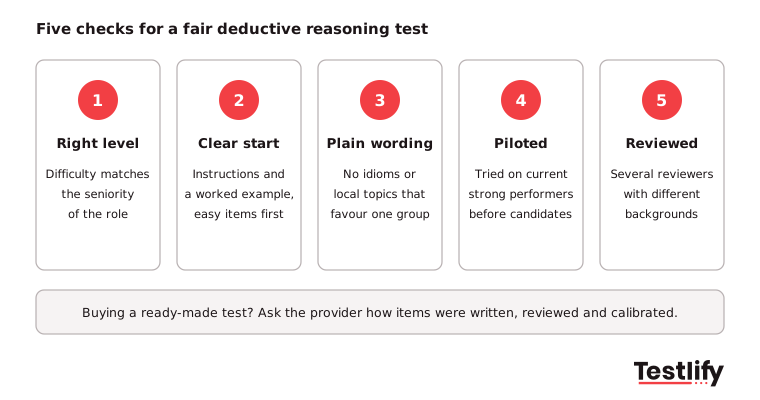
- Match difficulty to seniority: An intermediate test suits most graduate and mid-level roles. Senior analyst, risk or legal roles may need harder items or a second reasoning test.
- Ramp the difficulty: Start with easier questions and build up, so nervous candidates settle in before the hard items.
- Pilot on your own team: Run the test with a small group of current employees first. Questions that strong performers miss or argue about need fixing or removing.
- Write clear instructions: Explain the answer options, including "cannot say", and show one worked example before the timer starts.
- Use neutral, plain language: Avoid idioms, local references and topics that favour one background. A logic problem about cricket scores tests cricket knowledge as much as logic.
- Have several people review the items: A reviewer panel with different backgrounds catches wording that confuses or disadvantages a group.
If you buy rather than build, ask the provider how the items were written and reviewed. Testlify's test is designed by subject matter experts, peer-reviewed and calibrated on results from people skilled in the area.
How should you score results and set a cut-off?
Scoring a deductive reasoning test starts with your own benchmark, not a vendor default. Test 10 or more people who already do the role well, use their typical score as the reference point, and set the cut-off slightly below it. Candidates just under the line go to a review zone instead of an automatic reject.
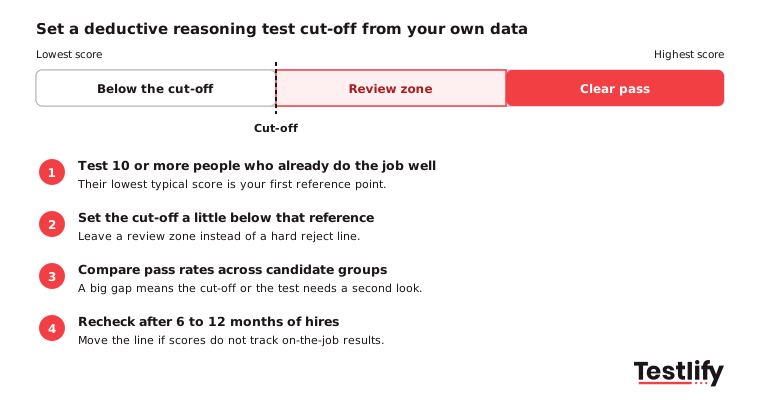
Three things make scores easier to use:
- Use percentiles for comparison: A raw score of 13 out of 18 means little on its own. A percentile against your benchmark group or the test's norm group tells you where the candidate stands.
- Look at accuracy and completion: A candidate who answered 12 questions and got all 12 right is different from one who answered 18 and got 12 right. The first may simply be slower and more careful.
- Treat a low score as a question, not a verdict: Time pressure, testing in a second language or a disability can pull a score down. Check whether the candidate needed an accommodation before you rule them out.
A simple banding scheme helps hiring managers read results quickly:
Percentile against your benchmark | What it means | Next step |
|---|---|---|
70th and above | Reasoning at or above your strong performers | Advance to interview |
40th to 69th | Close to the bar | Review zone: a person checks the full profile |
Below 40th | Well below your strong performers | Decline, with short feedback |
Adjust the bands once you have six to 12 months of hire data. For more on reading the numbers, see how to use cognitive ability test results.
Key takeaway: A deductive reasoning test should narrow the field, not make the final call. Combine the score with a role skills test and a structured interview, and give a person the final decision on every rejection near the cut-off.
What should you tell candidates before a deductive reasoning test?
Candidates should know the test format, the time limit, the kinds of questions, why the role needs the skill, and how to ask for an accommodation before they start. Clear expectations cut drop-off and complaints, and they make the test fairer, because nobody loses points to surprise.
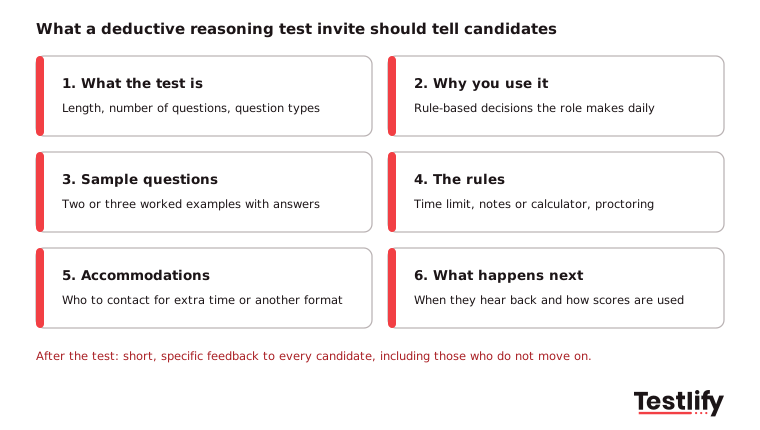
A good invite covers six points:
- What the test is: "A 20-minute deductive reasoning test with 18 questions."
- Why you use it: "The role applies policies to new cases every day, so we test that skill directly."
- What the questions look like: Link two or three sample questions with answers.
- The rules: Time limit, whether a calculator or notes are allowed, and that the test is proctored.
- Accommodations: Who to contact for extra time, a screen reader or another format, and by when. In the UK, GOV.UK guidance on reasonable adjustments covers changes to the recruitment process itself.
- What happens next: When candidates will hear back and how scores are used alongside interviews.
After the test, send short and specific feedback to everyone, including candidates who do not move forward. A line on what the test measured and where the candidate stood keeps your employer brand intact. See how to give constructive feedback to candidates.
How do you keep a deductive reasoning test fair and compliant?
Keeping a deductive reasoning test fair means three things: use it only where the role really needs the skill, check pass rates across candidate groups, and offer accommodations. Regulators in the US and UK expect all three, and New York City adds extra rules when an automated tool helps decide who moves forward.
- Job-related and needed: The EEOC guidance on employment tests says that when a test screens out a protected group at a higher rate, the employer must show it is job-related and consistent with business necessity. The employer stays responsible even when the vendor supplies the evidence. Write down why the role needs the skill (step 1 above) before you launch.
- Check pass rates by group: Compare the share of each candidate group that passes. A large gap is a signal to review the cut-off, the weight, or whether the test fits the role. No test is automatically bias-free; you find out by checking.
- Accommodations: The same EEOC guidance covers reasonable accommodations in how tests are given, such as extra time or a reader. In the UK, employers must make reasonable adjustments so a disabled candidate can be considered (see the invite section above).
- Automated decisions in New York City: Under Local Law 144, an automated employment decision tool needs a bias audit within one year of use, public audit results and notice to candidates. Testlify publishes its NYC bias audit of its Matching Model, completed in June 2023.
This is general guidance, not legal advice. Check local rules with your legal team before a new test goes live.
How do you stop cheating on an online reasoning test?
Stopping cheating on an online deductive reasoning test takes proctoring plus test design. Logic questions are short and text-based, so an unproctored test is easy to paste into an AI chat tool or hand to a friend. Proctoring checks, question randomization and a strict time limit close most of those gaps.
Practical controls to switch on:
- Full-screen mode and tab tracking: Candidates cannot open another window unnoticed.
- Copy and paste blocking: Questions cannot be dropped into a chatbot.
- Webcam snapshots and face detection: The same person sits the whole test.
- AI assistance detection: Answer patterns that suggest outside help get flagged.
- Question randomization: Two candidates rarely see the same order.
Testlify includes 20+ proctoring checks with every assessment, covering all of the above. See the full list on the anti-cheating and proctoring page.
What mistakes should you avoid when you hire top talent using deductive reasoning test scores?
The most common mistakes are using the test for every role, borrowing a vendor's default pass mark, rejecting candidates on the score alone, and never checking results after launch. Each one turns a useful screen into a filter that loses good people and is hard to defend.
- Testing every role the same way: A customer support hire and a risk analyst do not need the same weight on deduction.
- Copying a default cut-off: A vendor's norm group may look nothing like your applicants. Benchmark your own strong performers.
- Stacking too many tests: Three or four tests in one invite push completion down. Keep the whole session under 45 minutes.
- Letting the score decide alone: Always pair it with a role skills test and a structured interview.
- Skipping the follow-up: If you never compare scores with on-the-job results, you cannot tell whether the cut-off is right.
What is the difference between a deductive and an inductive reasoning test?
The difference between a deductive and an inductive reasoning test is the direction of the logic. A deductive test gives rules and asks for the conclusion that must follow. An inductive test gives examples, often shapes or number series, and asks the candidate to work out the rule. Many roles benefit from one of each.
Deductive reasoning test | Inductive reasoning test | |
|---|---|---|
Starts from | Rules, facts, premises | Examples, patterns, sequences |
Asks for | The conclusion that must be true | The rule behind the pattern |
Typical format | Text: syllogisms, ordering, grouping | Visual: shapes, series, matrices |
Best for | Analysts, auditors, legal, QA | Engineers, designers, researchers, new grads |
For the full comparison, read deductive vs inductive reasoning. If you need a broader screen of both, a logical reasoning test covers more question types in one sitting.
How does Testlify's deductive reasoning test work?
Testlify's Deductive Reasoning Test is a 20-minute, 18-question cognitive ability test at intermediate level, available in English and French. The test measures logical analysis, pattern recognition, problem solving, decision making, critical thinking and analytical reasoning, and suits roles such as analyst, auditor, risk manager, investigator, software developer and project manager.
You can run it on its own or inside a multi-test assessment with role skills tests from a library of 3,500+ tests. Results come back scored automatically, with a per-skill breakdown and a ranked list of candidates, and sync to your ATS. For a broader thinking-skills screen, the critical thinking test pairs well with it.
Ready to hire top talent with a deductive reasoning test?
Preview the sample questions and add the test to an assessment from the Deductive Reasoning Test page, with a 7-day free trial and no credit card. Hiring at volume or across several regions? Book a demo to see the test, proctoring and ATS sync in one walkthrough.
Frequently asked questions (FAQs)

Related resources
View all
HR & recruitment
How to assess HTML5 developer skills for hiring

HR & recruitment
How to hire top talent using sales tests: a step-by-step guide

HR & recruitment
How to hire top talent using analytical ability test

HR & recruitment
Candidate screening tools: 7 types and how to choose them

HR & recruitment
How to improve employer brand: 10 steps that hold up in 2026

HR & recruitment
How to handle employee conflicts with a proactive approach
Get started.
Hire on proof, not resumes.
Run your first skills-based assessment free — no credit card required.