
Deductive vs inductive reasoning: What are they and when to use?
Discover the role of adaptive leadership in HR. Learn how to navigate change, empower teams, and foster innovation in modern workplaces.

You are constantly making decisions that affect your company’s culture, productivity, and employee well-being. Whether you’re hiring new talent, resolving conflicts, or improving team dynamics, a key part of your job is making logical, data-driven decisions. This is where reasoning comes into play.
Reasoning is the process of drawing conclusions from available information. There are two main types of reasoning that you will frequently use in your role: Deductive reasoning and inductive reasoning. While these two concepts may sound similar, they are actually quite different and each has its unique strengths when applied in different scenarios.
In this blog, we’ll explore the differences between deductive and inductive reasoning, how they can be used effectively in HR, and real-world examples to illustrate each approach.
 ChatGPT
 Gemini
 Claude
 Grok
Grok Perplexity
What is reasoning?
Reasoning is the act of thinking logically about a situation in order to come to a conclusion.
You apply reasoning to everything—from assessing a candidate’s suitability for a role, to deciding on disciplinary actions, to predicting employee turnover trends.
But reasoning doesn’t come in just one flavor. There are two main types: Deductive and inductive reasoning. Both play a crucial role in how HR decisions are made.

What is deductive reasoning?
Deductive reasoning is often referred to as a “top-down” approach. It starts with a general rule or principle and works its way down to a specific conclusion. Think of it like applying a law to a case—if the law applies, the outcome is a certainty.
Here’s the basic structure:
You start with a broad theory, rule, or principle.
You then apply it to a specific situation to reach a conclusion.
Example of deductive reasoning in action
Let’s say your company has a clear policy: All employees must attend a mandatory yearly diversity training session. Here’s how you would apply deductive reasoning:
- All employees at the company must attend diversity training.
- Sarah is an employee at the company.
- Therefore, Sarah must attend the diversity training.
In this case, you start with a general rule about training attendance and use it to determine Sarah’s obligation to attend the session. If the premises are true, the conclusion follows logically.
Why it works in HR
Deductive reasoning is highly useful when dealing with established policies and rules. For instance, when you need to enforce company policies regarding attendance, promotions, or conduct, deductive reasoning gives you a clear framework for action.
Examples of deductive reasoning in HR
Policy enforcement: If an employee violates a clear company policy, deductive reasoning helps you determine the correct response. For instance, if an employee repeatedly misses deadlines (Which violates company policy), deductive reasoning can lead you to the conclusion that disciplinary action is needed.
Hiring criteria: If your company requires candidates to have a specific degree or certification, deductive reasoning helps you sift through applications. If a candidate meets the general qualifications (e.g., holds the degree), you can deduce that they meet the minimum hiring criteria.
Research from the SHRM found that 72% of organizations use clearly defined policies to address performance and behavioral issues. This shows just how valuable deductive reasoning is in maintaining order and consistency in HR practices.
What is inductive reasoning?
On the other side of the reasoning spectrum is inductive reasoning, a “bottom-up” approach. It starts with specific observations or data points and moves toward a broader generalization or theory. Inductive reasoning is more about identifying patterns and making predictions.
Here’s the basic structure:
You start with specific data or observations.
You then infer a general conclusion or pattern.
Example of inductive reasoning in action
Imagine you observe that several employees have been showing signs of burnout. Here’s how you might use inductive reasoning:
- John has been showing signs of burnout after Long weeks of overtime.
- Emily has also been complaining about burnout due to excessive workloads.
- Megan has mentioned similar concerns about her workload in recent weeks.
Therefore, it seems like burnout is becoming a widespread issue among employees in the company.
Here, you start with specific instances of burnout and infer a broader trend. While the conclusion might not be guaranteed, it gives you a plausible direction to explore further.
Why it works in HR
Inductive reasoning is incredibly valuable when there is no clear rule to apply, and you need to make sense of emerging trends or patterns. It helps you generate new insights from data that might not yet form a clear picture.
Examples of inductive reasoning in HR
Employee engagement: If you start to see a pattern where employees in different departments are expressing dissatisfaction with work-life balance, inductive reasoning can help you conclude that there May be an overarching issue to address—perhaps a company-wide policy change or improved benefits package.
Predicting employee retention: By looking at the behavior of employees who have left the company in the past, you May notice that Many of them left because of limited career growth opportunities. Inductive reasoning can help you form a hypothesis that offering better career advancement options could improve retention.
A Gallup poll revealed that 54% of employees who feel they have limited career advancement opportunities are likely to leave their current employer within two years. This is a prime example of using inductive reasoning to predict turnover based on observed trends.
Deductive vs inductive reasoning: Key differences
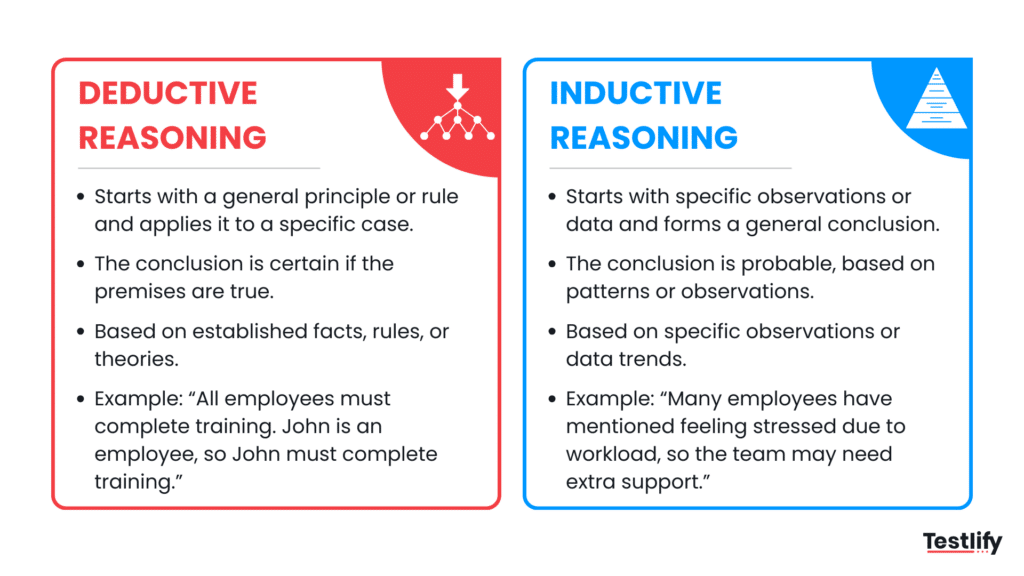
Let’s take a moment to break down the major differences between deductive and inductive reasoning in a side-by-side comparison.
1. Approach to logic
Deductive reasoning: This is “top-down” logic. You begin with a general principle and apply it to a specific case.
Inductive reasoning: This is “bottom-up” logic. You start with specific data and make a broader generalization.
2. Conclusion certainty
Deductive reasoning: The conclusion is definite. If the premises are true, the conclusion must be true.
Inductive reasoning: The conclusion is likely, but not guaranteed. Inductive reasoning is based on probabilities.
3. Use of evidence
Deductive reasoning: Relies on established principles, rules, or facts to draw conclusions.
Inductive reasoning: Uses specific observations, patterns, or data to form theories or conclusions.
When to use deductive and inductive reasoning
Let’s look at some real-life HR situations where you might apply each type of reasoning:
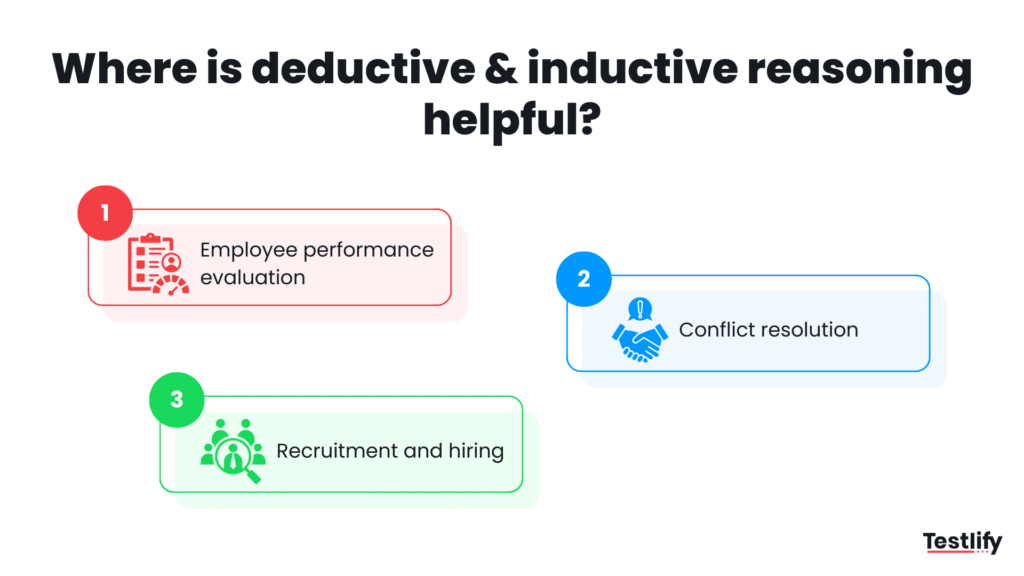
1. Employee performance evaluation
Deductive reasoning: Suppose you’re evaluating an employee’s performance based on a clear set of performance standards. If the employee has met all the targets, you can deduce that they’ve performed well, based on the criteria you’ve set.
Inductive reasoning: If you notice that employees in a particular department consistently meet their targets after undergoing a certain training program, you might inductively reason that this training is effective and could be rolled out to other departments.
2. Conflict resolution
Deductive reasoning: If you have a company policy that requires HR intervention for all serious employee conflicts, you can deductively apply this policy to a situation where employees have raised a serious grievance.
Inductive reasoning: If you observe recurring conflicts arising from communication issues between team members, inductive reasoning could lead you to explore the possibility that improving communication training might help reduce future conflicts.
3. Recruitment and hiring
Deductive reasoning: When screening candidates, if you know that a certain set of qualifications (e.g., a degree in business) Is required for the role, you can deduce that candidates who meet those criteria are eligible for consideration.
Inductive reasoning: If you’ve noticed that employees with certain characteristics (e.g., strong collaboration skills) Tend to thrive in your company culture, you might inductively reason that candidates with those traits Will be more likely to succeed as well.
Conclusion
Both deductive and inductive reasoning play a significant role in making HR decisions. Knowing when to use each method makes you approach work more strategically as you enforce policies, solve problems, or predict trends.
Deductive reasoning works best when you have clear rules and need to apply them in specific situations. It gives you certainty and clarity.
Inductive reasoning is unbeatable when one is trying to identify patterns, generate insights, or hypothesize about future trends. The chances are that the conclusions may not be absolute, but they give you a basis to go out and explore possibilities, to make informed hiring decisions.
The ability to master both kinds of reasoning will make you better at making decisions, reducing uncertainty, and effectively managing people and processes.
Frequently asked questions (FAQs)

Content Writer
Yashika Khandelwal is a Content Writer with 3+ years of experience creating research-backed content on hiring, talent assessment, and HR technology. She is a registered Organizational Psychologist and subject matter expert who combines behavioral science with practical recruitment insights to produce accurate, evidence-based content.
LinkedInRelated resources
View all
HR & recruitment
Building a Winning Team in the Financial Sector — Essential Recruiting Tips

HR & recruitment
What Is a Percentile Score? Meaning, Calculation, and Use in Hiring

HR & recruitment
What is predictive validity and why do recruiters need it?

HR & recruitment
Employee autonomy: what it is and how to build it

HR & recruitment
What is skills intelligence: Components, benefits and tips

HR & recruitment
30 virtual team building activities for remote teams
Get started.
Hire on proof, not resumes.
Run your first skills-based assessment free — no credit card required.