
What makes a hiring test legally compliant?
Learn how to make your hiring tests legally compliant, fair, and effective to avoid discrimination and ensure a smooth recruitment process.
When hiring new staff, many rely on hiring tests to make the process easier and to ensure they hire the best candidates. These tests range from skills testing to personality testing. Although they can be useful tools, there is one thing that companies must be extremely careful about: making sure the hiring test is compliant with the law.
You need to be sensitive to the legal ramifications of taking these tests. If you don’t, you risk lawsuits for discrimination, court cases, and expensive outcomes.
In this blog, we will simplify everything you need to know about creating hiring tests that are legally sound and protecting your business from possible legal problems.
 ChatGPT
 Gemini
 Claude
 Grok
Grok Perplexity
What are hiring tests?
Hiring tests or pre-employment tests are used by employers to assess job applicants’ skills, knowledge, analytical skills, logical thinking, and personal characteristics.
The tests can measure various abilities like cognitive ability, technical knowledge, and personality traits. The purpose is to give employers more insight into how a candidate may fit into the position and organization.
Some examples of hiring tests include:
- Cognitive ability tests (measuring logic, reasoning, and problem-solving)
- Role-specific tests (evaluating proficiency in a specific area such as coding, writing, or customer service)
- Personality tests (assessing traits like extroversion, conscientiousness, etc.)
- Situational judgment tests (gauging how candidates react in hypothetical situations)
But here’s the big question: are these tests legally compliant? Let’s explore that further.

Why does legal compliance matter in hiring tests?
Various laws and regulations govern the use of hiring tests. While these tests can be beneficial, they also come with legal risks if handled incorrectly. If you use a hiring test that is not legally compliant, it could lead to several issues, such as:
Discrimination claims: If the test disproportionately disadvantages candidates from certain protected groups (based on race, gender, age, disability, etc.), it could be deemed discriminatory.
Lawsuits: If a candidate believes they were unfairly tested or that the test violated their rights, they could file a lawsuit against the company.
Fines and penalties: Non-compliance with legal requirements could result in fines, penalties, or other consequences for the company.
Thus, understanding and following the legal framework surrounding hiring tests is essential to avoid costly mistakes and ensure fairness in your hiring process.
Key legal principles that impact hiring tests
Several critical legal principles govern the way hiring tests must be developed and administered. Let us review some of the predominant legal standards HR practitioners should know.
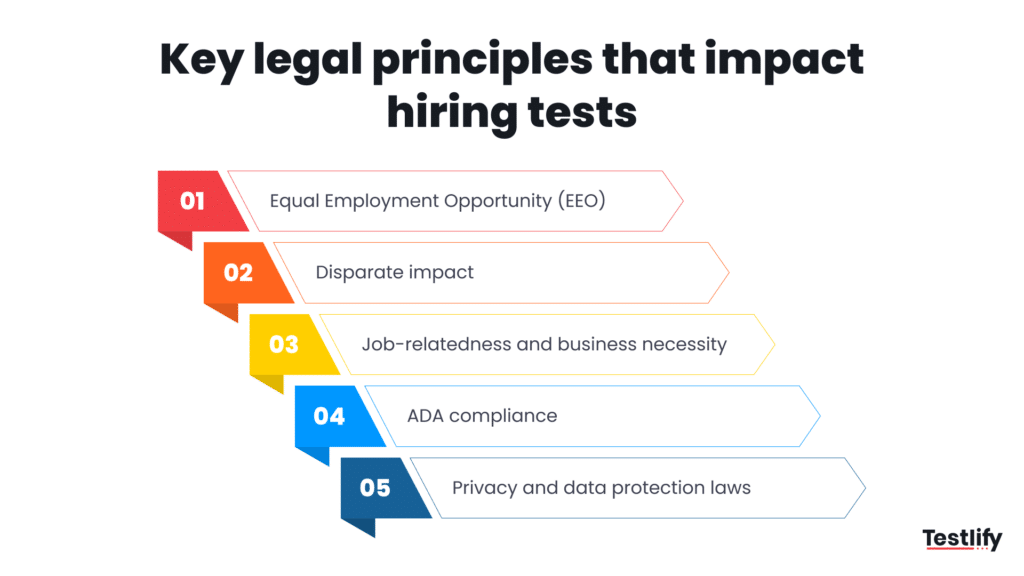
1. Equal Employment Opportunity (EEO)
The Equal Employment Opportunity (EEO) laws are among the most significant laws to consider when applying for hiring tests. A study found that applicants with names suggesting they were white got 50% more callbacks from employers than those whose names. The EEO laws ban employment discrimination based on race, color, national origin, gender, age, religion, disability, and genetic information.
Any recruitment test needs to be properly assessed so that it does not disproportionately screen out applicants on these protected characteristics. For instance, if a mental ability test is over-difficult for one group of people, then it will unfairly disadvantage them, potentially resulting in discrimination claims.
2. Disparate impact
The disparate impact concept is used when a test used in hiring is neutral at first glance but has a disproportionately negative effect on some groups of individuals. For instance, a test that calls for physical strength could lock out women or older applicants, even if these traits are irrelevant to the job.
Under the Civil Rights Act of 1964, if a test has a disparate impact on a protected class (e.g., women, minorities), the employer must show that the test is job-related and consistent with business necessity. The job may be discriminatory if the test is not required.
3. Job-relatedness and business necessity
To prevent legal concerns, a job test has to be job-specific and have a business necessity. This is because the test would have to examine skills, capacities, or attributes that are significant to perform the role’s duties. A job test that does not pertain to the occupation or examines attributes not concerning job performance can be termed discriminatory.
For instance, if you’re recruiting for a software developer position, a typing speed test may be pointless unless typing speed is explicitly tied in with the job requirements. However, coding skills would be an extremely relevant test for the position.
4. ADA compliance: Accommodating disabilities
Under the Americans with Disabilities Act (ADA), employers are required to make reasonable accommodations for individuals with disabilities as part of the hiring process, such as during the use of hiring tests.
Where a candidate has a disability that may affect their performance on a hiring test, an employer must provide an accommodation. This may involve giving additional time, testing in a different format, or permitting another assessment form.
5. Privacy and data protection laws
Another consideration is data protection and privacy. Pre-employment tests tend to gather sensitive data on applicants, be it test results, personal data, or psychological tests. Businesses must comply with data protection legislation, like the General Data Protection Regulation (GDPR) in the EU or equivalent legislation elsewhere.
Employers must be transparent about how they use test data, store it securely, and ensure it is not misused.
6. Impact on diversity and inclusion
Pre-employment evaluations that put too much emphasis on conventional measures of competence run the risk of excluding minority and underrepresented applicants, contributing to the maintenance of existing employment disparities. Employers should consider how their assessments affect diversity and inclusion initiatives and be prepared to address any negative consequences.
How to ensure legal compliance in hiring tests?
Now that we have the most important legal concepts covered let’s look at some real-world steps you can take to make your hiring tests legally compliant.
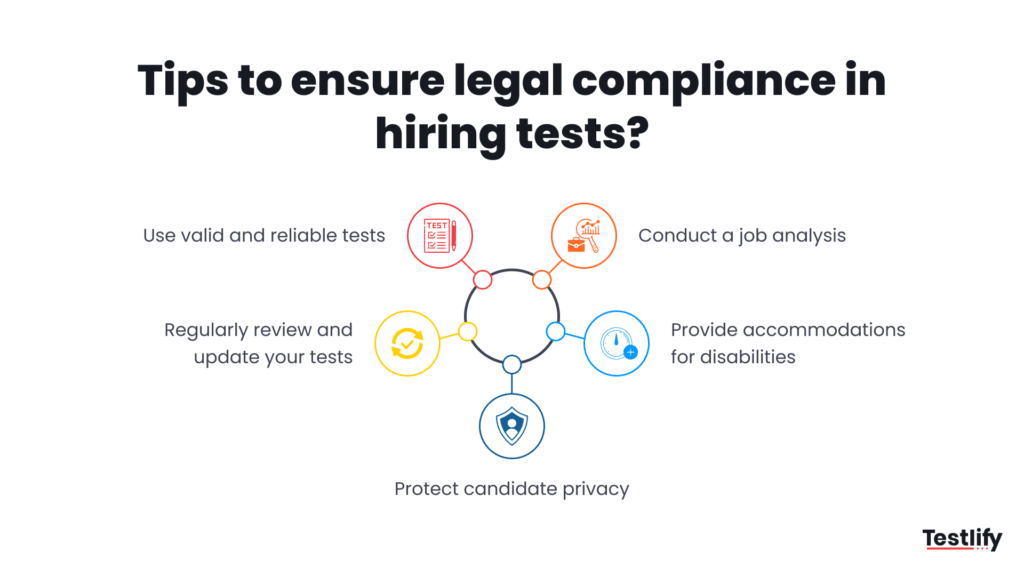
1. Use valid and reliable tests
One of the first things you should do is ensure that the tests you use are valid and reliable.
Validity is about whether the test assesses what it’s intended to assess. A programming skills test, for example, should be assessing coding skills and not problem-solving ability in general.
Reliability is about whether the test yields similar results across time. A test is reliable if it yields identical or comparable results when administered to the same group under the same conditions.
Ensure to select tests that have been constructed based on established psychometric theory. This guarantees they are scientifically valid and legally defensible if objected to.
2. Conduct a job analysis
Job analysis is important to ensure that the test is job-relevant and valid. Job analysis involves identifying the critical skills, knowledge, and abilities required to perform the job. By conducting a thorough job analysis, you can ensure the hiring test is designed to measure role-specific skills.
For instance, when hiring a customer service representative, a good job analysis will yield that communication ability, problem-solving, and conflict resolution are some of the primary factors. Your test should, therefore, aim at determining these qualities.
3. Regularly review and update your tests
Regulations, best practices, and laws can change over time, so review and update your hiring tests periodically. Stay informed about current hiring law trends, and ensure your tests align with the law.
Also, look at your test scores to determine any signs of disparate impact. If people groups consistently score lower on the test, it may be that the test is discriminatory and needs to be rewritten.
4. Provide accommodations for disabilities
As mentioned earlier, employers are covered by the ADA and must make reasonable adjustments for disabled job applicants. When designing recruitment tests, ensure there are mechanisms for providing accommodations when necessary. This could involve:
- Providing extra time
- Providing alternative testing methods (e.g., oral as opposed to written tests)
- Utilizing assistive technologies
Explicitly state the availability of accommodations in the job posting and in the application process so that candidates know how to ask for them if necessary.
5. Protect candidate privacy
You must maintain candidate privacy when giving hiring tests. Comply with data protection laws and procedures to ensure the integrity of test results and other confidential information.
If you’re collecting sensitive personal data, be transparent about what information you’re collecting, how it will be used, and how long it will be retained. Ensure that candidates have control over their data and can request that it be deleted if they choose.
6. Train your HR and recruiting team
HR and recruiting managers should be educated about the potential legal challenges that can arise from using pre-employment tests, along with strategies to address them. Training should cover topics such as privacy restrictions, anti-discrimination legislation, and best practices for assessment design and administration.
7. Consult legal professionals
To make sure pre-employment evaluations align with all relevant rules and regulations, employers should seek advice from legal professionals. Attorneys can help clarify assessment design, data privacy, and accommodation requirements, among other legal factors. For further reading, see legal counsel.
Final thoughts: Best practices for legally compliant hiring tests
Creating legally defensible hiring tests is not just about protecting your company from lawsuits. It’s also about ensuring fairness and equal opportunity for every candidate. By following the fundamental principles outlined in this blog, you can create hiring tests that are effective and legally defensible.
Key takeaways:
- Use valid and reliable tests that are job-related and business-essential.
- Perform a complete job analysis to match your tests with the needs of the job.
- Review and revise your tests periodically to maintain compliance with new laws.
- Accommodate disabled candidates.
- Maintain confidentiality of candidates and ensure secure processing of test data.
- Consider the impact of your assessments on diversity and inclusion, train your HR team on legal risk, and consult legal professionals when in doubt.
You can conduct hiring tests correctly to help find the best employees and ensure an unbiased and even hiring process with Testlify. Remember these recommendations to ensure your hiring processes are legally compliant, moral, and successful.
Frequently asked questions (FAQs)

Content Writer
Yashika Khandelwal is a Content Writer with 3+ years of experience creating research-backed content on hiring, talent assessment, and HR technology. She is a registered Organizational Psychologist and subject matter expert who combines behavioral science with practical recruitment insights to produce accurate, evidence-based content.
LinkedInRelated resources
View all
HR & recruitment
30 Onboarding Email Templates: Pre-Boarding to 90-Day (2026)

HR & recruitment
How long should the hiring process take?
HR & recruitment
10 free job offer email templates

HR & recruitment
How Dedicated Development Teams Improve Project Delivery and Efficiency
HR & recruitment
The Science of Persuasive Communication: Why HR Leaders Should Master Academic Writing

HR & recruitment
5 Tips for Organizing the Perfect Workation for Your Team
Get started.
Hire on proof, not resumes.
Run your first skills-based assessment free — no credit card required.