
Top employee selection methods to hire the best talent
Check out these employee selection methods. Learn effective techniques, modern trends, and tips for hiring the perfect candidates!

Selecting the right candidate for a job is one of the most crucial decisions an HR professional will make. An effective selection process ensures that an organization not only fills a vacancy but also hires someone who fits well with the company culture, meets the job requirements, and has the potential for growth within the organization.
However, with so many employee selection methods available today, it can be overwhelming to know which approach is the best fit for your company.
A report by SHRM suggests, new positions take an average of 42 days to fill, highlighting the importance of an efficient selection process.
In this blog, we’ll explore various employee selection methods, the pros and cons of each, and how you can use them effectively in your hiring process. Whether you’re an HR professional looking to refine your hiring process or a manager interested in understanding the best methods for selecting candidates, this blog will serve as your go-to resource.
 ChatGPT
 Gemini
 Claude
 Grok
Grok Perplexity
What is employee selection?
Employee selection refers to the process of choosing the right candidate from a pool of applicants for a specific role within an organization. It’s a critical step in talent acquisition and involves assessing a candidate’s skills, qualifications, experience, and compatibility with the organization’s values and culture.
The goal of the employee selection process is to ensure that the organization hires a candidate who will not only succeed in the role but also contribute positively to the company’s growth.

Why is employee selection important?
The importance of employee selection cannot be overstated. Here are a few reasons why:
- Talent acquisition: A well-structured selection process helps you attract and hire the best talent in the market.
- Cultural fit: Proper selection ensures that the candidate aligns with your company’s values and culture, leading to higher job satisfaction and retention.
- Improved performance: By selecting the right person for the job, you increase the chances of better performance, productivity, and job satisfaction.
- Reduced turnover: When you choose a candidate who is a good fit for the role and the company, the likelihood of turnover decreases, saving the company recruitment costs and time.
Employee selection methods: An overview
When it comes to selecting employees, HR professionals can choose from a variety of selection methods. These methods can be broadly categorized into traditional methods and modern methods. Both approaches have their benefits and limitations, and often, the best results are achieved by using a combination of techniques.
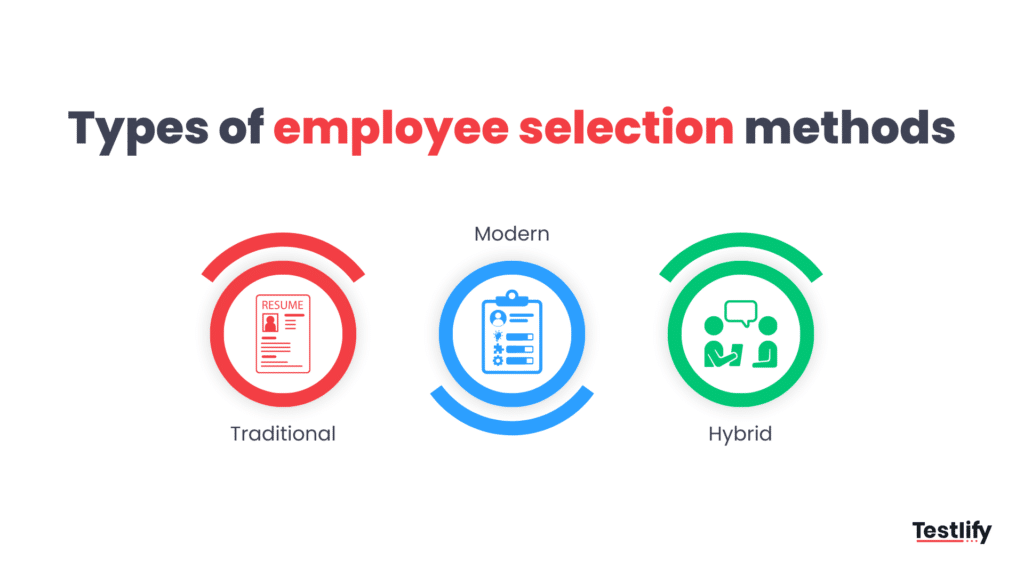
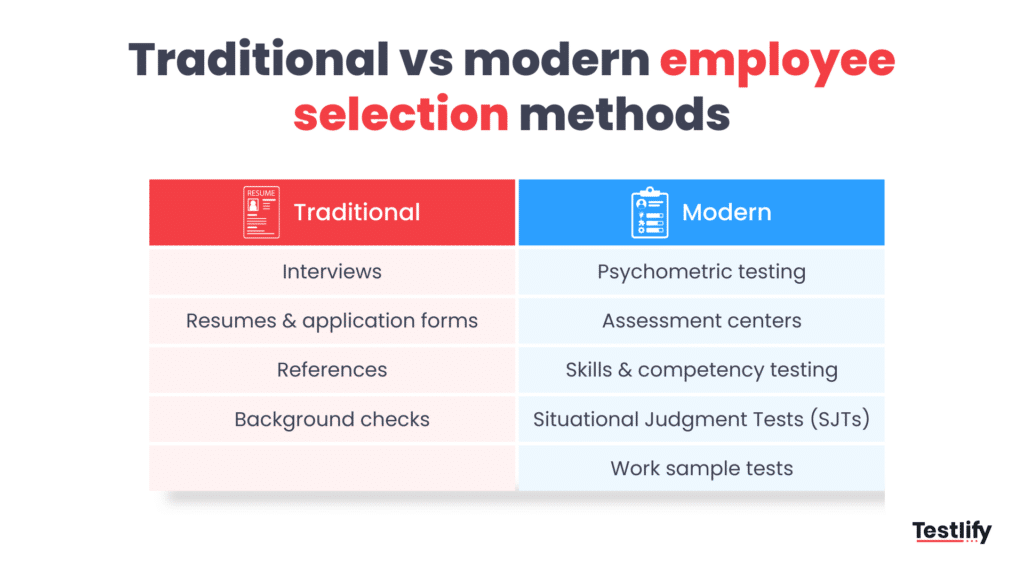
Traditional employee selection methods
- Interviews
- Resumes and Application Forms
- References
- Background Checks
Modern employee selection methods
- Psychometric Testing
- Assessment Centers
- Skills and Competency Testing
- Situational Judgment Tests (SJTs)
- Work Sample Tests
Hybrid selection methods
Some companies prefer a mix of traditional and modern methods to ensure that the most suitable candidate is selected for the job. For example, combining interviews with skills testing or incorporating reference checks along with psychometric assessments.
Now, let’s dive deeper into each of these methods to understand how they work, when they’re appropriate, and their benefits.
Traditional employee selection methods
1. Interviews
The interview is the most common and widely used employee selection method. In an interview, a candidate is asked a series of questions by an HR professional or hiring manager to assess their qualifications, experience, and fit for the role.
Types of interviews:
- Structured interviews: These are pre-determined questions asked in a fixed order to ensure consistency.
- Unstructured interviews: The conversation is more flexible, and the interviewer asks spontaneous questions based on the candidate’s responses.
- Panel interviews: Involves multiple interviewers asking questions to the candidate.
Pros:
- Provides a good opportunity to evaluate a candidate’s communication skills and personality.
- Allows the interviewer to gauge how the candidate responds in real-time.
Cons:
- Can be subjective and prone to interviewer biases.
- Relies heavily on the candidate’s ability to present themselves well.
2. Resumes and application forms
The resume and application form are often the first step in the selection process. HR professionals review a candidate’s resume or application to evaluate their qualifications, work experience, and skills.
Pros:
- Quick way to screen large volumes of applicants.
- Gives a detailed overview of the candidate’s education, work experience, and skills.
Cons:
- Candidates can exaggerate or fabricate information.
- Resumes might not provide enough insight into a candidate’s personality or work style.
3. References
Reference checks involve contacting a candidate’s previous employers, colleagues, or mentors to verify the accuracy of their qualifications and work performance.
Pros:
- Helps verify the candidate’s experience and performance in past roles.
- Provides insights into the candidate’s work ethic and attitude.
Cons:
- References might be biased or reluctant to share negative information.
- Some candidates may not have strong references, especially if they are new to the workforce.
4. Background checks
Background checks are typically used to verify a candidate’s criminal history, employment history, education, and credit history (if relevant to the role).
Pros:
- Helps identify any potential red flags in a candidate’s history.
- Provides additional confidence in the candidate’s reliability and trustworthiness.
Cons:
- Can be time-consuming and may require external service providers.
- There are legal and ethical considerations when conducting background checks.
Modern employee selection methods
1. Psychometric testing
Psychometric tests are designed to measure a candidate’s mental abilities, cognitive skills, and personality traits. These tests help assess whether a candidate’s personality is aligned with the role and the organization’s culture.
Types of psychometric tests:
- Cognitive ability tests: Measure a candidate’s problem-solving ability, logical reasoning, and critical thinking skills.
- Personality tests: Assess behavioral traits like introversion/extroversion, adaptability, and emotional stability.
Pros:
- Objective and data-driven assessment of a candidate’s abilities and personality.
- Can help reduce bias and improve the consistency of the selection process.
Cons:
- Candidates may be nervous about standardized tests, potentially affecting their performance.
- The tests need to be well-designed to accurately measure the relevant traits and abilities.
2. Assessment centers
An assessment center is a comprehensive and structured process used to evaluate candidates on various skills and competencies. It typically involves group exercises, case studies, role-playing scenarios, and presentations.
Pros:
- Provides a holistic view of the candidate’s abilities, including their communication, leadership, and teamwork skills.
- Allows HR to observe candidates in different scenarios and environments.
Cons:
- Expensive and time-consuming to organize.
- Requires significant preparation and coordination.
3. Skills and competency testing
Skills testing involves assessing a candidate’s technical abilities, such as programming skills, accounting knowledge, or language proficiency. Competency testing evaluates whether a candidate has the necessary competencies (such as decision-making or conflict resolution) for the role.
Pros:
- Directly tests the skills required for the job, providing a clear indication of the candidate’s abilities.
- Can be conducted online or in-person.
Cons:
- Tests need to be carefully designed to ensure they accurately reflect the job requirements.
- May not provide insight into soft skills or cultural fit.
4. Situational Judgment Tests (SJTs)
Situational Judgment Tests present candidates with hypothetical situations that they might encounter in the role. They are designed to assess how candidates would react or respond to different scenarios.
Pros:
- Provides insight into how a candidate might perform in real-world situations.
- Can assess both technical and soft skills.
Cons:
- Candidates may provide answers they believe the employer wants to hear, rather than authentic responses.
- Scenarios must be realistic to be effective.
5. Work sample tests
Work sample tests involve giving candidates a task or assignment that simulates the work they will do in the role. For example, a graphic designer might be asked to create a sample design.
Pros:
- Provides a direct measure of a candidate’s ability to perform the tasks required in the job.
- More accurate than interviews alone in assessing job fit.
Cons:
- Can be time-consuming and may require candidates to invest significant effort.
- Might not be feasible for all roles.
Hybrid selection methods
Many HR professionals combine several of the traditional and modern selection methods to create a more comprehensive hiring process. For instance, you might start with resume screening, followed by psychometric testing, and then conduct structured interviews for the top candidates. A hybrid method allows you to assess a candidate from multiple angles, ensuring a more well-rounded evaluation.
Choosing the right selection method for your organization
Selecting the right employee selection method depends on several factors, including:
- The nature of the job: Certain jobs may require more technical assessments, while others may focus on behavioral traits or cultural fit.
- The size of your organization: Smaller companies may not have the resources for complex methods like assessment centers, while larger organizations may prefer them for high-level roles.
- The budget: Some selection methods, such as background checks and psychometric testing, can be costly, so it’s important to factor in the budget when designing your selection process.
- Time constraints: Some selection methods, like assessment centers, are time-intensive, while others, such as resume screenings, can be done quickly.
Final thoughts
The employee selection process is not one-size-fits-all. Different methods serve different purposes, and the most effective selection process uses a combination of techniques to ensure that the right candidate is chosen for the role. Whether you are relying on traditional methods like interviews and resumes or incorporating modern approaches like psychometric testing and assessment centers, each method plays a vital role in your hiring strategy.
By understanding the strengths and weaknesses of each selection method and tailoring your approach to fit the specific needs of your organization, you can significantly improve your chances of making successful hires who contribute to your company’s long-term success.
Good luck in building your next dream team!
Frequently asked questions (FAQs)

Content Writer
Yashika Khandelwal is a Content Writer with 3+ years of experience creating research-backed content on hiring, talent assessment, and HR technology. She is a registered Organizational Psychologist and subject matter expert who combines behavioral science with practical recruitment insights to produce accurate, evidence-based content.
LinkedInRelated resources
View all
HR & recruitment
Top digital record keeping tips for recruiters

HR & recruitment
Top 8 HR priorities to look at in 2026

HR & recruitment
Recruiting active candidates: How and where to find?

HR & recruitment
Key compliance trends in 2026-27

HR & recruitment
What is a job aggregator? A recruiter’s guide

HR & recruitment
Candidate persona: A complete guide for recruiters
Get started.
Hire on proof, not resumes.
Run your first skills-based assessment free — no credit card required.