Demo
Demo
 +1 (844) 755 8378
 Contact


Departmentalization is one of the most crucial aspects of organizational structure. If you’re an HR professional, understanding departmentalization is key to managing your workforce effectively and ensuring your organization operates smoothly.
According to the Harvard Business Review, 73% of organizations with clearly defined structures report higher productivity.
In this blog, we will dive into the concept of departmentalization, explore its benefits, types, and strategies, and provide you with a detailed understanding of how it works.
Summarise this post with:
 Chatgpt
 Perplexity
 Gemini
 Grok
Grok Claude
What is departmentalization?
Departmentalization refers to the process of dividing an organization into different units or departments, each responsible for specific tasks, functions, or projects.
This method is used to organize resources, employees, and activities to enhance operational efficiency, improve communication, and allow an organization to meet its goals effectively.
In a departmentalized structure, each department focuses on specific tasks like marketing, finance, human resources, production, or sales.
Departmentalization provides clarity by setting boundaries and responsibilities for each area within an organization, which helps streamline decision-making, improve workflow, and allocate resources more efficiently.

Types of departmentalization
Now that we understand what departmentalization is and the benefits it offers, let’s explore the different types of departmentalization. Each type has its own advantages and is suited to different organizational needs.
1. Functional departmentalization
This is one of the most common types of departmentalization. In functional departmentalization, the organization is divided based on specialized functions, such as marketing, finance, human resources, operations, or research and development. This structure is ideal for organizations that require a high level of expertise in specific areas.
Example:
In a company, you may have departments like:
- Marketing department
- HR department
- Sales department
- Finance department
Each department focuses on its core area, leading to greater specialization and efficiency.
2. Product departmentalization
Product departmentalization divides the organization based on different products or product lines. This approach is common in organizations that have a diverse range of products or services. Each department is responsible for managing a specific product, which enables teams to focus on product development, marketing, and sales strategies for that particular offering.
Example:
A consumer goods company might have departments like:
- Household goods department
- Personal care products department
- Electronics department
3. Geographical departmentalization
In geographical departmentalization, the organization is divided based on location, such as regions, territories, or countries. This type is particularly beneficial for organizations that operate in multiple locations or international markets. Each geographical unit can adapt its strategies to local conditions and needs, improving responsiveness.
Example:
A multinational company might have departments like:
- North Aamerican operations
- European operations
- Asia-pacific operations
4. Customer departmentalization
Customer departmentalization is based on the different types of customers the organization serves. The company may create departments specifically designed to cater to the unique needs of different customer groups. This approach works well for businesses that deal with multiple customer segments, such as retail, corporate clients, or government organizations.
Example:
A service company may have departments like:
- Retail clients department
- Corporate clients department
- Government contracts department
5. Process departmentalization
Process departmentalization is based on the different stages of production or service delivery. This structure is useful for manufacturing or service organizations that require specific processes to be followed at different stages of production. Each department oversees a specific part of the process, allowing the company to optimize its operations.
Example:
In a manufacturing company, you might have departments like:
- Assembly department
- Packaging department
- Quality cControl dDepartment
Types of combined departmentalization
While the types mentioned above can stand alone, many organizations combine them to create a hybrid structure that best meets their unique needs. Here are a few examples of combined departmentalization:
1. Functional and product departmentalization
In this model, an organization divides its functions while also creating separate departments based on product lines. This approach ensures that both functional expertise and product focus are maintained.
Example:
- Marketing department (Functional)
- Product a marketing department (Product-based)
- Product b marketing department (Product-based)
2. Geographical and functional departmentalization
This model is often used by multinational corporations that require a combination of geographical and functional focus. It ensures both global reach and functional specialization.
Example:
- North Aamerican HR department
- European finance department
- Asia-pacific sales department
3. Customer and product departmentalization
This hybrid structure is commonly used by organizations that want to align both customer needs and product categories. It ensures that each customer group receives tailored service while maintaining focus on the products.
Example:
- Corporate clients (Customer-based)
- Consumer electronics (Product-based)
How does departmentalization work?
Departmentalization is not just about dividing an organization into smaller parts. It’s about creating an efficient system where departments collaborate while maintaining their unique responsibilities. Here’s how it works:
1. Identification of core functions or products
The first step is identifying what functions, products, or services need to be organized into separate departments. This requires a clear understanding of the organization’s operations, customer base, and goals.
2. Grouping related activities
Once the key areas have been identified, related activities are grouped together under the relevant departments. This ensures that employees with similar roles or expertise can work together, fostering collaboration and specialization.
3. Establishing leadership and responsibility
Each department must have a designated leader, typically a manager or head of the department, who oversees the work of the department and ensures that goals are met. Establishing clear leadership helps in decision-making and ensures accountability within each department.
4. Ensuring coordination between departments
While each department works independently, coordination is key for the organization’s overall success. Effective communication channels between departments must be established to ensure smooth collaboration across the company.
Why do organizations need departmentalization?
As organizations grow, it becomes harder for employees to manage all aspects of the business without specialization. Departmentalization helps in the following ways:
- Managing complexity: Larger organizations often have complex structures, and departmentalization helps break down this complexity into more manageable parts.
- Optimizing resource allocation: It allows organizations to allocate resources more effectively to areas that need them the most.
- Improving decision-making: With clear departmental boundaries, decision-making can be more streamlined and focused.
Advantages and disadvantages of departmentalization
Advantages of departmentalization
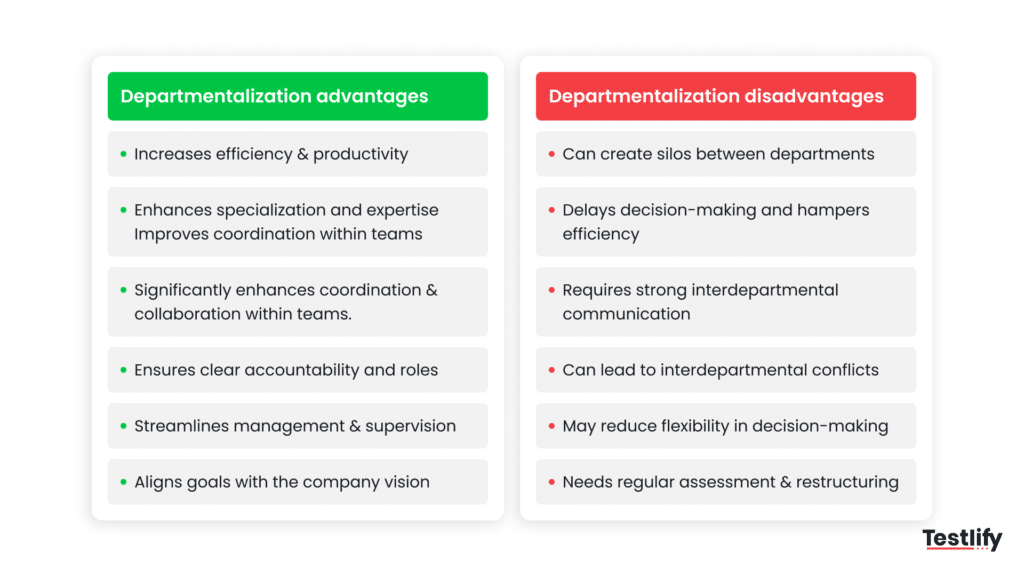
We’ve already touched on some advantages of departmentalization, but let’s break it down further:
- Specialization: Departments help employees become experts in their field, resulting in higher performance and quality.
- Faster decision-making: Decisions can be made quicker within departments as managers don’t need to consult multiple levels of hierarchy.
- Better coordination: Grouping related tasks together improves coordination between employees who work on similar projects or functions.
- Improved customer service: Customer-oriented departmentalization allows businesses to tailor their approach to different customer segments.
Disadvantages of departmentalization
While departmentalization has numerous benefits, it also has its drawbacks. Some disadvantages include:
- Silos: Departments can become isolated, leading to a lack of communication or cooperation between them.
- Duplication of resources: Some departments may end up duplicating efforts, leading to inefficiency and waste of resources.
- Limited perspective: Employees may become so focused on their department that they lose sight of the organization’s overall goals.
- Increased costs: The creation of multiple departments can result in increased administrative costs and complexity.
What to consider when departmentalizing?
When departmentalizing your organization, consider these key factors:
- Size and complexity: The larger and more complex the organization, the more departmentalization is needed.
- Organizational goals: Ensure that the structure aligns with your organization’s long-term objectives.
- Communication and collaboration: Ensure that there are systems in place for departments to communicate and collaborate efficiently.
- Flexibility: Departmentalization should remain flexible to adapt to changes in the business environment.
Strategies for effective departmentalization
To ensure successful departmentalization, HR professionals can implement the following strategies:
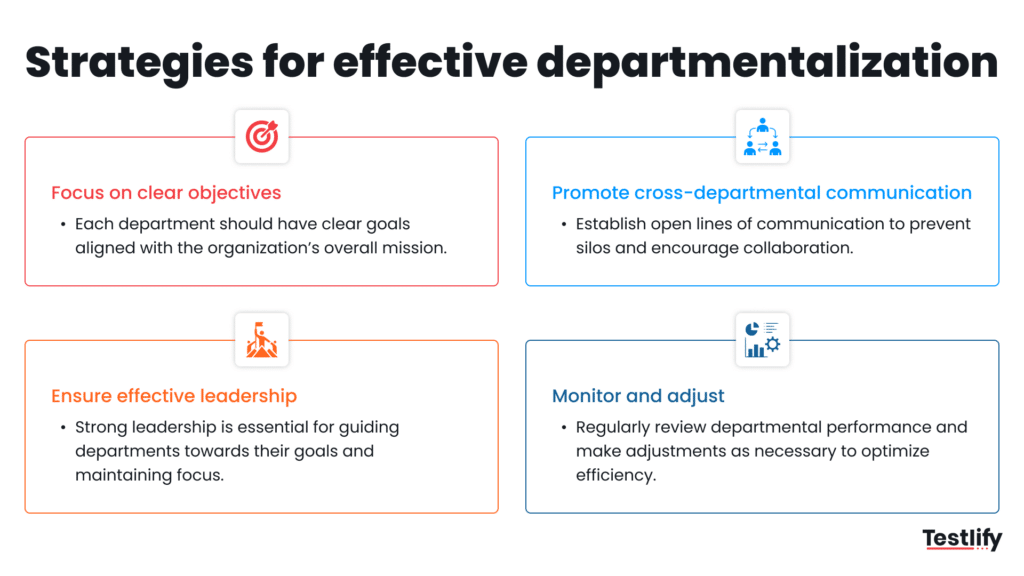
- Focus on clear objectives: Each department should have clear goals aligned with the organization’s overall mission.
- Ensure effective leadership: Strong leadership is essential for guiding departments towards their goals and maintaining focus.
- Promote cross-departmental communication: Establish open lines of communication to prevent silos and encourage collaboration.
- Monitor and adjust: Regularly review departmental performance and make adjustments as necessary to optimize efficiency.
Examples of departmentalization
1. Apple Inc.
Apple uses product departmentalization by creating separate departments for its different product lines, such as the iPhone, Mac, and iPad. Each department is responsible for its product’s design, production, and marketing strategies.
2. Procter & Gamble
Procter & Gamble uses a combination of functional and product departmentalization. It has distinct departments for functions like marketing, finance, and human resources, but also organizes by product lines like cleaning, personal care, and health.
3. Amazon
Amazon organizes its departments based on geographical regions. This allows Amazon to tailor its strategies to different markets, whether in the U.S., Europe, or Asia, adapting its approach to local needs and regulations.
Conclusion
Departmentalization is a powerful tool that helps organizations operate smoothly and efficiently. By choosing the right structure, businesses can boost productivity, improve communication, and drive success.
Understanding departmentalization is crucial in designing an effective organizational structure. The key is to find the right balance between specialization and flexibility to meet the company’s goals.
How is your organization departmentalized? If you’re considering restructuring, now is the perfect time to explore what works best for your business!