
Free job profile templates and how to customize
Job profile templates explained with structure, examples, and ready-to-use formats to help HR standardize roles, assess skills, and hire better.

A job profile template is a reusable, structured document that outlines the key details of a role, including responsibilities, required skills, and performance expectations. It helps recruiters standardize role descriptions so candidates clearly understand what success looks like before they apply.
Well-crafted templates also reduce hiring risks by focusing on skills, capabilities, and on-the-job performance instead of just resumes or vague requirements.
 ChatGPT
 Gemini
 Claude
 Grok
Grok Perplexity
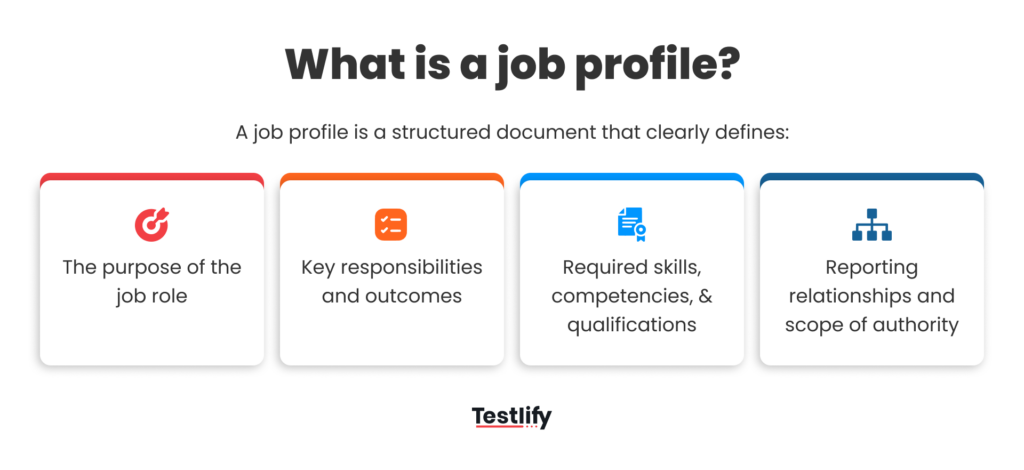
What is a job profile?
A job profile is a concise document outlining a specific job role’s key details. It helps employers attract suitable candidates and informs applicants about expectations.
Job profiling includes summarizing a position’s purpose, distinguishing it slightly from a full job description by focusing more on requirements and fit. It acts as a blueprint for recruitment, performance evaluation, and career alignment.
Job profiles streamline hiring by enabling quick candidate screening and setting clear performance benchmarks. They boost employee satisfaction through aligned expectations and support legal/HR compliance.

Core structure of a modern job profile
Most strong job profile templates, regardless of role or seniority, include a common backbone. You can reuse this structure and adapt the details for different positions.
Job title and level: Clearly state the role (e.g., “Junior Data Analyst”, “Senior Software Engineer Backend”) and indicate seniority.
Role summary: A short 3–5 line overview explaining the purpose of the role, who it reports to, and how it contributes to business goals.
Key responsibilities: A concise list (usually 6–10 bullets) of the most important tasks and ownership areas.
Required skills and competencies: This typically combines cognitive skills (e.g., numerical, logical, verbal), technical skills, and soft skills such as communication or teamwork.
Preferred or nice-to-have skills: Additional capabilities that help differentiate strong candidates without being strict filters.
Qualifications and experience: Educational background, certifications, or relevant experience ranges where they truly matter for the role.
Tools, technologies, and domain knowledge: Specific platforms, software, or industry knowledge necessary for success in the role.
Performance indicators: How success will be measured in the first 3, 6, and 12 months (KPIs, deliverables, quality metrics).
Assessment methods: Which tests or evaluations will be used: numerical reasoning, verbal reasoning, situational judgment, personality, or job-specific skills assessments.
Best job profile templates (with ready-to-use structures)
Below are ready-made templates for common job profiles, all following a similar tone and structure so you can reuse them across roles. You can tailor each template with your company’s context, tools, and domain examples.
1. Software Engineer job profile template
The Software Engineer will design, build, and maintain high-quality product features that directly impact user experience and business growth. The role demands strong problem-solving skills, clean coding practices, and the ability to collaborate with cross-functional teams, including product management, QA, and design.
Key responsibilities:
- Develop, test, and deploy scalable features in collaboration with product managers and designers.
- Write clean, maintainable, and well-documented code following best practices and team standards.
- Debug and resolve production issues, ensuring high availability and reliability of core systems.
- Participate in code reviews, architecture discussions, and sprint planning sessions.
- Optimize performance of existing modules through profiling, refactoring, and efficient use of resources.
- Collaborate with QA to design test cases and improve automated testing coverage.
Required skills and competencies
- Strong logical reasoning and analytical problem-solving.
- Proficiency in at least one primary language (e.g., Java, Python, JavaScript, C#) and experience with modern frameworks.
- Understanding of data structures, algorithms, and system design fundamentals.
- Ability to interpret technical documentation and communicate complex ideas clearly to non-technical stakeholders.
- Experience working with version control, CI/CD, and agile development practices.
Preferred skills
- Exposure to cloud environments (e.g., AWS, Azure, GCP) and microservices architecture.
- Familiarity with automated testing frameworks and performance monitoring tools.
- Experience with abstract reasoning-style problem-solving in technical challenges or coding assessments.
Qualifications and experience
- Bachelor’s degree in Computer Science, Engineering, or related field, or equivalent practical experience.
- 2–5 years of experience in software development for product-based or high-scale environments.
Performance indicators
- Feature delivery on time and within quality standards.
- Reduction in production defects and improved system performance metrics.
- Contribution to code quality, documentation, and cross-team collaboration.
Assessment methods
- Coding tests to evaluate programming skills and problem-solving.
- Logical and abstract reasoning tests to assess pattern recognition and analytical thinking.
- Situational judgment exercises focusing on collaboration, ownership, and decision-making in technical scenarios.
2. Data Analyst Job profile template
The Data Analyst will transform raw data into actionable insights that guide decision-making across the organization. This role combines numerical aptitude, data storytelling, and strong attention to detail to support stakeholders with accurate, timely analyses.
Key responsibilities
- Collect, clean, and validate data from multiple internal and external sources.
- Build dashboards and reports that track key business metrics and trends.
- Perform ad hoc analyses to answer business questions and support strategic decisions.
- Use statistical methods to identify patterns, anomalies, and opportunities for optimization.
- Collaborate with product, marketing, operations, and finance teams to define and track KPIs.
- Present insights and recommendations in clear, business-friendly language.
Required skills and competencies
- Strong numerical reasoning and ability to work with large datasets.
- Proficiency in spreadsheets, SQL, and at least one analytics or BI tool.
- Understanding of basic statistics, data visualization principles, and hypothesis testing.
- Verbal and written communication skills to translate technical findings into practical recommendations.
- High accuracy and attention to detail in data entry, validation, and reporting.
Preferred skills
- Experience with programming languages used in analytics (e.g., Python or R).
- Familiarity with A/B testing, experimentation frameworks, or predictive modeling.
- Exposure to domain-specific data (e.g., marketing, product, supply chain, finance).
Qualifications and experience
- Bachelor’s degree in Statistics, Mathematics, Economics, Computer Science, or related fields.
- 1–4 years of experience in data analysis, business intelligence, or similar roles.
Performance indicators
- Accuracy and reliability of dashboards and reports used by stakeholders.
- Impact of recommendations on business outcomes (e.g., revenue uplift, cost savings, efficiency gains).
- Turnaround time for ad hoc analysis requests and project delivery.
Assessment methods
- Numerical aptitude tests to measure quantitative skills and data interpretation.
- Data entry and accuracy tests to evaluate speed and precision in handling information.
- Case-based exercises where candidates analyze a dataset and present findings.
3. Customer Support Specialist job profile template
The Customer Support Specialist serves as the first point of contact for customers, ensuring a smooth and positive experience across channels. The role focuses on resolving issues efficiently, communicating clearly, and representing the brand’s values in every interaction.
Key responsibilities
- Respond to customer queries via email, chat, phone, or ticketing systems within defined SLAs.
- Diagnose issues by gathering relevant information and providing accurate solutions or workarounds.
- Escalate complex cases to appropriate teams while maintaining ownership and follow-up.
- Maintain detailed and accurate records of customer interactions and resolutions.
- Identify recurring issues and share insights with product and operations teams for improvement.
- Contribute to knowledge base articles and FAQs to support self-service.
Required skills and competencies
- Strong verbal reasoning and communication in both written and spoken formats.
- Empathy, patience, and conflict-resolution skills when handling challenging situations.
- Logical reasoning to troubleshoot issues based on limited or incomplete information.
- Ability to multitask, prioritize, and maintain composure under pressure.
Preferred skills
- Experience with CRM or ticketing tools such as Zendesk, Freshdesk, or HubSpot.
- Familiarity with the company’s domain (e.g., SaaS, e-commerce, fintech).
- Exposure to situational judgment or role-play assessments in past support roles.
Qualifications and experience
- Graduate degree in any discipline; specialization in communications, business, or related fields is a plus.
- 1–3 years of experience in customer-facing support roles.
Performance indicators
- Customer satisfaction (CSAT), net promoter score (NPS), and first contact resolution rate.
- Average handling time, response SLAs, and adherence to quality guidelines.
- Feedback from customers and internal teams on professionalism and ownership.
Assessment methods
- Verbal reasoning tests focusing on comprehension and clarity of communication.
- Situational judgment tests that simulate real-world customer scenarios and decision-making.
- Role-play or live support simulations to assess tone, empathy, and problem-solving.
4. Sales Representative (B2B) job profile template
The Sales Representative is responsible for identifying, engaging, and converting prospects into long-term customers. The role combines communication, persuasion, and strategic thinking to drive revenue and build strong client relationships.
Key responsibilities
- Generate and qualify leads through outbound prospecting, inbound inquiries, and partner networks.
- Conduct discovery calls to understand client needs, pain points, and decision criteria.
- Deliver compelling product demos and presentations tailored to each prospect.
- Negotiate terms, manage objections, and close deals aligned with revenue targets.
- Maintain accurate records in CRM tools and report on pipeline, forecasts, and sales activity.
- Collaborate with marketing, customer success, and product teams to ensure smooth onboarding and long-term satisfaction.
Required skills and competencies
- Strong verbal communication, persuasive storytelling, and listening skills.
- Logical reasoning to match customer needs with product capabilities and pricing structures.
- Resilience, self-motivation, and ability to work with targets and deadlines.
- Basic numerical aptitude to understand pricing models, discounts, and ROI calculations.
Preferred skills
- Experience selling in similar industries or to similar customer segments.
- Familiarity with sales methodologies such as consultative selling or solution selling.
- Understanding of CRM and sales enablement tools.
Qualifications and experience
- Bachelor’s degree in Business, Marketing, or related fields is preferred but not mandatory.
- 1–5 years of experience in B2B or B2C sales, depending on seniority level.
Performance indicators
- Quota attainment and revenue generated per quarter.
- Lead-to-opportunity and opportunity-to-close conversion rates.
- Retention and upsell potential of acquired customers.
Assessment methods
- Situational judgment tests centered on objection handling and negotiation scenarios.
- Verbal aptitude tests to evaluate communication clarity and comprehension.
- Role-play exercises simulating discovery calls and closing conversations.
5. HR Generalist job profile template
The HR Generalist supports the full employee lifecycle, from recruitment and onboarding to engagement, performance management, and offboarding. This role requires a balance of people skills, process discipline, and data-driven decision-making.
Key responsibilities
- Partner with hiring managers to define job profiles, coordinate assessments, and support interview processes.
- Manage onboarding programs, ensuring a smooth transition for new hires.
- Administer HR policies, benefits, and employee records accurately and confidentially.
- Support performance management cycles, including goal setting, reviews, and development plans.
- Help design and implement engagement, learning, and recognition initiatives.
- Address employee queries, grievances, and policy-related questions in a fair and consistent manner.
Required skills and competencies
- Strong verbal reasoning and written communication for policy and documentation.
- Logical reasoning for interpreting policies, compliance requirements, and data.
- High emotional intelligence, discretion, and conflict-resolution skills.
- Ability to manage multiple priorities and stakeholders.
Preferred skills
- Experience with HRIS, ATS, and payroll tools.
- Familiarity with aptitude, cognitive, and personality tests used in hiring and development.
- Knowledge of local labor laws and compliance standards.
Qualifications and experience
- Bachelor’s degree in Human Resources, Business Administration, Psychology, or related fields.
- 2–6 years of experience in HR roles, preferably in fast-paced or growth environments.
Performance indicators
- Time-to-hire, quality of hire, and experience metrics across the employee lifecycle.
- Accuracy of employee data, compliance adherence, and policy implementation.
- Feedback from employees and managers on HR support and responsiveness.
Assessment methods
- Situational judgment tests focused on people issues, policy dilemmas, and ethical scenarios.
- Personality assessments to understand working style, empathy, and collaboration approach.
- Case exercises involving HR problem-solving and stakeholder communication.
6. Operations Executive job profile template
The Operations Executive ensures that day-to-day processes run smoothly, efficiently, and in line with organizational standards. The role involves coordinating people, systems, and data to deliver reliable outcomes at scale.
Key responsibilities
- Execute and monitor operational processes across supply, logistics, customer delivery, or internal workflows.
- Track key operational metrics and generate periodic reports for leadership.
- Identify bottlenecks, inefficiencies, and risks, proposing improvements where necessary.
- Coordinate with cross-functional teams to resolve operational issues quickly.
- Maintain accurate records, documentation, and compliance with internal policies.
Required skills and competencies
- Strong attention to detail and accuracy in data entry and process execution.
- Numerical aptitude for tracking metrics, budgets, and forecasts.
- Logical reasoning to diagnose operational problems and recommend solutions.
- Organizational skills and the ability to handle multiple concurrent tasks.
Preferred skills
- Experience with ERP, inventory, or workflow management systems.
- Exposure to continuous improvement frameworks or quality standards.
Qualifications and experience
- Graduate degree in Operations, Business, Engineering, or related fields preferred.
- 1–4 years of experience in operations or process-driven roles.
Performance indicators
- Process SLAs, turnaround times, and error rates.
- Cost efficiency and resource utilization metrics.
- Stakeholder feedback on reliability and responsiveness.
Assessment methods
- Data entry tests to assess speed and accuracy.
- Numerical aptitude tests to evaluate comfort with metrics and reports.
- Situational judgment exercises reflecting real operational challenges.
7. Product Manager job profile template
The Product Manager owns the end-to-end lifecycle of a product or feature set, from discovery and prioritization to delivery and iteration. This role requires strategic thinking, customer empathy, and the ability to align cross-functional teams around a clear roadmap.
Key responsibilities
- Define product vision and roadmap based on user needs, business goals, and market insights.
- Gather and prioritize requirements through user research, data analysis, and stakeholder input.
- Collaborate with engineering, design, marketing, and operations to bring features to market.
- Monitor product performance, experiment with improvements, and iterate based on feedback.
- Communicate product status, plans, and outcomes to leadership and other stakeholders.
Required skills and competencies
- Strong analytical reasoning and comfort with numerical data.
- Verbal and written communication skills for storytelling, alignment, and documentation.
- Ability to make trade-offs and decisions under ambiguity.
- Customer-centric mindset with an understanding of user behavior and journeys.
Preferred skills
- Experience with analytics tools, A/B testing, and user research methods.
- Background in engineering, design, or domain-specific roles.
Qualifications and experience
- Bachelor’s degree in Business, Engineering, Design, or related fields; MBA is a plus for senior roles.
- 3–8 years of experience in product or adjacent roles such as business analysis, UX, or consulting.
Performance indicators
- Adoption and engagement metrics for key features and releases.
- Impact on revenue, retention, or strategic business goals.
- Stakeholder alignment and delivery predictability.
Assessment methods
- Logical and abstract reasoning tests to assess strategic thinking and pattern recognition.
- Case studies focused on product discovery, prioritization, and go-to-market decisions.
- Situational judgment tests reflecting cross-functional collaboration scenarios.
Job profiles and suitable assessment focus
You can use this table as a reference when pairing job profiles with key skills and assessment types during hiring.
Job profile | Core skills focus | Useful test types |
|---|---|---|
Software engineer | Logical thinking, coding, problem-solving | Logical reasoning, abstract reasoning, programming/coding tests |
Data analyst | Numerical skills, data interpretation, and accuracy | Numerical aptitude, data entry accuracy, and cognitive ability tests |
Customer support specialist | Communication, empathy, and decision-making | Verbal reasoning, situational judgment, and personality assessments |
Communication, persuasion, resilience | Verbal aptitude, situational judgment, and personality tests | |
HR generalist | People skills, policy judgment, and communication | Situational judgment, personality, verbal reasoning |
Operations executive | Detail orientation, numerical comfort, reliability | Data entry tests, numerical aptitude, and logical reasoning |
Product manager | Strategic thinking, analytics, and communication | Logical reasoning, abstract reasoning, situational judgment |
How to customize and use these templates?
Once you adopt a base structure for job profiles, you can tailor each template to your organization’s context and culture. Start by aligning responsibilities with your actual workflows, then adjust skill requirements to reflect the tools and systems you use daily.
To strengthen your hiring outcomes, pair these profile templates with a structured mix of aptitude, reasoning, and personality tests that match the role’s demands from entry-level to leadership. This skills-based approach helps you recognize true potential, reduce bias, and build teams that are both capable and aligned with your company’s way of working.
Frequently asked questions (FAQs)

Content Writer
Yashika Khandelwal is a Content Writer with 3+ years of experience creating research-backed content on hiring, talent assessment, and HR technology. She is a registered Organizational Psychologist and subject matter expert who combines behavioral science with practical recruitment insights to produce accurate, evidence-based content.
LinkedInRelated resources
View all
HR & recruitment
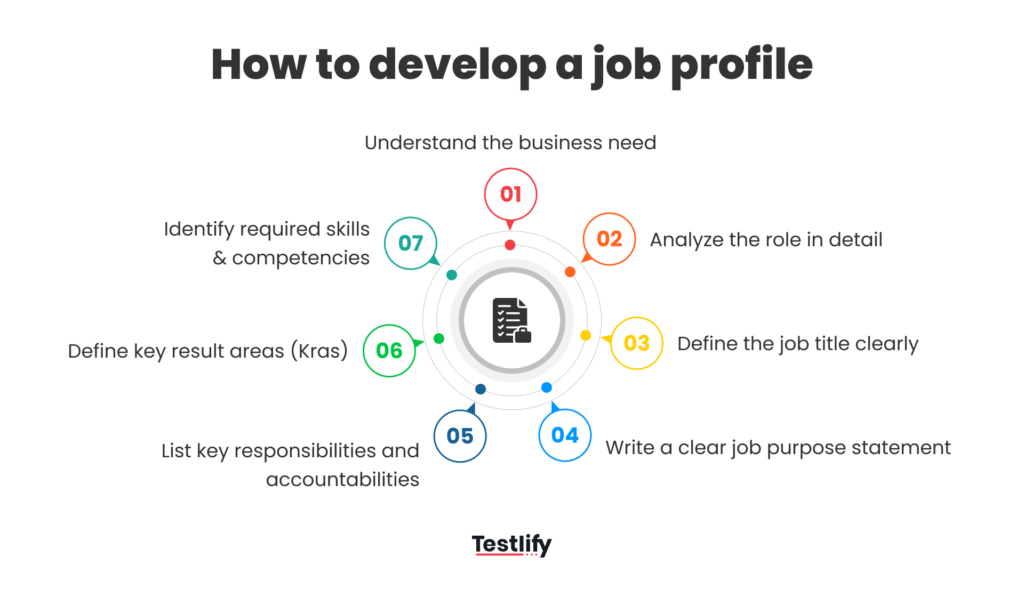
How to develop a job profile?
HR & recruitment
Best skills assessment question libraries: 3500+ skills coverage (Tech & non-tech)

HR & recruitment
Pros and cons of pre-hire assessments

HR & recruitment
11 different types of pre-hire testing for screening

HR & recruitment
6 real soft skills case studies every HR leader should study

HR & recruitment
Top 13 types of hiring bias and how to avoid them
Get started.
Hire on proof, not resumes.
Run your first skills-based assessment free — no credit card required.