
How to develop a job profile?
Learn how to develop a clear, effective job profile step by step. This practical HR guide covers role purpose, responsibilities, skills, and alignment.
Developing a clear and effective job profile is one of the most important responsibilities of HR. A well-written job profile is not just a hiring document. It is a foundation for recruitment, performance management, employee development, and even workforce planning. Yet, many organizations struggle with vague, outdated, or overly complex job profiles that fail to serve their purpose.
In this blog, we will walk through how to develop a strong job profile step by step.
 ChatGPT
 Gemini
 Claude
 Grok
Grok Perplexity
Why is creating a job profile important?
Roles evolve quickly. New technologies, remote work, and changing business priorities mean that job expectations are no longer static. This makes job profiles more important than ever.
A good job profile helps HR attract the right candidates by clearly explaining what the role is about. It supports hiring managers by setting realistic expectations. It guides employees by showing them what success looks like in their role. It also protects the organization by ensuring consistency and fairness in hiring and performance decisions.
When job profiles are poorly written, the consequences show up everywhere. Recruitment takes longer. New hires feel confused. Performance reviews become subjective. Career paths become unclear. Investing time in developing strong job profiles solves many of these problems before they start.

What job profile actually is?
Before writing a job profile, it is important to understand what it actually represents. A job profile is not just a list of tasks. It is a structured type of job description of a role that explains why the job exists, what outcomes are expected, and what skills and capabilities are needed to perform it well.
A job profile usually includes the job title, role purpose, key responsibilities, required skills, experience, qualifications, and reporting relationships. Some organizations also include behavioral competencies, performance indicators, and career progression links.
At its core, a job profile answers three simple questions. What is this job meant to achieve? What does the person in this role actually do? And what kind of person will succeed in this role? Keeping these questions in mind makes the development process much easier.
How to develop a job profile?
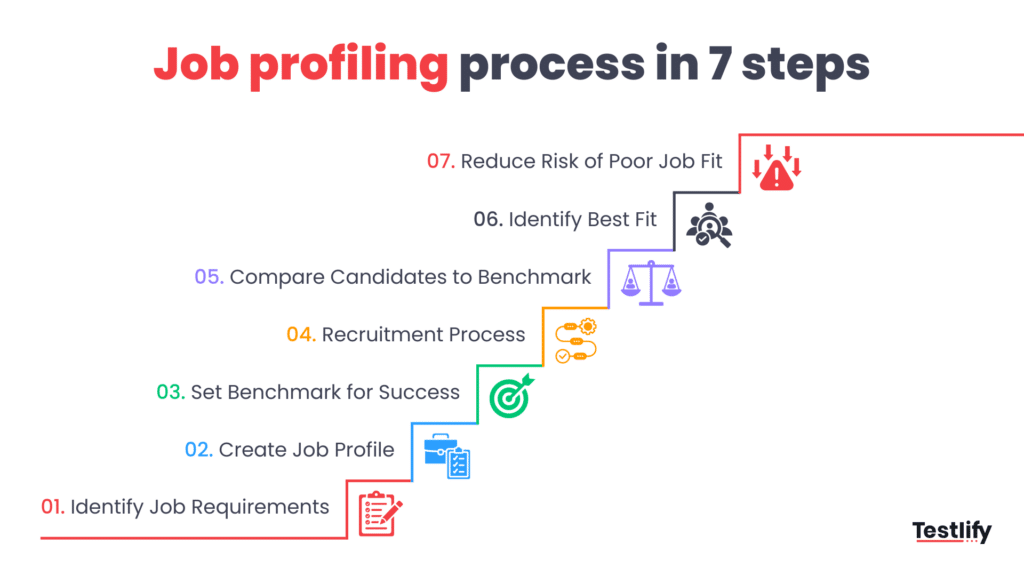
Step 1: Start with the business context
Every job exists for a reason. That reason is always connected to business goals. This is why the first step in developing a job profile should never be writing the responsibilities. Instead, it should be about understanding the business context.
As HR, you need to understand why the role exists now. Is it a new role created to support growth? Is it replacing an existing position? Is the role changing because of new technology or restructuring? Understanding this context helps you shape the job profile in a way that supports the organization’s current and future needs.
Talking to stakeholders is crucial at this stage. Conversations with hiring managers, team leaders, and even current role holders can provide valuable insights. Ask about challenges, expectations, and success factors. This information will later help you define the role purpose clearly and realistically.
Step 2: Define a clear and meaningful job title
Job titles may seem simple, but they are often a source of confusion. A good job title should be clear, accurate, and aligned with both internal structure and external market standards.
Avoid overly creative or vague titles that sound impressive but say little about the actual role. Titles like “Guru,” “Rockstar,” or “Champion” may look fun but can confuse candidates and create misalignment with compensation benchmarks.
At the same time, be careful not to overload titles with too many qualifiers. Long titles with multiple slashes and brackets can be difficult to understand. The goal is to strike a balance between clarity and simplicity.
When developing a job title, consider how candidates search for roles, how similar roles are titled in your industry, and how the title fits within your organization’s job architecture.
Step 3: Write a strong role purpose
The role purpose is one of the most important yet often neglected parts of a job profile. This section should clearly explain why the role exists and what it is meant to achieve.
A strong role purpose is usually written in a short paragraph. It focuses on outcomes rather than activities. Instead of listing tasks, it explains the value the role brings to the organization.
For example, rather than saying the role “handles customer queries,” the purpose could explain that the role “ensuring a positive customer experience by resolving issues efficiently and building long-term customer relationships.”
When written well, the role purpose helps candidates quickly understand whether the job aligns with their interests and strengths. It also helps employees connect their daily work to the bigger picture.
Step 4: Identify core responsibilities
Once the role purpose is clear, the next step is to describe what the person in the role will actually do. This is where many job profiles become either too detailed or too vague.
The key is to focus on core responsibilities rather than every possible task. Core responsibilities are the major areas of accountability that define the role. They should reflect how the role contributes to business outcomes.
Writing responsibilities in clear, action-oriented language improves readability. Descriptions should be specific enough to set expectations but flexible enough to allow for growth and change. Avoid copying old job descriptions without reviewing whether the responsibilities are still relevant.
It is also important to ensure that responsibilities align with the role level. A junior role should not carry strategic accountabilities, and a senior role should not be dominated by routine tasks.
Step 5: Define required skills and competencies
Skills and competencies explain how the job should be done, not just what should be done. This section helps HR and hiring managers assess whether a candidate can perform the role effectively.
Start by identifying the technical skills required for the job. These could include specific tools, systems, methodologies, or domain knowledge. Be realistic about what is truly required at entry and what can be learned on the job.
Next, consider behavioral and soft skills. Communication, problem-solving, collaboration, and adaptability are often just as important as technical expertise. These competencies should reflect the organization’s culture and values.
Instead of listing generic traits, describe them in context. For example, rather than simply stating “good communication skills,” explain the type of communication the role requires, such as presenting to stakeholders or collaborating with cross-functional teams.
Step 6: Clarify experience and qualification requirements
Experience and qualification requirements help narrow the candidate pool, but they should be defined carefully. Overly strict requirements can discourage strong candidates, while vague requirements can lead to mismatched applications.
When specifying experience, focus on the type and relevance rather than just the number of years. Consider what kind of experience truly prepares someone for success in the role. Industry exposure, scale of responsibility, or complexity of work may matter more than tenure.
Qualifications should be included only if they are genuinely required for the role. Avoid default degree requirements unless they are legally or practically necessary. Increasingly, organizations are recognizing the value of skills-based hiring over credential-based hiring.
Clear and fair requirements also support diversity and inclusion by reducing unnecessary barriers to entry.
Step 7: Define reporting relationships and key interactions
A job profile should clearly explain where the role sits within the organization. This includes who the role reports to and which teams or stakeholders the role interacts with regularly.
Reporting relationships provide clarity and help manage expectations. They also support smoother onboarding by helping new hires understand the organizational structure.
Key interactions are equally important. Many roles rely on collaboration across departments. Highlighting these interactions gives candidates a realistic picture of the work environment and helps HR assess collaboration skills during hiring.
This section also helps prevent role overlap and confusion by clearly defining boundaries and interfaces with other roles.
Step 8: Align the job profile with performance expectations
A strong job profile should be closely linked to performance management. The responsibilities and competencies described in the profile should form the basis for setting goals and evaluating performance.
When developing the job profile, think about how success in the role will be measured. While you may not include detailed KPIs, the profile should make it clear what good performance looks like.
This alignment benefits everyone. Managers have a clear framework for feedback. Employees understand what is expected of them. HR can ensure consistency and fairness across performance reviews.
Over time, this also makes it easier to update job profiles as roles evolve.
Step 9: Review for clarity, consistency, and bias
Once the job profile is drafted, it is important to review it carefully. Clarity should be the top priority. The language should be simple, direct, and free from unnecessary jargon.
Consistency across job profiles is also critical, especially in larger organizations. Similar roles should follow a similar structure, tone, and level of detail. This supports internal equity and easier comparison.
Bias is another important consideration. Review the language for gender-coded terms, age-related assumptions, or cultural biases. Inclusive language helps attract a broader and more diverse talent pool.
Involving multiple reviewers, including HR peers and hiring managers, can improve the quality of the final document.
Step 10: Keep job profiles alive and relevant
A job profile should never be treated as a one-time document. Roles change, and job profiles should evolve with them.
Set a regular review cycle, such as annually or during major organizational changes. Encourage managers and employees to provide feedback on whether the profile still reflects reality.
Updated job profiles support workforce planning, reskilling initiatives, and career development programs. They also help HR stay proactive rather than reactive.
When job profiles are treated as living documents, they continue to deliver value long after the hiring process is complete.
How strong job profiles support strategic HR?
Well-developed job profiles are not just operational tools. They play a strategic role in talent management.
They support better hiring decisions by aligning expectations early. They enable clearer career paths by defining role progression. They improve workforce analytics by providing structured role data. They also support compliance and fairness in HR processes.
For HR professionals, mastering job profile development is a skill that adds significant value to the organization. It strengthens HR’s role as a strategic partner rather than just an administrative function.
One common mistake is copying job descriptions from the internet without customization. While templates can be helpful, every role is unique and should reflect your organization’s context.
Another mistake is trying to cover every possible task. This leads to bloated profiles that are hard to read and difficult to use. Focus on what truly matters.
Avoid writing job profiles in isolation. Collaboration with business stakeholders ensures accuracy, buy-in, and long-term usefulness.
Final thoughts
Developing a job profile is both an art and a science. It requires understanding the business, listening to stakeholders, and translating complex expectations into clear, simple language.
For HR professionals, a well-written job profile is a powerful tool. It improves recruitment, supports performance management, and enhances employee engagement. Most importantly, it creates clarity in a world of constant change.
By following a structured, thoughtful approach and keeping the focus on purpose, outcomes, and people, HR can develop job profiles that truly work for the organization and its employees.
When done right, a job profile is not just a document. It is a shared understanding of what success looks like in a role and how everyone can work toward it together.
Frequently asked questions (FAQs)

Content Writer
Yashika Khandelwal is a Content Writer with 3+ years of experience creating research-backed content on hiring, talent assessment, and HR technology. She is a registered Organizational Psychologist and subject matter expert who combines behavioral science with practical recruitment insights to produce accurate, evidence-based content.
LinkedInRelated resources
View all
HR & recruitment
Best skills assessment question libraries: 3500+ skills coverage (Tech & non-tech)

HR & recruitment
Pros and cons of pre-hire assessments

HR & recruitment
11 different types of pre-hire testing for screening

HR & recruitment
6 real soft skills case studies every HR leader should study

HR & recruitment
Top 13 types of hiring bias and how to avoid them

HR & recruitment
Cross-cultural recruiting strategies for remote teams
Get started.
Hire on proof, not resumes.
Run your first skills-based assessment free — no credit card required.